Blog Posts
LNG Vessel Repair Habitat Requirements: A Practical Guide
What if the repair itself is only one part of the habitat decision? On an LNG vessel, the work location, surrounding systems, vessel condition, and operating arrangements all shape the assessment. That’s why LNG vessel repair habitat requirements should be set for the specific job, not copied from generic facility guidance.
Before selecting a hot-work habitat, gather clear information about the repair scope and conditions around it. This guide explains what to record, how vessel and worksite constraints affect the assessment, and how to prepare a project-specific requirements brief for technical and safety review.
Access, adjacent equipment, atmospheric monitoring, pressure control, and interfaces with vessel operations all inform the plan. The brief should also identify the applicable project procedures and vessel-specific requirements for review by the responsible parties. PetroHab LLC’s modular Hot Work Safety Enclosures, pressurized habitats, Quadra-Lock Panels, and monitoring systems can be assessed against those job requirements. The objective is a practical, documented basis for planning hot work and managing risk to personnel and vessel assets.
Key Takeaways
- Map the hot-work task, work position, access, egress, and required footprint before defining enclosure needs.
- Compare repair scenarios by their location constraints and vessel interfaces. Do not assume work is permitted in every condition.
- Build the assessment in sequence, with vessel, engineering, HSE, and contractor representatives contributing information relevant to their roles.
- Translate documented controls into practical enclosure, monitoring, setup, and operator-support requirements.
- Use LNG vessel repair habitat requirements to create a project-specific brief for technical and safety review.
What LNG Vessel Repair Habitat Requirements Actually Cover
A repair habitat is a controlled enclosure arranged to support specified hot work in a hazardous work environment. It provides a defined space for activities such as welding or cutting. Its configuration and controls must be assessed against the actual worksite conditions. LNG vessel repair habitat requirements are therefore project-specific. They are not a universal vessel-wide checklist or a fixed specification that can be applied without considering the repair.
Repair scope and site conditions determine the habitat assessment inputs. A localized task in one work area may have different access, surrounding equipment, and interface needs from work elsewhere on the same vessel. For background on vessel layout and cargo containment, see LNG Carrier Design and Safety.
Vessel design provides context, but the repair location and task determine what needs assessment. This video shows an LNG carrier construction process and offers a visual introduction to vessel arrangements.
Why LNG vessel repairs require a vessel-specific assessment
Vessel layout, repair position, and nearby systems can change the conditions around hot work. A task near piping, equipment, or restricted passageways raises different questions from work in an open area. For example, the team needs to consider how personnel will reach the worksite and whether the enclosure can fit without blocking essential routes. The LNG cargo system informs the overall hazard review, but it does not describe conditions at every repair location.
Operating and work conditions also vary. A vessel may be alongside, in a repair facility, or subject to specific operating arrangements. Use current project and vessel documents to establish the conditions for the job rather than assuming the same situation applies to every LNG carrier or repair.
What belongs in a habitat requirements brief
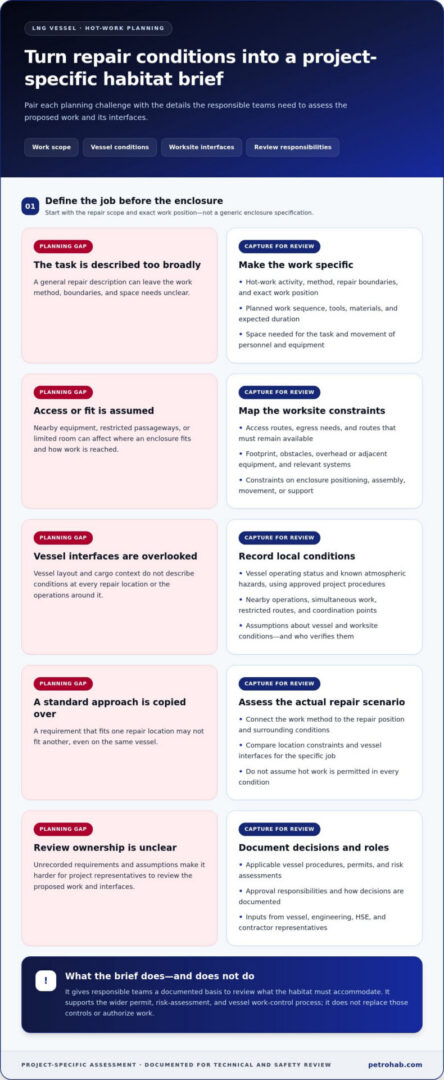
A useful brief gives vessel, engineering, HSE, and contractor representatives enough detail to review the proposed work and its interfaces. Record the task and work location, expected duration, access and egress needs, surrounding equipment, and constraints that could affect enclosure placement or movement. Identify who is responsible for reviewing each requirement and how decisions are documented.
- Describe the hot-work activity and exact work position.
- Document access routes, egress, space constraints, and relevant adjacent systems.
- List applicable vessel procedures, permits, risk assessments, and approval responsibilities.
- Record assumptions about vessel and worksite conditions, and identify who verifies them.
The brief supports the wider permit, risk-assessment, and vessel work-control process. It does not replace those controls or authorize work. Instead, it helps the responsible teams define what the habitat must accommodate and which details still need review. Apply the same disciplined approach used in hot work safety enclosure planning: define the task, identify interfaces, and document the controls required for that worksite.
How Repair Scope and LNG Vessel Conditions Shape Habitat Requirements
Start a habitat assessment with the work, not a standard enclosure size. The hot-work method, repair boundaries, tools, and materials determine what must fit in the work area and how the task will proceed. A short weld on an accessible plate has different setup and movement needs from cutting or welding in a confined space near equipment that must remain operational. These details turn the repair plan into practical inputs for the assessment.
Work scope, location, and surrounding conditions shape habitat requirements. For LNG vessel repair habitat requirements, connect the job method to the actual worksite and its interfaces. The vessel type alone is not enough to determine what the habitat needs to accommodate.
Repair task and worksite information to capture
Describe the repair sequence from preparation through completion. Include the hot-work method, boundaries, tools, materials, and expected movement of personnel and equipment. Then map the work position against nearby equipment, vessel systems, and routes. The proposed habitat footprint must accommodate the task while accounting for access, egress, and support arrangements identified by the project team.
- Mark the repair area and the space needed for the planned work sequence.
- Identify obstacles, overhead or adjacent equipment, and routes that must remain available.
- Record constraints on positioning, moving, assembling, or supporting the enclosure.
- Note scope changes that could affect the assessment.
These details help the team distinguish a straightforward clearance issue from a constraint that affects the enclosure layout or work plan. They also make it easier to identify when a scope change requires a fresh review.
Vessel conditions, hazards, and operating interfaces
Record the vessel’s operating status and known atmospheric hazards using the project’s approved assessment and monitoring procedures. The LNG cargo context informs the review, but conditions at the repair point and the systems around it need specific attention. Vessel representatives should identify nearby operations, simultaneous work, restricted routes, and coordination points that could affect the job or its controls.
Marine hot-work requirements depend on the space and circumstances. The OSHA Hot Work Regulations for Marine Environments provide a reference for marine work involving spaces that may have contained flammable substances. The responsible project team should establish which requirements apply using current vessel procedures and governing project documents.
Pressurization and monitoring may be relevant enclosure considerations, but assess them against documented site conditions and project controls. Do not assume they resolve every hazard or interface. A modular pressurized Hot Work Safety Enclosure can be considered alongside those inputs, with setup and operator support aligned to project requirements.
Which Habitat Requirements Change Across LNG Vessel Repair Scenarios?
Different repair settings raise different questions for the habitat assessment. A confined work area may limit enclosure placement and personnel movement. An exposed location may bring different access and environmental constraints. Work beside equipment can create interface questions that do not apply in a clear, unobstructed area. Use the comparison below to screen for these differences before detailed technical review.
| Planning scenario | Location and access considerations | Interfaces to identify | Assessment questions |
|---|---|---|---|
| Repair in a confined area | Restricted setup footprint, narrow approach, limited room to move tools or materials | Adjacent equipment, escape routes, nearby work | Can the proposed enclosure and task fit without obstructing required access? |
| Repair in an exposed location | Vessel arrangement and site conditions may affect positioning and support | Vessel operations, surrounding work areas | What site-specific conditions could affect setup, monitoring, or coordination? |
| Repair beside equipment with restricted access | Clearance and approach routes may constrain enclosure location | Equipment access, maintenance activity, operational interfaces | How will the work boundary relate to access needs and adjacent activities? |
| Discrete, defined repair | Work boundary may remain stable through the planned task | Permit and work-control interfaces | Are the defined method, location, and sequence represented in the assessment? |
| Extended or changing scope | Work area or access needs may shift as tasks progress | Concurrent work, scope changes, vessel coordination | Who reviews changes and updates the project controls? |
This table is a screening aid, not an engineering approval. It does not establish that hot work is permitted in any listed condition, and it does not replace project review. Determine LNG vessel repair habitat requirements using the actual repair information and applicable vessel and site documents.
Repair location and access constraints
Compare the proposed location with the route for personnel, tools, and enclosure components. In a confined space, a footprint that looks adequate on a drawing may still interfere with movement or emergency access. An exposed position or a location beside equipment can create different setup and support constraints. Treat vessel arrangement and site conditions as project inputs for review, not as assumptions that can be resolved by category alone.
Work scope, operating status, and concurrent activities
A discrete repair with stable boundaries differs from extended work where tasks, methods, or work limits may change. The vessel team should identify operating status, simultaneous activities, and coordination points through its work-control process. These details shape the interface assessment, but they do not independently establish which operating conditions are acceptable.
Separate vessel-specific facts from requirements that need verification in current project documents. Layout, access routes, adjacent equipment, and identified operating interfaces describe the worksite. Permit conditions, approvals, risk controls, and applicable technical criteria require review by the responsible project parties. Record assumptions clearly so changes trigger review instead of being treated as automatic approval.
A Practical Sequence for Assessing LNG Vessel Repair Habitat Needs
A reliable assessment turns job information into requirements the responsible teams can review and apply through established project controls. Follow a clear sequence: define, assess, specify, coordinate, and verify. This keeps the habitat brief connected to the repair while separating technical findings from permit approvals and operating controls. LNG vessel repair habitat requirements should reflect documented conditions, not assumptions carried over from another job.
- Define the task. Describe the hot-work method, repair boundaries, expected sequence, tools, materials, and planned duration. Align on what work is included and how proposed changes will be handled.
- Assess the worksite. Engineering and vessel representatives contribute relevant drawings and information about nearby systems, access routes, equipment, and physical constraints. HSE personnel use the project’s approved assessments and procedures to identify hazards and monitoring inputs.
- Specify the habitat needs. Translate the documented scope and site conditions into requirements for enclosure location, footprint, access, setup, monitoring, and support. Identify open technical questions instead of filling gaps with assumed criteria.
- Coordinate interfaces. Route the assessment through designated technical and safety personnel. Coordinate proposed setup, monitoring, simultaneous work, and operational interfaces with the vessel’s work-control process.
- Verify before work. Confirm that the agreed configuration and applicable operating checks match the reviewed job information. Work begins only through the project’s authorization and control process.
Build the job-specific requirements record
Keep the assessment traceable. Attach or reference the repair scope, worksite drawings, known hazards, relevant interfaces, and expected sequence. Record applicable vessel procedures and project-specific standards for review, along with who owns each input or decision. If a drawing, operating condition, or technical detail remains unresolved, mark it as an open question and name the party responsible for addressing it.
This record is an assessment tool. It captures requirements and findings, but does not grant approval or replace permits, risk assessments, or vessel work controls. That distinction helps prevent a preliminary habitat specification from being mistaken for authorization to conduct hot work.
Review, coordinate, and verify before work
Designated vessel, engineering, HSE, and contractor representatives review information within their responsibilities. They resolve interfaces through the project process and determine how the enclosure setup and monitoring fit the approved controls. Before authorized work begins, verify that the installed arrangement reflects the reviewed requirements and that applicable checks are complete under project procedures.
For projects assessing an enclosure option, PetroHab LLC’s modular Hot Work Safety Enclosures can be evaluated against documented requirements, including setup and monitoring needs. Explore PetroHab LLC enclosure options as part of the project-specific assessment.
Applying the Assessment to a Pressurized Hot Work Safety Enclosure
Once the repair assessment defines worksite conditions and project controls, teams can evaluate whether a pressurized Hot Work Safety Enclosure fits the job. The enclosure is one element of the hot-work plan, not a replacement for vessel procedures, permits, risk assessments, or approvals. Its configuration, monitoring, and operation should align with the documented scope and controls established by the responsible project teams.
Matching enclosure functions to documented project needs
Consider pressurization in relation to the hazards identified for the work area and the approved work controls. Positive pressure is intended to help prevent hazardous external gases from entering the enclosure, but it does not remove the need for the project’s atmospheric assessment, monitoring plan, or authorization process. Confirm how the enclosure’s monitoring arrangements fit the project’s defined procedures. Do not assume universal operating limits or acceptance criteria.
PetroHab LLC’s pressurized Hot Work Safety Enclosures can be assessed against those requirements. The Safe-Stop Automatic Shutdown System monitors gas levels and pressure. The project team should determine how that information fits its monitoring and response procedures without assuming thresholds or response specifications that are not part of the project requirements. PetroHab LLC enclosures use Quadra-Lock Panels and fire-resistant materials, which can also be considered when reviewing the proposed enclosure arrangement and worksite needs.
Practical fit matters. Compare the required work area with the available footprint, access routes, equipment interfaces, setup needs, and monitoring arrangements. A sound assessment documents how the proposed enclosure relates to the job and identifies unresolved technical or operational questions for review. Equipment selection is not authorization to proceed.
Project preparation and specialist support
Prepare a concise project package before evaluating enclosure fit. Include the repair scope, worksite details or drawings, known hazards, vessel interfaces, expected work sequence, relevant procedures, and project review requirements. Record who is responsible for technical review, HSE review, vessel coordination, and authorization. Clear inputs keep the discussion focused on the actual repair rather than generic assumptions.
Setup and operation also require competent support. PetroHab LLC provides on-site supervision and training to support enclosure setup and operation in line with project requirements. Coordinate this support with the vessel team’s work-control arrangements so responsibilities, monitoring practices, and applicable checks are understood before authorized work begins. Route any change in work scope or conditions through the project’s review process.
A disciplined brief gives technical and safety teams a sound basis to assess LNG vessel repair habitat requirements and compare the proposed enclosure with the job’s documented needs. Discuss LNG vessel repair habitat requirements with PetroHab LLC as part of your project-specific enclosure assessment.
Carry the Requirements Through to the Worksite
A requirements brief is most useful when it stays connected to decisions made during setup and execution. Keep its revision status clear, retain the basis for key assumptions, and route changes in scope or site conditions through the project’s established controls. This helps prevent an assessment prepared for one set of conditions from being treated as valid after the job changes.
Before mobilization, make the brief available to those responsible for technical review, safety oversight, vessel coordination, and enclosure setup. Clear ownership of open items helps the project team resolve them before they affect the work plan. The brief also gives the team a consistent reference for configuring the enclosure and checking it against approved arrangements.
Use your documented LNG vessel repair habitat requirements to guide the next project discussion. Review your enclosure brief with PetroHab LLC and move forward with a clear, project-specific basis for planning hot work.
Frequently Asked Questions
What information is needed to specify a habitat for LNG vessel repairs?
Start with the repair package and the latest worksite information. For LNG vessel repair habitat requirements, include the work method, boundaries, location references, anticipated sequence, tools, materials, and expected duration. Add relevant drawings, access restrictions, nearby systems, known hazards, and interfaces with vessel operations. Identify document revisions and open questions so reviewers can distinguish current facts from assumptions before assessing enclosure configuration and monitoring needs.
Does every LNG vessel repair require a pressurized habitat?
No. Whether a pressurized habitat is appropriate depends on the specific task, assessed hazards, worksite conditions, and project controls. A repair may involve no hot work, or the assessment may identify a different control approach. For example, replacing a component mechanically and welding a nearby support are distinct scopes, even if they share a work area. The vessel’s responsible technical and safety representatives determine the applicable approach through project procedures.
How do vessel operations affect hot-work habitat requirements?
Operations can change conditions around a repair and the interfaces that must be controlled. Cargo-related activity, equipment status, personnel movement, or changes in nearby work may affect access, coordination, or the project’s hazard assessment. Provide the team with the planned operating status and updates through established vessel channels. If operating conditions change after review, pause and reassess under the vessel’s work-control process before relying on the earlier plan.
What should a habitat requirements checklist include?
A useful checklist tracks technical inputs and their status. Include repair scope, worksite reference, drawing revision, access and egress constraints, adjacent systems, identified hazards, planned monitoring, enclosure setup needs, and interfaces with simultaneous activities. Add the responsible reviewer for each item, the source document, and any unresolved question. This makes it easier to see which details are documented, which need resolution, and which changes require the team to revisit its assessment.
Who determines the requirements for hot work on an LNG vessel?
The project’s designated vessel, engineering, and HSE representatives establish and review requirements within their responsibilities. The contractor and enclosure specialists can provide task and equipment information, while the vessel’s operator applies relevant procedures and approval arrangements. Requirements tied to class, flag, regulation, or operator standards must be checked against current project documents and by the responsible authorities. No single checklist or equipment supplier replaces the project’s approval process.
Can a habitat be used while other vessel work is taking place?
Possibly, but concurrent work must be assessed and coordinated under the vessel’s procedures. A nearby task may affect access, create conflicting work boundaries, alter site conditions, or complicate monitoring and communications. The project team should identify affected work groups, define coordination responsibilities, and establish how changes are communicated. The assessment alone does not authorize simultaneous activities; designated vessel personnel manage acceptance through the established work-control process.
When should habitat requirements be reviewed again?
Review them whenever a change could affect the assessment basis. Triggers can include a revised repair method, expanded work boundary, different location, altered vessel or equipment status, new simultaneous work, or changed site conditions. Also revisit the brief if setup differs from the reviewed arrangement or a required project check identifies a discrepancy. Follow the vessel’s process for documenting changes and obtaining review before work continues under revised conditions.