Blog Posts
Modular Habitat Design Flexibility: Engineering Safety in Complex Industrial Environments
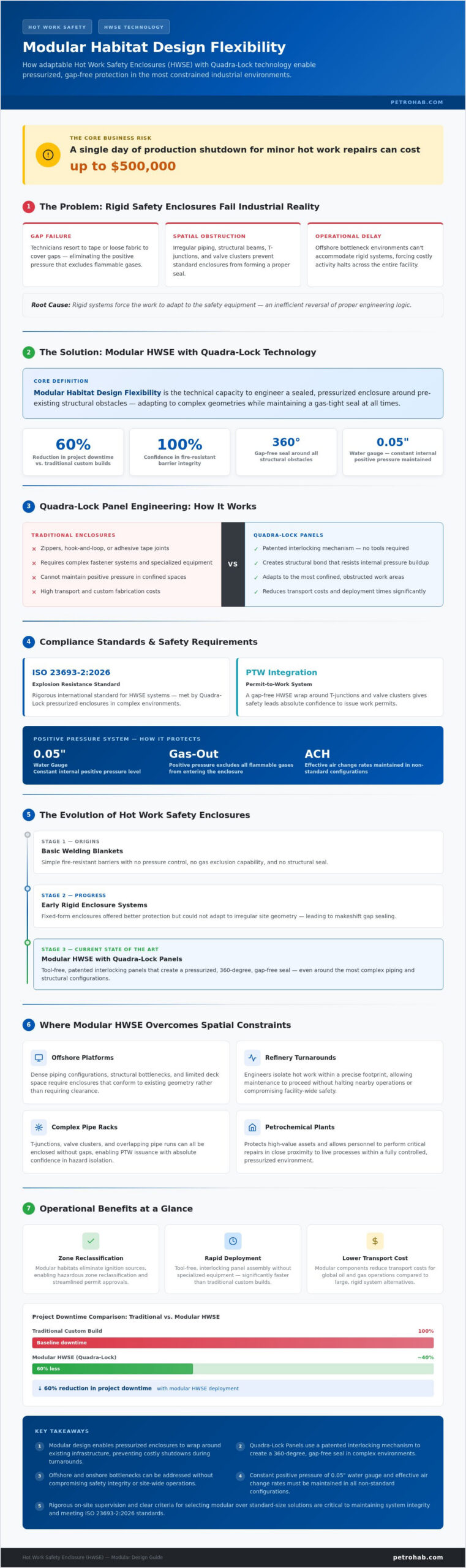
A single day of production shutdown for minor hot work repairs can cost an industrial facility as much as $500,000. You understand that rigid, legacy enclosure systems often fail to accommodate the dense piping and structural obstructions inherent to offshore platforms and petrochemical plants. When a habitat doesn’t fit the site’s unique geometry, safety managers face unacceptable risks from poorly sealed joints or excessive operational delays. In these high-stakes environments, modular habitat design flexibility is a functional necessity for maintaining absolute safety integrity across every possible spatial configuration.
This article demonstrates how versatile engineering in Hot Work Safety Enclosures (HWSE) allows for uncompromising protection in the most constrained spaces. You’ll learn how systems utilizing patented Quadra-Lock technology provide a gap-free, pressurized seal that meets the rigorous ISO 23693-2:2026 standards for explosion resistance. We’ll examine the technical mechanisms that facilitate fast, tool-free assembly while maintaining a constant internal pressure of 0.05 inches of water gauge. By prioritizing adaptable design, operators can achieve 100% confidence in their fire-resistant barriers and reduce project downtime by approximately 60% compared to traditional custom builds.
Key Takeaways
- Learn how modular habitat design flexibility allows for the construction of pressurized enclosures around existing infrastructure, preventing costly operational delays during turnarounds.
- Discover how Quadra-Lock Panels use a patented interlocking mechanism to create a 360-degree, gap-free seal in complex industrial environments.
- Master design strategies for deploying safety enclosures in offshore bottlenecks and around intricate pipe racks without compromising site safety.
- Understand the technical requirements for maintaining positive pressure and effective air change rates within non-standard habitat configurations.
- Identify the criteria for selecting modular solutions over standard sizes and the role of rigorous on-site supervision in ensuring system integrity.
Defining Modular Habitat Design Flexibility in Industrial Safety
In high-risk industrial environments, safety isn’t a static requirement. Modular habitat design flexibility refers to the technical capacity to engineer a sealed, pressurized enclosure around pre-existing structural obstacles. During refinery turnarounds, this modularity serves as the primary driver for operational continuity. Instead of halting all nearby activity, engineers can isolate hot work within a precise footprint, ensuring that maintenance proceeds without compromising the safety of the broader facility. This adaptability allows for the protection of high-value assets while personnel perform critical repairs in close proximity to live processes.
This design philosophy integrates directly with the facility’s Permit-to-Work (PTW) system. The PTW process relies on the certainty of hazard isolation. When an HWSE can wrap around a T-junction or a complex valve cluster without leaving gaps, the safety lead can issue permits with absolute confidence. By creating a controlled environment that eliminates ignition sources, modular habitats allow for the reclassification of hazardous zones. This streamlines the approval process for high-risk tasks and minimizes site-wide disruption. Industrial modular flexibility is the ability to adapt to complex geometries while maintaining a gas-tight seal.
To better understand this concept, watch this helpful video:
The Problem with Rigid Safety Enclosures
Static designs frequently fail in the face of irregular piping, structural beams, and bulkheads. When a standard enclosure cannot accommodate these site-specific constraints, technicians often resort to makeshift seals using tape or loose fabrics. These gaps represent a critical failure point. They prevent the system from maintaining the positive pressure required to exclude flammable gases, effectively nullifying the enclosure’s safety purpose. In offshore environments, where space is at a premium, the inability to deploy a habitat into a tight bottleneck results in significant operational delays and increased risk profiles. Rigid systems force the work to adapt to the safety equipment, which is an inefficient reversal of proper engineering logic.
The Evolution of the Hot Work Safety Enclosure (HWSE)
The industry has transitioned from basic welding blankets to sophisticated, modular pressurized welding habitats. This evolution mirrors the broader adoption of modular construction, which prioritizes the assembly of standardized components to improve reliability and speed. For global oil and gas operations, modular habitat design flexibility reduces transport costs and deployment times significantly. Modern systems, such as those utilizing tool-free, interlocking Quadra-Lock Panels, allow for rapid assembly without specialized equipment. These panels represent the pinnacle of this engineering; unlike traditional panels that require complex fastener systems, these interlocking components create a structural bond that resists internal pressure while remaining adaptable to the most confined work areas. This shift ensures that the safety barrier is as durable as the facility it protects, providing a rigorous defense against industrial hazards.
The Engineering Behind Flexible Safety Enclosures: Quadra-Lock Systems
Engineering a safety enclosure for high-stakes industrial environments requires a technical solution that balances structural strength with extreme adaptability. The core of modular habitat design flexibility lies in the structural integrity of the individual components and how they interface under pressure. Traditional enclosure systems often rely on zippers, hook-and-loop fasteners, or adhesive tapes to join panels. These methods represent significant failure points where gas ingress can occur. In contrast, Quadra-Lock technology utilizes a mechanical interlocking mechanism that enables modularity without sacrificing the barrier’s defensive capabilities. Quadra-Lock is a patented interlocking system that secures modular panels on all four sides to ensure a gas-tight, fire-resistant seal.
This four-sided interlocking design creates a 360-degree seal that remains effective regardless of the final enclosure shape. Whether the habitat is configured as a standard cube or a complex polygonal structure designed to navigate around bulkheads, the panels maintain a uniform overlap. This engineering ensures that the internal pressurization remains constant, effectively isolating ignition sources from the surrounding atmosphere. For engineers tasked with maintaining compliance, understanding these technical panel specifications is essential for risk mitigation.
Achieving a Gas-Tight Seal with Modular Panels
The physics of the Quadra-Lock overlap is designed specifically to prevent the ingress of flammable gases at the panel joints. By securing each panel on all four sides, the system eliminates the “fish-mouth” gaps common in traditional modular habitats. This comprehensive locking mechanism is superior to legacy attachments because it distributes the load of internal air pressure across the entire surface area of the panel. In high-wind offshore environments, this structural rigidity prevents the habitat from deforming or losing its seal, which is critical for protecting personnel and high-value assets during volatile weather conditions.
Material Versatility and Durability
The panels are constructed from high-grade silicon-coated fiberglass fabrics, engineered to meet the most stringent safety standards. These materials are rated to withstand continuous operating temperatures of 1,000°F (538°C) and can endure intermittent exposure to molten slag at temperatures reaching 1,500°F (815°C). Such thermal resistance is a core requirement under OSHA hot work regulations, which dictate rigorous precautions for welding and grinding in hazardous areas. Beyond fire resistance, the fabric is treated to resist UV degradation, chemical exposure, and extreme moisture. This material durability, combined with modular habitat design flexibility, allows operators to replace individual damaged sections immediately. This targeted maintenance ensures the habitat remains operational without the need to decommission the entire system, significantly reducing the total cost of ownership and minimizing project delays.
Overcoming Spatial Constraints in Offshore and Onshore Facilities
Industrial facilities, particularly offshore platforms, present extreme spatial limitations. Structural beams, complex pipe racks, and valve clusters often dictate the available working area. Modular habitat design flexibility allows safety teams to engineer enclosures that conform to these irregularities rather than forcing the site to adapt to the equipment. By utilizing the Quadra-Lock system, habitats can be configured into L-shaped or T-shaped footprints. This ensures the hot work area remains isolated even when it must wrap around a bulkhead or a vertical support column. In these non-standard shapes, the strategic placement of air ducting is critical. To maintain the mandatory 20 air changes per hour, intake and exhaust ports must be positioned to prevent “dead spots” where fumes or gases could accumulate.
Adapting to Complex Geometries
Deploying a pressurized enclosure begins with a rigorous site survey to map every protrusion and structural obstruction. Engineers use varying panel sizes to bridge gaps and navigate around obstacles that would render a standard cube habitat useless. Maintaining floor and ceiling integrity is particularly challenging when working on multi-level gratings. In these scenarios, specialized sealing techniques are applied to ensure the habitat maintains its internal pressure of 0.05 inWG. This precision prevents the ingress of hydrocarbons from lower decks, providing a definitive barrier between the ignition source and the hazardous atmosphere.
Minimising the Footprint of Hot Work
The ability to reduce the spatial impact of an enclosure is vital for supporting simultaneous operations (SIMOPS). A compact, well-engineered habitat allows adjacent processes to continue safely, which is essential for maintaining production levels during maintenance cycles. Integrating the Safe-Stop Automatic Shutdown System within these custom configurations provides an additional layer of protection. If the pressurized seal is compromised or gas is detected at the intake, the system immediately terminates power to the hot work equipment.
Modularity also offers significant logistical advantages. The compact nature of individual panels makes them ideal for air freight or helicopter transport to remote offshore sites. This portability ensures that modular habitat design flexibility doesn’t just apply to the physical build but also to the speed of response. When a critical repair is identified, the equipment can be mobilized and assembled rapidly, minimizing the duration of the hazard exposure. This efficiency is a hallmark of an expert safety partner focused on operational excellence and risk mitigation.
The Safety Implications of Modular Integrity and Pressurisation
While modular habitat design flexibility allows for complex configurations, this adaptability must never come at the expense of atmospheric containment. The primary safety function of an HWSE is to maintain a positive pressure differential. This pressure ensures that flammable or toxic gases cannot enter the workspace while hot work is performed. In non-standard modular configurations, such as L-shaped or multi-level structures, monitoring this differential pressure becomes more complex. Airflow dynamics change when the enclosure isn’t a simple cube. PetroHab habitats are engineered to maintain a minimum positive pressure of 0.05 inches of water column (12.5 Pa) regardless of modular configuration.
This commitment to pressurisation supports ATEX and IECEx compliance for Zone 1 and Zone 2 hazardous environments. Modularity facilitates the placement of pressure sensors and gas detectors at critical points within the custom structure. By ensuring that every Quadra-Lock panel joint is secure, the integrity of the containment is guaranteed. This level of control is essential for engineers who must demonstrate risk mitigation to regulatory bodies. If you need to verify your site’s specific requirements, you can consult our technical team for a configuration analysis.
Ignition Prevention in Hazardous Zones
The core objective of the HWSE is to establish a Pressurised Safe Area within an otherwise volatile environment. Quadra-Lock panels act as a physical and thermal barrier. They prevent sparks and molten slag from escaping the enclosure, which could otherwise travel over 10 meters and ignite external hazards. These panels are rated to withstand continuous temperatures of 1,000°F (538°C) according to current 2026 safety benchmarks. Integration with high-sensitivity gas detection systems ensures that if gas is detected at the clean air intake, the system reacts instantly. This multi-layered defense is the only way to ensure absolute confidence during hot work operations.
Compliance with Global Safety Standards
Meeting hazardous environment standards requires more than just high-quality materials; it requires a system-wide approach to safety. PetroHab’s design flexibility aligns with NFPA 51B and OSHA hot work guidelines by providing a documented, engineered solution for hazard isolation. Every modular component undergoes third-party certification to ensure it meets international benchmarks for fire resistance and structural strength. This rigorous testing confirms that the modular system performs reliably under the extreme conditions found in the energy and petrochemical sectors. By maintaining modular habitat design flexibility alongside strict compliance, operators can mitigate the risks of simultaneous operations effectively.
Implementing PetroHab’s Modular HWSE Solutions
Selecting between a standard configuration and a custom build requires a thorough assessment of the operational environment. While a standard 2-meter cube PetroHab habitat can be pressurized in under 3 hours, complex sites often demand modular habitat design flexibility to navigate dense infrastructure. When a production shutdown for minor repairs costs as much as $500,000 per day, the ability to deploy a habitat without modifying existing piping is a critical economic advantage. Facility managers must determine if the spatial constraints of the work area allow for a standard footprint or if the project necessitates the interlocking versatility of the Quadra-Lock system. This decision directly impacts both the safety timeline and the overall project budget.
Procurement models also vary based on the duration of the maintenance cycle. Leasing provides a cost-effective solution for short-term refinery turnarounds, offering access to the latest HWSE technology without long-term capital expenditure. Conversely, purchasing is often the preferred choice for facilities with frequent hot work requirements. This model allows for immediate deployment by internal teams, ensuring that safety protocols are integrated into the facility’s permanent risk management strategy. Both options provide access to the same rigorous engineering standards that define the PetroHab brand.
Expert Training and Supervision
Personnel competence is the foundation of habitat integrity. While the Quadra-Lock system is designed for tool-free assembly, the pressurized environment demands strict adherence to assembly protocols. PetroHab provides on-site technicians to oversee complex modular builds, ensuring every panel interface meets the 0.05 inWG pressure standard. For client-led deployments, custom training programs equip personnel with the technical skills to manage the Safe-Stop Automatic Shutdown System and monitor differential pressure. This oversight guarantees that the habitat remains a definitive barrier against ignition risks. It’s a standard of care that prevents the “makeshift” sealing errors common with less sophisticated systems.
Requesting a Custom Configuration
Transitioning from a small valve enclosure to a large-scale welding shop is a structured process. It begins with providing precise site dimensions, including all structural protrusions and nearby ignition hazards. This data allows for the engineering of a tailored modular solution that optimizes the workspace while maintaining a 360-degree seal. Operators can scale their protection as project requirements evolve, ensuring modular habitat design flexibility remains a constant throughout the maintenance cycle. This adaptability ensures that safety never becomes a bottleneck for production.
PetroHab continues to define the industry benchmark for hot work safety enclosures through technical precision and an unwavering commitment to risk mitigation. By prioritizing adaptable engineering and professional supervision, the brand ensures that personnel and high-value assets are protected in the most challenging industrial landscapes. Contact PetroHab today to schedule a technical consultation for your next turnaround project.
Securing the Future of Hazardous Hot Work
The technical necessity of isolating ignition sources in volatile environments demands a solution that’s as resilient as it is adaptable. We’ve established that maintaining a constant pressure differential of 0.05 inches of water gauge is the only way to ensure atmospheric integrity. By utilizing patented Quadra-Lock Panel Technology, operators can achieve this standard in any spatial configuration. This engineering ensures that global ATEX and IECEx compliance remains intact; even when navigating the dense infrastructure of offshore and onshore oil and gas facilities. The advancement of modular habitat design flexibility means that no structural obstruction prevents the implementation of a rigorous safety barrier.
Relying on proven technology reduces operational risks and minimizes the costly impact of facility downtime. It’s time to move beyond rigid, legacy systems that compromise the safety of your personnel and high-value assets. Professional engineering and meticulous on-site supervision are the benchmarks of a successful turnaround project. Take the next step in reinforcing your facility’s safety protocols by speaking with a specialist. Consult with a PetroHab Expert on Your Modular Habitat Requirements and ensure your next project is defined by technical excellence and absolute protection.
Frequently Asked Questions
How does modular design flexibility improve safety in hot work?
Modular flexibility allows for a precise fit around structural obstructions, eliminating the dangerous gaps that cause pressure loss in standard enclosures. By maintaining a gas-tight seal in complex spatial configurations, it ensures hazardous gases can’t reach the ignition source. This modular habitat design flexibility reduces the reliance on makeshift sealing materials like tape or loose fire blankets which often fail under pressure.
Can a modular habitat maintain positive pressure if it’s not a perfect cube?
Yes, the system maintains the required 0.05 inWG pressure regardless of its geometric shape. The Quadra-Lock interlocking mechanism ensures a consistent, airtight seal across all panel joints in L-shaped or T-shaped configurations. Proper placement of air intake and exhaust ports ensures uniform pressure distribution and prevents the accumulation of welding fumes within non-standard footprints.
What is the maximum size of a PetroHab modular enclosure?
There is no fixed maximum size because the modular system is inherently scalable. Panels can be added to expand the footprint from a small valve enclosure to a large-scale welding shop capable of housing multiple technicians. The only limiting factor is the capacity of the air management system to maintain 20 air changes per hour and the required pressure differential across the larger volume.
How long does it take to assemble a Quadra-Lock modular habitat?
A standard 2-meter cube enclosure can be fully assembled and pressurized in under 3 hours. Larger or more complex configurations require additional time based on the number of panels and the complexity of the site obstructions. The tool-free interlocking design significantly reduces assembly time compared to custom-built plywood or scaffolding enclosures, helping to minimize project downtime.
Are modular panels fire-resistant enough for heavy-duty welding?
Yes, the silicon-coated fiberglass panels are engineered specifically for high-heat industrial applications. They withstand continuous temperatures of 1,000°F and intermittent exposure to molten slag up to 1,500°F. This thermal resistance ensures the enclosure remains a definitive barrier between hot work activities and the external hazardous atmosphere, even during prolonged welding operations.
Does the flexible design of a habitat affect its ATEX certification?
No, the flexibility of the design doesn’t compromise its compliance with ATEX or IECEx standards. As long as the system is assembled according to technical specifications and maintains the required positive pressure, it remains certified for use in Zone 1 and Zone 2 environments. Each build is verified to ensure it meets the rigorous safety benchmarks of the energy sector.
Can PetroHab habitats be configured to fit around large-diameter piping?
Yes, the modular habitat design flexibility allows for the enclosure to wrap around large-diameter pipes and structural bulkheads. Technicians use specialized sealing components to bridge the interface between the Quadra-Lock panels and the pipe surface. This ensures a gas-tight seal even when the habitat is penetrated by facility infrastructure, maintaining the integrity of the pressurized environment.
What happens if a single modular panel is damaged during operations?
Damaged panels can be replaced individually without decommissioning the entire habitat. Because the system is modular, technicians can swap a compromised panel for a new one during a scheduled break or shift change. This minimizes operational downtime and ensures the structural and fire-resistant integrity of the enclosure is maintained throughout the entire project duration.