Blog Posts
PetroHab Air Ducting: The Engineering of Habitat Ventilation and Pressure Integrity
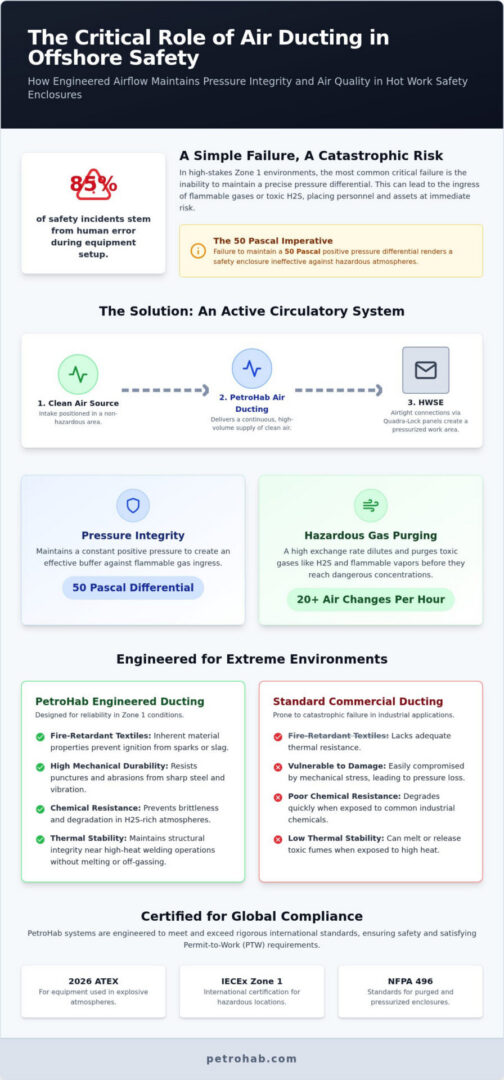
What if the most sophisticated safety enclosure on your platform is rendered useless by a simple failure in airflow management? In high-stakes offshore environments, 85% of industrial safety incidents stem from human error during equipment setup, often involving the critical failure to maintain a 50 Pascal pressure differential. PetroHab Air Ducting isn’t a passive accessory; it’s the active circulatory system that enables pressure integrity and life safety in a PetroHab Hot Work Safety Enclosure. You know that even a minor breach in a Zone 1 area can lead to the ingress of flammable gases or the toxic accumulation of H2S, putting personnel and high-value assets at immediate risk.
This article details how PetroHab’s engineered air ducting systems maintain critical pressure integrity and air quality within hot work safety enclosures. We’ll explore how these systems integrate with Quadra-Lock panels to withstand mechanical stress and high winds. You’ll also learn how our technical specifications ensure 100% compliance with 2026 ATEX and OSHA standards, providing a definitive technological remedy to the sealing paradox.
Key Takeaways
- Identify the technical requirements for maintaining a 50 Pascal pressure differential to ensure 2026 ATEX Zone 1 compliance.
- Evaluate the material specifications of PetroHab Air Ducting that enable it to withstand the mechanical stresses and chemical degradation found in offshore H2S environments.
- Learn to calculate the precise airflow requirements (CFM) necessary to create an effective safety buffer against flammable gas ingress.
- Master installation strategies for identifying clean air sources and establishing airtight connections with Quadra-Lock intrusion panels.
- Understand the critical safety benefits of integrating OEM ducting with the broader PetroHab Hot Work Safety Enclosure ecosystem.
The Critical Role of PetroHab Air Ducting in Habitat Ventilation
PetroHab Air Ducting serves as the primary conduit for atmospheric control within a Hot Work Safety Enclosure (HWSE). It is an engineered, flexible system designed to deliver a continuous supply of clean air while maintaining a strictly regulated internal environment. Unlike generic ventilation hoses, this system acts as the habitat’s circulatory system. It regulates internal temperature, dilutes potential contaminants, and ensures the pressure integrity required to isolate ignition sources from hazardous atmospheres. Engineering must be precise to maintain safety.
Standard commercial ducting often fails in heavy industrial applications because it lacks the thermal resistance and mechanical durability necessary for hot work. High-temperature slag and mechanical stress can compromise inferior materials, leading to a catastrophic loss of pressure. In contrast, an engineered positive pressure enclosure relies on ducting that maintains its structural integrity even under extreme conditions. Reliability is not optional in Zone 1 environments.
To better understand the fabrication and engineering behind industrial ventilation systems, watch this helpful video:
Mitigating H2S and Flammable Gas Ingress
Effective habitat ventilation requires more than just airflow; it requires the strategic displacement of hazardous gases. PetroHab Air Ducting facilitates a minimum of 20 air changes per hour (ACH). This high exchange rate ensures that toxic gases like H2S or flammable vapors are diluted and purged before they reach dangerous concentrations. Engineers must strategically position intake points in non-hazardous areas to ensure only breathable air enters the enclosure. Proper exhaust routing then directs internal air away from the work area, preventing the recirculation of fumes. This methodical approach eliminates stagnant pockets where gases might accumulate.
Regulatory Compliance and Industry Standards
Adhering to hazardous environment standards is a legal and operational necessity on offshore platforms. PetroHab systems are designed to meet 2026 ATEX and IECEx Zone 1 requirements for air movement in explosive atmospheres. This compliance is critical for satisfying the rigorous safety criteria of a Permit-to-Work (PTW) system. By meeting NFPA 496 standards for purged and pressurized enclosures, the ducting ensures that the habitat remains a controlled environment. Safety managers rely on these certifications to mitigate risk and protect personnel during high-stakes operations.
Engineering for Extremes: Materials and Specifications
Industrial environments demand materials that exceed standard commercial thresholds. PetroHab Air Ducting utilizes high-performance, fire-retardant textiles engineered to survive the mechanical stresses of offshore life. These materials resist punctures from sharp structural steel and abrasions from constant vibration on live platforms. The fabric is specifically treated to resist chemical degradation in H2S-rich environments, preventing the brittleness that typically plagues standard polymers in the energy sector. Reliability in these conditions is a direct result of meticulous engineering and field testing.
Operating performance remains stable even when the ducting is positioned near high-heat welding and grinding operations. While inferior materials may melt or off-gas when exposed to thermal stress, these engineered conduits maintain their physical properties. This thermal stability ensures that the air supply remains uncontaminated and the pressure boundary stays intact. To maintain a comprehensive safety barrier, safety managers often integrate these conduits into a complete pressurized welding habitats system.
Fire Resistance and Ignition Prevention
Inherent material properties provide superior protection compared to simple topical coatings. PetroHab ducting aligns with NFPA 701 and UL 94 standards, ensuring the conduit does not become a path for flame propagation. This ignition-resistant construction is non-negotiable for pressurized welding habitats. When hot slag or sparks contact the ducting, the material must remain intact to prevent a breach in the pressure boundary. This level of fire resistance is a critical linguistic anchor for quality and compliance in 2026 industrial safety protocols.
Flexibility vs. Structural Integrity
Maintaining a consistent cross-sectional area is vital for airflow efficiency. PetroHab integrates high-tensile wire reinforcement into the ducting walls. This engineering prevents the conduit from collapsing under suction or when routed through tight, complex geometries around pipes and structural steel. Despite this internal reinforcement, the system remains lightweight and manageable. Rapid deployment and strike-down on offshore platforms require equipment that operators can handle quickly without specialized lifting gear. Secure connections at the habitat interface are achieved through modular couplings, ensuring an airtight seal with Quadra-Lock panels. If you need to verify your site’s specific compliance needs, explore the engineering behind the PetroHab HWSE ecosystem for reliable risk mitigation.
Achieving Pressure Integrity: How Ducting Supports the HWSE
Positive pressure serves as the primary barrier against the ingress of flammable hydrocarbons and toxic gases. This safety buffer is created by a continuous supply of air that exceeds the volume of air escaping through the habitat’s seals. PetroHab Air Ducting provides the essential pathway for this airflow, acting as the critical link between the blower unit and the enclosure. Without high-integrity ducting, maintaining the mandatory 50 Pascal (Pa) pressure differential required for Zone 1 compliance is impossible. Pressure integrity is the delta between internal habitat pressure and external atmospheric pressure.
Calculating the required Cubic Feet per Minute (CFM) is a rigorous engineering task. It depends on the total volume of the Petro-Habitat and the requirement for a minimum of 20 air changes per hour. Engineers must also account for pressure drops caused by duct length and diameter. Friction loss increases significantly over longer runs, which can reduce the effective CFM delivered to the workspace. Using larger diameter PetroHab Air Ducting or increasing blower capacity compensates for these losses, ensuring the system maintains a consistent safety buffer even in high-wind environments.
The Synergy Between Airflow and Manometers
Precise pressure tracking relies on the steady delivery of air through the ducting system. Manometers monitor the internal environment, but their readings are only accurate if the airflow is uniform. Poorly routed ducting can create stagnant “dead zones” where air fails to reach critical corners or recesses. These pockets are dangerous because they allow H2S or welding fumes to accumulate despite a positive pressure reading elsewhere. Strategic placement of the ducting outlets ensures that clean air reaches every cubic foot of the enclosure, effectively flushing out contaminants and providing a breathable atmosphere for personnel.
Safe-Stop Integration and Emergency Protocols
The ducting system works in direct tandem with the Safe-Stop system to provide an automated safety response. If the internal pressure drops below the 25 Pascal threshold, the system triggers an audible 100-decibel alarm and cuts power to all hot work equipment in less than one second. For high-risk operations, safety managers often deploy dual ducting configurations. This redundancy ensures that if one line is compromised by mechanical stress, the second line maintains the pressure boundary. This controlled sequence allows for a safe work stoppage and ensures that the atmosphere remains non-explosive during an emergency egress. Integrating PetroHab Air Ducting into this ecosystem transforms a simple ventilation hose into a critical safety component.
Installation and Routing Strategies for Maximum Airflow
Operational excellence begins with a comprehensive pre-installation assessment. Safety engineers must identify the cleanest air source on-site, typically located upwind and at a sufficient distance from flare booms, exhaust stacks, or known gas vents. Once the source is secured, PetroHab Air Ducting is deployed to bridge the gap between the blower and the enclosure. This setup requires precision; any oversight during routing can lead to a failure in maintaining the 50 Pascal pressure differential required for Zone 1 compliance. Identifying the optimal air intake location is the first step in risk mitigation.
Connecting the conduit to the habitat requires utilizing the modular intrusion points on the Quadra-Lock panels. These panels provide a rigid, engineered interface that eliminates the need for makeshift sealing solutions like tape or elastic cords, which are primary causes of pressure loss. This modularity also contributes to the 50-60% reduction in assembly time associated with the Quadra-Lock system. After the connection is established, operators must secure the ducting using heavy-duty mechanical fasteners or magnetic anchors. This step is critical in high-traffic or high-wind industrial zones where vibration and wind shear can cause the ducting to shift or disconnect. Before hot work begins, safety personnel must verify airflow velocity using calibrated anemometers to ensure the system meets the calculated CFM requirements.
To ensure your site meets these rigorous ventilation requirements, consult with PetroHab for technical guidance on habitat airflow engineering.
Optimizing the Routing Path
Efficient airflow depends on minimizing friction loss. Every 90-degree bend in the routing path increases static pressure and reduces the volume of air delivered to the workspace. Engineers should favor straight, direct paths and use sweeping curves instead of sharp angles. On offshore multi-level decks, vertical routing is often the most efficient method to avoid obstructing walkways or conflicting with existing piping. The layout must also avoid proximity to extreme heat sources or sharp structural edges that could compromise the fabric’s integrity over time. Maintaining a clear, unobstructed path is essential for consistent pressure integrity.
Maintenance and Inspection Checklist
A rigorous maintenance schedule is the only way to ensure ongoing reliability. Daily inspections are mandatory to identify tears, loose couplings, or internal obstructions that could hinder airflow. In oily or soot-heavy environments, cleaning protocols must be followed to prevent buildup that can degrade the fabric or increase the weight of the system.
- Check all modular couplings for airtight seals and mechanical wear.
- Inspect the entire length for punctures caused by mechanical stress or sharp edges.
- Verify that the internal wire reinforcement hasn’t collapsed or deformed.
- Replace any section that shows signs of chemical brittleness or thermal damage.
Repairing damaged ducting is rarely a safe option in high-risk environments. If a breach is detected, the compromised section must be replaced immediately with OEM PetroHab Air Ducting to maintain the safety certification of the entire HWSE ecosystem. Meticulous documentation of these inspections supports the digital audit trails required for modern Permit-to-Work systems.
Optimizing Your Safety Ecosystem with PetroHab Solutions
The integration of engineered components defines the reliability of an industrial safety system. PetroHab Air Ducting acts as the final, essential link that completes the Hot Work Safety Enclosure (HWSE) package. It’s not merely a ventilation accessory; it’s a critical safety component that enables the habitat to function as an active, pressurized barrier. Using OEM PetroHab ducting ensures that every connection point and material specification is optimized for the Quadra-Lock system, maintaining the uncompromising standards required for high-stakes energy sector operations.
PetroHab provides global support for these systems, ensuring that operators in the US, UK, and Brazil have immediate access to certified parts and engineering expertise. This global availability is backed by Houston-based engineering, providing a consistent benchmark for safety excellence across international borders. We also offer comprehensive training and on-site supervision to ensure your personnel can manage habitat ventilation with technical precision. Meticulous oversight during the installation phase is the most effective way to eliminate the human error that causes 85% of industrial safety incidents.
The Quadra-Lock Panel Advantage
The synergy between the ducting and the habitat interface is most evident in the use of Quadra-Lock panels. These panels feature dedicated, reinforced entry points specifically designed to accept PetroHab Air Ducting. This engineered interface ensures a gas-tight seal that resists the mechanical stresses of high-wind environments and offshore vibrations. Unlike makeshift solutions, the modular design of the Quadra-Lock panels allows for rapid assembly without compromising the pressure boundary. This precision ensures that the internal atmosphere remains isolated from external ignition hazards, providing a definitive technological remedy to the challenges of Zone 1 containment.
Next Steps for Safety Managers
Proactive risk mitigation requires a detailed understanding of your site’s unique environmental challenges. Safety managers should begin by conducting a site-specific ventilation survey with PetroHab technicians to identify clean air sources and optimal routing paths. We specialize in customizing ducting lengths and configurations to meet the specific demands of complex refinery turnarounds or offshore platform maintenance. This tailored approach ensures that your safety ecosystem is as resilient as the equipment it protects. Contact PetroHab today for a technical consultation to define your ventilation requirements and ensure absolute compliance with global safety standards.
Securing the Future of Hot Work Safety
Maintaining a 50 Pascal pressure differential in a Zone 1 environment isn’t a suggestion; it’s a critical regulatory mandate. The integrity of a pressurized habitat relies entirely on the technical precision of its ventilation components. PetroHab Air Ducting provides the necessary durability to withstand mechanical stress while ensuring the continuous air exchange rates required by OSHA and ATEX standards. By integrating this system with patented Quadra-Lock technology and the Safe-Stop automatic shutdown system, operators effectively eliminate the high risks associated with human error and gas ingress.
Global oil majors in the US, UK, and Brazil trust these engineered solutions to protect their high-value assets and personnel. Meticulous planning and the use of OEM components are the only ways to ensure absolute safety during high-stakes hot work operations. Don’t leave your site’s pressure integrity to chance. We invite you to request a technical consultation for your HWSE ventilation needs to define a definitive technological remedy for your next project. Achieving operational excellence in hazardous environments is a duty we share, and we’re ready to support your mission.
Frequently Asked Questions
What is the standard diameter of PetroHab air ducting for offshore habitats?
The standard diameter for this equipment is typically 12 inches (305 mm) to ensure optimal airflow and pressure maintenance. This specific sizing allows the system to interface seamlessly with high-capacity blowers used on offshore platforms. Using the correct diameter is essential for achieving the mandatory 20 air changes per hour within the enclosure, ensuring that the internal atmosphere remains breathable and clear of welding fumes.
How does air ducting assist in H2S mitigation within a confined space?
PetroHab Air Ducting facilitates H2S mitigation by enabling the continuous displacement and dilution of hazardous gases. By delivering a steady stream of clean air, the system purges toxic accumulations and prevents stagnant pockets from forming. This active ventilation ensures that any H2S ingress is immediately diluted below dangerous thresholds, maintaining a safe environment for personnel during high-stakes hot work operations in H2S-rich zones.
Is PetroHab air ducting ATEX certified for use in Zone 1 environments?
Yes, the technical specifications for these systems align with 2026 ATEX and IECEx Zone 1 standards for pressurized habitats. This certification ensures the equipment is safe for use in explosive atmospheres where flammable gases are likely to occur. Safety managers rely on these international standards as linguistic anchors for quality, ensuring that every component of the ventilation system meets rigorous global compliance requirements.
What is the maximum recommended length for ducting before pressure loss occurs?
Pressure loss becomes a critical factor when ducting runs exceed 50 to 100 feet without supplemental blower support. Friction loss increases with the length of the conduit and the number of bends in the routing path. Engineers must calculate the specific CFM delivery at the habitat interface to ensure the 50 Pascal pressure differential is maintained. Longer runs may require larger diameter conduits to compensate for static pressure drops.
Can PetroHab ducting be used with third-party air blowers?
While the ducting features modular connections, it’s designed to work exclusively with the Petro-Habitat HWSE and Safe-Stop systems. Integrating third-party blowers can compromise the system’s pressure integrity and void safety certifications. For absolute reliability, safety managers should use OEM equipment to ensure the entire safety ecosystem functions as a definitive technological remedy against ignition hazards in hazardous areas.
How often should air ducting be replaced in a high-heat welding environment?
Replacement is mandatory whenever a daily inspection reveals punctures, chemical brittleness, or significant thermal damage. In high-heat environments, the material is subject to constant mechanical stress and potential slag exposure. While the fabric is fire-resistant, any breach in the pressure boundary renders the conduit unsafe. Regular replacement of compromised sections is a critical safety protocol for maintaining the integrity of the pressurized habitat.
Does the ducting material emit toxic gases when exposed to sparks?
No, the fire-resistant materials used in PetroHab Air Ducting are engineered to resist ignition and don’t emit toxic gases when contacted by sparks or slag. These materials meet ANSI/FM 4950 and UL 94 standards for industrial textiles. This inherent material safety ensures that the air being delivered to the habitat remains uncontaminated, protecting the respiratory health of welders and other personnel inside the enclosure.
How do I secure air ducting to Quadra-Lock panels during high winds?
Secure the conduit by utilizing the dedicated, reinforced entry points on the Quadra-Lock panels. These modular interfaces provide a rigid, engineered connection that resists shifting during high winds or platform vibrations. You should use heavy-duty mechanical fasteners rather than makeshift solutions like tape. This methodical approach ensures a gas-tight seal at the panel interface, maintaining the pressure integrity of the enclosure even in the harshest offshore conditions.