Blog Posts
Pressurized Habitat for Zone 1 Hazardous Area: Engineering Safety in High-Risk Environments
The choice between a total production shutdown and a catastrophic ignition event is a false dilemma that modern engineering has solved. In Zone 1 environments, where flammable gases are likely to be present for up to 1,000 hours per year, the margin for error is non-existent. Deploying a pressurized habitat for Zone 1 hazardous area provides a definitive technological remedy that isolates ignition sources from volatile atmospheres. These systems act as an active guardian, utilizing positive pressure to ensure that maintenance work doesn’t become a liability for your facility.
You understand that compliance with IEC 60079-13:2017 and ATEX directives is non-negotiable for offshore and industrial sites. This article demonstrates how to achieve 100% production uptime while maintaining a zero-incident safety record through advanced atmospheric monitoring. We’ll examine the technical synergy between Quadra-Lock panel technology and automated shutdown systems to ensure your site meets the highest international safety standards. By the end of this guide, you’ll have the technical roadmap required to maintain operational continuity in the world’s most demanding environments.
Key Takeaways
- Understand the specific technical requirements for a pressurized habitat for Zone 1 hazardous area to ensure full compliance with IEC 60079-13 standards.
- Learn how positive pressure mechanics effectively isolate ignition sources from hydrocarbon-rich environments during essential hot work operations.
- Identify the critical engineering differences between standard enclosures and the superior integrity provided by Quadra-Lock panel interlocking technology.
- Discover why integrating a Safe-Stop Automatic Shutdown System is mandatory for achieving the necessary safety redundancies in high-risk zones.
- Master the strategies for maintaining 100% production uptime while protecting personnel and high-value industrial assets from ignition risks.
Defining Zone 1 Hazardous Areas and the Necessity of Pressurization
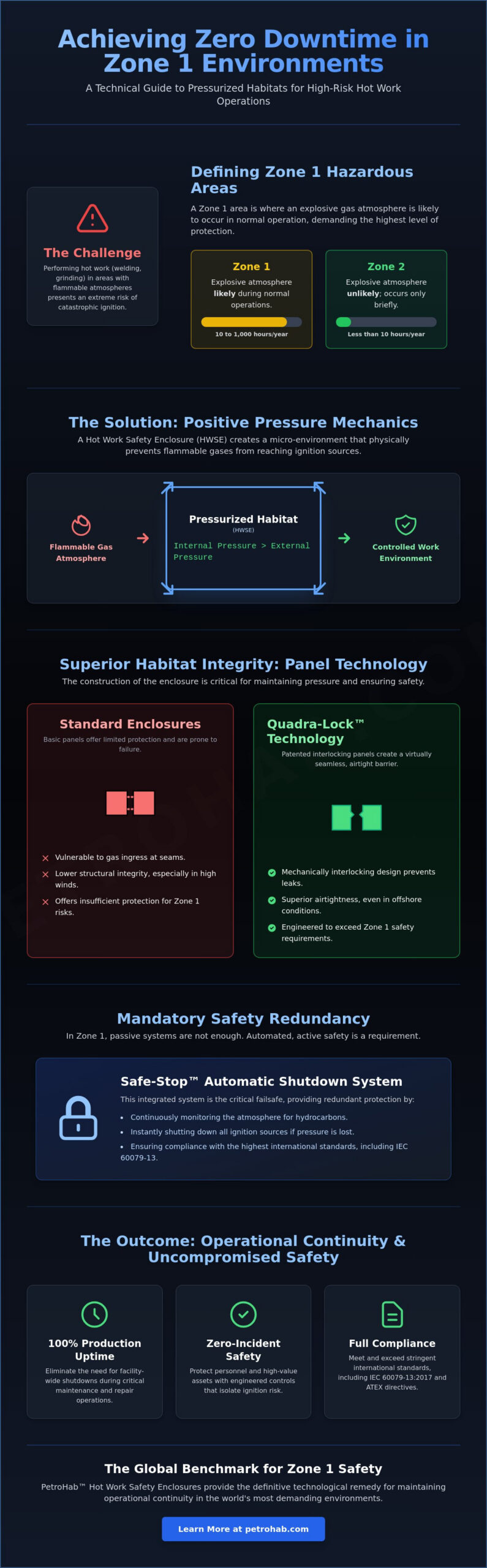
A Zone 1 area is characterized by the occasional presence of explosive gas atmospheres during normal operations, typically ranging from 10 to 1,000 hours annually. In these hazardous locations, the introduction of any ignition source presents an immediate risk of catastrophic explosion. Activities such as welding, grinding, and cutting generate high-energy sparks and heat. Without a definitive technical barrier, these operations are impossible to conduct safely while a plant remains live. Standard fire blankets or non-pressurized barriers provide thermal protection but offer zero defense against gas ingress, making them insufficient for high-risk environments.
To mitigate these risks, engineers deploy a pressurized habitat for Zone 1 hazardous area. This system, formally known as a Hot Work Safety Enclosure (HWSE), creates a temporary micro-environment where ignition sources are mechanically isolated from the surrounding atmosphere. By maintaining a controlled environment, operators can perform critical maintenance without forcing a facility-wide shutdown. This approach prioritizes both personnel safety and operational continuity, ensuring that high-value assets remain protected throughout the duration of the work.
To better understand how these systems function in a real-world setting, watch this technical overview:
Zone 1 vs. Zone 2: Why the Difference Matters for Habitat Selection
The distinction between Zone 1 and Zone 2 is defined by the frequency and duration of the explosive atmosphere. While Zone 2 areas only see explosive gases under abnormal conditions, Zone 1 presents a higher risk profile because the hazard is expected during routine operations. Consequently, regulatory expectations for a pressurized habitat for Zone 1 hazardous area demand more robust atmospheric monitoring and faster automatic shutdown response times. A failure in Zone 1 is statistically more likely to coincide with a gas release, making the engineering integrity of the enclosure paramount.
The Objective of Pressurized Containment
The primary goal of the HWSE is isolation through pressure differentials. By ensuring the internal pressure of the Petro-Habitat remains higher than the external ambient pressure, flammable gases are physically prevented from entering the work area. This protection of high-value assets and personnel allows for continuous production. It transforms a high-risk maintenance task into a controlled, predictable engineering procedure. Using specialized Quadra-Lock panels ensures that the enclosure remains airtight even in high-wind or offshore conditions.
The Mechanics of Positive Pressure: How HWSEs Isolate Ignition Sources
The efficacy of a pressurized habitat for Zone 1 hazardous area relies on the fundamental principle of atmospheric exclusion. By maintaining an internal pressure higher than the surrounding environment, the system creates a physical air barrier. This “over-pressure” state ensures that air flows exclusively outward through any enclosure seams or microscopic gaps. This mechanical action effectively prevents the ingress of volatile gases, isolating the ignition source from the hazardous atmosphere. It’s a definitive technological remedy for the risks associated with hot work in hydrocarbon environments.
Consistency is the hallmark of safety in these high-stakes settings. The air barrier isn’t static; it’s a dynamic system that compensates for environmental changes. According to OSHA standards for hazardous locations, purging and pressurizing is a recognized and approved protection method for preventing explosions in classified areas. This engineering approach transforms a volatile work site into a controlled environment where personnel can operate with absolute confidence. The structural integrity provided by Quadra-Lock panels further supports this pressure maintenance by minimizing unintended air leakage.
Clean Air Intake and Ventilation Protocols
Sourcing clean, breathable air is a critical safety function that requires precise execution. Air intake systems utilize specialized ducting to draw from a verified non-hazardous location, often situated dozens of meters away from the work site. The ventilation protocols must provide high air exchange rates to support worker respiratory health and dissipate heat from welding or grinding. Maintaining atmospheric integrity is mandatory even during personnel movement through airlock systems. For engineers managing complex site layouts, Petro-Habitats offer the modular flexibility required to maintain these airflows across various elevations and configurations.
Manometers and Pressure Sensing in Zone 1
Reliability in Zone 1 requires constant, real-time monitoring of the pressure differential. Digital manometers and sensors track the delta between the internal habitat and the external environment. These devices are not merely for observation; they’re integrated into the broader safety architecture. The minimum required pressure differential for industrial habitats in Zone 1 is 25 Pascals (0.1 inches of water column) to ensure a consistent outward flow of air. If pressure levels drop below this calibrated threshold, the system triggers immediate visual and audible alarms. This redundancy ensures that any breach in containment is met with a definitive response before a hazardous atmosphere can penetrate the enclosure.
Evaluating Habitat Integrity: Quadra-Lock Technology and Material Standards
The engineering requirement for a pressurized habitat for Zone 1 hazardous area demands a level of structural cohesion that standard modular systems cannot provide. Many traditional enclosures rely on hook-and-loop fasteners or heavy-duty zippers to connect panels. These components represent significant failure points. They degrade under UV exposure, collect industrial debris, and fail to maintain the necessary gas-tight seal under high-pressure differentials. In a Zone 1 environment, these leak paths are unacceptable. Reliability requires a mechanical solution that ensures the physical barrier remains impenetrable to external volatile gases.
PetroHab addresses these structural vulnerabilities through its proprietary Quadra-Lock technology. This system utilizes a patented interlocking mechanism (U.S. Patent No. 9,517,609) to secure modular panels without the use of zippers or velcro. This design provides a definitive technological remedy for atmospheric seepage. Compliance with the IEC 60079-2 standard for pressurized enclosures is a fundamental requirement for equipment operating in these high-stakes environments. The Quadra-Lock system ensures that the enclosure functions as a single, unified structure capable of maintaining internal atmospheric integrity under the most demanding conditions.
The Quadra-Lock Advantage for Zone 1
The Quadra-Lock design eliminates the “weak spots” common in inferior modular systems. By creating a continuous mechanical seal between every panel, the system prevents the pressure fluctuations that often plague zip-based enclosures. This structural stability is critical when operating on offshore platforms or in high-wind coastal refineries. The panels are designed for rapid assembly, yet they provide a level of durability that withstands repeated decontamination cycles. This ensures that the pressurized habitat for Zone 1 hazardous area remains a reliable asset for multiple project lifecycles without compromising safety margins.
Fire-Resistant Fabric and Component Engineering
Material science is the foundation of the Petro-Habitat safety profile. Every panel is constructed from high-grade silicone-coated fiberglass, a material specifically chosen for its extreme thermal thresholds. These textiles exceed NFPA 51B standards, providing a resilient barrier against molten slag, grinding sparks, and open flames. Beyond fire resistance, the engineering focus extends to the electrical properties of the fabric. In Zone 1 areas, the use of non-conductive and anti-static materials is mandatory to prevent incidental spark generation. This comprehensive approach to component engineering ensures that every element of the enclosure acts as an active guardian of the site and its personnel.
- Panels are resistant to temperatures exceeding 1,000°F (540°C) for short-duration contact.
- The silicone coating provides chemical resistance against common hydrocarbons and industrial solvents.
- Integrated viewing ports utilize fire-rated materials that maintain visibility without sacrificing enclosure integrity.
Integrating Automatic Shutdown Systems for Redundant Safety
While the mechanical integrity of the Quadra-Lock panels provides the first line of defense, physical isolation alone is insufficient for high-risk operations. A pressurized habitat for Zone 1 hazardous area demands an active, electronic layer of protection to mitigate the risks of gas migration. This is where the Safe-Stop Automatic Shutdown System serves as a non-negotiable redundancy. It acts as the central nervous system of the enclosure, continuously analyzing atmospheric data to ensure the work environment remains inert. Relying solely on manual monitoring is a risk that safety managers can’t afford in volatile hydrocarbon environments.
The system utilizes a network of high-precision sensors to detect Lower Explosive Limits (LEL), Hydrogen Sulfide (H2S), and Oxygen (O2) concentrations. These sensors communicate directly with a PLC-based control unit. If gas is detected at the air intake or if internal pressure drops below the 25-Pascal threshold, the system executes an automated response. This response is designed to be faster than human reaction time, cutting power to all potentially spark-producing equipment in a fraction of a second. Simultaneously, the system manages the air intake fans to prevent drawing contaminated air into the work space.
Safe-Stop Logic: What Happens During an Alarm Event?
Safety protocols must be instantaneous and procedural. When the Safe-Stop system identifies a hazard, it follows a rigorous three-step logic sequence to protect personnel and assets:
- Step 1: Detection. Redundant sensors identify gas ingress at the intake or a critical drop in positive pressure within the enclosure.
- Step 2: Notification. The system activates high-intensity visual and audible alarms both inside the habitat and at the external control station to alert the crew immediately.
- Step 3: Isolation. Power to all hot work tools is disconnected in milliseconds. This isolation is critical because gas ignition can occur almost instantaneously upon contact with a spark.
ATEX and IECEx Certification for Monitoring Hardware
For a shutdown system to be effective in Zone 1, the monitoring hardware itself must be intrinsically safe. All components of the Safe-Stop system carry ATEX and IECEx certifications, confirming they won’t act as an ignition source even if a flammable atmosphere is present. Regular calibration and integrated self-testing features ensure the hardware remains reliable throughout the project duration. Safe-Stop is the critical link in a pressurized welding habitat, bridging the gap between mechanical containment and electronic surveillance. To secure your site with these redundant safety systems, consult the experts at PetroHab for a technical evaluation.
PetroHab Hot Work Safety Enclosures: The Global Benchmark for Zone 1
PetroHab represents the apex of engineering excellence within the energy sector. As a seasoned veteran of the field, the brand understands that deploying a pressurized habitat for Zone 1 hazardous area is a mission-critical operation that leaves no room for compromise. Every Hot Work Safety Enclosure (HWSE) is a product of rigorous technical evolution, designed to withstand the volatile conditions of offshore platforms and onshore refineries alike. By prioritizing risk mitigation and the protection of high-value assets, PetroHab has established itself as the industry benchmark for safety and reliability.
Operational continuity is the primary objective for safety managers. Leading global operators choose to integrate these modular enclosures into their broader hot work safety systems to maintain 100% production uptime. The versatility of the equipment allows for seamless deployment across diverse industrial landscapes, from the high-wind environments of the North Sea to the humid conditions of Gulf Coast refineries. Whether through leasing or direct sales, PetroHab provides the technological remedy required to conduct hot work in areas where explosive atmospheres are a constant factor.
Global Support and On-Site Training
Reliability extends beyond the equipment itself to the personnel who manage it. PetroHab maintains a strategic presence in key energy hubs, including Houston, the United Kingdom, and Brazil, ensuring rapid mobilization of assets and expertise. Certified technicians provide oversight for complex Zone 1 installations, ensuring that every enclosure meets stringent internal and international safety standards. Comprehensive training programs empower client personnel to manage these systems with technical precision, fostering a culture of safety excellence that persists long after the initial installation is complete.
Custom Engineering for Unique Hazardous Locations
Industrial sites rarely offer uniform spaces for safety equipment. The modular nature of Quadra-Lock panels allows for bespoke configurations that adapt to the specific geometry of a work site. Engineers can configure a pressurized habitat for Zone 1 hazardous area to fit around existing piping, structural beams, and other obstacles that would render traditional enclosures useless. This flexibility ensures that the air barrier remains intact regardless of the structural complexity. For safety managers seeking a definitive solution to their most challenging maintenance projects, the logical next step is to Request a quote for PetroHab Zone 1 pressurized habitats and secure their site with the industry’s most durable protection.
Advancing Safety Standards in High-Risk Environments
Operating in explosive atmospheres demands an uncompromising approach to risk management. The deployment of a pressurized habitat for Zone 1 hazardous area effectively eliminates the choice between production uptime and personnel safety. By combining the structural integrity of patented Quadra-Lock Panel Technology with the electronic redundancy of the Safe-Stop Automatic Shutdown System, facilities don’t have to sacrifice compliance for operational speed. These systems provide a definitive technological remedy for the inherent dangers of hot work in hydrocarbon-rich zones.
Protecting high-value assets and ensuring a zero-incident record starts with selecting equipment engineered for extreme reliability. PetroHab provides the technical expertise and modular flexibility required to secure even the most complex industrial sites. It’s a system designed to function as an active guardian of your site operations, ensuring every weld and cut is performed within a controlled environment that meets global hazardous environment standards. This methodical approach to safety ensures that your maintenance objectives are met without introducing unnecessary liability.
Secure your Zone 1 operations with PetroHab HWSE solutions to ensure your next maintenance project is defined by technical precision and operational excellence.
Frequently Asked Questions
What is the difference between Zone 1 and Zone 2 pressurized habitats?
Zone 1 habitats require more robust atmospheric monitoring and faster automatic shutdown response times because explosive atmospheres are likely to occur during normal operations. In contrast, Zone 2 habitats are designed for areas where flammable gases are only expected under abnormal conditions. A pressurized habitat for Zone 1 hazardous area must maintain a higher degree of technical redundancy to mitigate the increased frequency of gas presence.
Can hot work be performed in Zone 0 with a pressurized habitat?
No, hot work is strictly prohibited in Zone 0 environments. Zone 0 areas contain explosive gas atmospheres continuously or for long periods, exceeding the safety parameters of pressurized containment systems. Habitats are engineered to provide a definitive technological remedy for Zone 1 and Zone 2 locations, but they aren’t designed to operate within the permanent explosive conditions of Zone 0.
How does the Safe-Stop system prevent ignition in a Zone 1 area?
The Safe-Stop system prevents ignition by automatically isolating power to all welding and grinding equipment within milliseconds of a hazard detection. It utilizes redundant sensors to monitor for gas ingress or pressure loss. By removing the ignition source before it can interact with a volatile atmosphere, the system acts as an active guardian of the work site.
What international certifications should I look for in a Zone 1 habitat?
You should prioritize equipment that complies with IEC 60079-13:2017 for pressurized rooms and IEC 60079-2 for enclosures. It’s also critical that the monitoring hardware carries ATEX or IECEx certifications. These standards ensure that the pressurized habitat for Zone 1 hazardous area and its electronic components are intrinsically safe for deployment in high-risk environments.
How long does it take to assemble a modular pressurized welding enclosure?
A standard 2m x 2m x 2m enclosure typically requires 2 to 4 hours for assembly by a trained two-person crew. The use of modular Quadra-Lock panels significantly reduces installation time compared to traditional systems. This efficiency allows for rapid deployment during tight maintenance windows without compromising the structural integrity of the air barrier.
Are PetroHab enclosures suitable for both onshore and offshore use?
Yes, PetroHab HWSE systems are engineered to withstand the extreme environmental stressors of offshore platforms, including high wind loads and salt corrosion. Their modular design also makes them highly effective for onshore refineries and chemical plants. The equipment maintains its pressure differential and structural stability across diverse industrial climates.
What happens if the internal pressure in the habitat drops below the safety threshold?
If internal pressure falls below the calibrated 25-Pascal threshold, the system immediately activates visual and audible alarms to alert personnel. Simultaneously, the Safe-Stop system cuts all power to ignition sources. This automated response ensures that a loss of positive pressure doesn’t result in a catastrophic ignition event.
Does the habitat require a constant clean air supply in Zone 1?
Yes, a continuous supply of clean air from a verified non-hazardous location is mandatory to maintain the positive pressure differential. This constant airflow prevents the ingress of flammable gases while ensuring worker respiratory health. It also serves to dissipate heat and fumes generated during welding or grinding operations.