Blog Posts
Pressurized Habitat Maintenance Checklist: The 2026 Industrial Safety Guide
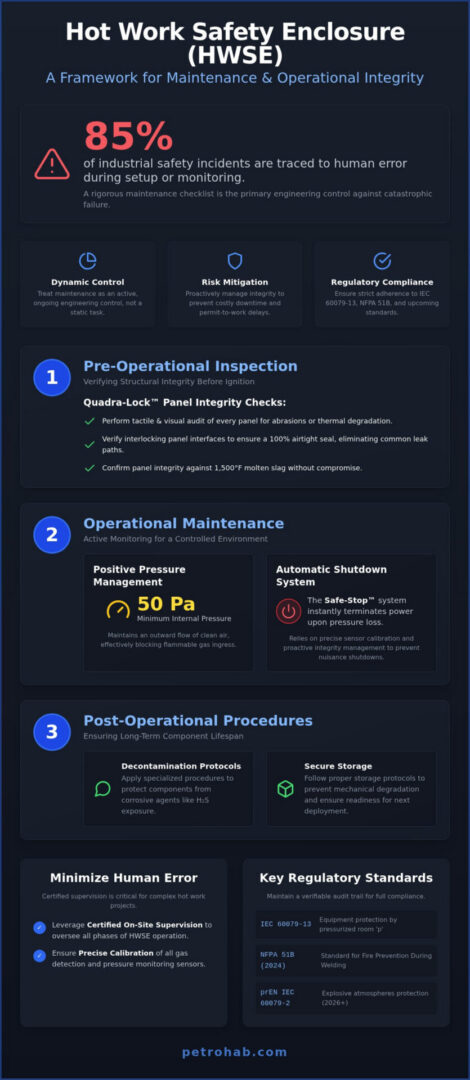
85% of industrial safety incidents are traced back to human error during the initial setup or monitoring of safety equipment. Because maintenance is a dynamic engineering control, using a rigorous pressurized habitat maintenance checklist is essential for Zone 1 and Zone 2 operations. You already recognize that a single pressure loss shutdown results in costly downtime and complicated permit-to-work delays. Maintaining a Hot Work Safety Enclosure (HWSE) requires a stoic commitment to risk mitigation and technical precision.
This guide provides the definitive framework needed to manage complex systems like the Safe-Stop automatic shutdown system and Quadra-Lock panels. By following these protocols, you’ll ensure 100% operational uptime and strict compliance with IEC 60079-13 and the 2024 edition of NFPA 51B. We’ve designed these steps to eliminate the fear of ignition through meticulous inspection and active verification of all physical barriers.
We’ll examine critical inspection points, from verifying the mandatory 50 Pascal internal pressure threshold to executing the multi-volume purge cycle required by the prEN IEC 60079-2:2026 standard. This guide ensures your safety managers can protect personnel while extending the operational lifespan of your HWSE components.
Key Takeaways
- Maintain compliance with IEC 60079-13 and NFPA 51B by treating habitat maintenance as a dynamic engineering control rather than a static task.
- Use a pressurized habitat maintenance checklist to verify the interlocking integrity of Quadra-Lock panels and ensure a 100% airtight seal before ignition.
- Utilize the Safe-Stop automatic shutdown system to maintain the mandatory 50 Pascal internal pressure threshold required for hazardous zone operations.
- Apply specialized decontamination and storage protocols to protect high-value HWSE components from H2S exposure and mechanical degradation.
- Leverage certified on-site supervision to ensure precise calibration of gas sensors and minimize the risk of human error during complex hot work projects.
The Critical Role of HWSE Maintenance in Hazardous Zones
In high-stakes energy sectors, maintenance serves as the primary engineering control against ignition. It isn’t a secondary task. It’s the active barrier between high-risk operations and explosive atmospheres. Failing to follow a rigorous pressurized habitat maintenance checklist compromises the structural and mechanical integrity of the enclosure. This neglect transforms a controlled environment into a liability. Reliable safety managers prioritize proactive integrity management to avoid the catastrophic costs of unplanned shutdowns.
The financial impact of maintenance failure extends beyond simple repair costs. When a system detects pressure loss, the Safe-Stop automatic shutdown system terminates power instantly. While this prevents a disaster, the resulting downtime can cost thousands per hour in lost productivity. Transitioning from reactive repairs to proactive habitat integrity management ensures that seals remain tight and sensors stay calibrated. It’s a calculation of risk versus reliability.
To better understand how these systems operate in real-world scenarios, watch this helpful video:
Understanding the Pressurization Safety Margin
The safety of a pressurized welding enclosure depends on the “Ex p” protection principle. This requires a minimum internal pressure of 50 Pascals (Pa), which is equivalent to 0.1 inches of water column. This specific threshold ensures that any leak results in an outward flow of clean air, effectively blocking flammable gas ingress. Environmental factors like heavy winds or extreme humidity can strain the system’s ability to maintain this pressure. During Hot Work Safety Procedures, these external variables must be countered with active blower adjustments. HWSE maintenance is the continuous verification of environmental isolation.
Regulatory Standards for 2026 Operations
Compliance is a moving target in the energy sector. The 2026 updates to ATEX 2014/34/EU guidelines and the prEN IEC 60079-2:2026 standard have introduced stricter verification cycles. A pressurized habitat maintenance checklist must now be integrated directly into the digital Permit-to-Work (PTW) platform. This integration creates a verifiable audit trail for safety inspectors and ensures that maintenance scheduling is never overlooked.
These regulations ensure that components like Quadra-Lock panels are inspected for mechanical wear before every shift. If a panel shows thermal damage from molten slag, it must be replaced immediately to maintain the enclosure’s integrity. For a deeper look at how these rules affect your site, read our analysis of Hazardous Environment Standards. Using certified technicians for these tasks ensures that maintenance meets the rigorous requirements of IEC 60079-13.
Pre-Operational Inspection: Verifying Quadra-Lock Integrity
Before the first spark of hot work occurs, the physical integrity of the enclosure must be absolute. The pre-operational phase of your pressurized habitat maintenance checklist focuses on the structural containment system. Unlike traditional habitats that rely on vulnerable zippers or velcro, the PetroHab HWSE utilizes patented Quadra-Lock technology to eliminate common leak paths. This initial inspection ensures that the “Ex p” protection principle remains uncompromised throughout the shift.
Technicians must perform a rigorous tactile and visual audit of every panel. Look for mechanical abrasions or thermal degradation. Although Quadra-Lock panels are engineered to manage 1,500°F molten slag without losing structural integrity, any compromise in the composite material requires immediate panel replacement. This proactive approach prevents the Safe-Stop system from triggering a nuisance shutdown due to avoidable pressure loss.
Quadra-Lock Panel Interface Checks
The interlocking mechanism is the primary defense for pressure retention; verify each connection point for a flush fit. Ensure the interfaces are free of grit, oil, or debris that could prevent an airtight seal. Modular scalability allows for complex configurations, but it also increases the number of potential leak paths. Every joint must be locked according to the manufacturer’s specifications. This verification aligns with the IEC 60079-13:2017 Standard, ensuring the habitat operates within certified parameters for Zone 1 and Zone 2 hazardous areas.
Penetration management is equally critical. Pipes, cables, and structural beams often pierce the enclosure walls. Inspect the compression seals around these penetrations to ensure they maintain the positive pressure margin. If you find gaps, re-seat the seals before proceeding with the purge cycle.
Enclosure Perimeter and Atmosphere Setup
Phase 1 begins with a baseline atmospheric test. Use calibrated gas detectors to confirm the external area is free of flammable vapors before inflation. In offshore environments, the stability of the support frame is a mandatory check. High winds or platform vibrations can cause structural shifting, which stresses the Quadra-Lock interfaces. Inspect all air ducting for obstructions or internal leaks. Any restriction in the intake flow prevents the system from reaching the mandatory 50 Pascal threshold required by global safety standards.
If your team requires advanced technical support for these complex setups, our on-site supervision services provide the expertise needed to guarantee absolute compliance during the inspection phase.
Operational Maintenance: Managing Positive Pressure and Gas Detection
Once hot work begins, the focus of the pressurized habitat maintenance checklist shifts to active system monitoring. It’s not enough to have a sealed enclosure; you must maintain a dynamic pressure differential. Safety managers must utilize manometers to track internal pressure levels continuously. If the pressure drops toward the 50 Pascal limit, immediate corrective action is required. Managing air flow rates isn’t just about safety. It’s about maintaining a clean-air environment that allows personnel to work without respiratory strain. This active guardian role ensures that any leak results in an outward flow of air, preventing hazardous ingress.
Safe-Stop System Calibration and Testing
The Safe-Stop automatic shutdown system is the non-negotiable standard for operational maintenance. Perform daily functional tests on gas detector alarms to ensure shutdown triggers activate within milliseconds. Technicians must verify sensor placement strategically to avoid “dead zones” where flammable gases might accumulate undetected. These sensors must be calibrated for both flammable and toxic gases, such as H2S, depending on the site’s specific hazards. If a detector fails to trigger the Safe-Stop system during a test, all hot work must cease immediately. Documenting these performance checks is essential for maintaining a verifiable audit trail for safety audits and PTW compliance.
Pressure Buffer Management
Environmental conditions change rapidly in offshore or coastal environments. Maintenance crews must adjust fan speeds to compensate for fluctuating external pressures caused by high winds. This management ensures the habitat adheres to Positive pressure enclosure safety standards. High wind speeds can create localized low-pressure areas around the habitat, potentially compromising the seal. Technicians should monitor the Quadra-Lock panels for any signs of stress or micro-leaks during active welding. These small leaks, if left unaddressed, can lead to larger pressure losses that trigger the Safe-Stop system and cause unnecessary downtime. Maintaining a consistent pressure buffer is the hallmark of a disciplined safety culture. For a deeper understanding of how these components integrate into a broader safety strategy, refer to our technical overview of Advanced Hot Work Safety Systems.
Post-Operational Procedures and Long-Term Component Care
The safety lifecycle of a Hot Work Safety Enclosure doesn’t end when the permit is closed. Post-operational care is a fundamental component of the pressurized habitat maintenance checklist that determines the reliability of the system for future deployments. In environments involving H2S or other toxic gases, decontamination is the first priority. Residual contaminants can degrade the specialized fibers of the enclosure and pose a health risk to technicians during teardown. Use only manufacturer-approved neutralizing agents to ensure the chemical integrity of the material remains intact.
Inventory management follows decontamination. Every component must be inspected for repair or replacement needs. This includes checking the mechanical fasteners, air ducting, and electrical conduits. Identifying wear early prevents “surprise” failures during the next mobilization. Maintaining a detailed log of component hours and exposure levels ensures that your fleet remains compliant with international safety standards. It also streamlines the transition between different project phases.
Cleaning and Material Integrity
Use only pH-neutral cleaning agents that don’t compromise the fire-resistant properties of the HWSE materials. Harsh chemicals can strip protective coatings, leaving the panels vulnerable to molten slag. Beyond surface grime, technicians must inspect for “invisible” thermal damage. This occurs when extreme heat weakens the internal fiber matrix without showing obvious charring. Improper storage of modular panels, such as tight folding or heavy stacking, leads to permanent creasing and eventual seal failure at the Quadra-Lock interfaces.
Safe-Stop and Sensor Storage
Sensitive gas detection hardware requires a controlled environment for long-term storage. Extreme temperature fluctuations or high humidity can drift sensor calibration and damage the internal Safe-Stop electronics. Battery backup systems must be maintained through regular charge cycles to prevent deep-discharge failure. Additionally, verify that all automated safety systems are running the latest firmware updates to ensure compatibility with digital PTW platforms. This maintenance ensures the system is ready for the next high-stakes deployment.
Ensuring your equipment is “Ready-to-Deploy” minimizes turnaround times for future projects. If you find damaged components during your post-work audit, you can purchase replacement Quadra-Lock panels and Safe-Stop components directly to restore your system’s integrity. This proactive replacement strategy is the only way to guarantee 100% operational uptime in hazardous zones.
Optimizing Safety with Professional Supervision and Training
Technical precision in habitat maintenance is only as reliable as the personnel executing the protocols. While the pressurized habitat maintenance checklist provides a structured path, the complexity of 2026 industrial environments demands specialized expertise. Human error remains the primary driver of safety incidents. Integrating certified technicians into your workflow ensures that automated systems like Safe-Stop are not just operational, but optimized for the specific hazards of your site. This professional oversight transforms safety from a compliance obligation into a core operational strength.
Professional supervisors act as the critical link between hardware and the Permit-to-Work (PTW) process. Their presence often accelerates approvals because safety managers and insurers trust the verification of a seasoned expert. This trust is built on a foundation of rigorous risk mitigation and the protection of high-value assets. Leveraging global support for on-site maintenance ensures that whether you’re in an offshore Zone 1 environment or a remote refinery, your habitat integrity remains uncompromised.
Certified On-site Supervision
Specialized oversight is critical for Zone 1 operations where explosive atmospheres are likely to occur occasionally. A certified supervisor provides third-party maintenance verification that is often required by insurers to validate the safety of high-risk projects. These experts monitor differential pressure and gas detection systems with a level of granular detail that general site workers might overlook. If your project faces unique engineering challenges, contacting PetroHab for global technical support ensures you have a safety partner capable of managing the most complex HWSE configurations.
Training for Maintenance Excellence
Reducing long-term costs begins with proper operator care. A comprehensive training curriculum focuses on the practical application of the pressurized habitat maintenance checklist, emergency response protocols, and component handling. When your crew understands the engineering behind Quadra-Lock panels, they’re less likely to cause mechanical damage during assembly or teardown. This knowledge reduces the frequency of replacement cycles and prevents nuisance shutdowns. For a deeper dive into the engineering that supports these protocols, consult our resource on Pressurized Welding Habitats. This training ensures that your team acts as an active guardian of the site, maintaining the highest standards of industrial safety.
Securing the Future of Hazardous Zone Operations
Effective risk mitigation in high-stakes environments depends on the seamless integration of engineering controls and human oversight. By implementing a rigorous pressurized habitat maintenance checklist, you transform your safety protocols from reactive measures into a proactive defense system. We’ve explored how maintaining the 50 Pascal pressure margin and verifying the integrity of Quadra-Lock panels ensures 100% operational uptime. These procedures aren’t just about compliance with IEC 60079-13; they’re about the absolute protection of your personnel and high-value assets.
Reliability is built through meticulous attention to detail, from pre-operational audits to post-work decontamination. Our Safe-Stop automated shutdown system and patented Quadra-Lock technology provide the industry benchmark for safety excellence. These systems, backed by global ATEX and IECEx compliance, offer the durability required for the most demanding industrial sites. You don’t have to manage these complex safety margins alone. To enhance your site’s ignition prevention strategy, Request a Quote for PetroHab HWSE Rental or Purchase. We’re ready to partner with you to achieve a zero-ignition workplace.
Frequently Asked Questions
How often should a pressurized habitat be inspected during active hot work?
A pressurized habitat requires continuous real-time monitoring of internal pressure and gas concentrations through automated systems. However, a physical inspection of the enclosure integrity must occur at the start of every shift and after any system alarm. Technicians should use a pressurized habitat maintenance checklist to verify the seal of Quadra-Lock panels and the condition of penetration seals. This proactive verification ensures that the “Ex p” protection principle remains effective during the hot work permit.
What is the required minimum pressure for a Hot Work Safety Enclosure?
The mandatory minimum internal pressure for a Hot Work Safety Enclosure (HWSE) is 50 Pascals (Pa), which is equivalent to 0.1 inches of water column. Maintaining this specific threshold is critical to ensure a constant outward flow of clean air. This pressure prevents the ingress of flammable gases from the external environment. If the pressure falls below this limit, the Safe-Stop automatic shutdown system terminates power to all ignition sources within milliseconds to prevent an incident.
Can I use standard duct tape to seal leaks in a pressurized habitat?
No, standard duct tape is not an approved sealing method for pressurized habitats because it lacks the necessary fire-resistance and adhesive durability for hazardous zones. Leaks should be addressed by re-adjusting the patented Quadra-Lock panels or using manufacturer-approved compression seals and fire-rated sealants. If a panel is damaged, it must be replaced with a new Quadra-Lock component to maintain compliance with IEC 60079-13 and NFPA 51B. Using uncertified materials compromises the habitat’s structural integrity.
Who is qualified to perform maintenance on the Safe-Stop automatic shutdown system?
Only certified technicians who’ve undergone specific training on the Safe-Stop automatic shutdown system are qualified to perform maintenance or calibration. These systems are complex engineering controls that integrate gas detection hardware with electrical trip mechanisms. PetroHab provides professional on-site supervision and training to ensure that your maintenance crew can accurately test shutdown response times and calibrate sensors. Unauthorized repairs can lead to system failure, voiding international safety certifications and increasing the risk of ignition during hot work.
What happens to the hot work permit if the habitat loses positive pressure?
If a habitat loses positive pressure below the 50 Pascal threshold, the hot work permit is immediately suspended. The Safe-Stop system will automatically terminate power to tools, and all ignition-producing activities must cease. Work cannot resume until the cause of the pressure loss is identified and corrected. Following a shutdown, a technician must re-verify the enclosure using a pressurized habitat maintenance checklist and perform a full purge cycle before the safety manager re-authorizes the permit.
How do I maintain the fire-resistance of Quadra-Lock panels over time?
Maintaining the fire-resistance of Quadra-Lock panels requires strict adherence to cleaning and storage protocols. Use only pH-neutral, manufacturer-approved cleaning agents to remove grease or slag without stripping the protective fire-resistant coatings. Avoid aggressive mechanical scrubbing that could damage the internal fibers. During storage, panels should be folded loosely or laid flat in a temperature-controlled environment. This prevents permanent creasing and structural degradation, ensuring the panels can still manage 1,500°F molten slag during future deployments.
What are the most common maintenance errors in offshore welding habitats?
The most common maintenance errors in offshore environments include improper management of penetration seals and neglect of sensor calibration. High vibrations and wind loads often stress the Quadra-Lock panel interfaces, leading to micro-leaks that go unnoticed without regular manometer checks. Additionally, failing to decontaminate materials after exposure to H2S can cause long-term material failure. Many operators also fail to maintain battery backup systems for automated shutdown units, which is essential for ensuring safety during platform power fluctuations.
Is daily sensor calibration mandatory for ATEX-certified systems?
Daily functional testing, also known as a bump test, is a mandatory requirement for ATEX-certified systems to verify that gas sensors respond correctly to target gases. While a full laboratory calibration may occur at longer intervals defined by the manufacturer, the Safe-Stop system requires daily verification of its alarm and shutdown triggers. This ensures the sensors haven’t drifted due to environmental exposure. Documentation of these daily tests is a critical component of maintaining a verifiable audit trail for regulatory compliance.