Blog Posts
Pressurized Habitat Personnel Protection for Hot Work Areas
Pressure alone does not protect personnel during hot work in a hazardous area. Effective pressurized habitat personnel protection combines positive pressure with atmospheric monitoring, gas detection, alarms, and defined shutdown responses. Protective controls must address the whole operating system, not just the enclosure.
Safety planning must account for how the habitat detects changing conditions and responds when pressure, gas levels, or the air supply become abnormal. This guide explains how these safeguards work together to protect personnel.
Learn how positive pressure supports a controlled hot-work area, how monitoring and alarms inform shutdown actions, and why emergency arrangements and site suitability matter. The focus is practical: understanding the controls that help manage hazards before and during hot work.
Key Takeaways
- Map pressure readings, gas detection, alarm setpoints, and control logic into one operating response, rather than treating each control in isolation.
- Define start-up, purge, shutdown, egress, and power-failure responses in the habitat’s approved operating documentation.
- Understand how Safe-Stop responds to detected hazards, including conditions that can trigger hot-work power shutdown or interruption of the air supply.
- Assess habitat suitability against the site’s hazardous-area classification and project requirements; a component’s certification alone does not establish the assembled system’s suitability.
Alarms, shutdown responses, and protective controls
A pressurized habitat’s protection depends on coordinated monitoring, alarms, and control logic. The arrangement may include pressure measurement, gas detection, alarm setpoints, and defined shutdown actions. Each signal needs a clear response, so personnel know whether to stop hot work, adjust airflow, or evacuate. Modular enclosure design does not replace this operating logic.
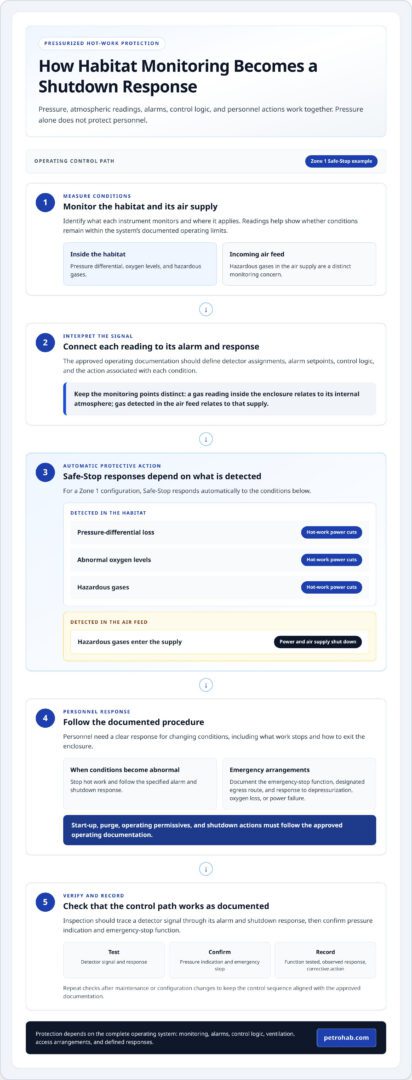
For a Zone 1 configuration, the Safe-Stop system automatically cuts hot-work power if it detects pressure-differential loss, abnormal oxygen levels, or hazardous gases inside the habitat. If hazardous gases enter the air feed, the system shuts down both power and air supply. These responses address different hazards; the approved operating documentation should define how each alarm and shutdown action functions.
What are the emergency procedures for habitat depressurization or oxygen loss? The documented procedure should identify the alarm response, emergency-stop function, and designated egress route. If pressure drops or oxygen reaches an abnormal level, personnel should stop hot work and follow that procedure.
Start-up, purge, operating permissives, and shutdown actions must follow the system’s approved operating documentation. Emergency arrangements should also define what to do in a power failure. Clear sequencing prevents uncertainty: personnel need to know which control acts, what work stops, and how to exit the enclosure.
Quality control and inspection should verify that monitoring and protective controls operate as documented. A practical inspection traces a detector signal through its alarm and shutdown response, then confirms pressure indication and emergency-stop function. The inspection record should note the function tested, the observed response, and any corrective action. Repeat checks after maintenance or configuration changes help keep the modular habitat’s control sequence aligned with its approved documentation.
A pressurized welding habitat’s monitoring and control arrangement may include pressure measurement, gas detection, alarms, setpoints, and control logic. Consider these elements together when defining how personnel should respond to changing conditions. Safe operation depends on the complete system, including atmospheric monitoring, ventilation, access arrangements, and the approved shutdown philosophy, not pressure alone.
A pressurized welding habitat’s emergency arrangements should document egress, emergency-stop functions, and the response to power failure. Keeping these arrangements consistent with the operating procedure gives personnel a clear basis for action when conditions change.
Atmospheric monitoring and gas detection
Atmospheric monitoring tracks oxygen, hazardous gases, and pressure conditions inside the habitat and in its air supply. Readings help establish whether the enclosure remains within its documented operating limits.
Oxygen and Hazardous-Gas Monitoring
Oxygen monitoring identifies abnormal levels that can affect the hot-work environment. Gas detection addresses hazardous substances inside the habitat and in the incoming air feed. These are distinct monitoring points, so the operating plan should identify which detectors cover each location and what condition each alarm represents.
Review each detector’s assigned hazard, alarm setpoint, and corresponding response in the approved operating documentation. For example, gas detected in the air feed requires a defined response for that supply, while a reading inside the enclosure relates to its internal atmosphere. Clear distinctions help personnel interpret alarms correctly.
Atmospheric Monitoring Checks
Monitoring checks should link each instrument reading to its intended control response. Confirm that pressure measurement, oxygen detection, and hazardous-gas detection each have a defined purpose. System documentation should also explain alarm setpoints and control logic so personnel understand what a changing reading means.
During documented checks, follow the system’s approved procedures and record the observed instrument response. Interpret a pressure reading alongside the habitat’s operating limits, not as an isolated value. Address any maintenance or configuration change through the applicable operating documentation.
Pressure and Oxygen Safety Levels
What pressure and oxygen levels are safe in a pressurized habitat? There is no universal setpoint for every configuration. Safe operating levels are those defined for the specific system and site in its approved operating documentation.
Use the documented limits for the habitat’s pressure and oxygen readings, and follow the specified response if either moves outside them. The operating plan should clarify which readings affect hot-work permissives and when personnel must stop work or leave. Connecting measurement to action is central to personnel protection.
Pressurized habitat enclosure and positive pressure
A pressurized welding habitat combines an enclosure with a controlled internal atmosphere. Positive pressure supports gas exclusion, but does not replace monitoring, ventilation, or an operating plan.
Positive Pressure in Welding Habitats
During welding, positive pressure maintains outward airflow through openings in the enclosure. When the habitat operates as designed, this helps limit the entry of hazardous external gases. The pressure differential matters because losing it can undermine that protective function. Pressure measurement and the system’s documented operating limits show whether the enclosure remains in its intended state.
Assess the complete configuration, including ventilation and access arrangements. A panel rating alone cannot establish the permissible ambient operating temperature for the assembled habitat. Material resistance and system operating limits answer different questions.
Positive-Pressure Gas Exclusion
Gas exclusion depends on maintaining the pressure differential across the habitat boundary. If pressure falls, outside air may enter through access points or other openings. The system’s operating documentation should define how to manage entry, maintain airflow, and respond to pressure loss.
Personnel should understand how an open access point affects the enclosure and what conditions require hot work to stop. Positive pressure is one control within the overall setup, not proof that hazardous gas cannot enter. Gas detection and the approved operating procedure remain essential.
Applicable Standards and Regulations
The international standard identified for pressurized habitats is IEC60079-13. A habitat configuration must also suit the site’s classified location. Equipment intended for Zone 1 is not automatically suitable for Zone 2, or vice versa. An Ex-certified component does not, by itself, certify the complete assembled habitat.
What training and medical screening do personnel need for pressurized habitats? Personnel need instruction on the specific enclosure’s entry arrangements, pressure-loss response, and emergency egress. Applicable medical screening should follow the project’s occupational-health process and the demands of the assigned work.
For a site review, assess the hazardous-area classification, hot-work scope, enclosure dimensions, layout, utilities, and project specifications together. This information helps determine whether the proposed enclosure and positive-pressure arrangement fit the worksite.
Personnel protection in hazardous areas
Personnel protection depends on matching work controls to hazards inside and around the habitat. Welding can expose workers to ignition sources, changing oxygen levels, hazardous gases, and loss of pressure or air supply. Controls must address the worksite and enclosure as one operating environment.
What are the main hazards to personnel in pressurized habitats? Key hazards include pressure-differential loss, abnormal oxygen, hazardous gases inside the habitat or in its air feed, and interruptions to power or air supply. Access restrictions and delayed egress can also increase exposure during an abnormal condition.
What personal protective equipment is required inside and outside a pressurized habitat? There is no single PPE set for every task or location. The hot-work hazard assessment and site procedures determine the required eye, face, hand, body, and respiratory protection, including any differences between work inside the enclosure and support tasks outside it.
Use PPE as one layer of the control plan, not as a substitute for enclosure safeguards. A welding helmet and protective clothing address task exposures, while gas detection and shutdown logic address changing atmospheric conditions. Personnel also need clear instructions for alarms, stopping work, and using the designated exit.
Before work begins, align the hot-work scope with the habitat’s operating documentation. Confirm that workers understand access arrangements, alarm meanings, emergency-stop functions, and the response to pressure loss or abnormal oxygen. A power failure also requires a defined response because it can affect monitoring or other controls. Site supervisors should coordinate these steps with applicable project procedures and personnel roles.
For pressurized habitat personnel protection, the practical takeaway is to connect each hazard to a control, a responsible response, and an exit plan. Review the work scope, site classification, enclosure configuration, and utility supply together. Discuss pressurized habitat requirements for hazardous-area hot work.
According to Wikimedia Foundation, basic space suits are worn inside spacecraft as a safety precaution in case of cabin-pressure loss. Pressurized welding habitats provide a controlled hot-work area, while basic fire-protection products offer limited control.
PetroHab LLC
PetroHab LLC helps teams address hot-work hazards with pressurized welding enclosures and related protective controls. Its offerings include the PetroHab Hot Work Safety Enclosure (HWSE), Safe-Stop Automatic Shutdown System, and Quadra-Lock Panels. These solutions support project planning for enclosure design, atmospheric hazards, and shutdown responses.
Consider PetroHab LLC when a project requires a pressurized habitat for hot work in a hazardous area. Share the site classification, work scope, enclosure dimensions, layout, utility supply, and applicable project specifications. These details help define system requirements and assess how the enclosure and controls fit the work.
Personnel protection depends on the complete operating arrangement, not a single component. Contact PetroHab LLC to discuss your hot-work habitat requirements.
Build the Next Step Into Project Planning
A project-specific plan for pressurized habitat personnel protection starts by translating site hazards into clear design and operating requirements. This connects the hot-work scope with the classified location, enclosure layout, utilities, and emergency arrangements. Keeping these decisions aligned gives project teams a practical basis for planning installation and operations.
Use the next planning discussion to clarify the work area, access needs, and how the habitat will fit into the wider site. Include project specifications and the conditions personnel may encounter. This creates a focused starting point for evaluating a suitable enclosure and its protective controls, without treating any single component as a complete personnel-protection plan.
When you’re ready to discuss those project requirements, contact PetroHab LLC about habitat protection. A clear scope helps move the conversation toward a considered hot-work setup. Take the next step with the site conditions and work objectives in view.
Frequently Asked Questions
What is a pressurized habitat and how does it protect personnel?
A pressurized habitat is an enclosure designed to provide a controlled area for hot work in hazardous environments. PetroHab LLC’s modular Hot Work Safety Enclosures use a pneumatic air supply, and the Petro-Habitat™ HWSE uses interchangeable panels with Quadra-Lock® technology. Together with atmospheric monitoring and shutdown controls, the enclosure supports personnel protection by managing the work environment around welding activity.
How are habitats protected against leaks, depressurization, and pressure changes?
Pressure changes are monitored so the system can respond to a loss of differential pressure. The Safe-Stop Safety Shutdown System monitors differential pressure and gas levels, and its shutdown response can stop hot-work power when pressure differential is lost. Quadra-Lock® technology joins panels without zippers. These controls detect or respond to defined conditions, but do not make the habitat leak-proof. Follow the approved operating and emergency procedures.