Blog Posts
Preventing Welding Explosions in Confined Spaces: The 2026 Engineering Guide
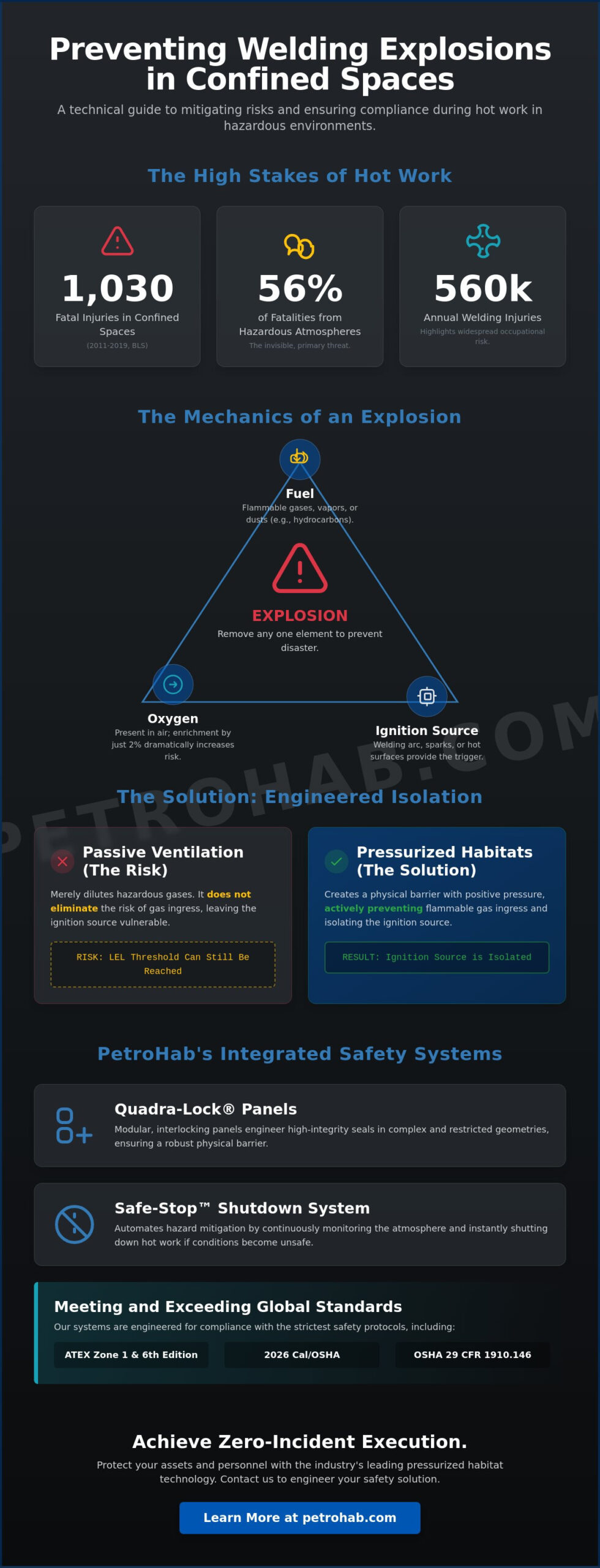
Between 2011 and 2019, the Bureau of Labor Statistics recorded 1,030 fatal injuries in confined spaces, and hazardous atmospheres accounted for 56% of those fatalities. When you factor in the estimated 560,000 annual welding injuries, the margin for error in industrial environments disappears. Relying on basic ventilation or passive monitoring is a liability that risks catastrophic asset loss and regulatory non-compliance. Mastering the rigorous engineering required for preventing welding explosions in confined spaces is the only way to ensure your site remains operational and your personnel stay protected.
You recognize that managing air quality and ignition sources in tight volumes is a constant struggle for safety managers. This guide delivers the technical protocols and habitat technologies required to eliminate explosion risks during hot work in hazardous environments. We’ll explore the integration of Quadra-Lock panels and the Safe-Stop automatic shutdown system to meet the 2026 Cal/OSHA standards and ATEX 6th Edition requirements. You’ll gain the specific knowledge needed for zero-incident execution and optimized turnaround times while maintaining the highest levels of industrial integrity.
Key Takeaways
- Identify the specific fuel and oxygen concentrations that trigger the explosion triangle within permit-required confined spaces.
- Deploy pressurized habitat technology to establish a definitive barrier against the ingress of flammable gases during hot work.
- Engineer high-integrity seals in restricted geometries using the modular, interlocking capabilities of Quadra-Lock panels.
- Automate hazard mitigation and maintain ATEX Zone 1 compliance by integrating certified shutdown systems like Safe-Stop.
- Apply strategic protocols for preventing welding explosions in confined spaces to protect high-value assets and achieve zero-incident execution.
Defining Hazards: The Mechanics of Welding Explosions in Confined Spaces
OSHA 29 CFR 1910.146 defines a confined space as an area large enough for an employee to enter, with limited means of entry or exit, and not designed for continuous occupancy. While some industry resources focus strictly on physical dimensions, true safety engineering requires a deeper analysis of the internal chemistry. Defining Confined Spaces involves identifying any environment where the explosion triangle, which includes fuel, oxygen, and an ignition source, can coalesce. Between 2011 and 2019, 56% of the 1,030 recorded confined space fatalities involved hazardous atmospheres. For engineers, the welding arc is a permanent ignition source that demands absolute isolation from potential fuel loads. PetroHab LLC acts as a critical safety partner in these high-stakes environments.
To better understand the immediate consequences of these hazards, watch this video detailing an ignition event during hot work:
High-hazard sites in the oil and gas sector are particularly susceptible to gas entrapment. In these tight volumes, even minor leaks from process piping can create a saturated environment. Common high-risk areas include offshore storage tanks, ship hulls, pressurized process vessels, and underground utility vaults. Preventing welding explosions in confined spaces requires a proactive approach to atmospheric control rather than reactive monitoring. If the air-to-fuel ratio reaches the Lower Explosive Limit (LEL), the introduction of a single spark will result in a catastrophic event.
The Chemistry of Confined Space Ignitions
Deflagration is the result of welding heat triggering a combustion wave that travels through a gas-rich environment. The flashpoint of industrial hydrocarbons is the specific temperature where they emit sufficient vapor to form an ignitable mixture with air. Oxygen enrichment is a frequent and overlooked hazard; a mere 2% increase in oxygen concentration can cause materials that are normally fire-resistant to burn violently. Leaking hoses or valves within a Petro-Habitat must be mitigated through automated systems that detect these shifts before they reach critical levels. We don’t accept compromises when it comes to ignition source control.
Atmospheric Hazards Beyond Flammability
Beyond flammability, the concentration of toxic fumes in windowless basements or duct systems can quickly exceed the OSHA PEL of 5 mg/m³ for iron oxide. Asphyxiation is another silent killer, particularly during TIG welding where inert gases like argon displace breathable air. Effective risk management must integrate continuous monitoring with strict adherence to hazardous environment standards to protect the lives of the 560,000 workers injured in welding accidents annually. Preventing welding explosions in confined spaces isn’t just about fire suppression; it’s about the total management of the breathable atmosphere.
Engineered Isolation: How Pressurized Habitats Neutralize Ignition Sources
Engineered isolation represents the shift from reactive monitoring to active prevention. Passive ventilation, as suggested by general industry guides, merely dilutes hazardous gases; it doesn’t eliminate the risk of ingress. A Hot Work Safety Enclosure (HWSE) acts as a primary barrier, creating a controlled environment where the welding arc is physically separated from the external atmosphere. This technology is critical for preventing welding explosions in confined spaces where flammable vapors may accumulate. Compliance with OSHA Welding Standards requires rigorous fire prevention measures that go beyond simple airflow.
The fundamental principle of an HWSE is overpressure. By maintaining an internal pressure at least 0.1 inches (25 Pa) of water column higher than the ambient environment, the system ensures that any atmospheric leak flows outward rather than inward. This engineered overpressure serves as a definitive seal against hydrocarbons. While passive ventilation relies on the hope that gases won’t find an ignition source, pressurized habitats utilize physics to make ingress impossible. High-frequency air changes, often exceeding 20 cycles per hour, simultaneously remove welding fumes to keep the internal atmosphere within permissible exposure limits.
Passive ventilation systems typically fail in confined environments because they cannot guarantee the exclusion of flammable gases. In a storage tank or offshore platform, gas pockets can shift unpredictably due to temperature changes or process leaks. Relying on fans alone creates a false sense of security. An engineered HWSE, conversely, provides a documented safety barrier that satisfies the most stringent global standards. This level of control is the gold standard for high-stakes industrial operations.
The Step-by-Step Mechanism of HWSE Protection
Step 1: Establishing a physical barrier using fire-resistant modular Quadra-Lock panels. These interlocking components ensure a high-integrity seal even in complex geometries like ship hulls or storage tanks.
Step 2: Initiating air intake from a verified non-hazardous area via flame-retardant ducting.
Step 3: Maintaining overpressure through automated blowers to ensure internal atmosphere integrity throughout the hot work duration.
Integrating HWSE with the Permit-to-Work (PTW) System
Modern safety protocols, including the 2026 Cal/OSHA standards, require site-specific permit programs and formalized communication. Utilizing pressurized welding habitats fulfills these PTW requirements by providing a documented, engineered control. The fire watch plays a critical role, monitoring habitat pressure gauges and gas detectors to verify the system’s performance. Coordination between habitat technicians and site safety officers ensures that any loss of pressure immediately halts hot work, preventing welding explosions in confined spaces before a hazard can materialize. You can enhance your site’s safety architecture by integrating PetroHab modular systems into your next project.
Structural Integrity and Monitoring: Quadra-Lock and Safe-Stop Integration
Technical isolation requires more than just a physical wall; it demands a fail-safe ecosystem where structural integrity and electronic monitoring converge. While some manufacturers focus strictly on specialized welding tools to minimize risk, these solutions don’t address the external atmospheric hazards present in oil and gas environments. True protection in preventing welding explosions in confined spaces depends on a high-integrity enclosure that remains resilient under pressure. Following IADC Safety Precautions, engineers must ensure that every entry point and seal is validated before hot work commences.
The Engineering of Quadra-Lock Panels
The Quadra-Lock system utilizes a patented interlocking panel design to eliminate the gaps that plague traditional soft-wall habitats. These modular panels are engineered to fit the tight geometries of storage tanks and offshore modules, allowing for setup around complex piping and structural obstructions. Each panel is manufactured from high-grade, fire-resistant materials. This modularity ensures that the pressurized habitat maintains its structural seal even when the workspace is restricted by high-volume internal equipment. It’s a rigorous solution for environments where standard enclosures fail to provide a gas-tight barrier.
Automatic Shutdown Protocols for Confined Spaces
Structural integrity is only half of the solution; it must be paired with an active hot work safety system to manage the unpredictable nature of hazardous gases. The Safe-Stop automatic shutdown system provides this critical layer of ignition source control. If the internal overpressure drops below the required threshold or if gas detectors identify flammable vapors at 10% of the LEL, the system instantly terminates power to the welding equipment. This logic prevents a spark from ever meeting a combustible mixture.
Safe-Stop integrates ATEX-certified gas detection within the shutdown loop, ensuring that the hardware remains compliant in Zone 1 and Zone 2 environments. By linking the habitat’s power supply directly to atmospheric sensors, you eliminate the risk of human error during a gas excursion. It’s a definitive technological remedy that transforms a dangerous confined space into a controlled industrial environment. This integration is the only way to achieve zero-incident execution in high-hazard zones where the potential for catastrophic asset loss is ever-present.
Risk Mitigation and Compliance: Navigating OSHA and ATEX Standards
Compliance is the foundation of industrial integrity. OSHA 29 CFR 1910.146 establishes the baseline for permit-required confined spaces, but the 2026 regulatory environment requires more granular control. As of January 1, 2026, new Cal/OSHA standards (CCR 1951-1956) mandate that a “Competent Person” conduct initial site surveys for construction related hot work. This ensures that the specific technical challenges of preventing welding explosions in confined spaces are identified before any personnel enter the volume. Failure to meet these standards risks catastrophic asset loss and severe legal liability.
In hazardous zones, equipment must match the classification of the environment. ATEX Zone 1 environments, where a flammable atmosphere is likely to occur during normal operations, require the most stringent ignition source control. Zone 2 environments, while less volatile, still demand rigorous protection measures. Every component within a pressurized habitat, including lighting and sensors, must be intrinsically safe. The January 2026 release of the 6th Edition ATEX Guidelines clarifies that digital versions of the EU Declaration of Conformity are now permitted, which streamlines the documentation process during high-pressure offshore turnarounds.
Global Standards for Welding Habitats
Safety managers must distinguish between regional and international certifications. While ATEX is a mandatory European directive, IECEx provides a global standard for equipment used in explosive atmospheres. Both certifications are essential linguistic anchors for quality. PetroHab ensures that all hardware, from the Safe-Stop system to the modular Quadra-Lock panels, adheres to these benchmarks. ISO 9001 certification further guarantees that the manufacturing and leasing processes maintain peak structural integrity. For a comprehensive look at procurement requirements, consult the definitive guide to HWSE.
Pre-Entry Risk Assessment Protocols
A “Confined Space Entry Permit” isn’t a mere administrative hurdle; it’s a critical safety roadmap. The 2026 standards emphasize continuous atmospheric monitoring over periodic checks. Given that hazardous atmospheres caused 56% of confined space deaths between 2011 and 2019, real-time data is non-negotiable. Assessment protocols must include:
- Verification of LEL levels below 10% before and during hot work.
- Validation of the “Competent Person” survey results.
- Formalized emergency egress planning for tight, windowless volumes.
- Coordination of communication between all contractors on-site.
Establishing these protocols ensures that every worker remains protected within a high-integrity environment. You can achieve full regulatory compliance and protect your personnel by partnering with PetroHab for your next hazardous area project.
Scaling Safety: PetroHab’s Global Modular HWSE Solutions
PetroHab positions itself as the active guardian of industrial sites, providing the technical infrastructure required for large-scale risk mitigation. Our role extends beyond the manufacturing of pressurized habitats; we act as a trusted safety partner for the world’s most demanding energy sectors. With operational hubs in Houston, Dundee, and Brazil, our engineering teams deliver rapid-response solutions to global offshore and onshore facilities. This international footprint ensures that high-integrity hardware is available wherever high-stakes hot work is performed. Preventing welding explosions in confined spaces requires this level of global coordination and technical availability.
The decision between leasing and purchasing an HWSE system depends on specific project turnarounds and asset management strategies. For short-term maintenance windows, leasing provides a cost-effective route to zero-incident execution. This model grants access to the latest Safe-Stop automatic shutdown systems and Quadra-Lock panels without the capital expenditure of a permanent purchase. For long-term facility operations, purchasing ensures that your site is perpetually equipped to handle emergency hot work while maintaining full ATEX and OSHA compliance. Both options provide the same unrivaled level of protection for human life and high-value assets.
Modular Design for Complex Geometries
The patented Quadra-Lock panels are engineered to solve the spatial challenges of offshore platform constraints. These interlocking components allow for the assembly of habitats in restricted volumes where traditional, rigid structures cannot fit. The portability of HWSE components is a critical advantage for remote industrial sites, as the entire system can be transported and erected with a minimal footprint. Each panel is constructed from materials tested for durability in corrosive marine environments, ensuring the structural seal remains intact against salt spray and extreme humidity. This modularity is essential for preventing welding explosions in confined spaces where obstructions are common.
Comprehensive Support and Training
Technical hardware is only effective when paired with expert oversight. PetroHab-certified technicians provide on-site supervision to manage setup, atmospheric monitoring, and the integration of shutdown protocols. We also offer rigorous training programs for client personnel, ensuring that your internal teams understand the granular details of ignition source control and habitat integrity. This commitment to education transforms safety from a mere checklist into a disciplined operational culture. To secure your site against atmospheric hazards and ensure regulatory excellence, Contact PetroHab for a specialized confined space safety consultation.
Securing Industrial Integrity Through Engineered Overpressure
The complexity of hot work in restricted environments demands a shift from basic monitoring to active isolation. You’ve seen how the integration of patented Quadra-Lock technology and ATEX-certified Safe-Stop systems creates a definitive barrier against atmospheric hazards. These systems don’t just alert you to danger; they physically prevent the conditions required for ignition by maintaining a high-integrity seal and automated shutdown logic. Achieving zero-incident execution in 2026 requires strict adherence to these technical protocols and the elimination of human error through automation.
Implementing these engineering standards is the only reliable method for preventing welding explosions in confined spaces while ensuring full compliance with the latest Cal/OSHA and ATEX 6th Edition guidelines. PetroHab provides the unrivaled expertise and 24/7 global technical support needed to protect your high-value assets and personnel. Request a Quote for Pressurized Welding Habitat Rental to secure your next turnaround and maintain operational excellence. Your commitment to safety ensures a resilient and productive future for your entire workforce.
Frequently Asked Questions
What is a confined space according to OSHA welding standards?
OSHA 29 CFR 1910.146 defines a confined space as an area large enough for an employee to enter, with limited means of entry or exit, and not designed for continuous occupancy. The 2026 Cal/OSHA standards for construction (CCR 1951-1956) further mandate a “Competent Person” to conduct initial site surveys. These regulations ensure that all atmospheric and physical hazards are documented before hot work begins in windowless volumes or underground vaults.
How does a pressurized habitat prevent explosions in confined spaces?
A pressurized habitat utilizes the physics of overpressure to establish a definitive barrier against flammable gas ingress. By maintaining an internal pressure at least 0.1 inches of water column higher than the ambient environment, the system forces air outward through any structural gaps. This active isolation is a primary protocol for preventing welding explosions in confined spaces where hydrocarbon accumulation is a constant risk in the oil and gas sector.
Is an automatic shutdown system required for hot work in Zone 1?
An automatic shutdown system is a technical necessity for maintaining ignition source control in ATEX Zone 1 environments. The Safe-Stop system provides this functionality by monitoring the atmosphere and pressure levels in real time. If gas concentrations reach 10% of the Lower Explosive Limit (LEL), the system instantly terminates power to the welding equipment. This fail-safe mechanism eliminates human error during a gas excursion and protects high-value assets.
Can Quadra-Lock panels be used in high-temperature environments?
Quadra-Lock panels are engineered from high-grade, fire-resistant materials specifically designed for industrial hot work environments. These modular components maintain their structural integrity and seal when exposed to the high temperatures generated by welding and grinding. The interlocking mechanism ensures that the habitat remains gas-tight even in the complex, high-heat geometries of offshore process modules or ship ballast tanks where traditional soft-wall systems often fail.
What are the common ignition sources in confined space welding?
The welding arc is the most significant ignition source, but sparks, molten slag, and heated metal surfaces also present high risks. In a confined volume, these sources can easily ignite trapped hydrocarbon vapors or oxygen-enriched atmospheres. Statistics from May 2024 indicate approximately 560,000 welding injuries occur annually. Many of these incidents are linked to the failure to isolate these permanent ignition sources from combustible gases through engineered barriers.
How often should gas detectors be calibrated for habitat use?
Gas detectors integrated into the Safe-Stop system must be bump tested daily before every shift and calibrated according to manufacturer specifications, typically every 90 to 180 days. Continuous monitoring is mandatory under the 2026 industrial safety standards. Meticulous calibration ensures that the LEL sensors provide the accurate data required to trigger automatic shutdown protocols before a hazardous atmosphere reaches a point of deflagration in restricted volumes.
What is the difference between ATEX and IECEx for welding habitats?
ATEX is a mandatory European Union directive (2014/34/EU) for equipment in explosive atmospheres, while IECEx is an international certification system. The January 2026 ATEX 6th Edition Guidelines provide updated clarifications on digital documentation for these standards. PetroHab systems utilize both certifications as linguistic anchors for quality. This ensures that our hardware meets the rigorous compliance demands of global offshore turnarounds and provides a gold standard in hot work safety.
Why is positive pressure critical for offshore welding safety?
Positive pressure is critical because it transforms a habitat into a controlled environment that is physically incapable of accepting external flammable gases. In offshore environments, gas pockets can shift unpredictably due to temperature changes or process leaks. Maintaining overpressure ensures that the work volume remains isolated. This is a fundamental requirement for preventing welding explosions in confined spaces on high-value assets like FPSOs and drilling rigs where the risk of catastrophic loss is extreme.