Blog Posts
Welding Fire Watch Alternatives: Engineered Safety vs. Manual Monitoring in 2026
The reliance on human observation to prevent catastrophic ignition events in high-hazard environments is no longer the industry benchmark for excellence. While manual monitoring remains a baseline regulatory requirement, the inherent risks of human fatigue and the soaring costs of operational downtime demand a more rigorous approach. Human error is a variable you can’t afford. You recognize that maintaining a 35-foot exclusion zone and managing dedicated safety personnel often compromises project timelines and facility throughput. This article explores how modern welding fire watch alternatives, specifically engineered hot work safety enclosures and automatic shutdown systems, provide a superior, technology-driven solution to these persistent challenges.
Discover how the integration of PetroHab Hot Work Safety Enclosures (HWSE) and Safe-Stop automatic shutdown systems eliminates the variables of human error. We’ll examine the technical advantages of pressurized containment using Quadra-Lock panels and the strategic implementation of automated gas detection. This transition from manual watching to engineered control ensures absolute protection for your personnel and high-value assets while significantly reducing necessary exclusion zones. By adopting these advanced systems, safety managers achieve a level of risk mitigation that human observation alone cannot match.
Key Takeaways
- Identify the critical failure points of manual fire watch protocols and why human observation alone is insufficient for high-stakes industrial environments.
- Learn how PetroHab Hot Work Safety Enclosures (HWSE) create a pressurized physical barrier to isolate ignition sources from flammable gases.
- Assess the technical advantages of welding fire watch alternatives such as the Safe-Stop system for automated gas detection and instantaneous equipment shutdown.
- Discover how modular Quadra-Lock technology allows for the reduction of exclusion zones, minimizing operational downtime during critical maintenance.
- Understand why the 2026 industry benchmark for hot work safety shifts from simple monitoring to engineered containment and integrated sensor arrays.
The Limitations of Manual Fire Watch Protocols in Heavy Industry
A fire watch is a manual monitoring protocol mandated by NFPA 51B and OSHA 1910.252. It requires a dedicated person to observe the work area for potential fires during and after hot work. These Hot work safety protocols are foundational to industrial maintenance; however, relying on a human observer introduces significant variables that compromise site safety. Manual monitoring is inherently reactive. It focuses on extinguishing a fire after ignition has occurred rather than preventing the ignition altogether.
Fatigue, distraction, and limited sensory perception are critical failure points in traditional monitoring. A human cannot see through steel decks or detect small hydrocarbon leaks with their eyes. As industry leaders seek more reliable welding fire watch alternatives, the focus shifts toward engineered controls that eliminate these physiological limitations. Relying on a human eye to catch a spark in a high-risk zone is a gamble that modern safety standards no longer support.
To better understand these regulatory requirements and the physical demands they place on personnel, watch this helpful video:
The economic burden of manual monitoring is substantial and often underestimated. OSHA mandates a fire watch for at least 30 minutes after welding ceases, while NFPA 51B often requires a 60-minute duration. This results in significant labor costs and extended project timelines where skilled labor remains idle to satisfy a monitoring requirement. The shift to welding fire watch alternatives represents a move from human-dependent observation to automated, engineered reliability.
A fire extinguisher is a secondary defense, not a primary safety solution. True risk mitigation involves isolating the ignition source from the fuel. When you rely on a manual fire watch, you’re managing the consequence of a failure rather than preventing the failure itself. Engineered solutions like pressurized habitats provide a proactive barrier that manual protocols cannot replicate.
Human Error and the 35-Foot Rule
The 35-foot rule assumes a clear line of sight, yet sparks often travel through gaps, vents, and conduits beyond a single monitor’s vision. In complex offshore platforms or refineries, monitoring multiple levels or obscured combustible areas manually is physically impossible. Historical failures in these environments often stem from sparks landing in areas the fire watch could not see. These blind spots are where fires develop undetected until they become uncontrollable.
Regulatory Requirements vs. Operational Reality
OSHA 1910.252 sets the responsible person designation, requiring individuals to have the authority to stop work if hazards arise. Under 2026 standards, the responsible person is the individual designated by management to oversee the hot work permit system and ensure all safety precautions, including the evaluation of hazardous conditions, are strictly followed before and during operations. While these regulations provide a baseline, adequate safety requires moving beyond minimum compliance toward technological remedies.
Engineered Containment: Pressurized Welding Habitats as a Technological Alternative
The transition from manual observation to engineered control represents a fundamental shift in industrial safety management. A PetroHab Hot Work Safety Enclosure (HWSE) provides a physical and atmospheric barrier that isolates ignition sources from the surrounding hazardous environment. Unlike traditional methods that rely on a human monitor to react to a flame, these pressurized habitats prevent the conditions necessary for a fire to start. This makes them the most robust welding fire watch alternatives available for high-stakes facilities like refineries and offshore platforms.
The enclosure is constructed from high-grade, fire-resistant materials. These exceed the protection offered by standard welding blankets. They withstand sustained heat and prevent slag or sparks from escaping into areas where hydrocarbons might be present. By housing the hot work within a controlled space, operators can maintain production in adjacent areas without violating OSHA hot work regulations. This level of containment is essential for maintaining operational continuity during critical repairs.
The Role of Positive Pressure in Ignition Prevention
The primary safety mechanism of an HWSE is the maintenance of positive internal pressure. The system pumps fresh air into the enclosure at a rate higher than the surrounding atmosphere. This creates a differential pressure that forces air out of any small gaps. It ensures that hazardous gases or flammable vapors cannot enter the work area. For a deeper technical analysis, safety managers should consult Pressurized Welding Habitats: The Definitive Guide to HWSE Technology. Integrated air ducting provides a continuous air exchange. This simultaneously extracts welding fumes and maintains a breathable environment for the technician.
Quadra-Lock Technology and Structural Integrity
The structural reliability of these habitats depends on the integrity of their seams. PetroHab utilizes patented Quadra-Lock technology to ensure a gas-tight seal between modular panels. Unlike standard interlocking systems that may degrade under mechanical stress, Quadra-Lock panels provide a secure, fail-safe connection. This modularity allows the enclosure to be built around complex piping, valves, and structural beams common in heavy industry.
The durability of these panels is critical in offshore environments. Extreme weather and salt spray can compromise temporary structures. The Quadra-Lock system remains resilient, maintaining the enclosure’s integrity in the harshest conditions. If you are planning a maintenance turnaround, considering PetroHab pressurized habitats as a proactive safety measure can significantly reduce your risk profile.
Automatic Shutdown Systems: Replacing the Human Eye with Gas Detection
The human eye is fundamentally incapable of detecting the colorless and odorless flammable gases that often precede a catastrophic ignition. While a manual fire watch focuses on spotting active flames, the Safe-Stop Automatic Shutdown System provides a proactive technological remedy by monitoring the atmosphere in real-time. This system acts as a digital guardian, offering 24/7 surveillance that human observation cannot replicate. As facility managers evaluate welding fire watch alternatives, the integration of automated gas detection emerges as a critical component of modern engineered hot work safety solutions.
The Safe-Stop system is designed to work in tandem with the PetroHab HWSE. It continuously scans for the presence of hydrocarbons and other explosive vapors. If the system detects a hazard, it triggers a “Safe-Stop” response, instantaneously isolating all ignition sources. This process happens in milliseconds, cutting power to welding machines, grinders, and other electrical equipment before a spark can meet a fuel source. This level of precision eliminates the delay inherent in human communication and reaction times. It’s a fail-safe mechanism that ensures the environment remains protected even if personnel are distracted or fatigued.
Advanced Gas Detection Capabilities
Electronic sensors offer a level of data-driven reliability that far exceeds human sensory perception. These sensors are ATEX and IECEx certified, ensuring they operate safely within the very hazardous zones they monitor. They specifically track the Lower Explosive Limit (LEL) of the surrounding air. In a typical industrial configuration, the Safe-Stop system is programmed to activate a visual and audible alarm when gas concentrations reach 10% of the LEL and will execute a mandatory equipment shutdown if levels exceed 25% of the LEL to prevent ignition. This data-centric approach removes the guesswork from hot work safety.
Pressure Monitoring and Manometer Integration
Beyond gas detection, the system incorporates manometers to verify the physical integrity of the pressurized habitat. These instruments measure the differential pressure between the inside of the enclosure and the external environment. If the pressure drops below the required safety threshold, indicating a breach in the Quadra-Lock panels or a blower failure, the Safe-Stop system immediately terminates all hot work operations. For a more technical breakdown of these protocols, refer to A Comprehensive Guide to Advanced Hot Work Safety Systems in 2026.
High-noise environments common in heavy industry can mask verbal warnings or small fires. To counter this, the system uses high-intensity strobe lights and high-decibel sirens. These alerts ensure that every person on-site is aware of a safety breach, even if they’re wearing hearing protection or working in obscured areas. This comprehensive sensor array transforms the work site from a zone of human-monitored risk into an environment of automated, technical certainty.
Operational Efficiency: Reducing Exclusion Zones and Downtime
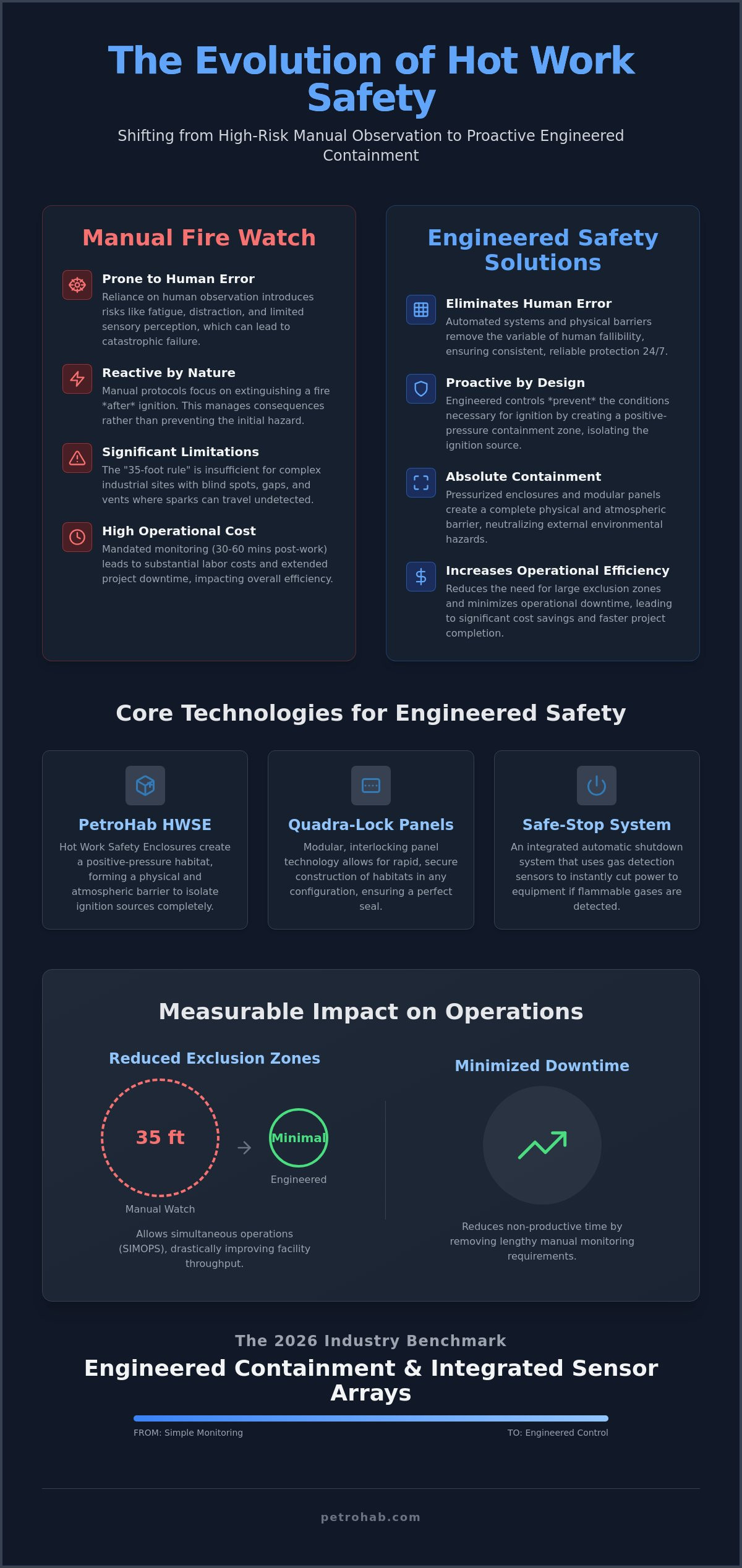
Traditional fire watch protocols often dictate the complete cessation of nearby industrial activities to satisfy the 35-foot rule mandated by NFPA 51B. This requirement creates significant operational bottlenecks, especially in the confined spaces of offshore platforms or the dense piping of refineries. When you rely on manual observation, the exclusion zone must remain clear of all personnel and processes. Transitioning to welding fire watch alternatives like the PetroHab HWSE allows for a drastic reduction in these zones. By containing the ignition source within a physical, pressurized barrier, the risk of spark migration is engineered out of the equation.
This containment enables Simultaneous Operations (SIMOPs). Production can continue in live hydrocarbon zones while critical maintenance or hot work occurs just feet away. The economic implications are profound. Industry data indicates that a single day of unplanned production downtime on a Tier 1 offshore platform can result in revenue losses exceeding $1.5 million. By using engineered habitats, facilities avoid these costly shutdowns, ensuring that maintenance schedules don’t compromise production targets.
Impact on Refinery Turnarounds and Offshore Maintenance
Refinery turnarounds are high-stakes events where every hour of downtime carries a specific price tag. Utilizing pressurized habitats has been shown to reduce maintenance downtime by as much as 30% in complex environments. The ROI of leasing an HWSE is immediately apparent when compared to the overhead of a full facility shutdown or the labor costs of multi-shift manual monitoring. For a detailed breakdown of how these systems integrate into large-scale projects, consult The Definitive Guide to Hot Work Safety Enclosures (HWSE) in 2026. These systems provide a level of financial and operational predictability that manual protocols cannot offer.
Streamlining the Permit-to-Work Process
Engineered controls simplify the Permit-to-Work (PTW) process by providing a standardized, verifiable safety environment. When a “Responsible Person” evaluates a hot work permit, the presence of a pressurized habitat and an automatic shutdown system provides concrete evidence of risk mitigation. This often leads to faster approval cycles and fewer administrative delays.
- Certified Deployment: PetroHab habitats are deployed by certified technicians who ensure the structural integrity of the Quadra-Lock panels.
- Verified Integrity: Continuous pressure monitoring provides real-time data that satisfies safety audits.
- Personnel Training: Workers inside the HWSE undergo specific training to understand gas detection responses and emergency egress protocols.
The transition to technology-driven safety doesn’t just protect lives; it optimizes the entire maintenance lifecycle. To secure your facility and enhance your operational throughput, integrate PetroHab hot work safety enclosures into your next maintenance window.
Conclusion: Selecting the Right Hot Work Safety Solution for 2026
The industrial sector’s transition from manual fire watch protocols to engineered containment marks a definitive advancement in risk management. While human observation remains a regulatory baseline, it’s no longer sufficient for the high-stakes environment of modern heavy industry. By adopting welding fire watch alternatives, safety managers replace the variability of human fatigue with the technical precision of pressurized habitats. This shift ensures that ignition source control is handled by robust, certified hardware rather than sensory perception alone.
The 2026 industry gold standard is a hybrid approach. This strategy combines the physical isolation of a PetroHab Hot Work Safety Enclosure (HWSE) with the automated intelligence of the Safe-Stop system. This dual-layered defense ensures that even if atmospheric conditions change, the response is immediate and mechanical. Evaluating potential solutions requires a rigorous assessment of international technical certifications. You must verify that any system used on-site carries ATEX and IECEx certifications to ensure it doesn’t become a secondary hazard in a volatile zone.
Leasing vs. Purchasing HWSE Systems
Selecting the right financial model depends on your facility’s maintenance lifecycle. Short-term refinery turnarounds often favor a leasing model. This provides access to the latest technology without the capital expenditure of long-term asset management. Conversely, facilities with constant hot work requirements may find purchasing more cost-effective. For a comprehensive analysis of these options, review Choosing the Right Hot Work Safety Enclosure Suppliers: A 2026 Procurement Guide. Regardless of the model, ensure your supplier provides on-site supervision and technical support to maintain system integrity.
The PetroHab Commitment to Safety Excellence
PetroHab remains the industry benchmark through an uncompromising commitment to engineering and safety advocacy. Our global technical support network ensures that your site stays compliant with the most stringent international standards. The integration of patented Quadra-Lock panels and the Safe-Stop automatic shutdown system provides a level of reliability that manual protocols simply can’t match. These technologies aren’t just equipment; they’re essential components of a broader mission to eliminate workplace accidents in hazardous environments.
Safety managers should now audit their current hot work protocols. Identify where human error poses the greatest risk and determine where technical integration can enhance your safety profile. To secure your personnel and high-value assets with the industry’s most resilient technology, contact PetroHab for a specialized hot work safety consultation today.
Advancing Industrial Safety Through Engineered Excellence
The evolution of hot work safety requires a departure from human observation toward technical certainty. Relying on manual protocols introduces unnecessary risk and operational inefficiency that modern facilities can’t tolerate. By integrating PetroHab Hot Work Safety Enclosures (HWSE) and automated monitoring, you eliminate the variables of human fatigue and sensory limitation. These welding fire watch alternatives provide a proactive barrier; it’s a solution that ensures ignition sources remain isolated from hazardous atmospheres at all times.
Our patented Quadra-Lock Panel Technology ensures structural integrity in the most demanding offshore and refinery environments. When combined with ATEX and IECEx Certified Safe-Stop Systems, these habitats offer a fail-safe remedy that protects your personnel and high-value assets. Global 24/7 technical support is available to assist your team in maintaining these rigorous safety standards throughout the maintenance lifecycle.
Take the next step in optimizing your site’s risk mitigation strategy. Request a technical consultation for your next hot work project and discover how engineered safety habitats redefine operational excellence. Your commitment to a zero-accident environment starts with the industry’s most resilient technology.
Frequently Asked Questions
Is a fire watch required if I use a pressurized welding habitat?
Regulatory standards including OSHA 1910.252 and NFPA 51B technically mandate a fire watch when hot work is performed near combustibles. However, the use of a PetroHab Hot Work Safety Enclosure (HWSE) provides an engineered physical barrier that often modifies how these requirements are met on-site. Many facility managers utilize these habitats to satisfy the “equivalent protection” clause, allowing for a more focused safety protocol that relies on technology rather than just manual observation.
Can the Safe-Stop system completely replace a human fire watch?
The Safe-Stop system replaces the monitoring function of a human fire watch with superior, 24/7 gas and pressure detection. While it provides a technical fail-safe that humans cannot match, some site-specific permits or local regulations may still require a designated person for emergency coordination or egress management. As one of the primary welding fire watch alternatives, Safe-Stop eliminates the risk of human fatigue and ensures that ignition sources are isolated in milliseconds upon detecting a hazard.
What are the NFPA 51B requirements for using safety enclosures?
NFPA 51B requires the protection of all combustible materials within a 35-foot radius of hot work operations. Pressurized welding enclosures satisfy this requirement by providing a fire-resistant, pressurized barrier that contains all sparks, slag, and heat. The standard emphasizes that these barriers must be effectively maintained to prevent the passage of sparks to adjacent areas. Using an HWSE allows you to maintain this protection without clearing large sections of a live facility.
How does Quadra-Lock technology improve the safety of a hot work habitat?
Quadra-Lock technology provides a patented, gas-tight mechanical seal between the modular panels of the enclosure. Unlike standard interlocking systems that may separate under mechanical stress or high internal pressure, Quadra-Lock panels ensure the structural integrity of the habitat is never compromised. This creates a resilient environment that maintains its protective pressure even in high-vibration offshore settings or extreme weather conditions.
Are PetroHab enclosures suitable for ATEX Zone 1 environments?
PetroHab habitats are specifically engineered for use in hazardous areas, including ATEX Zone 1 and Zone 2 environments. By maintaining positive internal pressure and using an ATEX-certified Safe-Stop system, the enclosure creates a non-hazardous micro-environment within the volatile zone. This allows for critical welding and cutting operations to proceed without the need for a full facility shutdown, provided the system is operated according to international safety standards.
What happens to the hot work if the habitat loses pressure?
If the internal pressure of the habitat drops below the pre-set safety threshold, the Safe-Stop system instantaneously terminates power to all welding equipment and ignition sources. This prevents flammable external gases from entering the workspace while tools are energized. Work cannot resume until the cause of the pressure loss is identified, the seal is verified, and the internal atmosphere is confirmed to be free of hydrocarbons.
How much does it cost to lease an HWSE compared to hiring a fire watch?
Leasing an HWSE represents a strategic investment in technology that delivers a high ROI through reduced downtime and smaller exclusion zones. While manual labor involves hourly rates for personnel, it doesn’t provide the proactive containment or gas detection capabilities of an engineered system. Many operators find that the cost of a single day of production downtime far exceeds the investment required for a pressurized habitat, making technology the more economical long-term choice.
Does OSHA recognize automatic shutdown systems as a valid safety measure?
OSHA recognizes automatic shutdown systems and pressurized enclosures as effective components of a comprehensive hot work safety plan. Regulations such as OSHA 1910.252(a)(2) allow for “other effective means” of fire protection when traditional 35-foot clearances cannot be maintained. These welding fire watch alternatives are increasingly viewed as the industry best practice for achieving high-level risk mitigation in complex refineries and offshore platforms.