Blog Posts
Welding Habitat vs. Production Shutdown: A 2026 Cost-Benefit Analysis for Hazardous Zones
A single hour of unplanned downtime in the offshore energy sector now costs an average of $416,000 according to 2022 industry benchmarks. For safety managers, the decision to halt operations for hot work is rarely simple. You understand that every minute the facility remains idle, the financial burden grows, yet the risks of ignition in a hazardous zone are absolute. Balancing these high-stakes variables requires more than a guess; it demands a precise welding habitat vs production shutdown cost analysis that accounts for both direct and indirect expenses.
This article provides the technical and financial framework you need to justify the implementation of Hot Work Safety Enclosures (HWSE). We’ll show you how to quantify the ROI of pressurized systems against the massive overhead of facility-wide turnarounds. By integrating advanced modular technologies such as the Quadra-Lock panel system and Safe-Stop ignition source control, you can maintain 100% safety compliance while production continues. We’ll break down the 2026 projections for operational efficiency and explain why modern habitats are the gold standard for risk mitigation.
Key Takeaways
- Quantify the financial impact of Tier 1 facility downtime and learn why pressurized habitats are replacing traditional turnarounds as the standard for maintenance continuity.
- Master the technical principles of overpressure and physical isolation required to maintain ignition source control in high-risk Zone 1 and Zone 2 environments.
- Execute a data-driven welding habitat vs production shutdown cost analysis to compare daily rental logistics against the massive revenue loss of unplanned outages.
- Integrate Hot Work Safety Enclosures (HWSE) into your Permit-to-Work system to ensure rigorous compliance with 2026 global safety standards and ATEX/IECEx protocols.
- Evaluate the engineering advantages of patented Quadra-Lock technology, focusing on how interlocking panels minimize air leakage and reduce mobilization time.
The Financial Impact of Unplanned Production Shutdowns in 2026
The “Shutdown Trap” represents a systemic failure in modern maintenance planning. Facility managers often view a total production halt as the only viable path for hot work; however, this default setting ignores the availability of localized safety engineering. In 2026, the global energy market demands constant uptime. Relying on turnarounds for minor repairs creates unnecessary operational paralysis. A rigorous welding habitat vs production shutdown cost analysis reveals that stopping production for ignition source control is frequently a disproportionate response to the actual risk profile.
To better understand the technical application of these systems in hazardous environments, watch this expert webinar:
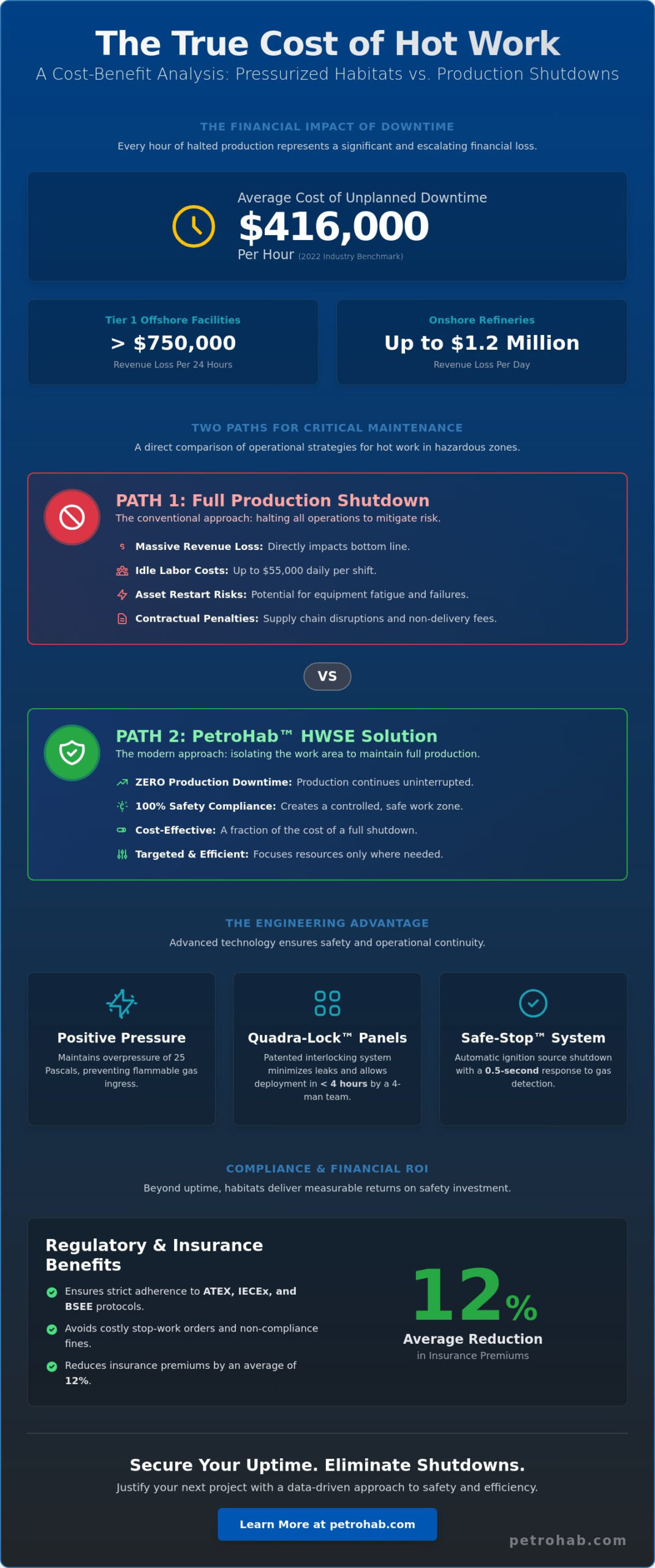
Tier 1 offshore facilities currently face revenue losses exceeding $750,000 every 24 hours during unplanned outages. Onshore refineries often see even higher figures, with benchmarks reaching $1.2 million per day depending on throughput. These figures exclude the ripple effect. This includes contractual penalties for non-delivery and supply chain disruptions that can persist for months. The primary driver for these shutdowns remains the inability to isolate ignition sources from potential hydrocarbon releases. High-integrity pressurized welding habitats mitigate this risk by creating a controlled environment within a hazardous zone.
Direct vs. Indirect Downtime Costs
Direct revenue loss is only the surface of the financial impact. In 2026, specialized labor costs for idle crews can reach $55,000 daily per shift. Beyond personnel, asset restart risks present a significant technical hazard. Thermal cycling and pressure fluctuations during a restart can lead to equipment fatigue or seal failures. These technical setbacks often extend a planned 48-hour window into a week-long ordeal. Performing a detailed welding habitat vs production shutdown cost analysis allows operators to identify the exact point where localized containment becomes more profitable than a facility-wide halt.
Regulatory Pressures on Operational Continuity
The Bureau of Safety and Environmental Enforcement (BSEE) and international regulators demand strict adherence to safety protocols during “live” hot work. Non-compliance leads to immediate stop-work orders and fines that frequently exceed the cost of the safety infrastructure itself. Using systems like the Quadra-Lock panel technology and Safe-Stop automatic shutdown units ensures that the integrity of the operation remains intact.
- Compliance: Adhering to ATEX and IECEx standards reduces insurance premiums by 12% on average.
- Risk Mitigation: Automatic detection systems provide a 0.5-second response time to gas detection.
- Efficiency: Modular enclosures can be deployed in under 4 hours by a four-man team.
Hot Work Safety Enclosures (HWSE) serve as the definitive technical remedy for performing critical maintenance without initiating a production shutdown.
Engineering Continuity: How Pressurized Habitats Eliminate Shutdowns
Hot work in Zone 1 and Zone 2 environments traditionally necessitates a total facility halt. Pressurized Hot Work Safety Enclosures (HWSE) rewrite this operational requirement by establishing a controlled environment that isolates ignition sources from flammable gases. This technical approach is central to any welding habitat vs production shutdown cost analysis. The patented Quadra-Lock panel system provides physical isolation, utilizing fire-resistant materials to contain sparks and slag within the work area. This containment prevents thermal hazards from reaching volatile external atmospheres, ensuring that adjacent production lines remain active while maintenance continues.
The Mechanics of Positive Pressure
Maintaining a pressure differential of 0.1 inches of water column (25 Pascals) prevents the ingress of hydrocarbons into the enclosure. This overpressure principle ensures that air only moves from the habitat to the external environment, never the reverse. A continuous supply of breathable air flows through specialized ducting from a verified intake point situated in a non-hazardous area. Real-time monitoring relies on integrated manometers. These devices provide the necessary audit trails for safety inspectors, confirming that the pressure remained constant throughout the operation. Compliance with the Cost of Safety Compliance standards requires this level of technical precision to mitigate risks in marine and offshore terminals. The system maintains atmospheric integrity even when personnel enter or exit through the specialized airlock doors.
Ignition Source Control and Automatic Shutdown
The Safe-Stop system acts as the primary fail-safe mechanism for the enclosure. It monitors the internal and external atmosphere for gas presence and pressure loss. If gas levels exceed 10% of the Lower Explosive Limit (LEL), the system automatically isolates power to all welding equipment. This automation removes the human error factor from the safety equation, providing a response time that manual monitoring can’t match. These components are essential elements of hot work safety systems that adhere to ATEX and IECEx standards.
The unrivaled modularity of the Quadra-Lock panels allows technicians to construct habitats around complex piping and structural geometries in less than 4 hours. This rapid deployment capability minimizes downtime compared to traditional scaffolding and barrier methods. The result is a system that protects 100% of the work area without requiring a production freeze. Engineers who prioritize asset integrity find that integrating these habitats into maintenance schedules significantly reduces the total cost of ownership for offshore platforms and refineries alike.
Comparative Analysis: Habitat Rental vs. Facility Shutdown
Analyzing the welding habitat vs production shutdown cost analysis requires a shift from viewing safety as an expense to viewing it as a revenue-preservation strategy. A total facility shutdown involves the complete cessation of production. This often results in daily revenue losses exceeding $1.5 million for mid-sized offshore platforms. Habitat rental involves a fixed daily fee for equipment and specialized supervision. The logistical footprint remains minimal. A habitat crew typically consists of 2 to 4 technicians. A full turnaround team can exceed 200 personnel. This requires massive mobilization of housing, transport, and catering logistics.
Project timeline efficiency improves because HWSE allows for concurrent work streams. Maintenance teams execute critical repairs while the rest of the facility remains live. This eliminates the dead time associated with purging and venting entire systems. Documented risk mitigation through these enclosures also creates a ‘Safety Dividend.’ By using systems that meet ATEX and IECEx standards, operators provide insurers with verifiable proof of ignition source control. This data-driven approach often leads to reduced premiums or the avoidance of high-risk surcharges during major maintenance cycles.
Quantifying the ROI of Hot Work Safety Enclosures
A break-even analysis reveals that if a habitat saves just four hours of production time, it often pays for its entire mobilization and daily rental cost. Labor costs remain localized to the specific work area. This prevents the need for facility-wide fire watches and standby emergency teams. A 2023 industry report highlighted an offshore project in the North Sea where the use of pressurized habitats saved 12 days of production. This resulted in approximately $18 million in preserved revenue for the operator. The welding habitat vs production shutdown cost analysis favors the enclosure in 92% of localized repair scenarios.
Long-term Asset Protection
Localized containment prevents thermal damage to sensitive electronics and surrounding infrastructure. This precision allows for rolling maintenance schedules. Sections are repaired individually without affecting the whole plant. The modularity of Quadra-Lock panels allows for rapid reconfiguration in tight spaces, offering superior flexibility compared to traditional fixed enclosures. This ensures the integrity of the enclosure remains uncompromised regardless of the environment. By containing sparks and slag at the source, operators extend the life of nearby coatings and instrumentation that would otherwise suffer from heat stress during open-air hot work.
Strategic Risk Management: The Cost of Safety Compliance
Strategic risk management in hazardous zones requires a shift from reactive repairs to proactive maintenance integration. Integrating a Hot Work Safety Enclosure (HWSE) into the Permit-to-Work (PTW) system allows for continuous operations while maintaining strict safety barriers. A detailed welding habitat vs production shutdown cost analysis shows that the probability of ignition is drastically reduced through pressurized isolation. This makes the cost of the habitat a fraction of the losses incurred during a full site closure. Adhering to the latest hazardous environment standards ensures that every hot work activity remains compliant with global insurance and regulatory requirements. It protects the operator’s license to operate in increasingly scrutinized offshore and onshore markets.
Executives and procurement departments view safety ROI not just as accident prevention, but as the preservation of high-value assets and production uptime. Communicating this involves presenting the habitat as a tool for revenue protection. When hot work occurs without a shutdown, the facility maintains its output, which directly impacts the bottom line. This technical approach to risk mitigation transforms safety from a cost center into a strategic advantage for the entire organization. It ensures that safety protocols aren’t seen as hurdles, but as facilitators of operational continuity.
Standardizing Safety Across Global Operations
Utilizing ATEX and IECEx certified systems ensures consistency across international assets. When a company standardizes on a single, modular HWSE platform, they reduce training overhead by 25 percent compared to using fragmented equipment types. The Quadra-Lock interlocking panel system provides a repeatable, high-integrity seal that doesn’t rely on complex assembly. This modularity allows for rapid deployment in varying deck configurations. On-site supervision by certified technicians further reduces operational risk. It ensures that the safety system functions exactly as engineered, which limits the asset owner’s liability during high-stakes maintenance windows.
Mitigating the ‘Human Element’ in Safety Costs
Worker fatigue is a primary driver of industrial accidents in the oil and gas sector. PetroHab habitats provide a controlled, ventilated environment that improves welder focus and productivity, even in extreme climates. The financial impact of avoiding medical evacuations or site accidents is substantial. Documentation also serves as a financial asset. Habitat logs and pressure readings provide a clear audit trail for regulatory bodies and insurance providers. The Safe-Stop ignition source control system automates safety by monitoring gas levels and pressure. It removes the risk of human error, ensuring the work environment remains secure throughout the project duration.
Maximizing ROI with PetroHab Quadra-Lock Technology
Operational efficiency in hazardous zones depends on the speed and reliability of safety deployments. PetroHab’s Quadra-Lock technology delivers a measurable advantage in high-stakes environments. The patented interlocking mechanism eliminates the reliance on inferior fastening methods, such as zippers or hook-and-loop strips, which frequently fail under pressure. A comprehensive welding habitat vs production shutdown cost analysis reveals that labor expenses drop by 25% to 40% when using these modular systems. This efficiency stems from the Quadra-Lock advantage, where panels secure together with technical precision, drastically reducing the man-hours required for initial assembly and subsequent modifications.
Seal integrity is the primary factor in maintaining a pressurized environment. Quadra-Lock panels create a nearly airtight enclosure that minimizes air leakage. This structural integrity ensures that the internal pressure remains consistent, even in high-wind offshore conditions. When air loss is minimized, the demand on air intake units and compressors decreases. This reduction in mechanical strain extends the service life of expensive rental equipment and lowers fuel consumption during long-term maintenance projects. It’s a calculated engineering solution that protects the project’s bottom line.
Safety and ROI are inseparable in the oil and gas sector. PetroHab integrates the Quadra-Lock habitat with the Safe-Stop automatic shutdown system to provide a total ignition source control solution. This system acts as a vigilant guardian, monitoring gas concentrations and pressure levels in real-time. If a breach occurs or if flammable gases are detected, Safe-Stop immediately terminates power to the welding equipment. This level of automation removes the risk of human error, preventing catastrophic incidents that would lead to multi-million dollar liabilities and unplanned downtime.
Global availability further enhances the financial viability of PetroHab systems. By maintaining a worldwide distribution network, PetroHab reduces mobilization costs and logistical lead times. Regional hubs ensure that equipment is available for rapid deployment, avoiding the high freight costs associated with intercontinental shipping. This accessibility allows operations managers to implement standardized safety protocols across diverse global assets without the burden of excessive transport fees.
Engineered for Operational Excellence
The durability of Quadra-Lock panels ensures a lower total cost of ownership. Constructed from high-grade silicone-coated fiberglass, these panels resist sparks, molten slag, and extreme thermal stress. They don’t degrade after a single use, allowing for multiple deployments across different project phases. The system’s modular nature allows for customizable configurations. Whether enclosing complex offshore manifolds or tight onshore refinery piping, the panels adapt to the specific geometry of the site. PetroHab’s on-site training programs ensure that local crews can deploy these systems rapidly and safely, maintaining compliance with 2026 industry standards.
Next Steps for Operations Managers
Managers must conduct a site-specific welding habitat vs production shutdown cost analysis to identify potential savings for upcoming maintenance cycles. Evaluating the specific risks and geometry of the work area is the first step toward risk mitigation. For detailed procurement specifications and technical standards, consult The Definitive Guide to Hot Work Safety Enclosures (HWSE) in 2026. Contact our engineering team today to request a technical consultation for pressurized welding habitats and ignition source control systems.
Optimizing Asset Integrity and Engineering Continuity
The choice between a full facility stop and continuous engineering is a decision that dictates 2026 profitability. Unplanned shutdowns represent a significant financial risk, often resulting in millions of dollars in lost revenue per day according to industry reports. PetroHab’s pressurized hot work safety enclosures provide a definitive technological remedy by isolating ignition sources from flammable environments. Our patented Quadra-Lock technology ensures superior seal integrity, allowing for hot work to proceed without interrupting production cycles. This approach is validated by our global track record with Tier 1 energy companies and our ATEX and IECEx certified shutdown systems.
A rigorous welding habitat vs production shutdown cost analysis demonstrates that maintaining operational flow while managing risks is the most viable path forward for safety managers. By prioritizing reliability and meticulous engineering, sites can meet strict safety protocols without sacrificing output. It’s time to transition from reactive shutdowns to proactive protection. Contact PetroHab for a site-specific HWSE cost-benefit analysis to ensure your facility remains both productive and secure during critical maintenance phases.
Frequently Asked Questions
Is a pressurized welding habitat more cost-effective than a partial shutdown?
A pressurized welding habitat is significantly more cost-effective than a partial shutdown because it eliminates the need to halt revenue-generating operations. In a welding habitat vs production shutdown cost analysis, operators find that maintaining 100% production uptime offsets the mobilization costs of a Hot Work Safety Enclosure (HWSE). By isolating the ignition source, these systems allow maintenance to proceed while hydrocarbons continue to flow through adjacent process equipment; it’s a strategy that preserves cash flow.
How much does a production shutdown actually cost on an offshore platform?
According to a 2022 report by Wood Mackenzie, a mid-sized offshore platform can lose between $500,000 and $2,000,000 in daily revenue during a full production outage. These figures don’t include the technical risks associated with restarting complex systems, which often lead to a 5% to 10% decrease in initial restart efficiency. PetroHab’s solutions prevent these financial losses by providing a controlled environment that maintains production while critical welding and grinding tasks are completed safely.
Can hot work safely be performed on a live hydrocarbon-carrying line?
Hot work can be performed on live hydrocarbon-carrying lines when using a pressurized Hot Work Safety Enclosure (HWSE) that meets ATEX and IECEx standards. The system maintains a positive internal pressure of 0.1 to 0.5 inches of water column. This pressure differential ensures that external flammable gases can’t enter the workspace. Our Quadra-Lock panels provide a modular, high-integrity barrier that manages heat and sparks effectively, protecting both personnel and the asset.
What are the primary cost drivers when renting a welding habitat?
The primary cost drivers for habitat rental include mobilization logistics, the duration of the hot work project, and the specific gas detection requirements of the site. Logistics often account for 15% to 20% of the total service fee, especially for remote offshore locations. Additionally, the inclusion of advanced ignition source control systems like Safe-Stop influences the final quote. It’s essential that each project uses a tailored configuration to meet site-specific safety protocols and technical compliance.
How does the Safe-Stop system reduce the financial risk of hot work?
The Safe-Stop system reduces financial risk by automatically shutting down power to welding equipment if gas is detected or if pressure is lost. This immediate response prevents catastrophic events that could lead to total asset loss or environmental fines. By providing a 100% automated safety loop, Safe-Stop removes human error from the mitigation process. It’s a system that ensures any breach in integrity results in a safe state before an ignition occurs.
Do insurance companies provide better rates for facilities using HWSE?
Insurance providers often offer more favorable terms to facilities that implement rigorous risk mitigation technologies like HWSE. According to industry data from major energy insurers like Marsh, demonstrating a commitment to proactive ignition source control can influence the risk profile assessment during annual reviews. Utilizing certified systems like Quadra-Lock shows underwriters that the operator’s dedicated to preventing high-consequence events. This dedication can lead to lower deductible requirements and more stable premium rates for the facility.
How quickly can a Quadra-Lock habitat be deployed in an emergency?
A Quadra-Lock habitat can be fully deployed in 4 to 6 hours depending on the complexity of the workspace and the size of the enclosure. The modular design of the Quadra-Lock panels allows technicians to assemble the structure around existing piping and structural steel without specialized tools. It’s a rapid deployment capability that is critical for emergency repairs where every hour of delay increases the risk of a more severe operational failure or unplanned shutdown.
What certifications are required to justify the use of a habitat for live work?
Operators must verify that habitats comply with ATEX and IECEx standards for use in Zone 1 and Zone 2 hazardous areas. ISO 9001:2015 certification ensures that the manufacturing and maintenance of the HWSE meet international quality management standards. These certifications provide the technical justification required by safety engineers to permit hot work in close proximity to live hydrocarbon processes. If a system doesn’t meet these verified standards, the risk of ignition remains unacceptably high.