Blog Posts
What is Hot Work? A Comprehensive Guide to Industrial Safety and Containment
Relying solely on a manual fire watch in a Zone 1 environment isn’t a safety strategy; it’s a calculated gamble with human lives and high-value assets. You recognize that in heavy industry, the margin for error is non-existent. The friction between complex Permit-to-Work systems and the pressure to reduce downtime often complicates essential maintenance. Every instance of hot work carries the risk of catastrophic ignition if hazardous atmospheres aren’t strictly controlled through rigorous engineering measures.
This guide provides the technical precision required to master industrial safety and containment. We’ll move beyond basic regulatory definitions to examine definitive engineering controls, specifically pressurized containment technologies designed for high-hazard environments. You’ll learn how to implement PetroHab Hot Work Safety Enclosures (HWSE) and utilize Quadra-Lock technology to maintain compliance with OSHA, NFPA, and ATEX standards. This structured analysis serves as a roadmap for safety managers and engineers who prioritize risk mitigation and personnel protection above all else. By the end of this article, you’ll understand how to transform hazardous work sites into controlled environments that safeguard both your workforce and your operational continuity.
Key Takeaways
- Identify the high-hazard processes that constitute industrial hot work and the specific ignition risks they present in volatile environments.
- Understand how pressurized HWSE systems provide total environmental isolation, moving safety protocols beyond basic fire watch.
- Examine the role of patented Quadra-Lock technology in creating durable, modular containment for offshore and refinery maintenance.
- Align maintenance workflows with OSHA and NFPA standards by integrating engineering controls into the Permit-to-Work (PTW) lifecycle.
- Discover how the Safe-Stop Automatic Shutdown System acts as a critical fail-safe by monitoring real-time gas levels.
Defining Hot Work in Hazardous Industrial Environments
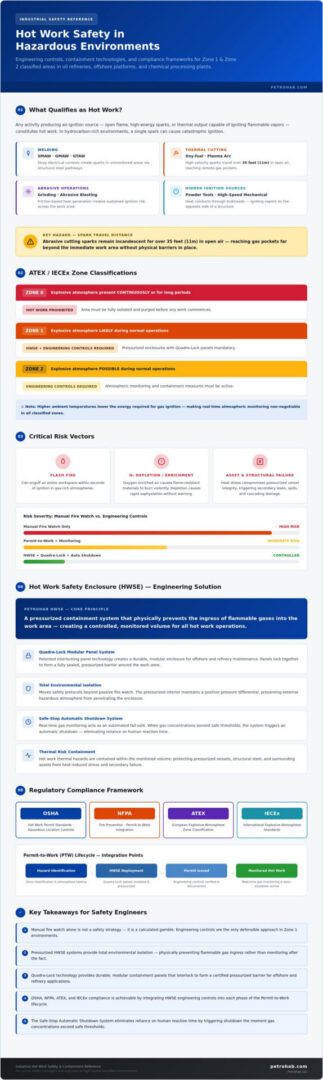
Industrial safety protocols define hot work as any maintenance or construction activity that produces a source of ignition. This includes processes generating open flames, high-energy sparks, or thermal output capable of igniting flammable vapors. While the definition remains consistent across industries, the stakes escalate significantly in high-hazard environments like oil refineries, offshore platforms, and chemical processing plants. In these settings, the presence of volatile hydrocarbons means that a single spark can lead to an immediate and catastrophic loss of life and assets.
The primary processes categorized under this definition include:
- Welding: Specifically Shielded Metal Arc Welding (SMAW), Gas Metal Arc Welding (GMAW), and Gas Tungsten Arc Welding (GTAW).
- Thermal Cutting: Oxy-fuel cutting and plasma arc processes.
- Abrasive Operations: Grinding and abrasive blasting that generate friction-based heat.
- Hidden Ignition Sources: Powder-actuated tools and friction-generated heat from high-speed mechanical equipment.
In hazardous industrial contexts, the “Source of Ignition” concept is applied with technical rigor. It isn’t limited to visible flames. It encompasses any tool or procedure capable of elevating the temperature of a surface or the surrounding air to the auto-ignition point of the specific chemicals present on-site. This necessitates a problem-solution architecture where hazardous tasks are met with definitive containment remedies.
Common Hot Work Processes and Their Hazards
Arc welding introduces the risk of stray electrical currents. In pressurized zones, these currents can find unintended paths through structural steel, potentially creating sparks in unmonitored areas. Abrasive cutting presents a different challenge. High-velocity sparks can travel over 35 feet (11 meters) in open air. Without physical barriers, these particles remain incandescent long enough to reach gas pockets far from the immediate work area. Soldering and brazing also carry risks of localized heat transfer. Metal structures conduct heat efficiently, meaning a torch applied to one side of a bulkhead can ignite flammable materials or vapors on the opposite side.
Zone Classifications and Ignition Risks
International standards such as ATEX and IECEx provide the framework for classifying hazardous areas. Zone 0 describes environments where an explosive atmosphere is present continuously or for long periods. Hot work is strictly prohibited in Zone 0 unless the area is fully isolated and purged. Zone 1 and Zone 2 environments represent areas where explosive atmospheres are likely or possible during normal operations. In these zones, safety managers must implement engineering controls like the PetroHab Hot Work Safety Enclosure (HWSE). These systems use Quadra-Lock panels to create a pressurized environment that physically prevents the ingress of flammable gases. Ambient temperature and humidity also play roles in risk assessment. Higher ambient temperatures can lower the energy required for gas ignition, making real-time atmospheric monitoring a non-negotiable requirement for operational safety.
Critical Risks: Why Hot Work Safety is Paramount
The risk profile of hot work in heavy industry is dominated by the potential for high-consequence events. In gas-rich environments, a single spark isn’t a minor incident; it’s the trigger for a devastating explosion. This volatility demands a shift from passive observation to active engineering control. Beyond immediate ignition, personnel face the threat of flash fires that can engulf a workspace in seconds. Oxygen depletion or enrichment also poses silent risks. If an atmosphere is oxygen-enriched, materials that are usually flame-resistant can burn violently. Conversely, oxygen-depleted environments lead to rapid asphyxiation without warning.
Asset protection remains a critical operational priority for any site manager. A fire on an offshore platform or within a refinery doesn’t just damage equipment. It results in massive operational downtime and potential structural failure. Heat-induced stress can compromise the integrity of pressurized vessels, leading to secondary leaks or environmental spills. Utilizing a PetroHab Hot Work Safety Enclosure (HWSE) ensures that these thermal risks are contained within a controlled, monitored volume. This technical remedy protects high-value assets from the consequences of accidental ignition.
The Fire Triangle in Industrial Settings
Effective risk mitigation requires a granular understanding of the fire triangle as it applies to industrial sites. Fuel in these environments isn’t limited to liquids; it includes Volatile Organic Compounds (VOCs) and heavy hydrocarbons that often linger in low-lying areas or dead legs of piping. Oxygen levels must be strictly monitored, as industrial processes can inadvertently create oxygen-enriched atmospheres where combustion occurs with explosive speed. Managing the ignition energy of welding equipment requires physical isolation to break the link between the heat source and the external hazardous atmosphere.
Secondary Hazards: Fumes and Toxic Exposure
While ignition prevention is the priority, secondary hazards can be equally lethal. Hot work processes like welding generate toxic fumes, including hexavalent chromium and manganese. In confined or enclosed spaces, these particulates accumulate rapidly, posing long-term health risks or immediate respiratory distress. Effective containment systems must balance gas exclusion with worker air quality. This is achieved through integrated ventilation that extracts fumes while maintaining the positive pressure required to keep external flammable gases out. Relying on Quadra-Lock panels ensures a seal tight enough for pressure maintenance while providing the structural integrity needed for rapid deployment in high-stakes environments.
Engineering Controls: Hot Work Safety Enclosures (HWSE)
Traditional safety measures often rely on fire watches and welding blankets. These methods catch sparks, but they fail to address the fundamental risk of gas ingress. True safety in high-hazard environments requires total environmental isolation. The PetroHab Hot Work Safety Enclosure (HWSE) serves as the primary engineering control by creating a physical and atmospheric barrier between the ignition source and the hazardous environment. This technology transforms a high-risk area into a controlled workspace, ensuring that hot work proceeds without compromising the integrity of the facility.
The core mechanic of an HWSE is positive pressure. By maintaining an internal pressure higher than the surrounding atmosphere, the system ensures that flammable gases can’t enter the enclosure. Even if a leak occurs in the surrounding area, the outward flow of air from the habitat acts as a definitive barrier. This problem-solution approach is essential for offshore platforms and refineries where maintenance turnarounds demand both speed and uncompromising safety. Modern habitats utilize fire-resistant, high-tenacity fabrics that withstand the rigors of industrial use while remaining modular for rapid deployment.
Quadra-Lock Panel Technology
The structural integrity of a habitat depends on the strength of its connections. PetroHab’s patented Quadra-Lock panels provide a definitive technological remedy for containment challenges. Unlike standard fastening systems, these panels interlock to create a rigid, air-tight seal. This modularity allows engineers to construct custom-sized habitats around complex piping geometries and structural bulkheads. Maintaining seal integrity is paramount; the Quadra-Lock system ensures the pressure differential remains constant, preventing atmospheric contamination throughout the duration of the task.
Positive Pressure Habitats: A Deep Dive
The effectiveness of a pressurized habitat relies on a continuous supply of clean air. Intake systems draw air from a certified area located away from potential gas sources, ensuring the internal atmosphere remains breathable and non-explosive. Real-time monitoring is facilitated by manometers, which provide a clear visual of the pressure differential. If the pressure drops below a safe threshold, the system must respond immediately. For a detailed breakdown of these systems, refer to the Pressurized Welding Habitats guide for technical specifications. This methodical approach to containment ensures every safety protocol is supported by reliable, field-proven hardware.
Compliance and the Permit-to-Work (PTW) System
Compliance in high-hazard environments is governed by rigorous standards that dictate the execution of every task. NFPA 51B and OSHA 1910.252 provide the foundational requirements for hot work safety, establishing mandatory fire prevention measures and permit systems. These aren’t mere administrative hurdles; they’re essential life-safety protocols designed to eliminate ignition sources in the presence of combustibles. Every permit issued must reflect the current environmental conditions and the specific engineering controls deployed to mitigate identified hazards.
Integrating a PetroHab Hot Work Safety Enclosure (HWSE) into the Permit-to-Work (PTW) lifecycle ensures that engineering controls are documented and verified before work begins. The PTW process starts with a thorough site assessment. It’s mandatory to perform multi-point gas testing to confirm the absence of flammable vapors and the removal of all loose combustibles within a 35-foot radius. Once the HWSE is deployed using Quadra-Lock panels, a final inspection verifies the positive pressure integrity before any ignition source is introduced.
Post-work protocols are equally critical for asset protection. After the task is completed, a mandatory fire watch must remain on-site for at least 30 to 60 minutes, depending on local regulations and the complexity of the work. This ensures that any smoldering materials are identified before the habitat is decommissioned. For facilities requiring absolute compliance, you can lease or purchase a certified HWSE system to meet these rigorous safety benchmarks.
Global Standards: ATEX, IECEx, and Beyond
Equipment compliance is a non-negotiable requirement for international offshore operations. Systems like the Safe-Stop Automatic Shutdown System must carry ATEX or IECEx certifications to operate in Zone 1 or Zone 2 areas. These certifications guarantee that the electrical components don’t become ignition sources themselves. For a deeper look at regulatory details, consult the Hazardous Environment Standards guide. Proper setup and supervision by certified technicians ensure that these technological remedies are deployed correctly, maintaining the safety of the entire facility.
The Checklist for Hot Work Authorization
Authorization for ignition requires a systematic verification of all safety layers. The checklist must confirm the following:
- Isolation of all flammable sources and purging of relevant piping systems.
- Operational status of the Safe-Stop Automatic Shutdown System and real-time gas detectors.
- Presence of trained fire watches equipped with appropriate fire-extinguishing equipment.
- Verification of positive pressure within the habitat using calibrated manometers.
Documentation of these steps within the PTW system provides a clear audit trail and ensures that no safety measure is overlooked during hot work operations. This structured approach suggests a brand that is organized, disciplined, and focused on operational excellence.
Advanced Mitigation: Automated Monitoring and Shutdown
Manual fire watches are a standard regulatory requirement, but they represent a passive safety layer vulnerable to human oversight. In high-stakes environments, hot work safety requires an active, automated fail-safe that operates independently of human intervention. The Safe-Stop Automatic Shutdown System provides this definitive technological remedy. It serves as the electronic brain of the containment operation, continuously analyzing atmospheric data to prevent ignition events before they occur. This system replaces uncertainty with technical precision, ensuring that safety protocols are strictly enforced by hardware rather than just observation.
The system integrates directly with gas detection hardware to monitor for Lower Explosive Limit (LEL) levels in real-time. If the detectors identify flammable vapors approaching a pre-set safety threshold, the Safe-Stop system executes an immediate shutdown of all connected ignition sources. This includes cutting power to welding machines and isolating pneumatic equipment. This automated power isolation also triggers if the system detects a loss of positive pressure within the HWSE. By linking atmospheric monitoring with power control, the system ensures that no hot work can continue if the structural or atmospheric integrity of the pressurized habitat is compromised. This synergy between the physical containment of Quadra-Lock panels and electronic oversight creates a redundant safety architecture.
Real-Time Gas Detection in Habitats
Effective monitoring requires a dual-point approach to gas detection. The system tracks gas concentrations both within the immediate work area and at the external air intake source. This ensures that the air being pumped into the enclosure remains free of contaminants from distant leaks. When hazards are detected, visual and audible alarm protocols provide immediate notification to personnel on-site. Beyond immediate safety, these systems provide automated logging of all atmospheric data. This creates a verifiable audit trail for HSE compliance, proving that the work was conducted within safe parameters throughout the entire operational shift.
Operational Excellence with PetroHab Systems
The primary objective of safety automation is the reduction of human error. Safety managers rely on automated safety interlocks to provide a level of reliability that manual observation cannot match. The integration of the Safe-Stop system into maintenance workflows suggests a brand that is organized, disciplined, and focused on operational excellence. For a technical breakdown of how these components interact, consult the guide on Advanced Hot Work Safety Systems. PetroHab’s integrated approach represents the industry benchmark for 2026, offering a rigorous, uncompromising solution for the most hazardous environments globally.
Advancing Industrial Safety Through Engineering Excellence
Mastering the complexities of hot work requires moving beyond administrative checklists toward definitive engineering controls. You’ve seen how total environmental isolation, powered by pressurized containment and automated monitoring, eliminates the risk of catastrophic ignition. By implementing patented Quadra-Lock technology and ATEX/IECEx certified systems, you ensure that your facility remains compliant with global standards while protecting personnel and high-value assets. These technological remedies don’t just mitigate risk; they provide the operational confidence needed for efficient maintenance turnarounds. Relying on field-proven hardware and global support structures reduces human error and keeps your production schedules on track.
Request a technical consultation for your next turnaround to see how our on-site supervision and modular habitats can safeguard your operations. Your commitment to safety excellence starts with the right equipment and a partner who understands the granular details of industrial hazards.
Frequently Asked Questions
What is the official definition of hot work according to OSHA?
OSHA 1910.252 defines this as any process involving burning, welding, or similar operations capable of initiating fires or explosions. This include brazing, cutting, and grinding. In hazardous industrial environments, this definition expands to any activity producing a source of ignition like friction or heat. Adhering to these standards is essential for regulatory compliance and personnel safety during essential maintenance on offshore platforms or within refineries.
How does a pressurized welding habitat work to prevent explosions?
A pressurized habitat prevents explosions by maintaining a positive pressure differential relative to the surrounding atmosphere. This higher internal pressure creates a continuous outward flow of air, physically blocking the ingress of flammable gases. By drawing intake air from a certified area, the system ensures the internal environment remains non-explosive even if a leak occurs in the vicinity of the work area.
Is a fire watch mandatory if an automatic shutdown system is in place?
A fire watch remains mandatory even when using an automatic shutdown system. While the Safe-Stop Automatic Shutdown System provides a critical electronic fail-safe, regulatory standards like NFPA 51B require a physical fire watch to monitor for smoldering materials and secondary hazards. The automated system and the fire watch work in tandem to provide a redundant, multi-layered safety architecture during hot work operations.
Can hot work be performed in a Zone 1 hazardous area?
This type of work can be performed in a Zone 1 hazardous area provided that definitive engineering controls are implemented. This requires the use of a pressurized Hot Work Safety Enclosure (HWSE) to isolate the ignition source from the volatile atmosphere. Without such containment, performing these tasks in a Zone 1 environment is strictly prohibited due to the high risk of immediate ignition and catastrophic failure.
What are the primary components of a Hot Work Safety Enclosure (HWSE)?
The primary components of a Hot Work Safety Enclosure include interlocking Quadra-Lock panels, fire-resistant fabrics, and a clean air intake system. These are supported by real-time monitoring hardware like manometers and gas detectors. When integrated with a Safe-Stop Automatic Shutdown System, these components form a comprehensive barrier that protects assets and personnel from the thermal and atmospheric risks inherent in industrial maintenance.
What happens if the positive pressure is lost during welding?
If positive pressure is lost, the Safe-Stop system immediately isolates power to all welding machines and ignition sources. This fail-safe mechanism prevents the ingress of flammable gases into the workspace before they can reach the ignition point. Work cannot resume until the pressure differential is restored and the internal atmosphere is verified as safe through calibrated gas detection equipment and on-site supervision.
How long must a fire watch remain on-site after hot work is completed?
OSHA and NFPA 51B standards require a fire watch to remain on-site for at least 30 minutes after all hot work is completed. Depending on the specific facility’s risk profile or the complexity of the task, some site managers extend this period to 60 minutes or longer. This duration allows for the detection of smoldering fires that may not be immediately visible after the task finishes.
What are the benefits of using Quadra-Lock panels over traditional welding screens?
Quadra-Lock panels offer superior structural integrity and an air-tight seal that traditional welding screens cannot provide. While screens only block sparks, these interlocking panels allow for the creation of a pressurized habitat that manages the internal atmosphere. This modular design provides a more durable remedy for containment, ensuring that hazardous gases are physically excluded from the workspace throughout the entire maintenance cycle.