Blog Posts
When is a Positive Pressure Habitat Required by Law? A 2026 Compliance Guide
A single spark in a Zone 1 environment doesn’t just risk a catastrophic ignition; it invites a mandatory shutdown and legal penalties that can exceed the cost of an entire project’s equipment. You’re likely balancing the need for operational uptime with the rigid demands of safety inspectors who don’t accept “best effort” as a defense. This guide provides the definitive answer to exactly when is a positive pressure habitat required by law, stripping away the ambiguity between BSEE, OSHA, and international ATEX mandates.
We’ll examine the specific 10 foot offshore rule, NFPA 51B 2024 updates, and the technical triggers that necessitate a Quadra-Lock enclosure to maintain legal hot work status. By the end of this analysis, you’ll have a clear framework for justifying the use of a Petro-Habitat or Hot Work Safety Enclosure (HWSE) based on current 2026 regulatory standards and IEC 60079-13 requirements. We focus on the engineering controls required to protect personnel and high-value assets while ensuring your site remains compliant with the latest US Coast Guard and global safety protocols. This methodical approach ensures that every ignition prevention measure is backed by the specific legal mandates that govern hazardous industrial environments.
Key Takeaways
- Identify the mandatory 10 foot separation rule under BSEE 30 CFR 250.113 and learn how a pressurized welding enclosure allows for live production waivers offshore.
- Understand exactly when is a positive pressure habitat required by law for onshore projects, specifically focusing on OSHA 29 CFR 1910.252 and combustible atmosphere triggers.
- Navigate the technical requirements for ATEX and IECEx compliance, focusing on the current 2026 standards for habitat monitoring and ignition prevention in explosive atmospheres.
- Discover how Quadra-Lock technology and the Safe-Stop Automatic Shutdown System work together to meet the structural and monitoring requirements of federal safety mandates.
- Review the 2024 updates to NFPA 51B and how documented permitting processes impact the legality of hot work in classified hazardous zones.
Regulatory Frameworks Governing Positive Pressure Habitats
A PetroHab Hot Work Safety Enclosure (HWSE) serves as a legally recognized engineering control designed for ignition prevention in volatile environments. This system creates a physical and atmospheric barrier between an ignition source and potential fuel. Determining when is a positive pressure habitat required by law requires a detailed understanding of the primary governing bodies. The Bureau of Safety and Environmental Enforcement (BSEE) dictates offshore standards. OSHA governs onshore industrial sites. The US Coast Guard regulates maritime and waterfront facilities. Each agency views the HWSE as a critical component of a comprehensive safety management system designed to protect personnel and high-value assets.
Compliance depends on a rigorous Permit-to-Work (PTW) system. This documentation serves as the legal record that all hazardous variables were identified and mitigated before work commenced. The 2024 edition of NFPA 51B now allows for “documented” permits, officially recognizing digital formats as legal proof of safety compliance. While voluntary consensus standards provide technical guidance, federal regulations carry the force of law. Failure to implement these controls when mandated leads to immediate stop-work orders and significant financial penalties. These penalties often exceed the operational cost of the habitat itself, making compliance both a safety and financial necessity.
To better understand this concept, watch this helpful video:
The Legal Definition of a Hazardous Atmosphere
Regulatory bodies define hazardous environments based on the likelihood of explosive gases being present. Zone 1 environments are areas where flammable concentrations are likely under normal conditions. Zone 2 environments are those where such concentrations are unlikely but possible. Law mandates Lower Explosive Limit (LEL) monitoring near these zones. A positive pressure enclosure is the only solution that actively displaces hazardous atmospheres, ensuring internal isolation even if external gas levels rise above 10% of the LEL.
Engineering Controls vs. Administrative Controls
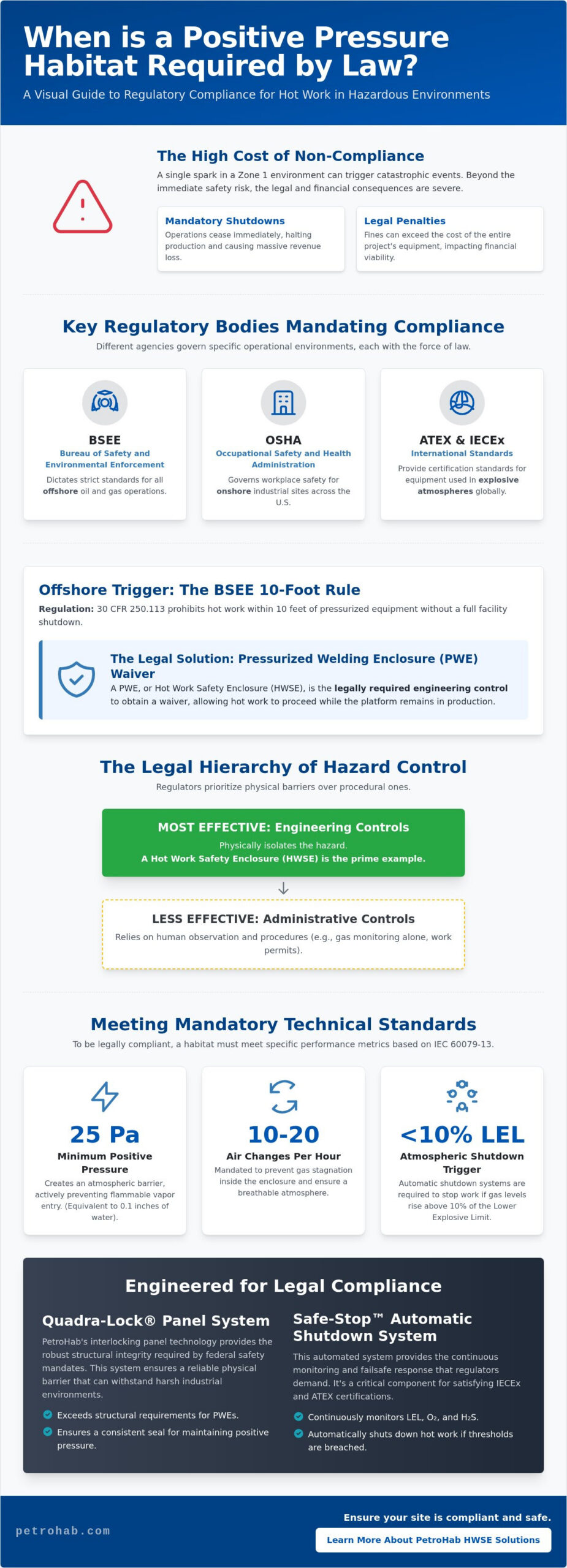
The legal hierarchy of hazard control prioritizes engineering controls like habitats over administrative measures. Regulators prefer engineering solutions because they don’t rely on human observation alone. Legal compliance requires maintaining a minimum positive pressure of 25 Pascals (0.1 inches of water) to prevent vapor entry. Safety protocols also mandate 10 to 20 air changes per hour to prevent gas stagnation. Managers must ensure the HWSE is certified to IEC 60079-13 standards to meet the highest levels of legal accountability and operational excellence.
Offshore Mandates: BSEE and Coast Guard Requirements
The Bureau of Safety and Environmental Enforcement (BSEE) enforces strict protocols for offshore hot work through 30 CFR 250.113. This regulation establishes the “10-foot rule,” which prohibits welding or burning within 10 feet of pressurized equipment unless the facility is completely shut down. For operators, this represents a significant threat to production uptime. To avoid a full platform cessation, a Pressurized Welding Enclosure (PWE) waiver is necessary. This specific regulatory trigger is exactly when is a positive pressure habitat required by law to provide a verified barrier between the ignition source and the hazardous atmosphere. These habitats must maintain a minimum positive pressure of 25 Pascals (0.00363 PSI) to exclude flammable vapors successfully.
Atmospheric monitoring offshore is a non-negotiable legal requirement. Systems must continuously track oxygen levels, Lower Explosive Limit (LEL) percentages, and hydrogen sulfide (H2S) concentrations. Similar to OSHA hot work regulations, the law demands that any deviation from safe atmospheric parameters results in an immediate cessation of work. A ventilation flow rate of 2,000 cubic feet per minute (cfm) per welder is mandated to dilute pollutants and ensure the habitat remains habitable. Ensuring your facility meets these offshore standards requires equipment engineered for extreme reliability, such as a PetroHab Hot Work Safety Enclosure.
The BSEE Waiver Process for Live Platforms
Securing a BSEE waiver for hot work on a live production platform requires formal notification and the implementation of specific engineering controls. The law necessitates the use of a Safe-Stop Automatic Shutdown System (ASD) that integrates directly with the habitat’s monitoring sensors. If the system detects a loss of pressure or a gas ingress, the ASD must instantly terminate power to the welding equipment. Operators are legally required to report any system failures or pressure losses that occur during the permitted work window to ensure continuous oversight of the mitigation strategy.
Maritime and Coastal Regulations
The U.S. Coast Guard regulates hot work at waterfront facilities under 33 CFR 126.30. These regulations prohibit ignition activities within 100 feet of bulk cargo operations involving flammable materials and within 50 feet of other hazardous substances. Compliance requires isolating hydrocarbon areas like wellheads and valves using rigid, interlocking structures. Utilizing Quadra-Lock technology ensures that the enclosure provides the structural integrity required to meet these maritime safety addendums. This creates a verified isolated environment that allows critical maintenance to proceed without violating coastal fire protection laws.
Onshore Safety: OSHA and NFPA Compliance for Hot Work
Onshore facilities like refineries and chemical plants face a different but equally rigorous legal landscape compared to offshore platforms. Determining exactly when is a positive pressure habitat required by law onshore often centers on OSHA 29 CFR 1910.252. This standard mandates that if fire hazards can’t be removed from a work area, guards must be used to confine heat, sparks, and slag. In environments where flammable vapors or combustible dusts are present, these guards must transition from simple fire blankets to sophisticated engineering controls like a PetroHab Hot Work Safety Enclosure (HWSE). This ensures that the ignition source remains isolated from the surrounding atmosphere at all times.
The National Fire Protection Association (NFPA) 51B standard, specifically the 2024 edition, serves as the primary legal benchmark for fire prevention during hot work. It requires a documented permit for any activity involving a flame or spark. While NFPA is technically a consensus standard, OSHA frequently cites it under the General Duty Clause to enforce safety in hazardous locations. For global operations, this aligns with the ATEX 137 Workplace Directive, which mandates that employers protect workers by controlling ignition sources in explosive atmospheres. These regulations collectively establish that whenever a 35 foot radius contains flammable materials, a verified enclosure is the required solution.
Confined space hot work adds another layer of legal complexity. OSHA 29 CFR 1917.152 requires a designated person to test the atmosphere before work begins. If the space contains hazardous vapors, a habitat isn’t just a best practice; it’s the required method for ensuring a ventilation flow rate of 2,000 cfm per welder. This prevents the stagnation of hazardous gases that lead to asphyxiation or explosion. By maintaining 10 to 20 air changes per hour, the system ensures the internal atmosphere remains breathable and non-combustible throughout the duration of the project.
Managing Combustible Dust and Vapors Onshore
Refineries and chemical processing plants are high-risk zones where flash fires are a constant threat. OSHA mandates special precautions whenever combustible materials are within the immediate vicinity of the work site. A pressurized habitat becomes a legal necessity when atmospheric monitoring reveals a potential for gas ingress. Using Quadra-Lock panels ensures the enclosure maintains the structural integrity required to withstand industrial pressures while providing a verified barrier. This active displacement of hazardous atmospheres is the only way to meet the threshold for legal hot work in these sensitive areas.
Turnaround Safety and Legal Liability
During maintenance turnarounds, the pressure to minimize downtime is intense. However, using non-certified containment systems creates immense legal liability for the asset owner. If an ignition occurs and the employer failed to provide a certified engineering control, they face litigation and OSHA citations for willful violations. A Petro-Habitat provides the documented safety assurance needed to justify hot work in sensitive areas without compromising site legality. This methodical approach to risk mitigation protects personnel and ensures the facility remains compliant with both federal law and insurance requirements.
International Standards: ATEX and IECEx Certifications
International industrial projects demand a transition from domestic codes to global safety directives. For operations within the European Union and many international waters, the ATEX Directive (2014/34/EU) serves as the primary legal framework. This mandate requires that all equipment used in potentially explosive atmospheres undergoes rigorous testing and certification. Determining when is a positive pressure habitat required by law on a global scale involves evaluating the site’s classification against IEC 60079-13. This standard governs pressurized rooms and is the technical foundation for both ATEX and IECEx certification schemes. Identifying when is a positive pressure habitat required by law ensures that your project avoids international regulatory fines and catastrophic safety failures.
Compliance isn’t merely a suggestion for offshore contractors; it’s a legal prerequisite for insurance and operational permits. The IECEx system provides a voluntary but widely recognized international framework that ensures equipment meets the same safety benchmarks across different jurisdictions. This harmonization allows a Petro-Habitat certified in one region to meet the legal requirements in another, such as Australia or New Zealand, where IECEx is often a direct legal mandate. These standards ensure that every component, from the pressure sensors to the structural panels, functions as a unified, explosion-protected system. To ensure your project meets these rigorous global benchmarks, request a technical consultation for your ATEX-certified Petro-Habitat today.
Zone 1 vs. Zone 2 Legal Requirements
Zone 1 environments represent areas where an explosive atmosphere is likely to occur during normal operations. The law mandates that habitats deployed in these zones must feature “fail-safe” monitoring systems. This means the hardware must be capable of automatically detecting a loss of overpressure or the presence of gas and immediately terminating power to any potential ignition source. While Zone 2 requirements are slightly less stringent, many operators adopt Zone 1 hardware as a legal safeguard to minimize liability and ensure maximum personnel protection. International reciprocity often depends on these higher standards being met regardless of the specific zone.
Material Certification and Fire Resistance
The structural integrity of a habitat is as critical as its electronic monitoring. Law requires that all enclosure materials meet specific fire-resistance standards, such as ANSI/FM 4950. This ensures that the panels can withstand extreme thermal stress from welding sparks and slag without compromising the pressure boundary. Verifying the integrity of Quadra-Lock panels is a key part of the certification process. These interlocking panels provide the thermal and physical durability necessary to comply with international safety laws. Using non-certified materials in these environments is a direct violation of international safety protocols and exposes the operator to extreme risk.
Ensuring Legal Compliance with PetroHab HWSE Solutions
PetroHab provides the definitive technological remedy for the regulatory triggers identified in this guide. Our engineering team designs every PetroHab Hot Work Safety Enclosure (HWSE) to meet the most stringent global mandates. Determining when is a positive pressure habitat required by law is the first step toward operational safety; the second is deploying a system that guarantees structural and atmospheric integrity. Our Quadra-Lock Panels utilize a patented interlocking design that ensures the enclosure remains airtight under industrial pressures. This structural reliability is essential for maintaining the 25 Pascal minimum pressure required to exclude flammable vapors in Zone 1 and Zone 2 environments.
Integrating these enclosures into your broader Hazardous Environment Standards strategy allows for seamless compliance across international borders. PetroHab maintains a global presence, ensuring that our solutions meet local legal requirements in the United States, the United Kingdom, and Brazil. We recognize that the high-stakes environment of heavy industry leaves no room for equipment failure. By choosing a certified HWSE, you protect your personnel and high-value assets from the legal and physical consequences of an ignition event.
Automated Safety: The Safe-Stop Advantage
Manual atmospheric monitoring is often legally insufficient for high-risk hot work because it cannot provide the instantaneous response required during a gas ingress. The Safe-Stop Automatic Shutdown System addresses this regulatory gap by providing a fail-safe mechanism that integrates directly with the habitat sensors. This system is a critical component for securing BSEE waivers for live production work. It provides real-time LEL and pressure logging, which serves as an immutable record for regulatory auditing and insurance verification. Linking ASD systems to Advanced Hot Work Safety Systems ensures that power is terminated to welding equipment the moment a safety threshold is breached.
Training and On-site Supervision for Legal Protection
Technical equipment requires expert oversight to maintain its legal status on a job site. PetroHab provides certified technician oversight to ensure that habitat deployment adheres to every nuance of OSHA and BSEE law. This professional supervision mitigates the risk of improper installation, which can void safety permits and expose the operator to liability. Our training programs ensure that all personnel understand the specific triggers for when is a positive pressure habitat required by law, reinforcing a culture of uncompromising safety excellence. Meticulous documentation of this training provides an additional layer of legal protection during site inspections. To secure your facility and ensure 2026 regulatory alignment, Contact PetroHab for a compliance-ready HWSE solution today.
Securing Operational Uptime Through Regulatory Alignment
Understanding the specific triggers for when is a positive pressure habitat required by law ensures that safety managers maintain total operational control. The 2026 regulatory environment mandates strict adherence to the BSEE 10 foot rule and OSHA 1910.252 standards to prevent costly shutdowns and legal penalties. Compliance is a technical necessity that protects personnel and high-value assets in the most volatile environments. By identifying these legal mandates early, you can integrate certified engineering controls that satisfy both federal inspectors and insurance underwriters.
PetroHab engineering facilitates this compliance through patented Quadra-Lock Panel Technology and ATEX and IECEx certified monitoring systems. We provide comprehensive global support in major oil and gas hubs to ensure your project meets every legal threshold. Our systems act as active guardians of your industrial site, providing the documented safety assurance required for modern hot work permits. These technological remedies eliminate the ambiguity of manual monitoring and provide a verified barrier against ignition risks.
Request a Quote for a Compliance-Ready Petro-Habitat and secure your site against regulatory risk. Your commitment to safety excellence is the foundation of industrial resilience.
Frequently Asked Questions
Is a pressurized habitat legally required for all offshore welding?
A pressurized habitat isn’t legally required for every offshore welding task, but it becomes mandatory when performing hot work within 10 feet of pressurized equipment on a live platform. Under BSEE 30 CFR 250.113, operators must either shut down production or utilize a Pressurized Welding Enclosure (PWE) with an approved waiver. This engineering control provides the necessary atmospheric isolation to prevent ignition in classified areas where flammable vapors may be present.
What is the BSEE 10-foot rule for hot work?
The BSEE 10-foot rule refers to 30 CFR 250.113, which prohibits welding or burning within 10 feet of any pressurized well, vessel, or pipeline. This regulation aims to eliminate ignition risks during live production. To circumvent a total facility shutdown, operators must apply for a waiver that mandates the use of a certified Hot Work Safety Enclosure (HWSE) to maintain a pressurized barrier between the work and hazardous vapors.
Does OSHA mandate the use of welding habitats onshore?
OSHA doesn’t explicitly name habitats in its standards, but 29 CFR 1910.252 mandates that special precautions be taken when fire hazards can’t be moved. In refineries or chemical plants, this often dictates the use of a pressurized habitat to isolate sparks from combustible atmospheres. Determining when is a positive pressure habitat required by law onshore involves assessing whether traditional fire blankets provide sufficient protection against gas ingress in Zone 1 or Zone 2 areas.
Can I use a habitat to avoid shutting down production during hot work?
Yes, utilizing a Petro-Habitat allows operators to continue production while performing necessary maintenance. By creating an isolated environment, these systems meet the legal requirements for a BSEE waiver under 30 CFR 250.113. This prevents the significant financial loss associated with facility shutdowns. However, the system must include an automatic shutdown system to terminate power if the pressure boundary or atmospheric integrity is compromised during the operation.
What certifications should a legal hot work habitat have?
A legally compliant habitat must adhere to IEC 60079-13, which is the international standard for pressurized rooms in explosive atmospheres. For operations in Europe or international waters, ATEX Zone 1 certification is the primary legal benchmark. Additionally, components should meet ANSI/FM 4950 for fire resistance. These certifications ensure that the entire system, including the Quadra-Lock panels and monitoring hardware, has undergone rigorous testing for ignition prevention and structural durability.
Is a hot work permit still required if I use a pressurized habitat?
Yes, a documented hot work permit remains a legal requirement under NFPA 51B and OSHA regulations even when using a habitat. The habitat is an engineering control that mitigates risk, but it doesn’t eliminate the administrative necessity of the Permit-to-Work (PTW) system. The 2024 edition of NFPA 51B emphasizes that all hot work must be documented, and the use of a pressurized enclosure should be listed as a primary mitigation measure.
What happens legally if a habitat loses positive pressure during work?
Legally, hot work must cease immediately if the habitat loses positive pressure or detects gas ingress. Safety protocols mandate a minimum pressure of 25 Pascals; falling below this threshold constitutes a breach of the BSEE waiver or OSHA safety plan. Utilizing a Safe-Stop Automatic Shutdown System ensures that power is terminated instantly without relying on human intervention. Failure to stop work during a pressure loss can result in severe regulatory fines and willful violation citations.
Are there specific legal requirements for habitat ventilation and air ducting?
Specific legal requirements for habitat ventilation include maintaining a flow rate of 2,000 cubic feet per minute (cfm) per welder. This ensures the dilution of pollutants and prevents the stagnation of hazardous gases. Safety standards also typically require between 10 and 20 air changes per hour. These parameters are critical for determining when is a positive pressure habitat required by law to ensure both fire prevention and the respiratory safety of personnel in confined spaces.