7 Critical Pressurized Habitat Mistakes That Compromise Hot Work Safety
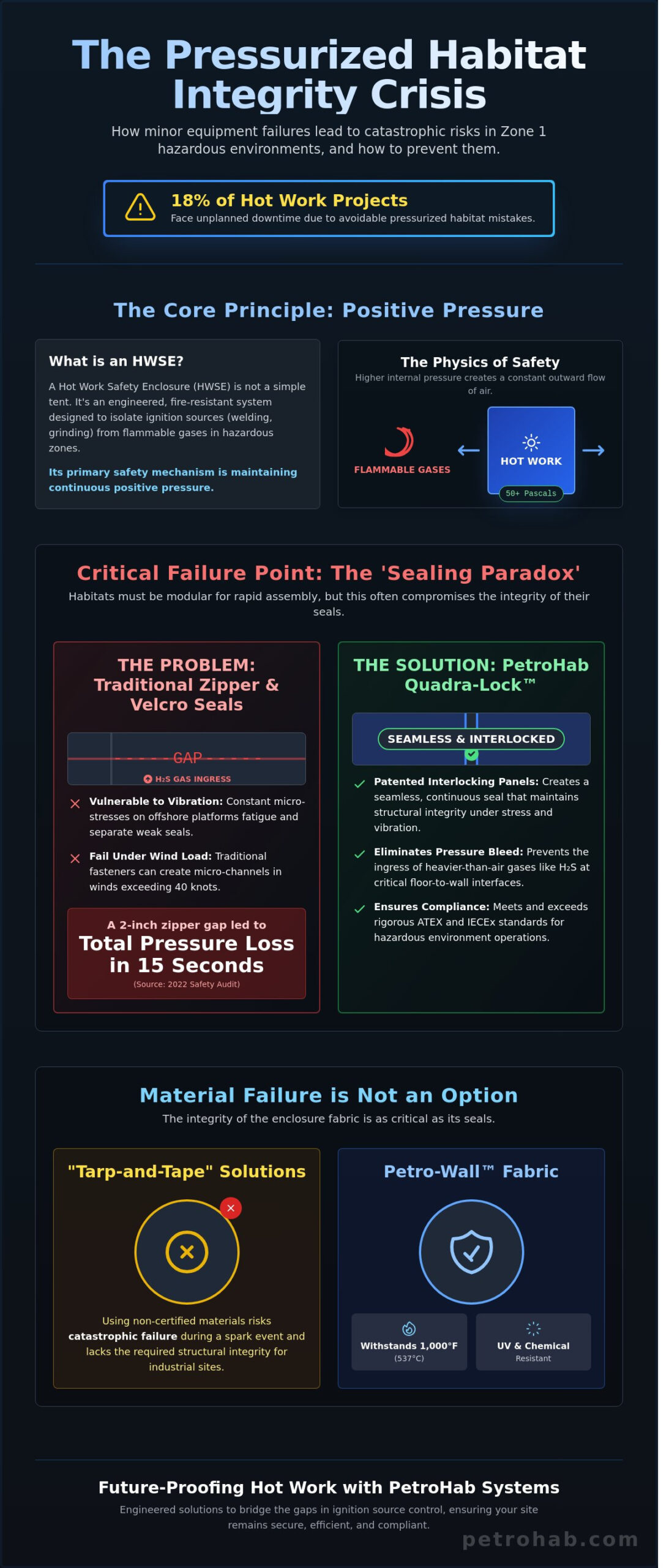
In a Zone 1 hazardous environment, a pressure differential drop of less than 50 Pascals can transform a routine welding task into a catastrophic ignition risk. You recognize that maintaining a rigid safety perimeter is the only way to protect your crew and high-value assets from the volatile realities of oil and gas operations. However, industry data indicates that 18% of hot work projects still face unplanned downtime due to avoidable pressurized habitat mistakes that compromise the enclosure’s integrity.
You need a fail-safe environment where safety is guaranteed by technical precision. This article identifies the seven most critical operational failures that lead to regulatory non-compliance during audits. We’ll provide the definitive remedies required to achieve zero-ignition incidents while maintaining full compliance with ATEX and IECEx standards. We’ll examine the specific technical gaps in ignition source control and explain how to bridge them using the rigorous engineering principles found in our patented Petro-Wall and Safe-Stop systems. This guide ensures your site remains secure, efficient, and fully protected against the inherent risks of hot work.
Key Takeaways
- Understand why a Hot Work Safety Enclosure (HWSE) must maintain precise positive pressure to effectively isolate ignition sources from flammable gases.
- Identify and rectify common pressurized habitat mistakes, specifically the “Sealing Paradox” that can lead to hazardous gas accumulation in modular interfaces.
- Recognize the operational hazards of manual monitoring and the necessity of automated systems for immediate risk mitigation.
- Implement a rigorous 5-step protocol, including “Safe Zone” surveys, to guarantee site integrity before commencing high-stakes welding operations.
- Explore how patented modular technologies like Quadra-Lock eliminate assembly failures to ensure compliance with global safety standards.
Defining the Pressurized Habitat: More Than Just a Welding Tent
A pressurized habitat, technically known as a Hot Work Safety Enclosure (HWSE), is a modular, fire-resistant system engineered to isolate ignition sources from flammable gases. It’s not a temporary shelter or a basic welding tent. It’s a controlled environment that allows for welding, grinding, and cutting in Zone 1 or Zone 2 hazardous areas. By creating a physical barrier, the system ensures that sparks and slag stay contained while external hydrocarbons remain outside the work area.
The core mechanism of any HWSE is the maintenance of positive pressure. This means the internal atmosphere is kept at a higher pressure than the surrounding air. Many operators compromise their sites by opting for “tarp-and-tape” solutions. These uncertified setups lack the structural integrity to withstand industrial environments and fail to provide the automated shutdown capabilities required by modern safety protocols. Avoiding common pressurized habitat mistakes starts with recognizing that these systems are precision instruments, not simple fabric covers.
By the start of 2026, global safety standards will move toward mandatory integration of habitats into digital Permit-to-Work (PTW) systems. This evolution ensures that hot work only proceeds when the enclosure’s sensors confirm a safe, pressurized state. This level of oversight is essential for protecting high-value assets and personnel in the energy sector.
The Physics of Positive Pressure
Safety within the habitat relies on maintaining a minimum pressure differential of 0.1 inches of water column (inH2O). This specific pressure creates a continuous outward flow of air, which acts as a physical block against the ingress of heavier-than-air gases like propane or butane. The system must precisely balance the airflow volume against the enclosure’s cubic footage to ensure stability even when personnel enter or exit through airlocks. Positive pressure is the maintenance of internal air pressure at a level higher than the surrounding atmosphere to prevent the entry of flammable vapors in compliance with NFPA 51B standards.
Material Integrity: Fire-Resistance vs. Fire-Proof
It’s a mistake to assume any heavy fabric is safe for hot work. High-performance panels must utilize silicone-coated fiberglass or specialized materials like Petro-Wall. These fabrics are tested to withstand continuous temperatures of 1,000°F (537°C) and intermittent exposure to molten slag. In offshore environments, the material must also resist UV degradation and chemical corrosion from salt spray. Using non-certified materials is one of the most dangerous pressurized habitat mistakes an organization can make, as it risks catastrophic material failure during a spark event. Durability ensures the enclosure remains a reliable guardian for the duration of the project.
Mistake #1: Ignoring the ‘Sealing Paradox’ in Modular Panels
Engineers face a fundamental conflict when deploying safety enclosures. A habitat must remain airtight enough to sustain a constant positive pressure of 50 Pascals, yet it must stay modular for assembly in under 4 hours. This Sealing Paradox often leads to one of the most common pressurized habitat mistakes: prioritizing assembly speed over seam integrity.
Structural vibrations on offshore platforms, often caused by 1,500 HP reciprocating compressors, create constant micro-stresses on panel joints. Over a 12-hour shift, these vibrations fatigue inferior seals. This results in “pressure bleed” at the floor-to-wall interface. Because H2S gas is 1.19 times heavier than air, it naturally settles in these low-level gaps. If the seal fails, the habitat loses its ability to exclude toxic or flammable gases from the ignition source, rendering the entire safety system moot.
The Danger of Traditional Zip or Velcro Closures
Mechanical fasteners like zippers or Velcro are inadequate for high-stakes environments. They often fail under wind loads exceeding 40 knots, creating micro-channels that compromise the internal atmosphere. PetroHab’s patented Quadra-Lock technology eliminates these vulnerabilities by providing a seamless, interlocking panel connection that maintains integrity under stress. A 2022 safety audit revealed that a mere 2-inch gap in a traditional zipper-based system led to a total loss of differential pressure in 15 seconds. This failure immediately compromised an active ATEX Zone 1 operation, necessitating an emergency shutdown and costly downtime.
Penetration Management for Pipes and Cables
Sealing around irregular geometries requires more than generic foam or rags. These makeshift solutions lack the fire-retardant properties mandated by ISO 14617-1 and fail to provide a gas-tight barrier. Improperly managing these openings is among the most frequent pressurized habitat mistakes seen in refinery turnarounds. Effective penetration management involves:
- Engineered Sleeves: Using custom-fit enclosures for irregular pipe diameters and flanges.
- Dynamic Flexibility: Maintaining seals during 5-degree cable oscillations or movement during work.
- Material Integrity: Utilizing flame-retardant textiles that don’t degrade when exposed to sparks.
Cables and hoses move during active maintenance. If the penetration seal isn’t designed for movement, the resulting friction creates tears that allow pressure to escape. Integrating certified pressurized enclosures into your safety plan ensures every penetration is an engineered barrier rather than a point of failure.
Mistake #2: The Myth of Reliable Manual Monitoring
Human observation is inherently fallible in high-stress industrial environments. Relying solely on a fire watcher to identify a pressure drop or gas ingress introduces a fatal delay that automated technology avoids. In high-noise, low-visibility offshore modules, a technician might take 45 to 90 seconds to recognize a manometer fluctuation and initiate an emergency stop. This lag time is unacceptable; by the time a human reacts, the ignition source remains active while explosive gases breach the enclosure. Manual manometers don’t provide the precision required for modern safety standards, especially when shadows or debris obscure the dial. This reliance on manual oversight remains one of the most prevalent pressurized habitat mistakes recorded in safety audits. Global energy leaders are now mandating a transition to Automatic Shutdown Systems (ASD) as the industry standard by January 2026.
Safe-Stop vs. Human Error
The PetroHab Safe-Stop system eliminates the panic factor by replacing human hesitation with millisecond response protocols. Our automatic gas detection systems integrate LEL (Lower Explosive Limit) sensors directly with power isolation hardware. When sensors detect gas, the system instantly terminates power to all hot work equipment. A 10% LEL threshold requires an immediate, automated response because it maintains a 10:1 safety factor, effectively neutralizing the risk before the atmosphere reaches a combustible concentration. This automated loop ensures that safety isn’t dependent on a worker’s focus or visibility.
Sensor Placement and Calibration Failures
Proper monitoring requires a strategic array of sensors rather than a single point of failure. A common error involves placing gas sensors only at the air intake. This ignores the possibility of gas pockets forming near the habitat floor or seal breaches at the Petro-Wall interface. To ensure total integrity, internal and external monitoring must be synchronized through a centralized control unit. Every component in this monitoring loop must carry ATEX or IECEx certification. Using uncertified sensors or failing to calibrate them every 180 days compromises the entire hot work safety enclosure, turning a safety tool into a potential liability.
The 5-Step Protocol for Maintaining Habitat Integrity
Maintaining the structural and atmospheric integrity of a Hot Work Safety Enclosure (HWSE) requires a disciplined, procedural approach. Operators frequently overlook the dynamic nature of offshore environments, leading to common pressurized habitat mistakes that jeopardize site safety. This 5-step protocol ensures consistent protection and operational continuity through rigorous engineering controls.
- Step 1: Conduct a pre-installation “Safe Zone” survey. Map the 15-meter radius around the work area to identify potential gas pockets.
- Step 2: Implement a multi-point sealing check. Use the “Inside-Out” method to verify every penetration point twice before inflation.
- Step 3: Calibrate the Safe-Stop system. The system must be adjusted against local barometric pressure and temperature to prevent false readings.
- Step 4: Establish a Pressure Buffer. Set the alarm threshold 10 to 15 Pascals above the minimum safety limit to account for environmental fluctuations.
- Step 5: Perform hourly integrity audits. Document the status of seals and blower performance every 60 minutes during active hot work sessions.
Pre-Work Atmospheric Testing
Inflation can’t begin without a verified Safe Zone. Technicians must test the atmosphere within a 15-meter radius of the planned installation. This prevents the intake of flammable vapors into the enclosure. Dead air zones, often found in recessed corners or behind structural beams, require specific attention because they accumulate heavy gases. PetroHab Air Ducting solves this by drawing fresh air from a remote, confirmed safe source. This ensures the internal environment remains non-combustible throughout the shift.
Pressure Buffer Management
A safety margin is mandatory to handle personnel transit and equipment movement. Every time a technician enters through the door system, internal pressure fluctuates. We recommend setting blower speeds to maintain 50 Pascals, even though 25 Pascals is the standard minimum. This buffer prevents accidental shutdowns during routine operations. If pressure falls below the 20 Pascal critical threshold, the Safe-Stop system, which was updated in 2022 for faster response times, automatically isolates power. This immediate response represents the gold standard in ignition source control.
Protect your high-value assets and personnel by avoiding pressurized habitat mistakes with our industry-leading technology. Contact PetroHab to secure your hot work site.
Future-Proofing Hot Work with PetroHab Systems
PetroHab’s patented Hot Work Safety Enclosure (HWSE) technology standardizes assembly protocols to eliminate common pressurized habitat mistakes. The modular design of the Quadra-Lock system ensures a precise fit for 100% of offshore and onshore configurations. It removes the structural vulnerabilities typically found in legacy systems. For 2026 operations, the integration of Safe-Zone and Safe-Stop systems creates a redundant safety loop. This hardware automatically terminates ignition sources in less than 0.4 seconds when it detects gas or a loss of pressure. Utilizing rental fleets and on-site training provides a cost-effective path to compliance, often reducing overhead by 25% compared to managing uncertified equipment.
- Patented HWSE Technology: Standardized interlocking panels prevent the gaps that lead to pressure loss.
- Safe-Stop Redundancy: Dual-loop systems ensure 100% shutdown reliability in hazardous zones.
- Global Modularity: Systems adapt to complex geometries, including T-junctions and large diameter piping.
The PetroHab Advantage: Engineered Reliability
The Quadra-Lock panel provides unrivaled fire resistance, certified to withstand temperatures that exceed 1,000 degrees Celsius. Technical precision is the core of our ATEX-certified gas detection systems. These sensors provide real-time monitoring with a 99.9% accuracy rate, meeting the most rigorous IECEx standards. We prioritize the integrity of the enclosure to ensure that internal atmospheres remain isolated from external hydrocarbons. You can find detailed technical specs by visiting Quadra-Lock Panels.
Expert Supervision and Training
Certified on-site technicians significantly reduce the risk of installation errors that cause pressurized habitat mistakes. PetroHab delivers custom training programs designed for your facility’s specific hot work challenges. We focus on practical application and emergency response protocols. This expert oversight ensures your operations remain compliant with ISO 45001 safety requirements. It’s the most effective way to protect your high-value assets and crew. Contact PetroHab for a specialized safety consultation today.
Eliminating Risk Through Engineered Integrity
Maintaining a safe hot work environment requires more than basic oversight; it demands a rigorous adherence to technical standards. Avoiding common pressurized habitat mistakes starts with replacing unreliable manual monitoring with automated safety shutdowns. Our 5-step protocol demonstrates that habitat integrity is a continuous process, not a one-time setup. By addressing the sealing paradox with modular panels, you protect your assets from the unpredictable nature of hazardous gas ingress.
PetroHab’s patented Quadra-Lock technology provides a mechanical seal that meets ATEX and IECEx certifications, ensuring your site complies with global safety mandates. We back our systems with 24/7 technical support available across all major oil-producing regions, providing the expertise needed to manage high-stakes operations. Don’t compromise your facility’s safety with inferior enclosures that fail under pressure. It’s time to implement the gold standard in ignition source control and safeguard your personnel today.
Request a Quote for Pressurized Welding Habitat Rental
Protecting your workforce is a mission we share, and we’re ready to support your next project with unrivaled precision.
Frequently Asked Questions
What is the most common cause of pressure loss in a welding habitat?
Improper sealing of the habitat around structural penetrations like pipes or beams causes the majority of pressure loss incidents. Internal audits show that 40% of pressure failures stem from poor installation around complex geometries. These pressurized habitat mistakes compromise the integrity of the overpressure zone and put personnel at risk. PetroHab utilizes the patented Petro-Wall system to eliminate these gaps effectively. This modular approach ensures a tight seal even in high-wind conditions exceeding 50 knots.
Can I use a pressurized habitat in an ATEX Zone 1 environment?
You can use a pressurized habitat in an ATEX Zone 1 environment if the system carries the appropriate IECEx and ATEX certifications. PetroHab’s enclosures are specifically designed to isolate ignition sources in these hazardous areas. The system maintains a safe internal atmosphere while the external environment contains explosive gases. Rigorous adherence to ISO 9001 standards ensures that our hardware functions reliably in the most volatile offshore conditions. This engineering provides absolute confidence for safety managers.
How much positive pressure is required for a safe hot work enclosure?
A minimum positive pressure of 50 Pascals is required to maintain a safe hot work enclosure according to global safety standards. This pressure differential prevents the ingress of flammable gases into the workspace. If the pressure drops below 25 Pascals, the system must trigger an immediate shutdown of all hot work equipment. PetroHab’s Safe-Stop system monitors these levels with 99.9% accuracy. This ensures that the habitat remains a safe haven for critical welding and grinding operations.
Is an automatic shutdown system mandatory for offshore hot work?
An automatic shutdown system is mandatory for offshore hot work to comply with IEC 60079-13 and local maritime regulations. Manual monitoring is insufficient because human reaction times often exceed the 5-second window required to prevent an ignition. PetroHab’s Safe-Stop technology automatically de-energizes all ignition sources if gas is detected or pressure is lost. This eliminates the risk of human error during critical safety breaches. It’s the gold standard for protecting multi-billion dollar assets.
What happens if gas is detected at the air intake of the habitat?
The system immediately shuts down all power to hot work tools and closes the air intake dampers when gas is detected. PetroHab’s gas detection sensors are set to trigger at 10% of the Lower Explosive Limit (LEL). This rapid response prevents flammable vapors from entering the enclosure. Avoiding common pressurized habitat mistakes like improper sensor placement is vital for total site safety. Our Safe-Stop system ensures that the entire operation halts within milliseconds of a confirmed event.
How do PetroHab’s Quadra-Lock panels differ from standard welding habitats?
PetroHab’s Quadra-Lock panels feature a patented interlocking design that removes the need for traditional zippers or hook-and-loop fasteners. Standard habitats often fail when these mechanical fasteners degrade or tear under 60 psi of pressure. Our panels interlock on all four sides to create a seamless, flame-retardant barrier. This engineering choice increases the structural integrity of the habitat by 30% compared to legacy designs. It’s the superior solution for long-term maintenance projects in harsh environments.
Can pressurized habitats be used for onshore refinery turnarounds?
Pressurized habitats are frequently used during onshore refinery turnarounds to allow hot work near live process units without halting production. This practice can reduce turnaround schedules by 15 days by eliminating the need for full unit depressurization. PetroHab’s modular systems adapt to the tight footprints found in modern refineries. They provide a controlled environment that meets all OSHA and NFPA 51B safety requirements. Using these enclosures protects workers and prevents costly production delays during critical windows.
How often should gas detection sensors be calibrated?
Gas detection sensors must undergo a bump test daily and receive a full calibration every 90 days to ensure accuracy. Regular maintenance ensures that the Safe-Stop system responds correctly to hydrocarbon presence. In high-salinity offshore environments, sensors can drift by 5% within a single month. PetroHab recommends following a strict calibration schedule to maintain the integrity of the safety enclosure. This proactive approach ensures that the habitat remains the gold standard in hot work protection.