
Blog Posts
Certified Habitat Daily Rates: Compare Value With Low Bids
The lowest daily bid can carry the highest operational cost. Overcoming procurement skepticism regarding certified habitat daily leasing rates starts with comparing the full value of a lease, not its daily rate in isolation. Procurement teams are right to scrutinize charges, especially when bids appear to offer the same protection at different prices.
The meaningful comparison is whether the enclosure, shutdown system, lease duration, and project requirements align, and how those factors affect return on investment. Assess the lease against a low bid, account for costs over the same period, and identify the conditions that support value-based procurement. This gives you a clearer basis for weighing the rate against operational fit and risk control, without assuming a lower bid is better value.
Key Takeaways
- Compare bids on overall operational value, not daily rate alone; the Federal Acquisition Regulation describes the best-value continuum in subpart 15.101, according to the Federal Acquisition Regulatory Council.
- Assess lease return on investment over a consistent time frame, including relevant lifecycle costs and the expected period of use.
- Understand what “certified habitat” means for the specific equipment and work conditions before using the label to compare bids.
- Identify which applicable certifications and standards matter to the project, then weigh their relevance alongside lease terms and operational requirements.
Best-value selection versus low-bid procurement
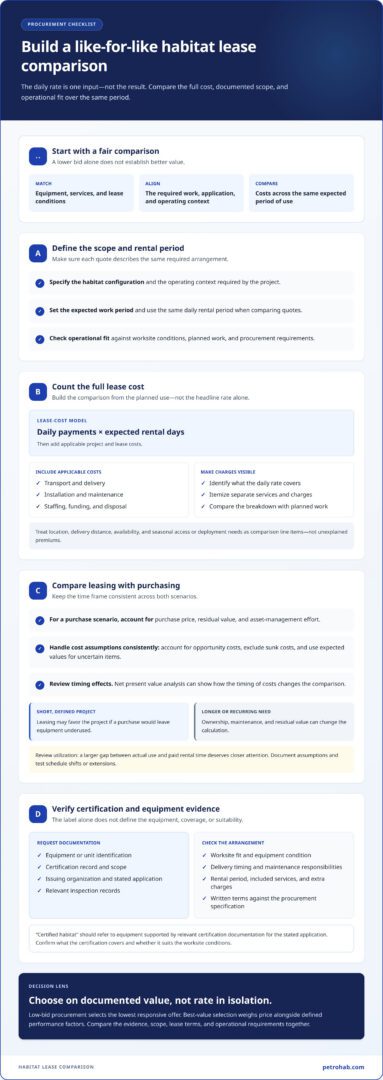
Compare each daily rate with documented requirements, operational fit, and lease terms. A lower bid alone does not establish better value.
Best-Value and Low-Bid Criteria
Low-bid procurement selects the lowest responsive offer. Best-value selection weighs price alongside defined performance factors. That distinction matters when daily rates cover different equipment, services, or lease conditions. The Federal Acquisition Regulation describes the best-value continuum in subpart 15.101, according to the Federal Acquisition Regulatory Council. Under the U.S. Federal Acquisition Regulation, certified cost or pricing data shall not be obtained for acquisitions at or below the simplified acquisition threshold, according to the Federal Acquisition Regulatory Council. This rule concerns a specific pricing-data requirement; it does not make a low bid proof of operational equivalence.
Certifications and Standards Affecting Costs
Certification and standards can affect a lease rate when they shape equipment design, inspection, documentation, or maintenance requirements. Their cost relevance depends on the project requirements and what the quoted rate includes. Ask for the certification record, its scope, issuing organization, and any applicable inspection records. Request a written rate breakdown showing the rental period, included services, and separate charges. These documents help distinguish certification-related requirements from other differences between bids, without assuming that a label alone establishes equivalent protection.
Certified Habitat in Daily Leasing
In daily equipment leasing, “certified habitat” should refer to equipment supported by relevant certification documentation for the stated application. The term alone does not explain which standard applies, what the certification covers, or whether the equipment suits the worksite conditions. For a clear comparison, define the required habitat configuration and operating context in the procurement documents. Then align each quote with those requirements and the same daily rental period. This lets evaluators compare scope and evidence rather than treating “certified” as a complete specification.
Risks of Leasing Certified Units
Procurement should assess worksite fit, certification scope, equipment condition, delivery timing, maintenance responsibilities, and lease terms. These factors can determine whether the unit suits the planned work and whether the daily rate reflects the required arrangement. Request documentation identifying the unit and certification scope, relevant inspection records, a rate breakdown, and written terms covering the rental period, included services, and additional charges. Compare these records with the procurement specification. Gaps between the documents and the actual requirement can undermine a bid comparison, even when the headline rate is lower.
Lease return on investment example
Lease return on investment compares the value of using a habitat with the full cost of leasing it over the same period. The daily rate is one input, not the result. Build the comparison around the project’s expected use and operational requirements. A transparent model supports overcoming procurement skepticism regarding certified habitat daily leasing rates by showing how the rate fits the project’s actual scope.
For a practical model, list daily payments and expected rental days, then add applicable transport, installation, maintenance, staffing, funding, and disposal costs. In the purchase scenario, include the purchase price, residual value, and asset-management effort. Account for opportunity costs, exclude sunk costs, and use expected values for uncertain items. Keep the time frame consistent across options. Net present value analysis can show how timing changes the comparison.
The written agreement determines what a daily lease rate includes. It should identify the habitat use covered and itemize separate delivery, installation, maintenance, or other charges. Compare the breakdown with the planned work period instead of assuming that two daily quotes cover the same scope.
Location affects mobilization and transport requirements, while delivery distance changes the logistics involved. Availability can affect whether the required unit and schedule fit the project. Seasonal conditions may alter site access or deployment planning, affecting the arrangement and its supporting costs. Treat each factor as a line in the comparison, not an unexplained premium.
A short, defined project may favor leasing if a purchase would leave equipment underused. A longer or recurring need can change the calculation as ownership, maintenance, and residual value enter the model. The greater the gap between actual use and paid rental time, the more closely utilization needs review. Document assumptions and test how results change if schedules shift or work extends. For procurement teams, overcoming procurement skepticism regarding certified habitat daily leasing rates means tying the decision to these project-specific assumptions.
For projects requiring a pressurized habitat, review pressurized habitat options as part of the scope and lease comparison.
What does certified habitat mean in daily equipment or vehicle leasing?
In industrial leasing, “certified habitat” should refer to a specific habitat and documented certification, not just a sales description. The record should identify the equipment it covers, the certification’s scope, and the relevant application. A daily lease charges for time-based use, but the billing period does not define or establish certification. Procurement should separate three questions: what is being leased, what evidence supports its certified status, and what period the rate covers.
For example, a pressurized welding habitat is a work enclosure, while a vehicle lease describes a different equipment category. The word “certified” does not make these items interchangeable or explain their capabilities. The purchasing specification should name the intended work, required configuration, and operating conditions. Evaluators can then compare the proposed unit and its documentation with the same defined requirement, rather than treating a label as a complete technical description.
Use the paperwork to connect the certification claim to the leased unit. Procurement records can identify:
- The unit or equipment description covered by the documentation.
- The certification or standard named in the record and its stated scope.
- Any inspection or maintenance records relevant to the lease period.
- The rental dates and equipment configuration associated with the quote.
These details help distinguish documented evidence from a general claim. They also make later review more traceable if the work scope or equipment changes.
Daily pricing raises a separate comparison issue. A rate may apply to a particular unit, configuration, and rental period; by itself, it does not show that another quote covers identical equipment or certification evidence. Procurement can align quotes by matching the stated work conditions, equipment description, certification scope, included services, and billing period. If a proposed substitute changes any of these elements, record the difference before comparing rates. This keeps the technical requirement distinct from the commercial calculation.
For a defensible evaluation, define “certified habitat” in the procurement documents before requesting daily rates. Specify the required evidence and connect it to the work application. This gives vendors a consistent basis for responding and evaluators a clear way to distinguish certification documentation, equipment suitability, and lease terms.
Which certifications and standards affect habitat leasing costs?
No single certification label defines every habitat lease. Applicable requirements depend on the work, site conditions, procurement specification, and governing rules. Certification can affect a daily rate when it requires particular design controls, testing, inspection, or documentation. Its effect depends on the certified scope and the equipment configuration being leased, not simply on the presence of a certificate.
Start by identifying the standard or certification named in the project specification. Then establish which equipment, components, and operating conditions it covers. A certificate for one configuration should not automatically be treated as evidence for another. Compare the documented scope with the proposed habitat and work application, and record any differences that affect evaluation.
Cost factors may include the engineering and materials needed to meet specified requirements, documented testing, inspection, and the work required to maintain equipment records. The lease scope matters too. A rate covering a particular configuration or supporting documentation may differ from one covering another scope. Ask for a written breakdown that distinguishes the daily rental charge from included services and other charges. This makes the quote easier to assess without assuming every certification adds the same amount.
Use a consistent review sequence:
- Identify project-required certifications or standards in the specification.
- Match each stated requirement to the certificate’s scope and equipment description.
- Review relevant inspection and maintenance records for the rental period.
- Compare quotes against the same technical requirements and lease scope.
This process helps separate mandatory project requirements from additional specifications that may not affect the work. It also makes gaps visible: a certificate may exist, yet its scope may not address the stated application. Record how each requirement affects equipment suitability and the quoted scope. This gives procurement a clear basis for assessing whether a rate reflects the required configuration, documentation, and support, rather than relying on an unexplained “certified” label.
For projects requiring a pressurized configuration, review pressurized habitat options alongside the applicable project requirements.
PetroHab LLC
PetroHab LLC manufactures, leases, and sells Hot Work Safety Enclosures (HWSE) for hazardous work environments. Its product range includes the Petro-Habitat HWSE, Safe-Stop Safety Shutdown System, Quadra-Lock panels, and pressurized welding enclosures. The Safe-Stop system monitors differential pressure and gas levels, and can be equipped with oxygen and/or carbon-dioxide detectors.
For procurement teams, the next step is to align project operating conditions with the required enclosure and system scope. Compare that scope with the daily lease terms and supporting documentation. This keeps the decision grounded in work requirements, equipment configuration, and risk controls rather than price alone.
Contact PetroHab LLC to discuss habitat requirements for your project.
Make the Procurement Decision Actionable
Turn the evaluation into a decision record that connects the selected habitat requirements to the project’s operating plan. Assign responsibility for tracking changes in scope, rental duration, and site conditions. If the work changes, procurement and operations can revisit the original assumptions before those changes affect the lease decision. This creates a clear basis for internal review and keeps the selection tied to the hazards personnel must control.
Overcoming procurement skepticism regarding certified habitat daily leasing rates depends on a transparent rationale, not pressure to accept a quote. Keep the technical basis and commercial decision connected, and make the next step specific to the work planned. PetroHab LLC’s habitat systems may be relevant when the project requires a hot-work enclosure and associated safety equipment.
Contact PetroHab LLC about habitat leasing to discuss your project requirements. A disciplined procurement decision gives your team a stronger starting point for planning controlled work.
Frequently Asked Questions
How can suppliers substantiate certified habitat rates to skeptical procurement teams?
Suppliers can substantiate rates with a traceable evidence package linking the quoted configuration to the project’s requirements. Include the quote revision, equipment identification, certification documents, and a clear record of scope assumptions. For PetroHab habitats, identify the applicable ATEX and IECEx certification in the supporting documentation. This lets procurement evaluate the specific proposed package and its evidence, rather than relying on a “certified” label alone.
What procurement benchmarks and total-cost-of-ownership calculations support habitat lease pricing?
Build a benchmark from offers that meet the same stated requirement, then calculate evaluated lease outlay per expected operational day. Under the U.S. Federal Acquisition Regulation, adequate price competition generally requires at least two responsible offerors competing independently to submit priced offers that meet the Government’s stated requirement, according to the Federal Acquisition Regulatory Council. For total-cost analysis, test how the result changes under lower or extended utilization, and document which assumptions affect the decision.