
Blog Posts
Gas Turbine Maintenance Enclosure: A Technical Guide to Pressurized HWSE Solutions
Can your facility afford to lose $600/kW in asset value to a preventable maintenance shutdown? With gas turbine prices projected to rise nearly 200% by 2027, the financial stakes of operational downtime have never been higher. Engineers and safety managers often feel forced into an impossible choice between absolute safety and production continuity when performing hot work in Class 1 Division 1 or 2 environments. A specialized gas turbine maintenance enclosure eliminates this false dichotomy by creating a controlled, pressurized environment that isolates ignition sources from explosive gases.
You already know that compliance with the 2026 OSHA National Emphasis Program and updated NFPA 51B standards is a non-negotiable requirement for protecting personnel and high-value assets. This guide demonstrates how pressurized Hot Work Safety Enclosures (HWSE) utilize Quadra-Lock panels to permit critical welding and grinding without a total facility outage. We’ll examine the technical requirements of IEC 60079-13 and the impact of the January 2026 EPA Subpart KKKKa amendments on your maintenance protocols. This analysis provides the technical roadmap needed to implement engineered controls that satisfy rigorous ATEX/IECEx requirements while maintaining your site’s operational excellence.
Key Takeaways
- Understand how a specialized gas turbine maintenance enclosure functions as a critical engineered control to isolate high-risk ignition sources from potentially explosive atmospheres.
- Learn the technical principles of positive pressure containment and how fire-resistant materials maintain habitat integrity during intensive welding and grinding.
- Identify the essential international certifications, including ATEX and IECEx, required to ensure your maintenance protocols align with current 2026 safety and environmental standards.
- Master the procedural requirements for successful deployment, including rigorous pre-installation site surveys and the modular assembly of certified pressurized habitats.
- Discover the structural advantages of Quadra-Lock panels and how they provide the industry’s most reliable pressure seal for securing hazardous industrial environments.
What is a Gas Turbine Maintenance Enclosure (HWSE)?
A gas turbine maintenance enclosure is a specialized Hot Work Safety Enclosure (HWSE) engineered to isolate ignition sources from explosive atmospheres. While permanent acoustic housings provide noise attenuation and weather protection for a gas turbine, they don’t provide the pressurized containment required for hot work. This temporary pressurized maintenance habitat creates a controlled environment where welding and grinding can occur safely, even when surrounding equipment remains pressurized.
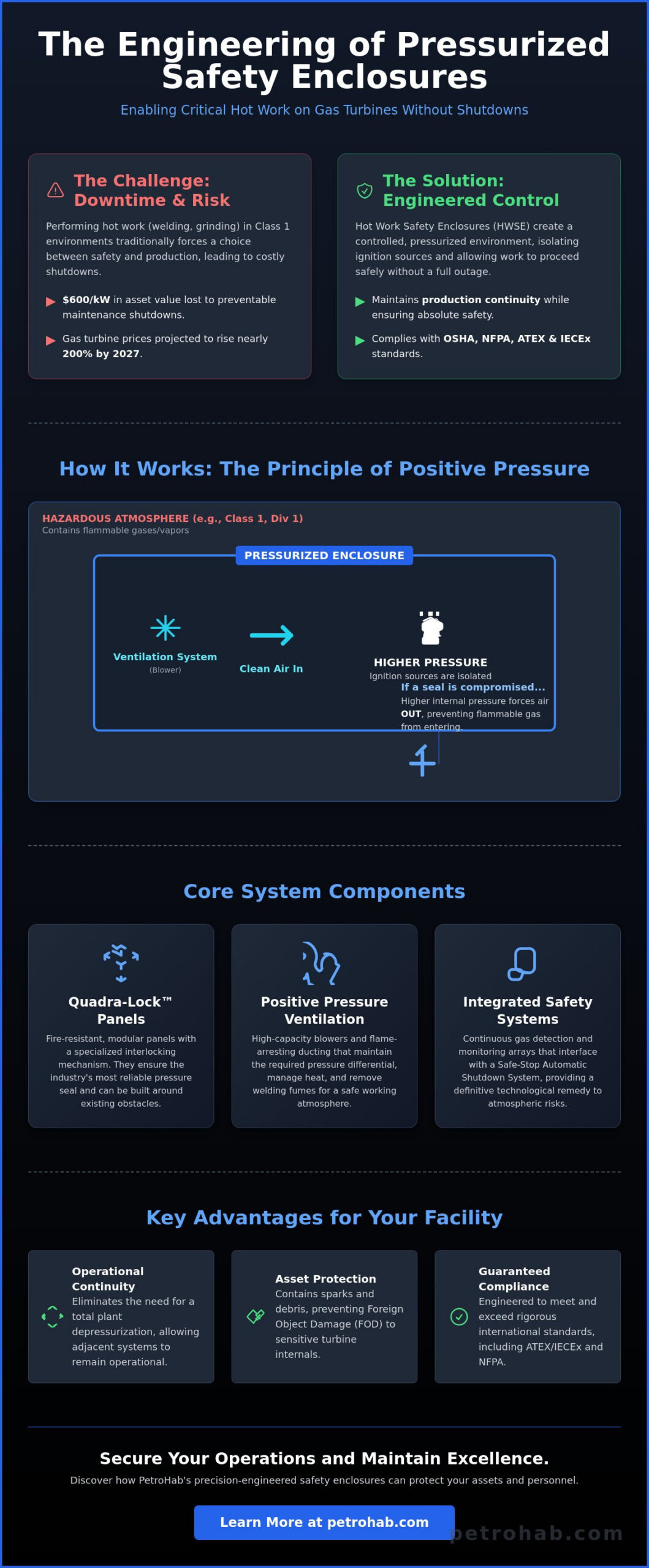
The system relies on positive pressure as the primary barrier. By forcing clean air into the enclosure at a pressure level higher than the external environment, the system ensures that flammable gases cannot enter. If a seal is compromised, air flows out rather than allowing hazardous vapors in. This principle is fundamental to maintaining a secure working environment in Class 1 Division 1 or 2 areas.
To better understand the complexities of turbine maintenance and the factors influencing service intervals, watch this helpful video:
The Role of HWSE in Turbine Turnarounds
During a major turnaround, every hour of downtime translates to lost revenue. A gas turbine maintenance enclosure facilitates on-site repairs without requiring total plant depressurization. This capability allows technicians to perform critical structural welding or component repairs while adjacent systems remain operational. Beyond ignition prevention, these enclosures protect sensitive turbine internals from metallic debris, sparks, and welding slag. This containment prevents foreign object damage (FOD) that could otherwise compromise turbine performance post-maintenance.
Key Components of a Maintenance Habitat
The integrity of a maintenance habitat depends on its structural components. The enclosure consists of fire-resistant modular panels, specifically Quadra-Lock panels, which utilize a specialized interlocking mechanism to ensure a reliable pressure seal. A high-capacity positive pressure ventilation system, comprising blowers and flame-arresting ducting, maintains the required atmospheric differential. To ensure continuous safety, these systems integrate gas detection and monitoring arrays that interface with the Safe-Stop Automatic Shutdown System, providing a definitive technological remedy to atmospheric risks.
The Engineering Behind Pressurized Maintenance Habitats
The effectiveness of a gas turbine maintenance enclosure depends on the strict application of fluid dynamics and material science. At its core, the system creates a pressure differential where the internal habitat pressure is maintained at a higher level than the surrounding atmosphere. This overpressure acts as an invisible shield. If a breach occurs, air moves exclusively from the inside out, preventing flammable hydrocarbons from reaching the ignition source. This engineering control is essential for meeting OSHA safety standards regarding hot work in hazardous locations.
Materials must be equally uncompromising. Panels are constructed from high-grade, fire-resistant textiles capable of withstanding molten slag and high-intensity sparks without compromising structural integrity. Because gas turbine decks are congested with complex piping and instrumentation, a rigid, one-size-fits-all structure is impractical. Modularity allows the enclosure to be built around existing obstacles, ensuring a tight seal regardless of the site’s geometric complexity. This flexibility ensures that the enclosure remains a definitive technological remedy for risk mitigation.
Air exchange rates are another critical engineering factor. High-volume ventilation doesn’t just maintain pressure; it also manages heat dissipation and removes hazardous welding fumes. This ensures that technicians remain safe and productive even in the high-ambient temperatures typical of turbine environments. Maintaining these rates requires a calculated approach to blower capacity and ducting layout.
Maintaining Positive Pressure Integrity
Precision monitoring is required to verify that the pressure barrier remains intact. Digital or liquid-filled manometers provide real-time data on the pressure differential, alerting safety officers immediately if levels drop below the safety threshold. Airlock doors are utilized to maintain this pressure during personnel movement. These dual-door systems ensure that at least one barrier remains sealed at all times, preventing the sudden pressure drops that occur with standard zippered openings. Technicians must pay close attention to leak points where panels meet the turbine deck or penetrate around piping, using specialized gaskets to secure these interfaces.
Modular Panel Technology for Custom Configurations
The Quadra-Lock panel system represents the pinnacle of modular safety engineering. Unlike inferior solutions that rely on zippers or adhesive tapes, interlocking panels provide a mechanical seal that is far more resilient under pressure. This design allows for rapid assembly and disassembly, which is vital for minimizing downtime during scheduled outages. For those seeking to optimize their safety protocols, understanding the technical specifications of HWSE solutions is the first step toward incident-free maintenance. These panels can be configured to navigate around complex turbine instrumentation, ensuring that the enclosure provides comprehensive protection without requiring the removal of critical equipment.
Regulatory Compliance for Turbine Safety Enclosures
Rigorous adherence to international safety standards isn’t a suggestion; it’s the legal foundation for performing hot work in high-stakes environments. A gas turbine maintenance enclosure must align with the latest hazardous environment standards governing 2026 industrial operations. These standards dictate the engineering requirements for environmental containment and ignition prevention, ensuring that every component—from the panels to the monitoring systems—functions as a reliable guardian of the site. Compliance ensures that technical safety measures translate into real-world protection for personnel and assets.
Electrical components within the habitat, such as blowers and gas detectors, require ATEX and IECEx certifications. These international benchmarks verify that equipment won’t become an ignition source in the presence of explosive gases. Additionally, NFPA 51B provides the framework for fire prevention during welding and cutting. While the traditional 35-foot rule is often impossible to maintain on a crowded turbine deck, a pressurized enclosure provides the engineered barrier necessary to satisfy documented permit requirements. This integration ensures that the habitat is not an isolated tool but a critical component of the facility’s Permit-to-Work (PTW) system.
ATEX Zone Classifications in Turbine Areas
Industrial sites differentiate between Zone 1, where an explosive atmosphere is likely to occur, and Zone 2, where it’s less frequent. A pressurized enclosure effectively “de-classifies” the internal work area. By maintaining a constant positive pressure, the system ensures that the interior remains free of hazardous vapors regardless of external conditions. This technical transition requires meticulous documentation and certification to prove that the habitat meets the specific atmospheric requirements of the zone. Safety managers rely on these certifications as linguistic anchors for quality, ensuring that every deployment adheres to strict regulatory mandates.
OSHA and International Safety Mandates
Compliance with OSHA guidelines is mandatory for any hot work performed in confined or hazardous spaces. The 2026 OSHA National Emphasis Program has increased the focus on engineered controls over administrative ones. This shift makes continuous gas monitoring a necessity rather than an option. Every gas turbine maintenance enclosure must feature integrated sensors that trigger an immediate cessation of work via the Safe-Stop Automatic Shutdown System if gas is detected or pressure is lost. Verification of fire-resistance ratings for enclosure materials is equally vital. Using Quadra-Lock panels ensures the habitat meets stringent international standards for thermal protection and structural integrity, protecting both personnel and high-value assets during intensive maintenance cycles.
Operational Implementation: Setting Up for Success
Successful deployment of a gas turbine maintenance enclosure begins with a rigorous pre-installation site survey. Our technicians meticulously identify potential gas migration paths, fuel line proximity, and structural obstructions on the turbine deck. This assessment ensures the enclosure acts as a calculated engineering control tailored to the site’s specific hazards. Identifying these variables early prevents delays during the critical path of a turnaround. This survey ensures the gas turbine maintenance enclosure is positioned to maximize safety and efficiency while maintaining clear access for personnel.
After the survey, certified technicians begin the assembly of the modular structure. This phase requires technical precision to ensure every interface is sealed against pressure loss. Once the physical build is complete, the system undergoes a purge and pressure test to establish atmospheric integrity. This process clears any residual gases and confirms that the internal pressure exceeds the external atmosphere by the required safety margin. This verified environment is essential for the safe commencement of hot work.
Step-by-Step Installation Process
The installation follows a methodical sequence to ensure structural and atmospheric protection. Technicians first assemble the base frame, integrating Quadra-Lock panels to form the primary containment. Unlike traditional habitats, these panels lock mechanically to provide a superior pressure seal. Following the build, we install high-capacity ducting for optimal air distribution and heat management. The final step involves integrating the Safe-Stop Automatic Shutdown System. Sensors are calibrated to detect specific hydrocarbon concentrations and pressure fluctuations, ensuring the system can execute an immediate shutdown if safety thresholds are breached. To ensure your site meets these rigorous operational standards, consult with our safety engineers for a customized enclosure strategy.
Minimizing Maintenance Downtime
Turnaround efficiency depends on the speed of safety preparations. The rapid-assembly modularity of our systems significantly reduces the time required for habitat setup compared to traditional wooden or fabric structures. On-site supervision by seasoned safety veterans ensures that the installation doesn’t interfere with other concurrent maintenance activities. This allows for a seamless transition between maintenance phases without the need for a full habitat teardown. By maintaining the enclosure throughout the duration of the hot work window, facilities can keep the turbine deck active and productive. This disciplined approach to implementation protects high-value assets while preventing the astronomical costs associated with extended facility outages.
The PetroHab Advantage: Precision Safety for Gas Turbines
PetroHab provides an uncompromising approach to industrial safety through technology that is as durable as the assets it protects. Our PetroHab Hot Work Safety Enclosures (HWSE) represent the global benchmark for hazardous zone maintenance. Every gas turbine maintenance enclosure we deploy is a result of calculated engineering designed to eliminate the risks of ignition in volatile environments. We prioritize the protection of personnel and high-value assets through systems that act as active guardians of your facility. This commitment to reliability ensures that safety managers can execute maintenance with absolute confidence.
Our global availability and technical support ensure that turbine maintenance projects receive expert guidance regardless of location. We act as a trusted advisor and critical safety partner, providing the technical roadmap needed for incident-free operations. By integrating proprietary technologies with rigorous safety protocols, we help facilities maintain peak performance without compromising on risk mitigation.
Quadra-Lock: The Benchmark in Modular Integrity
The Quadra-Lock panel system provides the industry’s most reliable pressure seal. Unlike standard habitat assembly methods that utilize zippers, hook-and-loop fasteners, or adhesive tapes, the Quadra-Lock design features a four-sided interlocking mechanism. This mechanical connection eliminates typical leak paths that compromise atmospheric integrity. These panels are manufactured from heavy-duty, fire-resistant materials that withstand the harsh conditions of offshore platforms and onshore refineries. The system’s durability ensures that the habitat remains a definitive technological remedy throughout the entire maintenance cycle. This modularity allows for rapid configuration around complex turbine geometries, ensuring a secure fit where lesser systems fail. It’s a solution built for the rigorous demands of heavy industry.
Safe-Stop: The Ultimate Safety Redundancy
True safety requires more than a physical barrier; it requires active, automated monitoring. The Safe-Stop system acts as the central intelligence of the enclosure. It continuously monitors hydrocarbon levels and internal pressure differentials simultaneously. If gas is detected or pressure drops below the safety threshold, the system executes an immediate, automatic isolation of all ignition sources, including welding machines and power tools. This fail-safe technological design removes the element of human error from emergency response. It ensures absolute worker safety by providing 24/7 protection during critical maintenance windows. This level of integration addresses the common gaps in manual safety monitoring, providing a robust redundancy that protects your site’s most valuable assets.
Optimizing Asset Protection and Operational Continuity
Effective turbine maintenance requires a shift from administrative permits to engineered safety ecosystems. Implementing a gas turbine maintenance enclosure ensures that critical hot work proceeds without the financial penalty of a total facility outage. By utilizing patented Quadra-Lock technology, facilities achieve a mechanical seal that standard habitats cannot replicate. This structural integrity, paired with Safe-Stop automatic shutdown integration, provides the necessary redundancy to meet strict ATEX and IECEx compliance requirements. These systems act as active guardians, transforming hazardous work zones into controlled environments where technical precision and safety coexist.
Protecting high-value assets demands a rigorous, uncompromising approach to risk mitigation. Our technical team stands ready to help you navigate the complexities of 2026 regulatory standards while maintaining your site’s operational excellence through durable, resilient hardware. Global availability of these systems ensures that your next turnaround is supported by seasoned experts who understand the granular details of ignition prevention. Secure your site’s future by choosing engineering that prioritizes the protection of personnel and high-utilization production assets. Request a Technical Consultation for Your Turbine Maintenance Project to begin your implementation.
Frequently Asked Questions
What is the primary difference between a standard enclosure and an HWSE for turbine maintenance?
A standard enclosure is typically designed for acoustic attenuation or weather protection, whereas a Hot Work Safety Enclosure (HWSE) is an engineered safety control. The HWSE utilizes fire-resistant Quadra-Lock panels and positive pressure to isolate ignition sources from explosive atmospheres. Unlike permanent housings, these habitats are modular and temporary, specifically designed to permit welding and grinding in hazardous zones.
Can hot work be performed on a live gas turbine using a pressurized habitat?
Hot work can be performed near operational equipment provided that a pressurized habitat is used to isolate the ignition source. This approach allows for critical maintenance without a total facility shutdown, significantly reducing operational downtime. By creating a controlled environment, the habitat ensures that sparks and heat are contained and separated from any potential hydrocarbon leaks in the surrounding area.
How does positive pressure prevent gas from entering the maintenance enclosure?
Positive pressure functions by maintaining the internal atmosphere of the gas turbine maintenance enclosure at a higher level than the external environment. This pressure differential ensures that air only moves from the inside out. If a seal is compromised, the outflowing air physically blocks flammable hydrocarbons from entering the habitat, preventing them from reaching the ignition source.
What are the requirements for an automatic shutdown system in a gas turbine environment?
An automatic shutdown system must provide continuous monitoring of both gas concentrations and internal pressure levels. It’s required to interface directly with the power supply of all hot work equipment. If the system detects hazardous gases or a loss of pressure, it must execute an immediate, fail-safe isolation of all ignition sources via a system like Safe-Stop.
Are PetroHab maintenance enclosures ATEX and IECEx compliant?
All electrical components used in our maintenance enclosures, including blowers, gas detectors, and control systems, meet ATEX and IECEx standards. These international certifications verify that the equipment is safe for use in Zone 1 and Zone 2 explosive atmospheres. This compliance provides safety managers with the necessary documentation to satisfy rigorous global regulatory requirements.
How long does it typically take to assemble a modular turbine maintenance enclosure?
Assembly time depends on the complexity of the turbine deck, but the modularity of Quadra-Lock panels allows for rapid deployment. Most standard configurations are completed within a single shift by our certified technicians. This efficiency is critical for minimizing the maintenance window and ensuring that the project stays on the turnaround schedule.
What happens if the pressure inside the habitat drops during hot work?
If the internal pressure drops below the established safety threshold, the Safe-Stop Automatic Shutdown System triggers an immediate power isolation. All welding and grinding equipment is neutralized before the internal atmosphere can equalize with the external hazardous zone. This proactive technological remedy ensures that work doesn’t continue in an unpressurized, high-risk state.
Is on-site training required for operating a pressurized welding habitat?
Operating a pressurized gas turbine maintenance enclosure requires specialized technical training for the habitat technician. This instruction covers the mechanical assembly of panels, sensor calibration, and the management of pressure differentials. Proper training ensures that the technician can maintain the integrity of the habitat and respond correctly to any automated safety alerts.