
Blog Posts
Hot Work Fire Watch Requirements: The 2026 Compliance Guide
In a high-stakes industrial environment, the margin for error during welding or cutting is zero. You recognize that managing hot work fire watch requirements across complex facilities is a significant operational challenge, especially as safety standards evolve toward stricter digital documentation. Failing to adapt to these changes increases the risk of catastrophic ignition and costly downtime.
This guide provides the technical precision required to master the latest NFPA 51B and OSHA standards while integrating advanced safety technology to protect your high-risk assets. We’ll analyze the essential duties of fire watch personnel, the mandatory monitoring durations, and the role of the PetroHab LLC Hot Work Safety Enclosure (HWSE) in mitigating ignition risks. By utilizing Quadra-Lock panel technology and the Safe-Stop Automatic Shutdown System, your facility can move beyond administrative oversight toward a definitive, engineered safety solution that ensures absolute reliability.
- Understand the critical distinctions between OSHA 1910.252 and NFPA 51B to ensure your site meets all hot work fire watch requirements for 2026.
- Learn mandatory timelines for post-work surveillance, including the 60-minute fire watch and the subsequent 3-hour fire monitoring phase.
- Establish clear Stop Work Authority protocols that empower fire watch personnel to act as decisive guardians of the job site.
- Discover how PetroHab LLC Hot Work Safety Enclosures (HWSE) use Quadra-Lock technology to isolate sparks and minimize the fire watch area.
- Integrate Safe-Stop automatic shutdown systems into your management plan to reduce reliance on human observation and mitigate ignition risks.
What are Hot Work Fire Watch Requirements?
Hot work fire watch requirements constitute the primary defensive protocol in heavy industrial environments. According to OSHA 1910.252 and the 2024 edition of NFPA 51B, a fire watch is a designated individual tasked with monitoring the work site to detect and extinguish smoldering fires. This role isn’t merely observational. It requires active engagement during activities that produce slag, sparks, or open flames, such as welding, cutting, brazing, and grinding. The core objective remains the immediate mitigation of ignition sources before they evolve into catastrophic events.
The Permit Authorizing Individual (PAI) serves as the technical lead for this process. It’s the PAI’s responsibility to inspect the area and determine if the hazards present necessitate a dedicated watch. They must ensure that the environment is prepared according to documented standards, moving beyond simple checklists to a rigorous assessment of risk factors. If the PAI determines that a fire watch is required, that individual must remain focused solely on fire detection duties.
When is a Fire Watch Mandatory?
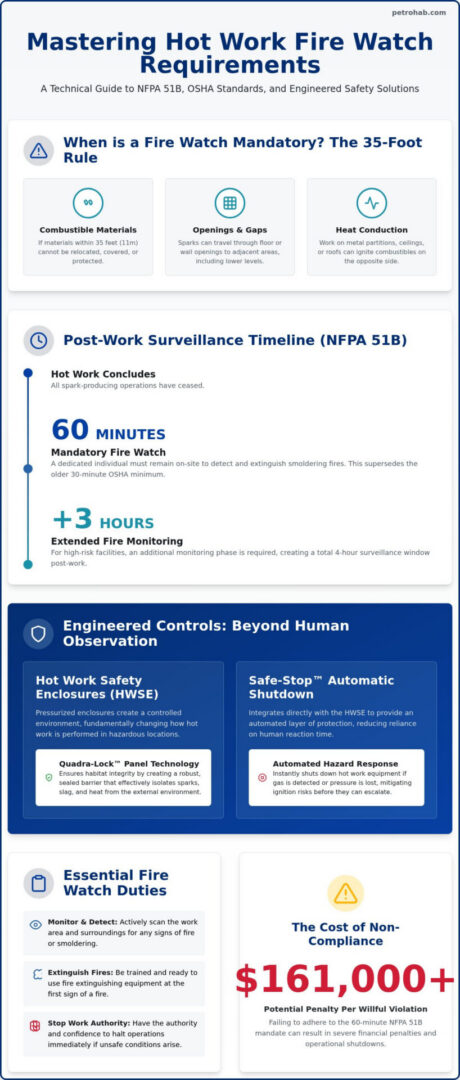
A fire watch is mandatory under several specific conditions defined by the 35-foot rule. If combustible materials are within 35 feet (11 meters) of the hot work and can’t be relocated, a watch must be established. This requirement extends to scenarios where sparks could travel through openings to lower levels or hidden spaces. Specifically, a watch is required when:
- Floor or wall openings expose combustibles in adjacent areas or on different levels.
- Hot work is performed on metal walls, ceilings, or roofs with combustible coverings or insulation.
- Combustible materials are adjacent to the opposite side of metal partitions and are likely to be ignited by conduction.
The 2026 Regulatory Landscape
In 2026, the regulatory environment has become significantly more stringent. OSHA 1915.504 now dictates precise watch protocols for the maritime and shipyard sectors, where confined spaces amplify risk. Globally, operators are increasingly aligning with IECEx and ATEX standards for environmental containment. In Zone 1 and Zone 2 hazardous locations, standard fire prevention measures are often insufficient. These high-risk areas require engineered solutions, such as pressurized PetroHab LLC habitats. By utilizing Quadra-Lock panels to ensure habitat integrity, operators can meet stringent hot work fire watch requirements while maintaining operational uptime. This shift reflects a move from administrative oversight to definitive technological control.
Duration and Monitoring: Compliance with NFPA 51B Standards
Compliance with hot work fire watch requirements hinges on precise timing and rigorous post-work surveillance. The 2024 edition of NFPA 51B mandates that a fire watch remain on-site for at least 60 minutes after all hot work operations conclude. This duration isn’t a suggestion; it’s a critical window for detecting smoldering combustion that often remains invisible to the naked eye. The Permit Authorizing Individual (PAI) manages this timeline, ensuring that every spark is accounted for before the formal watch is released.
Beyond the initial hour, the standard introduces a “fire monitoring” phase. This phase can last an additional three hours, creating a total four-hour surveillance window post-work. The PAI evaluates the facility’s occupancy and construction type to determine if this extension is necessary. For example, non-fire-resistive structures or areas with high combustible loads require this extended oversight. Documentation is essential. The current standard requires “documented” permits rather than just “written” ones, facilitating the use of digital safety management systems that provide a tamper-proof audit trail of the monitoring process.
The 1-Hour vs. 30-Minute Fire Watch Debate
While OSHA 1910.252 still references a 30-minute minimum, sophisticated industrial operators recognize this as a baseline, not a sufficient safety standard. Data from fire investigations suggests that smoldering fires in wall cavities or insulation frequently take more than 45 minutes to manifest into open flames. Adhering only to the 30-minute minimum leaves a dangerous gap in risk mitigation. Legally, failing to meet the 60-minute NFPA mandate can result in willful violation citations. In 2026, these penalties can exceed $161,000 per instance, making strict adherence to the longer duration a financial and operational necessity.
Extended Fire Monitoring Protocols
The additional three-hour monitoring phase doesn’t always require a dedicated person standing idle, but it does require constant vigilance. Modern technology now bridges the gap between manual observation and continuous safety. Thermal imaging and gas sensors provide real-time data, identifying heat signatures that human observers might miss during long shifts. Integrating these tools into hazardous environment standards ensures a comprehensive safety net across the site. For facilities utilizing Safe-Stop automatic shutdown systems, this monitoring becomes part of an engineered safety ecosystem, significantly reducing the margin for human error during extended post-work surveillance.
Essential Duties and Equipment for Fire Watch Personnel
Fire watch personnel serve as the primary administrative guardians during hazardous operations. Their most critical tool is Stop Work Authority. This mandate allows them to suspend all activity immediately if they observe a breach in safety protocols or an uncontrolled ignition source. Meeting hot work fire watch requirements demands a dedicated focus. These individuals cannot be assigned concurrent tasks that distract from their surveillance duties. Clear communication channels between the welder, the fire watch, and site supervisors must be established and tested before work begins. Whether using intrinsically safe radios or standardized hand signals, the flow of information must be instantaneous.
Physical positioning is equally vital. A fire watcher must maintain an unobstructed line of sight to all potential spark paths and slag accumulation points. This often requires monitoring multiple levels or the opposite side of a bulkhead. Training is mandatory. Designated watchers must demonstrate proficiency in fire chemistry, extinguisher operation, and site-specific emergency response plans before receiving authorization to monitor a permit. They act as the final check in a system designed to protect high-value assets and personnel.
Fire Watcher Responsibilities and Limitations
A fire watcher’s attention cannot be divided. They don’t assist with the welding process or handle materials. Their role is strictly limited to fire detection and initial response. When monitoring partitions, they must check the “other side” where conduction can ignite combustibles out of the welder’s view. If a fire starts, the watcher must make a split-second decision. They extinguish small, manageable flames but immediately trigger the site alarm and initiate evacuation if the fire exceeds the capacity of portable equipment.
The Fire Watcher’s Toolkit
Proper equipment is the foundation of effective surveillance. Personnel must wear fire-resistant clothing and appropriate eye protection to withstand the environment. Extinguisher selection is hazard-specific. Using a Class A water-based unit on a Class B liquid fire is a catastrophic error. In 2026, the toolkit has expanded beyond the basic extinguisher. Portable gas detectors and manometers are now essential for verifying the atmosphere and habitat pressure. When integrated with a Safe-Stop automatic shutdown system, these tools provide a technological redundancy that mitigates the risks of human fatigue during long shifts.
Enhancing Fire Watch Safety with Hot Work Safety Enclosures (HWSE)
Engineering controls provide a more resilient safety barrier than administrative oversight alone. While previous sections detailed the human protocols necessary for compliance, hot work safety enclosures (HWSE) offer a physical solution to isolate ignition sources at their origin. By containing sparks, slag, and heat within a pressurized environment, these habitats fundamentally streamline hot work fire watch requirements. Instead of monitoring a vast, open area with potential hidden combustibles, the fire watcher’s focus is narrowed to the containment integrity, significantly reducing the risk of stray ignition in complex industrial geometries. This localized containment ensures that hazardous debris remains isolated from the surrounding facility.
Quadra-Lock: Ensuring Enclosure Integrity
The reliability of a pressurized habitat depends on the quality of its structural seal. Traditional welding blankets often fail to provide a complete barrier, leaving gaps where sparks can escape or flammable gases can enter. PetroHab LLC utilizes patented Quadra-Lock panel technology to solve this problem. These interlocking panels create a robust, pneumatic seal that maintains positive pressure within the habitat. This pressure ensures that any hot work debris remains trapped inside while preventing hazardous external atmospheres from infiltrating the work area. The superior engineering of these panels provides a technical anchor for the entire safety permit process, allowing for safe operations even in high-risk zones.
Automating the Fire Watch with Safe-Stop
To further mitigate the risk of human error, the Safe-Stop Automatic Shutdown System provides a layer of automated vigilance. This system continuously monitors internal pressure and gas concentrations, acting as a technological redundancy to the human watcher. If the system detects a loss of pressure or the presence of hazardous gases, it immediately cuts power to the welding equipment. This rapid, automated response ensures that hot work fire watch requirements are met with the highest level of technical assurance, even in high-stakes environments where human fatigue might occur. It allows safety managers to implement a multi-layered defense strategy that combines rigorous manual observation with definitive engineering safeguards.
To optimize your facility’s safety protocols and ensure full regulatory compliance, evaluate the PetroHab LLC HWSE solutions designed for high-hazard environments. Request a technical consultation to learn more about our integrated safety systems and how they can be deployed at your site.
Implementing a Comprehensive Hot Work Safety Strategy in 2026
A robust safety strategy in heavy industry requires moving beyond basic compliance toward a site-specific Hot Work Management Plan (HWMP). This document serves as the operational blueprint for risk mitigation, defining how your facility will meet hot work fire watch requirements across varying asset classes. Effective integration starts with the Permit-to-Work (PTW) system. By embedding fire watch protocols directly into the PTW workflow, you ensure that no hot work commences without a documented assessment of the surrounding environment. This systematic approach transforms safety from a reactive task into a disciplined operational standard.
Every hot work task must be preceded by a Job Safety Analysis (JSA) or Job Hazard Analysis (JHA). These assessments identify specific ignition risks, such as proximity to pressurized lines or volatile storage tanks. In high-hazard sectors like offshore energy and refining, manual surveillance alone often fails to address the complexity of the site. Implementing advanced hot work safety systems allows operators to maintain high safety standards while minimizing operational downtime. These systems provide the technical redundancy needed to protect high-value assets during critical maintenance turnarounds.
The PAI Decision Matrix
The Permit Authorizing Individual (PAI) must utilize a rigorous decision matrix to determine the scope of surveillance. For complex geometries or multi-level structures, a single watcher is often insufficient. The PAI must evaluate whether the site requires multiple fire watchers to maintain a continuous line of sight or if an engineered solution is more effective. There’s a clear operational trade-off between the high labor costs of extended manual watches and the efficiency of pressurized habitats. Utilizing Petro-Habitats with Quadra-Lock technology allows the PAI to contain the hazard at the source, often reducing the personnel requirement while increasing the overall safety factor.
Continuous Improvement and Training
Operational excellence depends on the continuous review of fire watch logs and incident reports. These records provide the data necessary to identify recurring hazards or procedural gaps. Training must be equally rigorous. Personnel should receive specialized instruction on the deployment of Hot Work Safety Enclosures (HWSE) and the operation of Safe-Stop automatic shutdown systems. To ensure 2026 regulatory compliance, your final checklist must include:
- Verification of digital, tamper-proof permit documentation.
- Confirmation of the mandatory 60-minute post-work fire watch.
- Testing of gas detection and habitat pressure sensors.
- Validation of Stop Work Authority for all designated watchers.
By treating fire watch protocols as a core component of asset integrity management, you protect both your personnel and your long-term operational viability.
Advancing Industrial Safety Through Engineered Containment
Adhering to hot work fire watch requirements is a fundamental component of asset integrity management. While the mandatory 60-minute surveillance window provides a necessary baseline, the integration of engineered containment systems represents the highest standard of risk mitigation. By deploying PetroHab LLC Hot Work Safety Enclosures, operators move beyond the limitations of manual observation. These habitats create a controlled environment where ignition sources are isolated from the surrounding facility, ensuring that sparks and slag never compromise site safety.
The combination of patented Quadra-Lock technology and ATEX/IECEx certified safety systems provides the technical assurance required for high-stakes turnarounds. PetroHab LLC offers global 24/7 on-site supervision and training to support your team in maintaining these rigorous standards. This multi-layered approach ensures that your personnel and high-value assets remain protected throughout the duration of the work and the subsequent monitoring phases. Absolute reliability is not just a goal; it is an operational necessity in hazardous environments.
Request a technical consultation for PetroHab LLC HWSE and Safe-Stop systems to discover how our engineering expertise can secure your next project. Your commitment to safety excellence starts with the right technology partners.
Frequently Asked Questions
How long is a fire watch required after hot work is completed in 2026?
A fire watch must remain on-site for a minimum of 60 minutes following the completion of hot work operations. This requirement is established by the 2024 edition of NFPA 51B, which remains the active standard in 2026. The Permit Authorizing Individual (PAI) may extend this duration if the site contains specific hazards, such as non-fire-resistive construction. This 1-hour window is critical for identifying smoldering combustion that can escalate after personnel leave the area.
Can the person performing the hot work also serve as the fire watch?
No, the individual performing the welding or cutting cannot simultaneously serve as the fire watch. Meeting hot work fire watch requirements necessitates a dedicated watcher whose sole responsibility is fire surveillance. Their attention must remain focused on detecting sparks, slag, and ignition sources without the distraction of operational tasks. This separation of duties ensures that hazardous conditions are identified immediately, maintaining the integrity of the safety permit and protecting personnel.
What is the difference between a fire watch and fire monitoring?
A fire watch involves an active, dedicated individual on-site for the first 60 minutes post-work. Fire monitoring refers to the subsequent three-hour period where surveillance continues but doesn’t necessarily require a dedicated person standing idle. Monitoring can be performed by personnel frequently returning to the area or via technological solutions like thermal imaging. Together, these phases provide a total four-hour safety window to ensure all heat signatures have dissipated safely.
Does OSHA require a written fire watch policy for all industrial sites?
OSHA mandates that management establish and implement a fire prevention program for all hot work activities. While the term “written” has been updated to “documented” in recent NFPA 51B standards to accommodate digital systems, the requirement for a formal policy remains absolute. This documentation must outline the specific hot work fire watch requirements for the site, including personnel training, permit procedures, and emergency response protocols to ensure full regulatory compliance.
How many fire watchers are required for a single welding operation?
The number of fire watchers is determined by the Permit Authorizing Individual based on the complexity of the work area. A single watcher is sufficient if they maintain a clear, unobstructed line of sight to all potential spark paths. However, if hot work occurs near wall openings or on multiple levels where sparks could travel out of view, additional watchers are mandatory. Each watcher must be positioned to monitor specific hazard zones effectively.
What training is mandatory for a designated hot work fire watch?
Designated fire watchers must complete formal training covering fire chemistry, the selection and use of fire extinguishers, and site-specific emergency procedures. They must also be trained in the exercise of Stop Work Authority. This training ensures that personnel can identify hazardous conditions and act decisively to protect high-value assets. Verification of this training is a non-negotiable component of the hot work permit process in high-hazard industrial environments and offshore facilities.
Can automatic gas detection systems replace a human fire watch?
No, automatic gas detection systems cannot legally replace a human fire watch under current NFPA 51B and OSHA standards. However, systems like Safe-Stop provide critical technological redundancy. These systems monitor gas concentrations and habitat pressure in real-time, automatically shutting down equipment if hazards are detected. While they significantly reduce the risk of human error, they function as a supplement to, rather than a replacement for, the required human surveillance during hot work.
What are the specific fire watch requirements for offshore oil platforms?
Offshore fire watch protocols are governed by more stringent standards due to the extreme risks of confined spaces and limited egress. These environments often require the use of pressurized Petro-Habitats with Quadra-Lock panels to isolate ignition sources. In addition to the standard 60-minute watch, offshore sites frequently mandate continuous gas monitoring and automated shutdown systems to mitigate the potential for gas ingress during hot work operations in high-risk, hazardous areas.