Blog Posts

What if the primary threat to your project timeline isn’t a mechanical failure, but a cumulative loss of air pressure measured in mere Pascals? You recognize that maintaining a pressurized environment is the only reliable way to isolate ignition sources from flammable gases, yet finding the source of a pressure drop often feels like chasing ghosts in a complex industrial site. Effective positive pressure habitat troubleshooting requires moving beyond guesswork to adopt a disciplined, engineering-led diagnostic framework. PetroHab LLC provides the specialized technology and procedural expertise necessary to restore integrity and ensure that your site remains in full regulatory compliance.

This technical guide delivers a comprehensive protocol for identifying and resolving pressure loss before it triggers a costly automatic shutdown. Operational continuity depends on precision. Safety is an active pursuit. You’ll learn how to audit external air supply systems, seal complex structural penetrations, and leverage real-time telemetry to maintain stability. By mastering these diagnostic steps, you ensure that your Hot Work Safety Enclosure remains a resilient barrier against explosive atmospheres.

Key Takeaways

  • Master a two-phase diagnostic protocol that separates external air-supply verification from internal structural audits to isolate pressure loss quickly.
  • Apply systematic positive pressure habitat troubleshooting to identify cumulative micro-leaks in corner gaskets and door thresholds that often bypass basic inspections.
  • Utilize patented Quadra-Lock technology to minimize panel-seam leak paths, ensuring the structural integrity required to maintain the 25 Pascal safety threshold.
  • Recognize how ducting length and internal liner collapses contribute to static pressure loss, preventing common airflow obstructions that trigger system alarms.
  • Leverage Safe-Stop telemetry and early-warning logic to identify pressure trends before they escalate into high-cost, automatic production shutdowns.

The Physics of Positive Pressure in Hot Work Safety Enclosures

Understanding the fundamental physics of air pressure is the first step in effective positive pressure habitat troubleshooting. A Positive pressure enclosure operates on a critical differential: maintaining a higher internal pressure than the surrounding atmosphere. This creates a physical barrier. If a structural breach occurs, air flows out rather than allowing flammable gases to enter. This principle of overpressure is the primary engineering control used to isolate ignition sources from potentially explosive environments.

The 25 Pascal (0.1 column inches of water) standard is the non-negotiable safety minimum. Regulatory bodies like BSEE mandate this specific metric because it provides a sufficient safety margin against external atmospheric fluctuations without compromising the structural integrity of the enclosure. Maintaining this gradient is essential for compliance and risk mitigation. If the pressure drops below this threshold, the risk of gas ingress increases exponentially, necessitating immediate diagnostic action.

Beyond ingress prevention, this pressure gradient facilitates a “sweeping” effect. Constant air exchange, typically calibrated for high-volume turnover, removes hazardous welding fumes and particulates from the workspace. This ensures a breathable atmosphere for personnel and prevents the buildup of heat. The relationship between air exchange rates and pressure is linear; high-volume blowers must supply enough air to overcome both intentional exhaust and unintentional leak paths to maintain a consistent gradient.

Pressure as a Risk Mitigation Tool

Pressurization acts as the primary defense in Zone 1 or Zone 2 hazardous areas. Adhering to NFPA 51B and ATEX standards ensures that hot work ignition sources remain isolated. The Safe-Stop Automatic Shutdown System provides the necessary real-time telemetry to manage this risk. It monitors pressure differentials constantly. If the pressure falls below the 25 Pascal threshold, the system initiates an immediate shutdown of all hot work equipment to prevent a catastrophic event. This automation removes human error from the safety equation.

Environmental Impacts on Habitat Stability

Offshore environments introduce variables that challenge pressure stability. High wind speeds can create a Venturi effect, where moving air produces localized low-pressure zones outside the habitat. This can trick sensors or cause erratic readings. Ambient temperature fluctuations also alter air density. Cold, dense air requires more blower effort to maintain the same pressure as warm air. When personnel encounter fluctuating readings, positive pressure habitat troubleshooting must account for these atmospheric variables. Engineers must also consider the “stack effect” in vertical configurations, where pressure varies between the floor and the ceiling. The PetroHab Hot Work Safety Enclosure (HWSE) is designed to withstand these dynamics, but manual adjustments to intake volumes are occasionally required to maintain the safety envelope.

Step-by-Step Diagnostic Protocol for Pressure Restoration

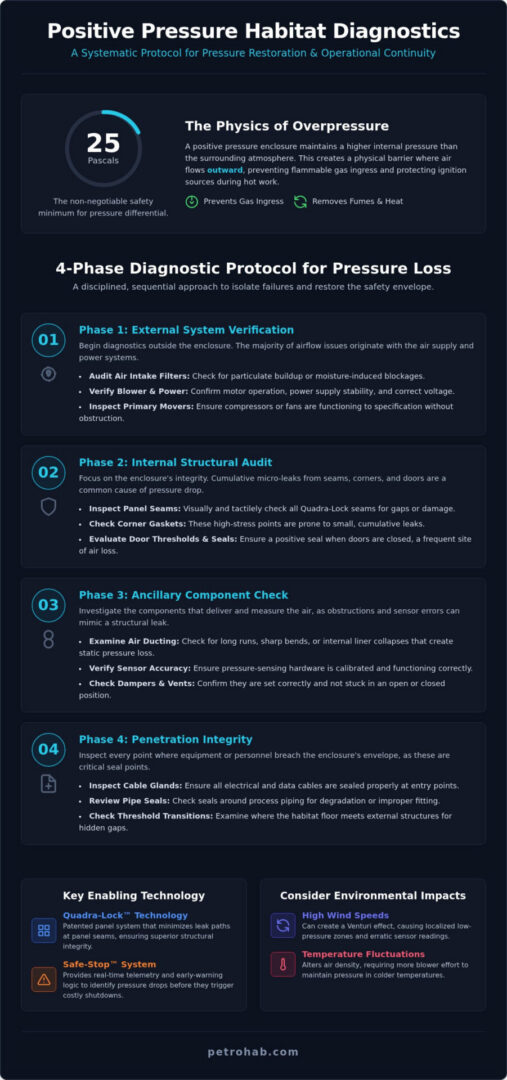
A systematic positive pressure habitat troubleshooting protocol prevents the fragmented, reactive adjustments that lead to extended downtime. When the Safe-Stop system triggers an alarm, technicians must follow a rigid hierarchy of checks to isolate the failure. This process moves from the external air supply to the internal structural integrity, ensuring that no potential leak path or mechanical deficiency is overlooked. A disciplined approach identifies the root cause quickly, allowing hot work to resume without compromising the safety envelope established by PetroHab LLC.

  • Phase 1: External System Verification. Audit the primary movers, power sources, and intake filters.
  • Phase 2: Internal Structural Audit. Execute a visual and tactile inspection of all Quadra-Lock seams and joints.
  • Phase 3: Ancillary Component Check. Evaluate the condition of ducting and the accuracy of pressure-sensing hardware.
  • Phase 4: Penetration Integrity. Inspect all cable glands, pipe seals, and threshold transitions for localized air loss.

External Air Supply Diagnostics

The diagnostic process begins outside the enclosure. Technicians must inspect air intake filters for particulate buildup or moisture-induced blockages that restrict airflow. Beyond a visual check, verify the blower motor performance by measuring the RPM and amperage draw. If the motor pulls higher-than-normal amperage, it often indicates a mechanical strain or an impending failure that limits static pressure. Inspect the PetroHab Air Ducting for sharp bends, internal liner collapses, or external punctures. Even a minor kink in the flexible ducting can significantly reduce the volume of air reaching the enclosure, making it impossible to maintain the 25 Pascal minimum.

Internal Integrity and Manometer Verification

Once the air supply is confirmed, the focus shifts to the habitat’s physical structure. Technicians should cross-reference digital Safe-Stop telemetry with analog manometers to rule out sensor drift or calibration errors. If the digital reading shows a drop but the analog gauge remains steady, the issue is likely electronic rather than structural. However, if both readings align, you must identify physical leak paths. Utilizing smoke pens or ultrasonic leak detectors along the Quadra-Lock panel seams reveals “silent” leaks that are invisible to the eye. Pay close attention to floor-to-deck seals and corner transitions; these areas are prone to shifting during active hot work. Safety managers often rely on the PetroHab HWSE for its superior modular seal integrity, which simplifies this audit by reducing the number of potential failure points compared to traditional enclosures.

Finalizing the protocol requires an audit of all penetrations. Cable glands and pipe seals must be tightened to ensure they haven’t loosened due to vibration or movement. Every opening in the enclosure is a potential exit point for pressurized air. By methodically sealing these penetrations, you ensure the internal atmosphere remains controlled and the risk of gas ingress is eliminated.

Identifying and Sealing Structural Leak Paths

Structural integrity is the foundation of any pressurized environment. In positive pressure habitat troubleshooting, identifying physical gaps requires a granular understanding of modular construction. Standard enclosures often suffer from cumulative air loss across multiple joints, which quickly compromises the safety envelope. The PetroHab Hot Work Safety Enclosure (HWSE) mitigates this risk through patented engineering designed to minimize leak paths. Standard adhesive tapes often fail in high-heat environments because their adhesives degrade or lose elasticity under stress. Technicians must use industrial-grade, fire-resistant sealing solutions designed to maintain adhesion and flexibility when temperatures rise.

Thermal expansion is a frequently overlooked factor in pressure loss. Welding generates intense localized heat that causes metal substrates and enclosure frames to expand at different rates. If the sealing system isn’t robust, this expansion creates micro-gaps at the seams. Door thresholds and corner gaskets are the most common failure points because they experience the highest mechanical stress during personnel transit. These areas require frequent inspection to ensure the 25 Pascal gradient remains intact throughout the duration of the hot work.

Mastering Quadra-Lock Panel Integrity

The interlocking “teeth” of Quadra-Lock panels must be free of debris, grit, or weld spatter to seat correctly. Any deformation in these teeth prevents a flush connection, creating a path for air to escape. Proper panel tensioning is critical; loose panels allow the integrated seals to disengage, leading to a “silent” pressure drop. Quadra-Lock technology provides a superior seal compared to traditional ‘hook and loop’ systems by creating a mechanical, interlocking barrier that physically blocks air egress.

Sealing Complex Penetrations

Irregular geometries, such as I-beams and large-diameter pipes, present the greatest challenge to enclosure integrity. Technicians should use a “stuffing box” approach for high-density cable bundles. This involves using fire-retardant pillows or specialized gaskets to fill the voids between individual cables. For structural penetrations like I-beams, custom-cut gaskets combined with fire-resistant sealant ensure a tight fit. Standard modular panels often struggle with these transitions, but the flexibility of the Quadra-Lock system allows for tighter integration around complex infrastructure. Temporary penetrations should always be secured with certified fire-retardant materials to prevent localized pressure drops that trigger the Safe-Stop system.

Managing these penetrations requires meticulousness. A single unsealed cable gland can leak enough air to trigger an early warning on the Safe-Stop telemetry. By treating every penetration as a critical failure point, you maintain the rigid standards required for offshore and refinery safety. This proactive sealing strategy is the only way to ensure operational continuity in high-stakes environments.
Positive Pressure Habitat Troubleshooting: A Technical Guide to HWSE Integrity

Troubleshooting Air Intake and Ducting Obstructions

Maintaining internal overpressure requires a rigorous approach to positive pressure habitat troubleshooting that extends beyond the enclosure seams to the air delivery infrastructure. Even a perfectly sealed structure will lose integrity if the volume of air delivered is insufficient to overcome static pressure loss. Friction within flexible ducting is a frequent culprit. Every foot of ducting and every change in direction reduces the Cubic Feet per Minute (CFM) output of the blower. High-velocity air creates turbulence at sharp bends, which significantly diminishes the pressure gradient within the enclosure.

The Safe-Stop system addresses the gap between hardware delivery and shutdown logic by monitoring airflow velocity at the intake. This real-time telemetry allows safety managers to detect internal liner collapses in flexible ducting before they cause a total pressure failure. A liner collapse occurs when the inner layer of the ducting detaches and partially obstructs the airway, an issue that is often invisible from the exterior. By integrating velocity sensors with pressure monitoring, Safe-Stop provides a dual-phase warning system that prevents the sudden shutdowns typical of less advanced hardware.

Optimizing Ducting Layout

Efficient airflow depends on a disciplined layout. Technicians must calculate the maximum allowable ducting run based on the specific blower performance curve. Standard practice dictates the elimination of 90-degree bends; use long-radius curves instead to minimize friction loss. Secure all connections with industrial-grade tension clamps. Standard worm-gear clamps often fail under high vibration, leading to blow-offs that immediately compromise the safety envelope. Positioning air intakes is equally critical. Intakes must be located upwind and at a sufficient distance from the habitat exhaust to prevent the re-circulation of welding fumes, which can trigger gas detectors and cause unnecessary downtime.

Blower Performance and ATEX Compliance

Blower units are the mechanical heart of the system and must maintain their ATEX certification through regular maintenance. Impeller wear is a gradual process that slowly erodes CFM output, making it harder to maintain the 25 Pascal minimum over time. Regular diagnostic checks should include measuring the static pressure at the blower discharge to facilitate thorough positive pressure habitat troubleshooting. For large-scale hot work safety enclosures, managing multiple blower configurations requires a synchronized approach to ensure balanced airflow. If one unit underperforms, it can create localized low-pressure zones that jeopardize the entire site safety protocol. To ensure your air delivery system meets these rigorous standards, contact PetroHab LLC for a technical assessment of your site requirements.

Leveraging Safe-Stop and Quadra-Lock for Operational Continuity

Operational continuity in hazardous environments relies on the seamless integration of structural hardware and intelligent monitoring. While previous sections focused on physical repairs, long-term success requires a shift from reactive positive pressure habitat troubleshooting to predictive management. The synergy between Quadra-Lock panels and the Safe-Stop system provides a multi-layered defense that minimizes the risk of unplanned shutdowns. By utilizing real-time telemetry, safety managers can maintain the 25 Pascal threshold while optimizing work schedules during critical turnaround projects.

Modern hot work safety systems utilize sophisticated logic to distinguish between minor fluctuations and critical failures. The Safe-Stop system employs an ‘Early Warning’ phase that alerts technicians to pressure drops before they reach the mandatory shutdown limit. This allows for minor adjustments to seals or air supply without halting production. Conversely, the ‘Hard Shutdown’ logic acts as a fail-safe, instantly isolating ignition sources if the safety envelope is breached. This dual-phase approach ensures that safety isn’t compromised while preventing the financial losses associated with unnecessary work stoppages.

The role of certified on-site supervision and training is equally vital in maintaining enclosure integrity. Human error, such as failing to secure a door latch or improperly tensioning a panel, remains a leading cause of pressure loss. Professional oversight ensures that every component of the PetroHab Hot Work Safety Enclosure (HWSE) is installed and maintained according to rigorous technical standards. This expert guidance transforms the hardware from a simple barrier into a high-performance safety system.

Predictive Maintenance with Safe-Stop Data

Analyzing historical pressure logs allows safety teams to identify gradual seal degradation over time. If the data shows a consistent, incremental increase in blower effort to maintain the same pressure, it’s an indication of a structural leak or filter blockage. Setting ‘Pre-Alarm’ thresholds provides a window for proactive positive pressure habitat troubleshooting during scheduled breaks. The Safe-Stop system acts as the centralized brain of the pressurized welding habitat, coordinating sensor data to ensure constant environmental control.

Engineering Reliability into the Hot Work Zone

The modularity of the Quadra-Lock system significantly reduces the mean time to repair (MTTR) for enclosures. Because panels are interchangeable and utilize a mechanical interlocking mechanism, damaged sections can be replaced in minutes rather than hours. This reliability is enhanced by integrating gas detection with pressure monitoring, creating a redundant safety architecture. Every hot work session should conclude with a verified pressure stability test as part of the Permit-to-Work (PTW) audit. This final validation confirms that the enclosure is resilient enough to withstand the operational rigors of the shift ahead.

Securing Operational Continuity with Engineering Precision

Maintaining the integrity of a hot work safety enclosure is an exercise in technical discipline. By implementing the systematic approach outlined in this guide, you move beyond reactive maintenance to a state of absolute operational control. Effective positive pressure habitat troubleshooting depends on your ability to reconcile real-time Safe-Stop telemetry with physical structural audits. You now possess the framework to identify cumulative leak paths, optimize air delivery layouts, and ensure compliance with rigorous BSEE and OSHA standards.

Relying on patented Quadra-Lock sealing technology and ATEX and IECEx certified systems eliminates the guesswork from hazardous area isolation. Our global 24/7 technical support ensures that your site remains protected regardless of environmental challenges or complex penetration requirements. Protecting your personnel and high-value assets is a continuous duty that demands the most resilient equipment available. Take the next step in securing your facility’s future and ensuring safety excellence.

Request a Technical Consultation or HWSE Rental Quote to integrate these industry-leading safety standards into your next project. Your commitment to meticulous risk mitigation starts with the right engineering partner.

Frequently Asked Questions

What is the minimum positive pressure required for an HWSE?

The industry standard for a Hot Work Safety Enclosure (HWSE) is a minimum of 25 Pascals, which is equivalent to 0.1 column inches of water. This specific pressure gradient is mandated by BSEE and international safety protocols to ensure a definitive physical barrier against the ingress of flammable gases. Maintaining this threshold is critical for regulatory compliance and the protection of personnel in hazardous environments.

How does the Safe-Stop system respond to a sudden loss of pressure?

The Safe-Stop system initiates an immediate automatic shutdown of all connected hot work equipment the moment pressure falls below the 25 Pascal set-point. By removing the ignition source instantly, the system prevents a catastrophic event before hazardous gases can penetrate the enclosure. This fail-safe mechanism ensures that safety is managed by precise electronic logic rather than human reaction time.

Can I use standard duct tape to seal leaks in a pressurized habitat?

Standard duct tape is insufficient for industrial safety applications because its adhesive degrades rapidly under the high-heat conditions of welding and grinding. You must use certified industrial-grade, fire-resistant sealing solutions designed to maintain their bond during thermal expansion. Utilizing Quadra-Lock panels further reduces the reliance on temporary seals by providing a mechanical, interlocking joint that blocks air egress more effectively.

What are the most common causes of a low-pressure alarm on an offshore platform?

Low-pressure alarms are typically caused by cumulative micro-leaks at door thresholds, panel seams, or unsealed cable penetrations. On offshore platforms, high wind speeds can create a Venturi effect that produces localized low-pressure zones, tricking sensors and necessitating positive pressure habitat troubleshooting. Other frequent root causes include internal liner collapses in flexible ducting or particulate buildup in blower intake filters.

How often should manometers be calibrated in a pressurized welding habitat?

Technicians should perform a zero-point verification on all manometers before the start of every work shift to ensure baseline accuracy. Formal calibration must occur according to the manufacturer’s schedule or local regulatory requirements to rule out sensor drift. Cross-referencing digital Safe-Stop telemetry with analog gauges provides a necessary layer of redundancy, ensuring that pressure readings remain reliable throughout the project duration.

What role does wind speed play in maintaining habitat pressure?

High wind speeds can significantly impact habitat stability by creating pressure differentials across the enclosure’s exterior surfaces. Moving air can pull internal pressure out through minor gaps, requiring blowers to work harder to maintain the safety gradient. Enclosures must be positioned and secured to withstand these atmospheric variables, and intake volumes may require manual adjustment during periods of extreme weather to prevent nuisance alarms.

How do I seal a habitat around a complex pipe penetration?

Sealing irregular geometries requires a “stuffing box” approach using fire-retardant pillows and specialized gaskets to fill voids. For complex intersections involving I-beams or high-density cable bundles, custom-cut fire-resistant materials must be applied to ensure a flush fit. This meticulous sealing prevents localized pressure drops that would otherwise compromise the entire safety envelope and trigger the Safe-Stop system’s early warning logic.

What is the difference between a hard shutdown and a warning alarm in the Safe-Stop system?

A warning alarm is a predictive alert that triggers when pressure trends downward but has not yet breached the 25 Pascal safety limit. This allows technicians to perform positive pressure habitat troubleshooting and adjust seals without stopping work. A hard shutdown is a definitive safety action that occurs the moment pressure hits the critical threshold, instantly terminating power to all welding and grinding tools to eliminate ignition risks.

Positive Pressure Habitat Troubleshooting: A Technical Guide to HWSE Integrity

What if the primary threat to your project timeline isn’t a mechanical failure, but a cumulative loss of air pressure measured in mere Pascals? You recognize that maintaining a pressurized environment is the only reliable way to isolate ignition sources from flammable gases, yet finding the source of a pressure drop often feels like chasing ghosts in a complex industrial site. Effective positive pressure habitat troubleshooting requires moving beyond guesswork to adopt a disciplined, engineering-led diagnostic framework. PetroHab LLC provides the specialized technology and procedural expertise necessary to restore integrity and ensure that your site remains in full regulatory compliance.

This technical guide delivers a comprehensive protocol for identifying and resolving pressure loss before it triggers a costly automatic shutdown. Operational continuity depends on precision. Safety is an active pursuit. You’ll learn how to audit external air supply systems, seal complex structural penetrations, and leverage real-time telemetry to maintain stability. By mastering these diagnostic steps, you ensure that your Hot Work Safety Enclosure remains a resilient barrier against explosive atmospheres.

Key Takeaways

  • Master a two-phase diagnostic protocol that separates external air-supply verification from internal structural audits to isolate pressure loss quickly.
  • Apply systematic positive pressure habitat troubleshooting to identify cumulative micro-leaks in corner gaskets and door thresholds that often bypass basic inspections.
  • Utilize patented Quadra-Lock technology to minimize panel-seam leak paths, ensuring the structural integrity required to maintain the 25 Pascal safety threshold.
  • Recognize how ducting length and internal liner collapses contribute to static pressure loss, preventing common airflow obstructions that trigger system alarms.
  • Leverage Safe-Stop telemetry and early-warning logic to identify pressure trends before they escalate into high-cost, automatic production shutdowns.

The Physics of Positive Pressure in Hot Work Safety Enclosures

Understanding the fundamental physics of air pressure is the first step in effective positive pressure habitat troubleshooting. A Positive pressure enclosure operates on a critical differential: maintaining a higher internal pressure than the surrounding atmosphere. This creates a physical barrier. If a structural breach occurs, air flows out rather than allowing flammable gases to enter. This principle of overpressure is the primary engineering control used to isolate ignition sources from potentially explosive environments.

The 25 Pascal (0.1 column inches of water) standard is the non-negotiable safety minimum. Regulatory bodies like BSEE mandate this specific metric because it provides a sufficient safety margin against external atmospheric fluctuations without compromising the structural integrity of the enclosure. Maintaining this gradient is essential for compliance and risk mitigation. If the pressure drops below this threshold, the risk of gas ingress increases exponentially, necessitating immediate diagnostic action.

Beyond ingress prevention, this pressure gradient facilitates a “sweeping” effect. Constant air exchange, typically calibrated for high-volume turnover, removes hazardous welding fumes and particulates from the workspace. This ensures a breathable atmosphere for personnel and prevents the buildup of heat. The relationship between air exchange rates and pressure is linear; high-volume blowers must supply enough air to overcome both intentional exhaust and unintentional leak paths to maintain a consistent gradient.

Pressure as a Risk Mitigation Tool

Pressurization acts as the primary defense in Zone 1 or Zone 2 hazardous areas. Adhering to NFPA 51B and ATEX standards ensures that hot work ignition sources remain isolated. The Safe-Stop Automatic Shutdown System provides the necessary real-time telemetry to manage this risk. It monitors pressure differentials constantly. If the pressure falls below the 25 Pascal threshold, the system initiates an immediate shutdown of all hot work equipment to prevent a catastrophic event. This automation removes human error from the safety equation.

Environmental Impacts on Habitat Stability

Offshore environments introduce variables that challenge pressure stability. High wind speeds can create a Venturi effect, where moving air produces localized low-pressure zones outside the habitat. This can trick sensors or cause erratic readings. Ambient temperature fluctuations also alter air density. Cold, dense air requires more blower effort to maintain the same pressure as warm air. When personnel encounter fluctuating readings, positive pressure habitat troubleshooting must account for these atmospheric variables. Engineers must also consider the “stack effect” in vertical configurations, where pressure varies between the floor and the ceiling. The PetroHab Hot Work Safety Enclosure (HWSE) is designed to withstand these dynamics, but manual adjustments to intake volumes are occasionally required to maintain the safety envelope.

Step-by-Step Diagnostic Protocol for Pressure Restoration

A systematic positive pressure habitat troubleshooting protocol prevents the fragmented, reactive adjustments that lead to extended downtime. When the Safe-Stop system triggers an alarm, technicians must follow a rigid hierarchy of checks to isolate the failure. This process moves from the external air supply to the internal structural integrity, ensuring that no potential leak path or mechanical deficiency is overlooked. A disciplined approach identifies the root cause quickly, allowing hot work to resume without compromising the safety envelope established by PetroHab LLC.

  • Phase 1: External System Verification. Audit the primary movers, power sources, and intake filters.
  • Phase 2: Internal Structural Audit. Execute a visual and tactile inspection of all Quadra-Lock seams and joints.
  • Phase 3: Ancillary Component Check. Evaluate the condition of ducting and the accuracy of pressure-sensing hardware.
  • Phase 4: Penetration Integrity. Inspect all cable glands, pipe seals, and threshold transitions for localized air loss.

External Air Supply Diagnostics

The diagnostic process begins outside the enclosure. Technicians must inspect air intake filters for particulate buildup or moisture-induced blockages that restrict airflow. Beyond a visual check, verify the blower motor performance by measuring the RPM and amperage draw. If the motor pulls higher-than-normal amperage, it often indicates a mechanical strain or an impending failure that limits static pressure. Inspect the PetroHab Air Ducting for sharp bends, internal liner collapses, or external punctures. Even a minor kink in the flexible ducting can significantly reduce the volume of air reaching the enclosure, making it impossible to maintain the 25 Pascal minimum.

Internal Integrity and Manometer Verification

Once the air supply is confirmed, the focus shifts to the habitat’s physical structure. Technicians should cross-reference digital Safe-Stop telemetry with analog manometers to rule out sensor drift or calibration errors. If the digital reading shows a drop but the analog gauge remains steady, the issue is likely electronic rather than structural. However, if both readings align, you must identify physical leak paths. Utilizing smoke pens or ultrasonic leak detectors along the Quadra-Lock panel seams reveals “silent” leaks that are invisible to the eye. Pay close attention to floor-to-deck seals and corner transitions; these areas are prone to shifting during active hot work. Safety managers often rely on the PetroHab HWSE for its superior modular seal integrity, which simplifies this audit by reducing the number of potential failure points compared to traditional enclosures.

Finalizing the protocol requires an audit of all penetrations. Cable glands and pipe seals must be tightened to ensure they haven’t loosened due to vibration or movement. Every opening in the enclosure is a potential exit point for pressurized air. By methodically sealing these penetrations, you ensure the internal atmosphere remains controlled and the risk of gas ingress is eliminated.

Identifying and Sealing Structural Leak Paths

Structural integrity is the foundation of any pressurized environment. In positive pressure habitat troubleshooting, identifying physical gaps requires a granular understanding of modular construction. Standard enclosures often suffer from cumulative air loss across multiple joints, which quickly compromises the safety envelope. The PetroHab Hot Work Safety Enclosure (HWSE) mitigates this risk through patented engineering designed to minimize leak paths. Standard adhesive tapes often fail in high-heat environments because their adhesives degrade or lose elasticity under stress. Technicians must use industrial-grade, fire-resistant sealing solutions designed to maintain adhesion and flexibility when temperatures rise.

Thermal expansion is a frequently overlooked factor in pressure loss. Welding generates intense localized heat that causes metal substrates and enclosure frames to expand at different rates. If the sealing system isn’t robust, this expansion creates micro-gaps at the seams. Door thresholds and corner gaskets are the most common failure points because they experience the highest mechanical stress during personnel transit. These areas require frequent inspection to ensure the 25 Pascal gradient remains intact throughout the duration of the hot work.

Mastering Quadra-Lock Panel Integrity

The interlocking “teeth” of Quadra-Lock panels must be free of debris, grit, or weld spatter to seat correctly. Any deformation in these teeth prevents a flush connection, creating a path for air to escape. Proper panel tensioning is critical; loose panels allow the integrated seals to disengage, leading to a “silent” pressure drop. Quadra-Lock technology provides a superior seal compared to traditional ‘hook and loop’ systems by creating a mechanical, interlocking barrier that physically blocks air egress.

Sealing Complex Penetrations

Irregular geometries, such as I-beams and large-diameter pipes, present the greatest challenge to enclosure integrity. Technicians should use a “stuffing box” approach for high-density cable bundles. This involves using fire-retardant pillows or specialized gaskets to fill the voids between individual cables. For structural penetrations like I-beams, custom-cut gaskets combined with fire-resistant sealant ensure a tight fit. Standard modular panels often struggle with these transitions, but the flexibility of the Quadra-Lock system allows for tighter integration around complex infrastructure. Temporary penetrations should always be secured with certified fire-retardant materials to prevent localized pressure drops that trigger the Safe-Stop system.

Managing these penetrations requires meticulousness. A single unsealed cable gland can leak enough air to trigger an early warning on the Safe-Stop telemetry. By treating every penetration as a critical failure point, you maintain the rigid standards required for offshore and refinery safety. This proactive sealing strategy is the only way to ensure operational continuity in high-stakes environments.

Positive Pressure Habitat Troubleshooting: A Technical Guide to HWSE Integrity

Troubleshooting Air Intake and Ducting Obstructions

Maintaining internal overpressure requires a rigorous approach to positive pressure habitat troubleshooting that extends beyond the enclosure seams to the air delivery infrastructure. Even a perfectly sealed structure will lose integrity if the volume of air delivered is insufficient to overcome static pressure loss. Friction within flexible ducting is a frequent culprit. Every foot of ducting and every change in direction reduces the Cubic Feet per Minute (CFM) output of the blower. High-velocity air creates turbulence at sharp bends, which significantly diminishes the pressure gradient within the enclosure.

The Safe-Stop system addresses the gap between hardware delivery and shutdown logic by monitoring airflow velocity at the intake. This real-time telemetry allows safety managers to detect internal liner collapses in flexible ducting before they cause a total pressure failure. A liner collapse occurs when the inner layer of the ducting detaches and partially obstructs the airway, an issue that is often invisible from the exterior. By integrating velocity sensors with pressure monitoring, Safe-Stop provides a dual-phase warning system that prevents the sudden shutdowns typical of less advanced hardware.

Optimizing Ducting Layout

Efficient airflow depends on a disciplined layout. Technicians must calculate the maximum allowable ducting run based on the specific blower performance curve. Standard practice dictates the elimination of 90-degree bends; use long-radius curves instead to minimize friction loss. Secure all connections with industrial-grade tension clamps. Standard worm-gear clamps often fail under high vibration, leading to blow-offs that immediately compromise the safety envelope. Positioning air intakes is equally critical. Intakes must be located upwind and at a sufficient distance from the habitat exhaust to prevent the re-circulation of welding fumes, which can trigger gas detectors and cause unnecessary downtime.

Blower Performance and ATEX Compliance

Blower units are the mechanical heart of the system and must maintain their ATEX certification through regular maintenance. Impeller wear is a gradual process that slowly erodes CFM output, making it harder to maintain the 25 Pascal minimum over time. Regular diagnostic checks should include measuring the static pressure at the blower discharge to facilitate thorough positive pressure habitat troubleshooting. For large-scale hot work safety enclosures, managing multiple blower configurations requires a synchronized approach to ensure balanced airflow. If one unit underperforms, it can create localized low-pressure zones that jeopardize the entire site safety protocol. To ensure your air delivery system meets these rigorous standards, contact PetroHab LLC for a technical assessment of your site requirements.

Leveraging Safe-Stop and Quadra-Lock for Operational Continuity

Operational continuity in hazardous environments relies on the seamless integration of structural hardware and intelligent monitoring. While previous sections focused on physical repairs, long-term success requires a shift from reactive positive pressure habitat troubleshooting to predictive management. The synergy between Quadra-Lock panels and the Safe-Stop system provides a multi-layered defense that minimizes the risk of unplanned shutdowns. By utilizing real-time telemetry, safety managers can maintain the 25 Pascal threshold while optimizing work schedules during critical turnaround projects.

Modern hot work safety systems utilize sophisticated logic to distinguish between minor fluctuations and critical failures. The Safe-Stop system employs an ‘Early Warning’ phase that alerts technicians to pressure drops before they reach the mandatory shutdown limit. This allows for minor adjustments to seals or air supply without halting production. Conversely, the ‘Hard Shutdown’ logic acts as a fail-safe, instantly isolating ignition sources if the safety envelope is breached. This dual-phase approach ensures that safety isn’t compromised while preventing the financial losses associated with unnecessary work stoppages.

The role of certified on-site supervision and training is equally vital in maintaining enclosure integrity. Human error, such as failing to secure a door latch or improperly tensioning a panel, remains a leading cause of pressure loss. Professional oversight ensures that every component of the PetroHab Hot Work Safety Enclosure (HWSE) is installed and maintained according to rigorous technical standards. This expert guidance transforms the hardware from a simple barrier into a high-performance safety system.

Predictive Maintenance with Safe-Stop Data

Analyzing historical pressure logs allows safety teams to identify gradual seal degradation over time. If the data shows a consistent, incremental increase in blower effort to maintain the same pressure, it’s an indication of a structural leak or filter blockage. Setting ‘Pre-Alarm’ thresholds provides a window for proactive positive pressure habitat troubleshooting during scheduled breaks. The Safe-Stop system acts as the centralized brain of the pressurized welding habitat, coordinating sensor data to ensure constant environmental control.

Engineering Reliability into the Hot Work Zone

The modularity of the Quadra-Lock system significantly reduces the mean time to repair (MTTR) for enclosures. Because panels are interchangeable and utilize a mechanical interlocking mechanism, damaged sections can be replaced in minutes rather than hours. This reliability is enhanced by integrating gas detection with pressure monitoring, creating a redundant safety architecture. Every hot work session should conclude with a verified pressure stability test as part of the Permit-to-Work (PTW) audit. This final validation confirms that the enclosure is resilient enough to withstand the operational rigors of the shift ahead.

Securing Operational Continuity with Engineering Precision

Maintaining the integrity of a hot work safety enclosure is an exercise in technical discipline. By implementing the systematic approach outlined in this guide, you move beyond reactive maintenance to a state of absolute operational control. Effective positive pressure habitat troubleshooting depends on your ability to reconcile real-time Safe-Stop telemetry with physical structural audits. You now possess the framework to identify cumulative leak paths, optimize air delivery layouts, and ensure compliance with rigorous BSEE and OSHA standards.

Relying on patented Quadra-Lock sealing technology and ATEX and IECEx certified systems eliminates the guesswork from hazardous area isolation. Our global 24/7 technical support ensures that your site remains protected regardless of environmental challenges or complex penetration requirements. Protecting your personnel and high-value assets is a continuous duty that demands the most resilient equipment available. Take the next step in securing your facility’s future and ensuring safety excellence.

Request a Technical Consultation or HWSE Rental Quote to integrate these industry-leading safety standards into your next project. Your commitment to meticulous risk mitigation starts with the right engineering partner.

Frequently Asked Questions

What is the minimum positive pressure required for an HWSE?

The industry standard for a Hot Work Safety Enclosure (HWSE) is a minimum of 25 Pascals, which is equivalent to 0.1 column inches of water. This specific pressure gradient is mandated by BSEE and international safety protocols to ensure a definitive physical barrier against the ingress of flammable gases. Maintaining this threshold is critical for regulatory compliance and the protection of personnel in hazardous environments.

How does the Safe-Stop system respond to a sudden loss of pressure?

The Safe-Stop system initiates an immediate automatic shutdown of all connected hot work equipment the moment pressure falls below the 25 Pascal set-point. By removing the ignition source instantly, the system prevents a catastrophic event before hazardous gases can penetrate the enclosure. This fail-safe mechanism ensures that safety is managed by precise electronic logic rather than human reaction time.

Can I use standard duct tape to seal leaks in a pressurized habitat?

Standard duct tape is insufficient for industrial safety applications because its adhesive degrades rapidly under the high-heat conditions of welding and grinding. You must use certified industrial-grade, fire-resistant sealing solutions designed to maintain their bond during thermal expansion. Utilizing Quadra-Lock panels further reduces the reliance on temporary seals by providing a mechanical, interlocking joint that blocks air egress more effectively.

What are the most common causes of a low-pressure alarm on an offshore platform?

Low-pressure alarms are typically caused by cumulative micro-leaks at door thresholds, panel seams, or unsealed cable penetrations. On offshore platforms, high wind speeds can create a Venturi effect that produces localized low-pressure zones, tricking sensors and necessitating positive pressure habitat troubleshooting. Other frequent root causes include internal liner collapses in flexible ducting or particulate buildup in blower intake filters.

How often should manometers be calibrated in a pressurized welding habitat?

Technicians should perform a zero-point verification on all manometers before the start of every work shift to ensure baseline accuracy. Formal calibration must occur according to the manufacturer’s schedule or local regulatory requirements to rule out sensor drift. Cross-referencing digital Safe-Stop telemetry with analog gauges provides a necessary layer of redundancy, ensuring that pressure readings remain reliable throughout the project duration.

What role does wind speed play in maintaining habitat pressure?

High wind speeds can significantly impact habitat stability by creating pressure differentials across the enclosure’s exterior surfaces. Moving air can pull internal pressure out through minor gaps, requiring blowers to work harder to maintain the safety gradient. Enclosures must be positioned and secured to withstand these atmospheric variables, and intake volumes may require manual adjustment during periods of extreme weather to prevent nuisance alarms.

How do I seal a habitat around a complex pipe penetration?

Sealing irregular geometries requires a “stuffing box” approach using fire-retardant pillows and specialized gaskets to fill voids. For complex intersections involving I-beams or high-density cable bundles, custom-cut fire-resistant materials must be applied to ensure a flush fit. This meticulous sealing prevents localized pressure drops that would otherwise compromise the entire safety envelope and trigger the Safe-Stop system’s early warning logic.

What is the difference between a hard shutdown and a warning alarm in the Safe-Stop system?

A warning alarm is a predictive alert that triggers when pressure trends downward but has not yet breached the 25 Pascal safety limit. This allows technicians to perform positive pressure habitat troubleshooting and adjust seals without stopping work. A hard shutdown is a definitive safety action that occurs the moment pressure hits the critical threshold, instantly terminating power to all welding and grinding tools to eliminate ignition risks.