Blog Posts
Hot Work Habitat for FPSO Maintenance: How It Works
On an FPSO, welding near live process units requires control of the atmosphere around the work, not just a barrier around sparks. A hot work habitat for FPSO maintenance is a pressurized enclosure that supplies air to help maintain positive pressure, directing airflow outward and helping keep surrounding gases and vapours from entering the welding zone. It combines environmental control with the physical protection of an enclosure.
That distinction matters during maintenance and shutdown work, when hot work may take place close to operating equipment. A habitat provides a physical enclosure; a pressurized habitat also manages airflow for work in hazardous environments where flammable atmospheres may be possible.
This article explains how pressurized welding enclosures work, where they are used offshore and during industrial shutdowns, and which project factors shape the system. It covers the enclosure, air supply, access points and gas detection, as well as how a design can be adapted to the work area and operating conditions.
Key Takeaways
- Understand how filtered air and positive pressure help limit the entry of surrounding gases and contaminants into a welding enclosure.
- See where portable pressurized habitats can support short-term industrial maintenance and shutdown work.
- Learn how these enclosures are used for offshore and petrochemical hot work, including maintenance near live process units.
- Identify the design considerations that shape a project-specific habitat, from fire-resistant materials to system compatibility.
WHAT IS A PRESSURIZED WELDING ENCLOSURE?
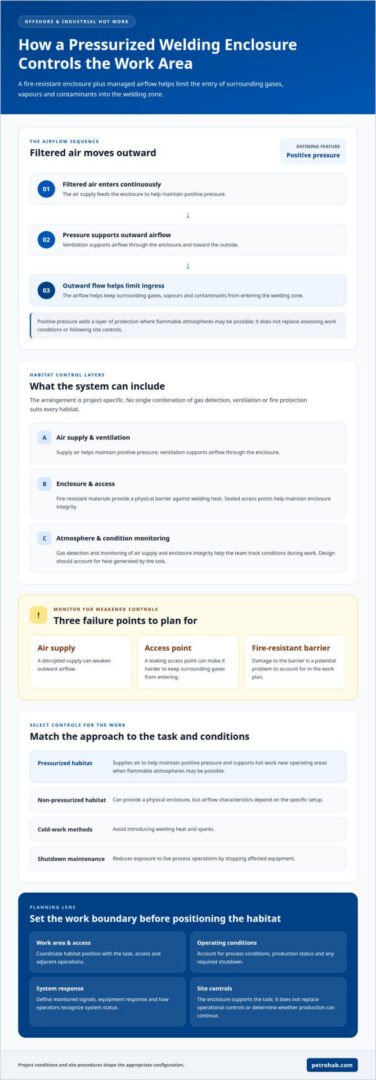
A pressurized welding enclosure combines a fire-resistant barrier with controlled airflow around hot work. Its defining feature is positive pressure: filtered air enters continuously and flows outward, helping keep surrounding gases, vapours, and contaminants from entering the welding zone.
Gas, Pressure, and Temperature Safety Systems
Gas, pressure, and temperature safety systems manage the atmosphere and conditions inside a welding habitat. For the worksite team, their purpose is to support controlled hot work without treating the enclosure as a substitute for site procedures.
The air supply helps maintain positive pressure, while ventilation supports airflow through the enclosure. Habitat design can include sealed access points and gas detection. Fire-resistant materials provide a physical barrier against welding heat, and the design should account for heat generated during the task.
Habitat Monitoring, Protection, and Failure Modes
Monitoring a habitat involves the air supply, enclosure integrity and gas levels during work. A disrupted air supply or compromised seal can weaken outward airflow and make it harder to keep surrounding gases from entering.
Offshore, the habitat is positioned around the designated work area, access points are secured, and air is supplied to establish positive pressure. Ventilation supports airflow, while gas monitoring and fire-resistant materials contribute to the planned controls. The work plan should account for potential problems such as loss of air supply, a leaking access point or damage to the fire-resistant barrier.
A non-pressurized habitat may provide a physical enclosure, but its airflow characteristics depend on the specific setup. A pressurized version supplies air to help maintain positive pressure, adding a layer of protection where flammable atmospheres may be possible. It does not remove the need to assess work conditions and follow site controls.
Cold-work methods avoid introducing welding heat and sparks, while shutdown maintenance reduces exposure to live process operations by stopping affected equipment. A pressurized habitat supports hot work near operating areas, but does not make hot work interchangeable with those alternatives.
No single gas detection, ventilation or fire protection arrangement suits every habitat. A system may combine air supply, ventilation, fire-resistant construction, sealed access and gas detection. Project conditions and site procedures determine the appropriate configuration.
Industrial maintenance and shutdown projects
Portable pressurized welding habitats can support short-term industrial maintenance and modification work. Before welding starts, planning should connect the task and work area with production status and shutdown controls.
Maintenance and Shutdown Project Use
An industrial maintenance habitat is a temporary enclosure for welding or modification tasks during a maintenance window. It provides a contained work area for short-term repairs where fixed facilities are impractical. For a pipe modification, planners coordinate the habitat’s position with access, adjacent operations, ventilation and the work permit. During a shutdown, hot work can be scheduled alongside other maintenance tasks.
Hot Work Without Production Shutdowns
A pressurized habitat can support hot work near operating areas, but its presence alone does not determine whether production can continue. Operations teams assess the work scope, nearby equipment, process conditions and site controls. If the work requires equipment isolation or shutdown, installing an enclosure does not replace those measures. This helps planners compare the habitat option with cold-work methods and scheduled shutdown work.
PLC monitoring can coordinate defined input signals with configured control logic. For example, a project may connect habitat monitoring and designated equipment controls to a PLC so the system responds to a specified abnormal condition. The control sequence should state which signals are monitored, which equipment responds and how operators recognize the system’s status. Include these details in the project’s control and work plans.
Automatic ignition-source shutdown means stopping designated ignition-producing equipment when a defined trigger occurs. Operators should understand the trigger, affected equipment and reset process before work begins. This function can form part of a broader hot-work control arrangement, but does not by itself establish whether nearby production can remain online.
For maintenance planning, map the work boundary, production interfaces and shutdown logic before positioning the habitat. This helps teams determine whether the task fits a short-term maintenance window or requires coordinated shutdown work.
Offshore oil and gas and petrochemical applications
On an FPSO, pressurized welding habitats support hot work near live process units during maintenance and shutdown projects. Their use must be planned around the facility’s operating conditions and applicable offshore restrictions.
FPSO and Offshore Hot Work
An offshore hot-work habitat creates an enclosed work area for welding on FPSOs, platforms and at petrochemical facilities. When maintenance requires hot work near process operations, the work boundary and operating status shape the plan.
Refineries and petrochemical plants also use pressurized habitats for hot work. For an FPSO repair, planners coordinate the work location with nearby process equipment, the maintenance scope and any required shutdown. The enclosure supports the task, but does not replace operational controls or determine whether production can continue.
Mobilization and Installation
Mobilization and installation involve transporting the habitat to the FPSO, positioning it and preparing it for the planned work. The work location, access, deck layout, equipment movement and fit between the enclosure and repair area all affect the plan.
Installation planning also covers the air supply, access points, ventilation and monitoring interfaces. A confined work area or complex route to the job can change the installation sequence and duration. Coordinating these factors with the maintenance window helps build a realistic schedule without assuming a fixed installation time.
For offshore operations, BSEE regulations prohibit welding within 10 feet of pressurized process equipment or the perimeter of a well bay unless the platform is shut in. The stated exception is tied to the platform being shut in; it should not be treated as an informal waiver. This restriction makes equipment location and operating status central to task planning.
Before mobilization, map the worksite in relation to process equipment and the well-bay perimeter. Then align the proposed hot work with the facility’s operating plan and shutdown status. This helps determine whether the work location falls within the stated restriction and whether the schedule needs adjustment.
Custom engineering for industrial hot work
Custom engineering adapts a habitat system to the worksite, task and operating interfaces. An FPSO repair area, for example, differs from a refinery vessel or a restricted pipeline workspace. A design review should connect the welding scope with site geometry, material requirements, air supply, access and monitoring interfaces. The aim is a system that works together, not an enclosure considered in isolation.
Start with the work area and access route. A habitat for a vessel repair must accommodate the task while fitting the available space and planned access. Then assess material fire resistance and dimensional stability. PetroHab’s habitats use fire-resistant materials, including silicone-coated fiberglass cloth, for hot-work applications. Material properties should be considered alongside project requirements.
Then review compatibility across the system. Air supply, ventilation, sealed access, and gas detection interfaces need to align with the habitat design and worksite arrangements. A mismatch can undermine the planned setup; for example, an access point that conflicts with the repair position may complicate enclosure layout. Customization should therefore resolve practical interfaces before equipment is mobilized.
Buyers should assess design experience, customization, system compatibility, quality control, and lead time, as well as material fire resistance. These factors connect engineering choices to project execution. Quality control supports consistent fabrication, while lead time affects how the system fits the maintenance schedule. The project’s work scope and operating environment determine which considerations carry the greatest weight.
A useful review traces each requirement to a design decision: work location to enclosure layout, heat exposure to material selection, and monitoring needs to system compatibility. This creates a clear basis for project-specific engineering rather than relying on a generic configuration. Discuss project-specific hot-work requirements as the design moves from scope definition to system selection.
PetroHab: Safe-Stop Automatic Shutdown System
PetroHab’s Safe-Stop Safety Shutdown System (SSS) is relevant when a hot-work plan includes automatic shutdown controls. It gives project teams a specific system to consider alongside the worksite’s ignition-source control strategy.
For an FPSO maintenance project, identify the intended shutdown function, the equipment it affects, and how operators will recognize system status. These details help align the system with the project’s control plan. PetroHab also offers pressurized welding enclosures, pressurized habitats, and Quadra-Lock Panels for hot-work habitat applications.
Consider the Safe-Stop Safety Shutdown System when planning how automatic shutdown fits into the broader habitat arrangement. The work scope, site conditions and control interfaces should guide the system-level discussion.
Contact PetroHab to discuss your hot-work habitat requirements.
Move from Work Scope to Project Design
For a hot work habitat for FPSO maintenance, start by translating the task scope into clear design requirements. Define the work location, operating conditions, access needs and control interfaces. This gives the project team a practical basis for aligning the habitat with the maintenance plan before mobilization.
PetroHab offers the Petro-Habitat™ HWSE, Petro-Shield™ HWSE and Petro-Lite™ HWSE, along with the Safe-Stop Safety Shutdown System and Quadra-Lock® panels. These products address different elements of hot-work enclosure and shutdown planning. Project teams can discuss how they fit the work scope and site requirements, without treating any single component as a substitute for operational controls.
Bring the planned task, worksite constraints and maintenance schedule into the project discussion. A clear scope helps focus the design conversation on the interfaces that matter for execution.
Contact PetroHab to discuss your project and take the next step toward a defined hot-work plan.
Frequently Asked Questions
What is a hot work habitat for FPSO maintenance and how does it work?
A hot work habitat for FPSO maintenance is a fire-resistant enclosure that supports welding in a controlled work area. In a pressurized model, supplied air helps maintain positive pressure and outward airflow. Before a planned weld near process equipment, teams can map the repair location, enclosure boundary and nearby operations. The habitat supports the work plan, but does not itself authorize hot work.
What types of FPSO maintenance require a hot work habitat?
A habitat may suit maintenance or modification work involving welding near process units, such as a planned pipeline or vessel repair. The deciding factors include the need for hot work, its location and nearby operations. For example, a repair that can use a cold-work method may not need a welding enclosure. Let the work scope guide the choice.
What are the key safety requirements for offshore hot work habitats?
Plan the habitat around fire-resistant construction, filtered air supply, ventilation, sealed access points, and gas-detection compatibility. Before work starts, align those elements with the task location and facility controls. For example, confirm that the planned enclosure boundary and access arrangement fit the repair area, and define how personnel will monitor conditions and respond if airflow or enclosure integrity is disrupted.
What regulations and standards govern hot work habitats on FPSOs?
Requirements depend on the offshore jurisdiction and facility procedures. In the United States, BSEE regulations prohibit welding within 10 feet of pressurized process equipment or the perimeter of a well bay unless the platform is shut in. That restriction is specific to the stated conditions. Identify the rules that apply to the FPSO’s location and the planned work before scheduling hot work.
What permits, inspections, and emergency plans are needed before hot work begins on an FPSO?
Prepare the facility’s hot-work authorization around the task scope, work location, nearby process equipment, and operating or shutdown status. A pre-work inspection can cover enclosure condition, access seals, air supply, ventilation, and monitoring arrangements. The emergency plan should identify how crews communicate, stop work, and respond to changing conditions. Site procedures determine the required permit and approval process.