Blog Posts
Temporary pipeline hot work habitats for hazardous gas exclusion
A temporary habitat for pipeline hot work must do more than surround a weld. It should help exclude hazardous gas while supporting controlled welding conditions. Positive pressure can help prevent flammable gas from entering the work area, but the habitat is only one part of the site’s hot-work controls. Configure it to suit the hazards, permit requirements, and emergency plan.
This distinction matters on pipeline jobs, where a temporary enclosure must accommodate the welding task without overlooking conditions around the worksite. Gas monitoring, ventilation, fire watch, access control, and escape routes remain part of the overall safety plan.
This article explains how positive pressure helps exclude gas, what the habitat needs to accommodate, and how site risks and hazardous-area requirements shape the setup. It also covers key considerations when selecting a modular enclosure, including airflow, fumes, fire-resistant construction, and emergency response. Use these points to plan the habitat as one component of a coordinated hot-work system, not as a standalone guarantee.
Key Takeaways
- Positive pressure can help prevent flammable gas from entering the welding area; treat it as one layer of a wider hot-work safety plan.
- Match the enclosure to the pipe weld, with attention to fumes, ventilation, access, communication, and emergency escape routes.
- Use the site risk assessment, hazardous-area classification, permit requirements, and emergency response plan to shape the habitat setup.
- Under U.S. maritime safety regulations, oxygen cylinders must be separated from fuel-gas cylinders and combustible materials by at least 20 feet or by a barrier with a 30-minute fire-resistance rating, according to the Occupational Safety and Health Administration.
Positive-pressure habitats and hazardous gas exclusion
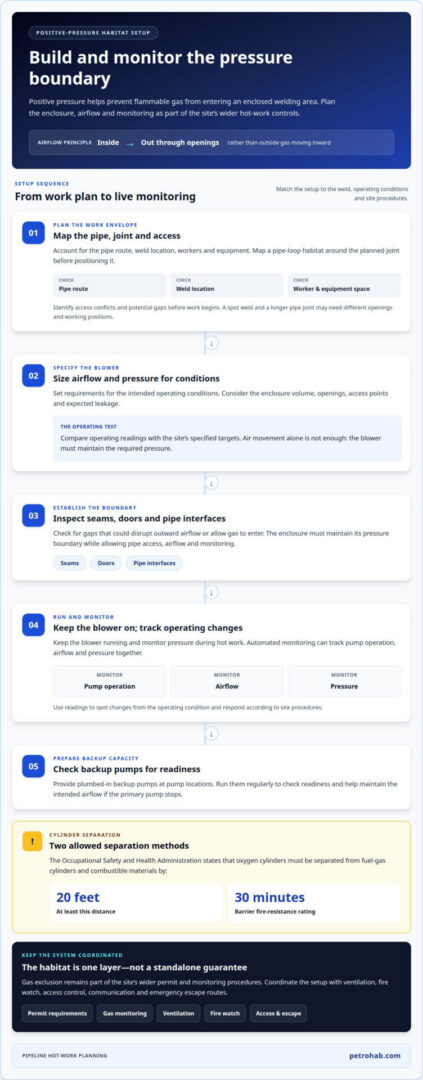
Positive pressure helps prevent flammable gas from entering an enclosed welding area. The setup must maintain its pressure boundary while allowing for pipe access, airflow, and monitoring.
Blower Airflow and Pressure Specifications
Select a blower to provide the airflow and pressure needed for the intended operating conditions. Consider the enclosure volume, openings, access points, and expected leakage when setting requirements. During setup, compare operating readings with the site’s specified targets. A blower that moves air but cannot maintain the required pressure will not support effective positive-pressure containment.
Pipe Loop Habitat Configurations
A pipe loop habitat encloses part of a high-pressure pipeline while keeping the welding area accessible. Its configuration should account for the pipe route, weld location, and space required for workers and equipment. Map the loop around the planned joint before positioning the enclosure to identify access conflicts and potential gaps where pressure could escape or gas could enter.
Positive-Pressure Containment
Positive-pressure containment relies on air flowing outward through openings rather than outside gas moving inward. Inspect seams, doors, and pipe interfaces for gaps that could disrupt this boundary. Keep the blower running and monitor pressure during hot work. Gas exclusion is one part of the site’s wider permit and monitoring procedures, not a replacement for them.
Automated monitoring can track pump operation, airflow, and pressure together. Use the readings to spot changes from the operating condition and respond according to site procedures. Provide plumbed-in backup pumps at pump locations and run them regularly to check readiness and help maintain the intended airflow if the primary pump stops.
For cylinder placement, the Occupational Safety and Health Administration states that oxygen cylinders must be separated from fuel-gas cylinders and combustible materials by at least 20 feet. The Occupational Safety and Health Administration also states they may instead be separated by a barrier rated for 30 minutes of fire resistance.
Temporary welding habitats for pipe and spot welds
Arrange the enclosure around the pipe or spot weld, tools, and worker access. Match ventilation, hose routing, and fume controls to the welding task.
Roof Ventilation for Welding Fumes
Roof vents can help dissipate fumes when integrated with the habitat’s ventilation or exhaust system. Assess the welder’s position and how air moves through the enclosure. Position extraction to remove fumes without carrying them through another worker’s breathing area. Align airflow with the task, whether the crew is making a pipe joint or a spot weld.
Worker Protection from Welding Fumes
Fume control starts with the welding process, work position, and ventilation path. Include exposure controls in the job plan, then provide appropriate personal protective equipment and worker training. Keep access, communication, and escape routes clear during welding. Supervisors should also consider oxygen levels and heat stress as conditions inside the habitat change.
For pipeline work, position the enclosure around the specific weld and leave room for the welder, tools, and pipe movement. A spot weld may need a different opening and working position than a longer pipe joint. Map access before work starts, then check that the setup does not obstruct ventilation, communication, or emergency egress.
Inspect welding hoses and connections before use. Look for wear, damage, loose fittings, and routing that could expose hoses to sparks or interfere with movement. Under U.S. maritime safety regulations, a hose subjected to flashback or showing severe wear or damage must be tested to twice normal working pressure, but at no less than 200 p.s.i., before reuse.
Include chlorinated-solvent cleaning in the work-area review. Keep solvent use separate from active welding, and address residues and vapors in the work plan before striking an arc. Record the cleaning method and coordinate controls with the hot-work permit and ventilation arrangements.
For welding operations, pressurized habitat planning can help align enclosure airflow with the work area and fume-control needs.
Site risk assessment and hazardous-area requirements
Assess the pipeline, surrounding materials, ignition sources, and work location before selecting an enclosure. Let the permit and emergency plan determine the required controls.
Portable Habitats for Hazardous Zones
A portable habitat can be positioned around a pipeline weld when the site assessment identifies flammable gas, vapor, mist, or combustible dust. Check the hazardous-area classification, enclosure structure, access, and escape route against the planned task. For hazardous metals, assess welding fumes and exposure controls, then specify suitable respiratory protection and worker training.
Habitat and Custom Enclosure Comparisons
Portable habitats can move as work locations change, while custom-built enclosures can suit fixed equipment or unusual layouts. Compare how each option fits the pipe, work envelope, ventilation, access, and emergency plan. Choose a configuration that supports the assessed hazards and permit conditions without obstructing the welding task.
Safety Limits and Emergency Requirements
Set oxygen, combustible-gas, and ventilation limits through site procedures and the hot-work permit, then monitor against them during work. For confined-space hot work, use general mechanical or local exhaust ventilation, or supplied-air respirators with an equipped, prepared standby person outside. OSHA guidance calls for fire watch when combustible materials or fire risks are present. Include gas testing and emergency equipment in the plan.
Live or pressurized pipework can present ignition, gas-release, and pressure hazards. The assessment must account for the line’s condition and the consequences of disturbing it.
Permits, Approvals, and Safety Standards
In the United States, apply relevant OSHA hot-work guidance and site permit requirements to the task, location, and hazards. The U.S. Coast Guard requires prior permission from the Captain of the Port before hot work at a facility where dangerous cargoes are located or handled, under 33 CFR 126.15(c). Record inspection, gas testing, fire-watch arrangements, and emergency response provisions in the work controls.
Temporary modular enclosures for pipeline hot work
A modular enclosure brings panels, a frame, access, and ventilation together around a defined pipeline work area. Plan its configuration and setup around the weld, equipment, and site procedures.
Modular Enclosure Configuration
Start by mapping the pipe route, weld location, worker access, and equipment footprint. Arrange fire-resistant panels and the frame to contain sparks and slag while preserving entry and observation. Include ventilation or air supply, access doors, and monitoring equipment in the layout. Before welding, check how each opening affects containment and movement.
A temporary habitat for pipeline hot work can be configured for the work location and task. Its layout must still suit the site risk assessment and hot-work permit, with clear access and an emergency escape route.
Habitat Setup and Grounding
Set up in the designated work area, following the approved site plan and the enclosure manufacturer’s instructions. Assemble and inspect the frame, panels, doors, ventilation connections, and monitoring equipment before workers enter. Keep the pipeline and welding equipment accessible without blocking exits or disrupting airflow. Record setup checks as site procedures require.
Grounding must follow the applicable site electrical and welding procedures. Coordinate the habitat, welding equipment, and pipeline with the responsible site personnel; don’t assume the enclosure frame alone provides grounding. Inspect connections using the approved site method before work starts, then stop and resolve any identified fault before welding.
Before energizing welding equipment, confirm the assembled habitat matches the permit layout and that ventilation and monitoring are operating as planned. Include the enclosure in the work-area inspection, and keep emergency access available throughout the task. For modular enclosure planning, discuss a habitat configuration suited to the pipeline work area.
Hot-work habitats are temporary enclosures designed to support welding, cutting, and other hot-work operations in a controlled environment where flammable materials, gases, or hazardous conditions are present.
PetroHab: PetroHab Hot Work Safety Enclosure (HWSE)
PetroHab LLC’s Hot Work Safety Enclosure (HWSE) gives pipeline teams a modular option for creating a controlled work area around hazardous conditions. Its pressurized welding enclosures use Quadra-Lock® panels to configure the temporary habitat for pipeline hot work to suit the site and task.
The Safe-Stop Safety Shutdown System (SSS) monitors differential pressure and gas levels, supporting oversight during hot work. Consider it when the site assessment identifies a need for a pressurized habitat as part of the wider permit, monitoring, and emergency plan. The enclosure does not replace those controls or the crew’s procedures.
To discuss a habitat for your pipeline hot-work requirements, contact PetroHab LLC.
Move from Assessment to an Enclosure Plan
Turn the job scope into a practical habitat plan before equipment reaches the worksite. Select a temporary habitat for pipeline hot work around the actual work sequence, site layout, and operating constraints, rather than treating it as a generic enclosure. Bring together the welding scope, pipeline configuration, work-area boundaries, and applicable site documents to establish a clear design basis.
Next, align the enclosure plan with the people responsible for welding, operations, and site safety. Resolve access, equipment placement, setup responsibilities, and change management before work begins. If the work location or scope changes, reassess the plan instead of relying on assumptions from the original setup.
PetroHab can help connect those project requirements to its hot-work enclosure options. Contact PetroHab about your habitat to discuss the pipeline work ahead and take the next planning step with a defined scope.
Frequently Asked Questions
When is a welding habitat required for pipeline hot work?
A habitat is appropriate when the site assessment identifies ignition risks that require an enclosed, controlled work area. For example, maintenance near potential flammable-gas sources may call for additional separation and containment under the site’s hot-work permit. Consider the work scope, nearby process conditions, and whether other controls can manage the identified hazards. Reflect the selected setup in the permit and emergency plan.
How do weather, wind, and hazardous-area classification affect habitat requirements?
Wind can affect enclosure pressure and airflow, while rain, temperature, or changing conditions can influence setup, access, and equipment operation. Reassess conditions if the weather shifts during the job. The hazardous-area classification informs which equipment and controls suit the location. For example, a habitat near classified process equipment needs a configuration aligned with that classification and the site’s permit conditions.
What oxygen, combustible gas, and ventilation limits apply inside a welding habitat?
Set oxygen, combustible-gas, and ventilation limits through site procedures and the hot-work permit, then monitor against them during work.