Blog Posts
Pressurized Habitat for FSRU: A Buyer’s Guide to Project Fit
What if a habitat fits the hot-work scope but not the vessel worksite? Selecting a pressurized habitat for FSRU work means looking beyond enclosure size. Deck constraints, nearby equipment, access, and project interfaces all affect the configuration the work requires.
The decision can feel complex when pressure monitoring, gas detection, and automatic shutdown functions need to work together within the site’s hot-work controls. Start with the task and vessel conditions, then compare habitat configurations and safety-system requirements against them.
This guide explains how to define project-specific selection criteria, assess monitoring and shutdown needs, and plan for operational interfaces before procurement. It also covers how modular Quadra-Lock panels support configuration planning, and how leasing or purchase may suit different project durations and ownership needs. PetroHab’s pressurized habitats and Safe-Stop Automatic Shutdown System can be evaluated as part of an integrated equipment review, rather than as standalone components.
Key Takeaways
- Evaluate a pressurized habitat for FSRU against the actual hot work, access needs, and vessel interfaces, not footprint alone.
- Review how enclosure pressurization, gas and pressure monitoring, and automatic shutdown functions fit the project’s control approach.
- Compare configuration flexibility, material information, system functions, and support using the same criteria for each habitat option.
- Document project requirements before mobilization, then align configuration and operating decisions with approved project documents and site procedures.
- Compare leasing and purchase against project duration and equipment ownership needs.
Why a Pressurized Habitat for FSRU Work Must Fit the Vessel and Work Scope
Start the purchase decision with the hot-work task and the vessel’s actual conditions. A pressurized habitat for FSRU work must fit the worksite, not just occupy the available footprint. Pipework, nearby equipment, access routes, and vessel operations can all affect where the habitat can be positioned and how the crew can work around it.
An FSRU combines LNG storage and regasification functions in a vessel-based facility. That operating context makes the work location and surrounding systems important inputs to habitat planning. The Floating Storage and Regasification Unit (FSRU) overview provides broader context on the vessel’s role in the LNG supply chain. Project teams still need site-specific information to assess the work area.
The following video shows a pressurized welding enclosure:
Which FSRU worksite conditions should shape habitat selection?
Begin with the precise work location and the systems around it. Pipework, valves, structural elements, and installed equipment can affect enclosure placement, entry points, and the space available for tools and personnel. Review access routes into the worksite and movement in and out of the enclosure. A layout that fits on a drawing may create practical access constraints when obstructions and crew movement are considered.
Include planned concurrent activities in the review. Other work in or near the area can affect access, coordination, and the boundaries required for the hot-work task. Record these activities and their timing in project planning rather than treating the enclosure as an isolated footprint.
How should teams define the hot-work scope before comparing habitats?
Document the task, exact work location, intended work boundaries, and relevant operating context. Specify whether the work involves welding, cutting, grinding, or another defined hot-work activity. Capture the site information that affects positioning and access, including nearby systems, obstructions, and planned concurrent work.
Separate verified site details from assumptions. Flag unresolved dimensions, access conditions, or activity plans for project review instead of allowing them to become implicit design inputs. This gives engineering and safety teams a clear basis for resolving gaps before deciding on a configuration.
Selection takeaway: A documented scope turns vessel conditions into reviewable criteria. Use it to compare habitat configurations against the task and worksite, rather than assuming a generic product specification will suit every FSRU activity. When partnering with industry leaders like PetroHab LLC, ensuring your specifications match your operational reality guarantees safer and more efficient offshore execution.
How Pressurization, Gas Monitoring, and Shutdown Work Together
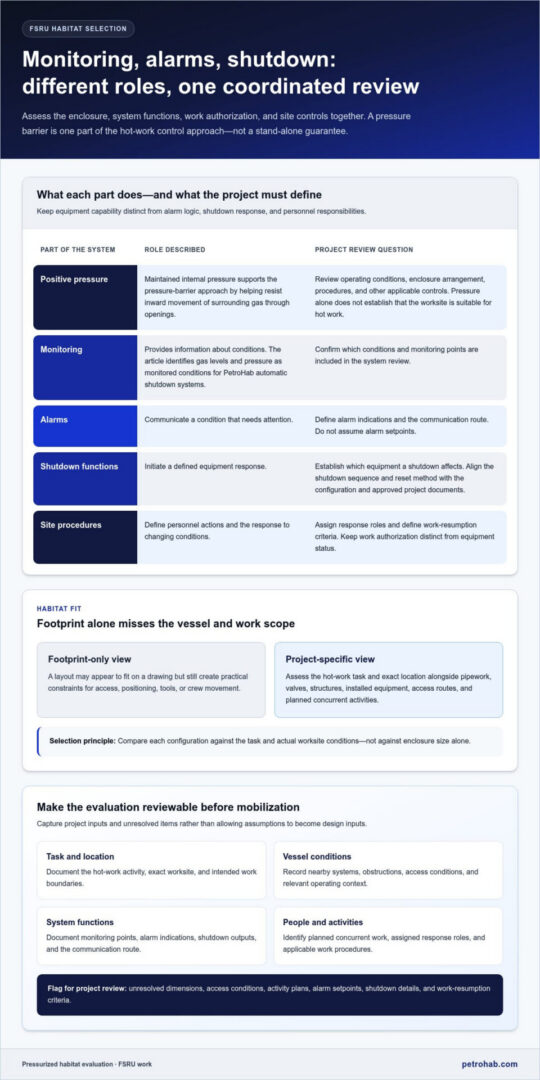
A pressurized welding habitat is an enclosure that maintains internal pressure as part of its hot-work control approach. The pressure differential is intended to help limit the entry of surrounding atmosphere into the workspace. It is a barrier, not a stand-alone guarantee of safe conditions. Evaluate the enclosure, monitoring, shutdown functions, work authorization, and site controls together.
For a pressurized habitat for FSRU work, buyers need to understand what each system function does and how the project defines a response to changing conditions. PetroHab’s automatic shutdown systems monitor gas levels and pressure. Monitoring provides information about conditions; alarms communicate a condition that needs attention; shutdown functions initiate a defined equipment response. Project procedures establish what personnel must do before work can begin or resume.
What role does positive pressure play in a habitat system?
Maintained internal pressure supports the habitat’s pressure-barrier approach by helping resist inward movement of surrounding gas through openings. Its effectiveness depends on operating conditions and the complete installation, so pressure alone cannot establish that a worksite is suitable for hot work. The project must also account for the enclosure arrangement, operating procedures, and other applicable controls.
This system-level view aligns with the broader marine safety context described in ABS FSRU Services and Safety Standards. For habitat selection, the practical point is to treat pressure as one part of a coordinated control strategy, not as a substitute for site assessment, authorization, or approved procedures.
What should buyers assess in gas monitoring and shutdown functions?
Review monitoring capability separately from the project’s alarm and shutdown logic. Determine which conditions the system monitors, how alarms are communicated, what equipment a shutdown affects, and who is responsible for responding. These are separate questions. Monitoring can detect or indicate a condition, while approved project procedures define the response and authority to act.
For example, a pressure change or gas indication may call for a specified response under site procedures. Don’t assume alarm setpoints, shutdown sequence, reset method, or work-resumption criteria. Those details need to align with the equipment configuration and approved project documents. The PetroHab pressurized habitat systems can be included in this integrated equipment review.
Before mobilization, document the monitoring points, alarm indications, shutdown outputs, communication route, and assigned response roles in the applicable review materials. Keep work authorization distinct from equipment status: a system indication does not itself grant permission to start or restart hot work. Site procedures and approved project documents govern those decisions.
Compare FSRU Habitat Options Using Project-Specific Selection Criteria
A useful comparison applies the same questions to each candidate habitat and records the evidence behind each answer. For a pressurized habitat for FSRU work, this keeps selection tied to the task, vessel conditions, and project requirements rather than broad product descriptions. Use the table as a review framework, then carry unresolved points into the project’s technical review.
| Criterion | Project question | Evidence to review |
|---|---|---|
| Work-scope fit | Does the proposed arrangement suit the defined task, work boundaries, and worksite? | Scope description, location details, and proposed enclosure arrangement. |
| Configuration flexibility | Can the enclosure configuration address the work area and relevant interfaces? | Layout information and documentation describing modular components, including Quadra-Lock panels. |
| Materials | Are construction and material details suitable for the project’s review criteria? | Supplied material information, including documentation for fire-resistant materials. |
| Monitoring | Do the documented gas-level and pressure monitoring functions align with project needs? | System descriptions, monitored conditions, and relevant interface information. |
| Shutdown functions | Is the shutdown response understood in relation to the project’s procedures? | Shutdown-system documentation, affected equipment, and project-defined response steps. |
| Service support | What support is relevant to equipment use and project execution? | Information on applicable on-site supervision and training arrangements. |
Which technical evidence belongs in a habitat comparison?
Review evidence, not just stated capabilities. Construction and material information should be available for the project team to assess against its requirements. PetroHab uses fire-resistant materials, and project documentation should establish the details relevant to the specific work. For monitoring and shutdown, compare documented functions with the conditions and interfaces identified in the project scope. Record open questions, such as how a signal is communicated or what equipment a shutdown affects, for technical review.
Apply the same discipline to standards and certification statements. Treat them as claims that require project-specific documentation review. The project team should establish whether the documents support the intended equipment use and satisfy applicable project requirements. Don’t infer applicability from a label or general product description.
When should an FSRU project consider renting or purchasing?
Rental and purchase are procurement routes, not measures of technical performance. Compare them against project duration, plans for repeat use, ownership requirements, and the support needed during execution. A limited-duration scope may lead a team to assess rental; recurring work or equipment ownership needs may make direct purchase relevant. The decision should follow the project’s commercial and operational criteria, not assumptions about configuration or safety functions.
PetroHab offers equipment leasing and direct sales, with on-site supervision and training among its support offerings. Include support needs in the procurement review alongside equipment requirements. Keep the considerations distinct: the procurement route does not replace the technical assessment of enclosure construction, monitoring, shutdown functions, or project interfaces.
Use the comparison to identify evidence already available, the project requirements it addresses, and questions still requiring resolution. This creates a traceable basis for technical and procurement decisions without treating rental as inherently more suitable or purchase as inherently more capable.
Prepare a Reviewable FSRU Habitat Evaluation Before Mobilization
A reviewable evaluation turns project requirements into documented decisions before equipment moves to the vessel. It should show how the selected habitat configuration relates to the hot-work scope, what evidence informed the decision, which interfaces need coordination, and who owns unresolved items. For a pressurized habitat for FSRU work, this record helps carry technical decisions into mobilization without treating assumptions as approved inputs.
What project information should be assembled for the review?
Bring together the work description, location information, access constraints, adjacent operational interfaces, and planned activities that may affect the work area. Add available information on enclosure configuration, monitoring, shutdown functions, and relevant equipment connections. Label each item as verified, assumed, or pending review, then assign an owner and resolution route to every open question.
Keep the review package practical and traceable. Include current scope and layout information, supporting technical documents, interface notes, and a decision record that links requirements to evidence. If the project identifies a documentation gap, record its impact and assign an appropriate reviewer rather than treating an incomplete item as resolved.
Use this sequence to prepare the evaluation:
- Define the task. Record the hot-work activity, work boundaries, location, and relevant operating context.
- Assemble site inputs. Gather worksite details, access constraints, nearby equipment information, and adjacent operational interfaces.
- Map system interfaces. Collect available information on enclosure configuration, monitoring, shutdown, and connections that affect project coordination.
- Review evidence and open items. Compare supplied documentation with project criteria, identify assumptions, and assign owners to resolve them through the established review process.
- Record decisions and readiness. Document the selected criteria, supporting evidence, outstanding actions, and the responsible project process for confirming readiness.
How should teams carry the evaluation into mobilization?
Before mobilization, preserve the link between each decision and its supporting evidence. Make the current configuration, interface responsibilities, and unresolved actions clear to the people coordinating the work. Include training and on-site supervision in the readiness review where they form part of the project plan, and identify how those arrangements fit site procedures.
Final configuration and operating decisions remain subject to approved project documents and site procedures. The responsible project process must confirm readiness before hot work begins. If worksite conditions or scope change, route the change through that process and review affected decisions rather than relying on an outdated evaluation.
For project-specific equipment and support planning, Review your FSRU habitat requirements with PetroHab.
How PetroHab Supports Pressurized Habitat Requirements for FSRU Projects
PetroHab’s modular Hot Work Safety Enclosure and pressurized habitat offerings give project teams equipment options to assess against their defined work scope and vessel conditions. Fit depends on the specific task, enclosure arrangement, system interfaces, and project requirements. Reviewing these elements together helps buyers connect equipment choices to worksite needs rather than treating components as standalone features.
How do PetroHab components relate to the project criteria?
Patented Quadra-Lock panels are a modular panel technology used in enclosure configurations. In an FSRU review, consider how the panel arrangement relates to the required work area, nearby equipment, and access needs. Assess the configuration against documented site conditions rather than assuming one layout suits every task.
The Safe-Stop Automatic Shutdown System monitors gas levels and pressure. Buyers can include these functions in the technical review alongside project monitoring requirements, equipment interfaces, and approved response procedures. Consider the system in context: documentation and project review establish how the equipment fits the work plan, while site procedures govern work authorization and response.
PetroHab’s components can be evaluated against the same criteria as the full habitat: defined scope, worksite arrangement, relevant interfaces, and supporting project documents. This keeps the review focused on evidence and project fit rather than unsupported performance assumptions.
What can buyers discuss when planning a PetroHab project?
Begin with the operational picture. Useful planning inputs include the hot-work task, work location, surrounding systems, access conditions, and interfaces with vessel activities. These details help shape a project-specific discussion of enclosure configuration and the monitoring and shutdown equipment included in the review.
Procurement planning can address whether equipment leasing or direct sale better matches the project’s duration, repeat-use plans, and ownership requirements. These are commercial routes, not rankings of technical capability. Include support needs in the same discussion: PetroHab offers on-site supervision and training, which teams can consider as part of their project plan.
A focused discussion can cover:
- Work scope and site conditions: the task, location, access needs, and surrounding equipment.
- System interfaces: enclosure configuration, gas-level and pressure monitoring, and shutdown functions.
- Procurement and support: leasing or direct sale, plus any planned supervision or training.
This gives the project team a clear starting point for aligning the habitat option with its technical review and procurement needs. Discuss a PetroHab habitat solution for your project.
Move From Evaluation to a Clear Project Brief
Turn selection criteria into a shared project brief. Bring engineering, safety, operations, and procurement around the same documented requirements, and identify which decisions each team needs to carry forward. This helps ensure a pressurized habitat for FSRU work is assessed consistently during technical review, purchasing, and mobilization.
A concise brief should clarify project priorities and the decision path: what the habitat must accommodate, what evidence supports the proposed fit, and which items remain subject to site approval. This gives the team a practical foundation for the next discussion and keeps procurement aligned with operational needs.
Discuss your FSRU habitat requirements with PetroHab to plan a well-defined project review. Clear requirements help teams move forward with a shared understanding of the work.
Frequently Asked Questions
What does FSRU stand for?
FSRU stands for Floating Storage and Regasification Unit. It is a vessel-based facility that stores liquefied natural gas and converts it back to gas for transfer into a pipeline or other delivery system. For habitat planning, the term signals a marine operating environment where equipment location, adjacent systems, crew access, and vessel activities need to be reviewed together, rather than as if the worksite were a standalone workshop.
Can a pressurized habitat be configured for different FSRU work locations?
Yes. Assess a habitat configuration against the particular work location and task. PetroHab’s modular enclosures use Quadra-Lock panels, which support project-specific configurations. For example, a work area with nearby piping and restricted access may call for a different arrangement than a more open location. The project review should establish how the proposed layout fits the work boundaries and site conditions.
What information should a project team provide when evaluating an FSRU habitat?
Provide the task description, intended work location, work boundaries, available layout details, access constraints, and information about nearby equipment or operating interfaces. Note planned activities that may affect the work area. Identify which details are verified and which still need review, then assign responsibility for resolving open items. This gives the evaluation a clear basis and helps prevent assumptions from becoming unexamined configuration requirements.
How do gas monitoring and automatic shutdown relate to habitat operations?
Gas and pressure monitoring provides information about conditions inside the habitat, while an automatic shutdown system can initiate a defined equipment response. PetroHab’s Safe-Stop system monitors gas levels and pressure. Project teams should distinguish system indications from the steps personnel must take under site procedures, including who responds, how the response is communicated, and what approval is required before work resumes.
Should an FSRU project rent or purchase a pressurized habitat?
Choose the procurement route based on the project’s expected use and ownership needs, not on an assumption that either route changes technical capability. Consider whether the work is limited to one project or the equipment will be needed for repeat tasks, who will manage it between uses, and what support the project requires. PetroHab offers equipment leasing and direct sales, allowing teams to assess both routes against their plans.
What standards or certification documents should be reviewed for a habitat project?
Start with the standards and documentation identified by the project’s approved requirements. Review supplied technical documents for the equipment’s intended use, covered components, configuration, and any stated limitations. Compare that evidence with site and project criteria rather than relying on a general standards reference or certificate title alone. The project’s technical and safety review should determine applicability and record any documentation gaps for resolution.
Can a habitat project include on-site supervision and training?
Yes. PetroHab offers on-site supervision and training as project support options. Teams can plan for these needs by identifying which work stages require supervision and what personnel need instruction on the habitat and associated systems. Define the intended participants, responsibilities, and timing through the project’s established planning process, then align the arrangements with site procedures and the approved work plan.