Blog Posts
Refinery Maintenance Safety Solutions: Engineering Zero-Ignition Environments in 2026
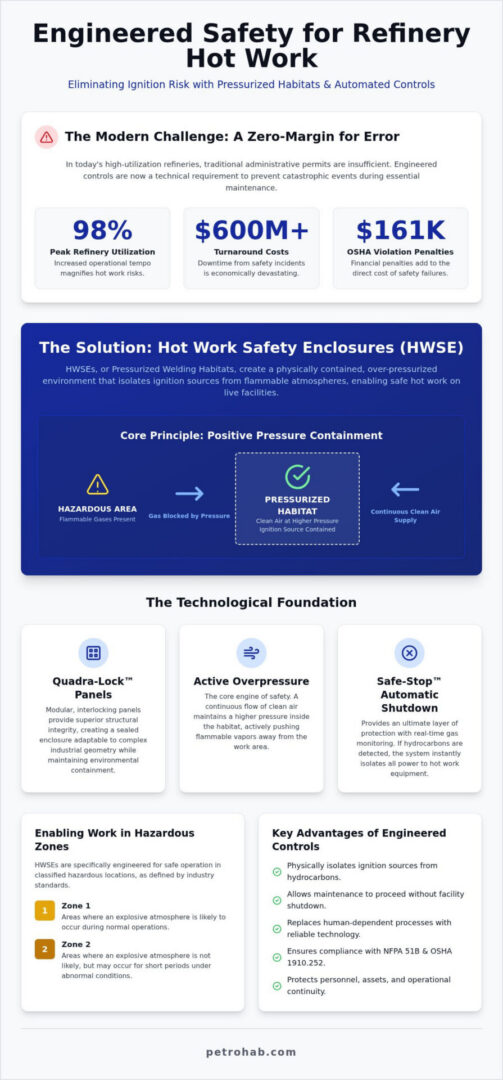
Engineering a zero-ignition environment is no longer a goal; it’s a technical requirement for modern industrial operations. With Gulf Coast refinery utilization rates reaching 98.0% in mid-2026, the margin for error during hot work has effectively vanished. You understand that managing human behavior is insufficient when high-value assets and personnel are at risk in Zone 1 and Zone 2 areas. Relying solely on administrative permits creates a vulnerability that today’s high-stakes energy sector can’t afford. Implementing robust refinery maintenance safety solutions is the only way to maintain operational continuity without compromising on absolute safety standards.
This article details how advanced pressurized habitats and automated shutdown systems eliminate ignition risks during critical refinery maintenance and turnarounds. We’ll examine the technical architecture of the Safe-Stop system and the modular integrity provided by Quadra-Lock technology. These engineered controls ensure your next maintenance cycle achieves a zero-accident record while navigating complex regulatory landscapes like NFPA 51B and OSHA 1910.252. You’ll learn how to deploy cost-effective Hot Work Safety Enclosures (HWSE) that provide a definitive technological remedy to the hazards of volatile atmospheres.
Key Takeaways
- Understand how engineered refinery maintenance safety solutions move beyond administrative permits to physically isolate ignition sources from flammable gases.
- Learn the mechanics of positive pressure and how modular Quadra-Lock panels adapt to complex refinery structures to maintain environmental integrity.
- Explore the role of the Safe-Stop Automatic Shutdown System in providing real-time gas monitoring and immediate power isolation for hot work.
- Identify critical pre-turnaround planning steps and ventilation strategies to ensure personnel protection and operational continuity.
- Evaluate the advantages of rental versus purchase models for pressurized welding enclosures based on project frequency and capital expenditure requirements.
The Critical Role of Safety Solutions in Modern Refinery Maintenance
Refinery maintenance safety solutions are engineered systems designed to isolate ignition sources from flammable gases through physical containment and atmospheric control. They represent a mandatory evolution from passive protection methods like fire blankets, which fail to address the risk of gas migration. In high-pressure environments, a single spark meeting a fugitive hydrocarbon release results in catastrophe. Safety managers now prioritize environmental containment over simple PPE, utilizing positive pressure technology to create a zero-ignition workspace. These refinery maintenance safety solutions directly impact refinery ROI by preventing unplanned shutdowns during critical turnaround windows.
Identifying High-Risk Hot Work Zones
Effective risk mitigation begins with precise mapping of Zone 1 and Zone 2 hazardous areas. Zone 1 locations involve explosive atmospheres that occur frequently during normal operations, whereas Zone 2 environments see these conditions only under abnormal circumstances. Performing hot work near active hydrocarbon processing units introduces extreme risk that administrative permits alone can’t mitigate. A hazardous zone is defined as any area where flammable gases or vapors exist in concentrations sufficient to produce ignitable or explosive mixtures. By deploying pressurized habitats, engineers physically separate the ignition source from the surrounding atmosphere, allowing “live” maintenance to proceed without compromising facility integrity.
The Cost of Safety Failures and Downtime
The financial impact of safety failures extends far beyond regulatory fines. While OSHA willful violation penalties reach $161,000 in 2026, the real threat is the loss of operational continuity. With some 2026 turnarounds exceeding $600 million in projected costs, any delay caused by a safety incident is economically devastating. Integrating hot work safety enclosures into a refinery’s permit-to-work (PTW) system ensures that hot work is conducted within a verified, engineered environment. These systems often communicate with the facility’s Distributed Control System (DCS) to provide a holistic view of site safety. This integration allows for proactive risk identification rather than reactive crisis management. Utilizing Quadra-Lock panels ensures the structural integrity of these enclosures, maintaining the positive pressure differential required to keep flammable gases at bay. This technical precision is what differentiates modern engineered controls from traditional, less reliable safety measures. It’s about removing the element of human error and replacing it with a definitive technological remedy.
Pressurized Welding Habitats: The Core of Ignition Prevention
The engineering behind pressurized habitats represents the primary defense in modern refinery maintenance safety solutions. Unlike passive barriers, these systems use active overpressure to ensure that flammable gases cannot enter the work area. This is achieved by introducing a continuous flow of clean air into the enclosure, maintaining a pressure differential higher than the surrounding atmosphere. If a gas leak occurs nearby, the positive pressure pushes the vapors away from the ignition source. This active guardian role is what allows hot work to proceed safely in high-risk environments.
How Positive Pressure Enclosures Prevent Ignition
The principle of overpressure is the foundation of environmental containment. By creating a higher pressure inside the habitat, the system acts as a physical barrier against hydrocarbon ingress. Precise monitoring is essential; manometers and pressure sensors provide real-time data to ensure the differential remains constant. These sensors are integrated into broader safety protocols for refinery turnarounds, providing an engineered safeguard that functions independently of human oversight. For safety managers requiring a deeper technical understanding of these systems, our guide on pressurized welding habitats details the specific airflow requirements and sensor calibration standards necessary for Zone 1 compliance.
Quadra-Lock Technology: Structural Integrity for Refineries
Traditional safety enclosures often rely on hook-and-loop fasteners, which are prone to degradation and gapping under industrial stress. The patented Quadra-Lock interlocking system replaces these unreliable methods with a mechanical connection that ensures panel stability. Each panel locks into the next, creating a rigid, gas-tight seal that withstands high winds and chemical exposure common in refinery environments. This structural integrity is critical for maintaining the pressure differential. Without a mechanical lock, the enclosure’s skin can flex or pull apart, causing a loss of overpressure and immediate safety risks. Quadra-Lock panels are engineered from advanced fire-resistant materials that provide superior thermal containment, protecting both the personnel inside and the high-value assets outside the habitat.
Modular design allows these systems to adapt to complex refinery piping and structural steel. Engineers can configure the enclosure around obstructions that would render standard tents useless. This flexibility ensures that refinery maintenance safety solutions are applicable in the most congested areas of the plant. If your facility requires uncompromising protection, you may want to explore engineered safety solutions to find the configuration that fits your specific turnaround needs.
Advanced Monitoring and Automatic Shutdown Systems
Detection without automated mitigation is an incomplete safety protocol. In the high-decibel, high-risk environment of a refinery, human reaction time is too slow to prevent ignition if a gas release occurs. Engineered refinery maintenance safety solutions must include an active response mechanism that removes the hazard source before it can interact with the atmosphere. The Safe-Stop Automatic Shutdown System acts as the digital brain of the enclosure, continuously monitoring for hydrocarbon gases and pressure loss. If gas concentrations reach a pre-set threshold, typically 10% of the Lower Flammable Limit (LFL), the system immediately isolates power to all welding equipment. This level of automation is essential when 2026 utilization rates leave no room for operational error.
Dual-sensor technology is the industry benchmark for redundancy. If one sensor fails or requires calibration, the secondary unit maintains the safety perimeter. This prevents false positives that cause unnecessary downtime while ensuring that a genuine hazard is never missed. Audio and visual alarms are integrated into the hardware, using high-intensity strobes and sirens to overcome the ambient noise of active processing units. The power distribution unit (PDU) serves as the primary gateway for all electrical tools used within the habitat. By routing all power through the Safe-Stop system, the facility ensures that no uncontrolled ignition source exists within the Zone 1 or Zone 2 perimeter. This centralized control provides safety managers with absolute confidence that hot work is occurring within a strictly regulated environment. This integration of refinery maintenance safety solutions transforms the habitat from a simple tent into a sophisticated safety instrument.
Integrating Gas Detection with Safe-Stop Technology
Safe-Stop technology doesn’t just watch; it acts. The system architecture links gas detectors directly to a power distribution unit, ensuring that when a hazard is detected, power is severed in milliseconds. This rapid mitigation is the definitive remedy for potential ignition events. For a detailed look at system logic and wiring, safety managers should review our hot work safety systems documentation.
Compliance with International Safety Standards
Adherence to international standards is non-negotiable for hardware deployed in explosive atmospheres. All electrical components must meet ATEX or IECEx certifications to ensure they don’t become ignition sources themselves. The system also aligns with NFPA 51B standards for fire prevention during hot work. ATEX certification is mandatory for refinery safety hardware because it guarantees that equipment is specifically engineered to operate safely in environments with a high risk of explosion.
Best Practices for Deploying Safety Solutions During Turnarounds
Successful deployment of refinery maintenance safety solutions during a turnaround requires a shift from passive procurement to active operational management. Pre-turnaround planning must involve a granular assessment of site-specific hazards, including the proximity of high-pressure lines and potential fugitive emission sources. Engineers should determine the exact footprint for each Hot Work Safety Enclosure (HWSE) based on the geometry of the work area and the required clearance for personnel. This phase ensures that the modular Quadra-Lock panels are configured to provide maximum structural integrity without obstructing essential refinery pathways. Mapping these requirements early prevents the costly delays associated with improper equipment sizing or placement.
Optimizing Habitat Ventilation and Air Flow
Maintaining atmospheric integrity requires more than just positive pressure; it demands a calculated approach to ventilation. Air intakes must be strategically placed in areas verified to be free of hazardous vapors. Using PetroHab air ducting solutions ensures that fresh air is delivered efficiently into the habitat, providing both cooling for technicians and a continuous supply of breathable air. Simultaneously, fume extraction systems must be positioned to remove welding byproducts without compromising the internal pressure differential. This dual-flow management is critical for protecting welders from respiratory hazards while maintaining the enclosure’s role as a zero-ignition environment. Proper ducting layout prevents air stagnation and ensures a consistent exchange rate within the habitat.
Training and Supervision: Maximizing Safety Performance
The human element remains a variable that must be controlled through rigorous training and expert oversight. Technicians must demonstrate a complete understanding of the Safe-Stop logic, knowing exactly how the system reacts to gas detection or pressure loss. On-site supervision from certified safety professionals reduces the risk of human error during the critical setup and strike-down phases. Standardized procedures ensure that every enclosure is inspected daily for panel alignment and seal integrity. These protocols prevent the gradual degradation of safety margins over the course of a multi-week turnaround project. When every worker is aligned with the safety architecture, the risk of an unplanned shutdown is significantly reduced.
Daily inspection protocols serve as the final layer of defense. Inspectors must verify that all Quadra-Lock connections remain secure and that sensors are calibrated to meet 2026 standards. This methodical approach ensures that the engineered controls remain effective throughout the project duration, regardless of environmental shifts or structural vibrations. To ensure your facility is prepared for its next maintenance cycle, you can request a turnaround safety consultation from our expert engineering team.
Sourcing Reliable Refinery Maintenance Safety Solutions
Procurement of refinery maintenance safety solutions requires a data-driven approach that prioritizes engineered reliability over simple equipment availability. Deciding between a rental or purchase model depends on the frequency of your turnaround cycles and your long-term capital expenditure strategy. Leasing offers the benefit of reduced storage requirements and access to the latest technical iterations, making it ideal for short-term projects. Conversely, purchasing a dedicated fleet of Hot Work Safety Enclosures (HWSE) provides immediate availability for routine maintenance programs. Regardless of the commercial model, evaluating manufacturers based on their patent history and international certifications is the only way to ensure the hardware meets the high-stakes requirements of a 2026 refinery environment. Reliability is not a generic claim; it’s a result of rigorous engineering and adherence to global standards.
Strategic Procurement for Global Refinery Operators
Technical merit serves as the primary benchmark when you evaluate hot work safety enclosure suppliers. A supplier’s ability to customize habitats for unique vessel shapes, high-elevation piping, or congested structural areas is a critical differentiator. Standardized tents often fail to provide the gas-tight seal required for Zone 1 operations. Seeking out modular systems like Quadra-Lock ensures that the enclosure adapts to the facility’s geometry rather than forcing the facility to adapt to the safety hardware. This flexibility, combined with rapid global logistics, allows operators to deploy critical safety infrastructure to remote or international sites without compromising on lead times or engineering standards. Strategic procurement focused on these technical capabilities reduces the risk of project delays and safety breaches.
The PetroHab Advantage: Uncompromising Safety
PetroHab operates as a critical safety partner for major energy firms, leveraging a Houston-based engineering core with a global operational reach. Our presence in the United States, Brazil, and the United Kingdom ensures that high-specification refinery maintenance safety solutions are available in the world’s most active energy hubs. We don’t just provide equipment; we deliver a commitment to zero-ignition through patented technologies like Safe-Stop and Quadra-Lock. This technical precision is designed to instill absolute confidence in safety managers who oversee high-value assets and personnel. Our role is to act as an active guardian, providing the definitive remedies required to mitigate the granular details of industrial hazards. We understand that in heavy industry, reliability is the only acceptable metric for success.
Contact PetroHab today to schedule a specialized refinery safety solution assessment and ensure your next turnaround meets the highest standards of technical compliance. Our engineers are ready to design a custom containment strategy that protects your workforce and your ROI.
Securing Operational Continuity through Engineered Safety
Modernizing your facility’s approach to hot work requires moving beyond administrative permits and into the realm of engineered certainty. We’ve examined how positive pressure habitats and automated response systems create a definitive barrier against ignition risks in Zone 1 and Zone 2 areas. By integrating refinery maintenance safety solutions that feature ATEX and IECEx certified systems, operators can maintain operational continuity without compromising on personnel protection.
The structural integrity provided by patented Quadra-Lock technology ensures that environmental containment remains uncompromised, even in the most congested refinery sectors. With global support infrastructure in the USA, UK, and Brazil, technical expertise is always within reach for your next turnaround project. This methodical approach to risk mitigation is what allows safety managers to achieve zero-accident records while protecting high-value assets.
Are you ready to elevate your facility’s safety architecture? Request a Technical Consultation for Your Refinery Safety Solutions to partner with an uncompromising expert in ignition prevention. Your commitment to safety excellence starts with a partner who understands the granular details of industrial hazards.
Frequently Asked Questions
What is a pressurized welding habitat and how does it work?
A pressurized welding habitat is an engineered enclosure that utilizes positive pressure to isolate ignition sources from flammable gases. It works by continuously pumping clean air into the enclosure to maintain a pressure differential higher than the surrounding atmosphere. This overpressure creates a physical barrier that prevents the ingress of hydrocarbon vapors. It is a fundamental element of modern refinery maintenance safety solutions, ensuring that hot work proceeds without the risk of catastrophic ignition.
Are PetroHab enclosures compliant with ATEX and IECEx standards?
PetroHab systems are engineered to meet and exceed stringent international safety standards. All electrical components within the Safe-Stop system and the habitat infrastructure are designed specifically for use in hazardous areas, aligning with current ATEX and IECEx requirements. This certification ensures that the safety equipment itself does not become an ignition source in volatile environments like Zone 1 or Zone 2 areas, providing safety managers with absolute technical confidence during high-stakes maintenance.
How does the Safe-Stop system prevent refinery fires during welding?
The Safe-Stop system prevents refinery fires by providing an automated response to hazardous conditions. It provides real-time monitoring of gas concentrations and pressure levels within the habitat. If the system detects hydrocarbon levels reaching 10% of the Lower Flammable Limit or a loss of positive pressure, it immediately isolates power to all welding equipment. This rapid mitigation removes the ignition source before it can interact with a volatile atmosphere, providing a definitive technological remedy.
Can hot work safety enclosures be used on offshore refinery platforms?
PetroHab enclosures are designed for the high-risk conditions found on both onshore refineries and offshore platforms. Their modular architecture allows for deployment in congested areas with complex piping and structural obstructions. The fire-resistant panels and Quadra-Lock technology provide the durability needed to withstand harsh offshore environments, including high winds and chemical exposure. These systems ensure that critical hot work can be performed safely without shutting down entire production units on the platform.
What are Quadra-Lock panels and why are they safer than Velcro?
Quadra-Lock panels are patented interlocking components that form the structural foundation of the enclosure. Unlike traditional hook-and-loop fasteners, which are prone to degradation and gapping in industrial environments, Quadra-Lock uses a mechanical connection to ensure a gas-tight seal. This mechanical integrity prevents the habitat from flexing or pulling apart under pressure. This level of structural reliability is essential for maintaining the constant positive pressure differential required to keep flammable gases out of the workspace.
Is it better to rent or buy hot work safety enclosures for a refinery turnaround?
The decision to rent or buy depends on project frequency and capital expenditure goals. Renting is a cost-effective option for short-term maintenance turnarounds, providing access to the latest safety technology without long-term storage requirements. Direct purchase is often preferred by facilities with recurring hot work programs. PetroHab provides both leasing and sales, offering versatile refinery maintenance safety solutions that allow operators to maintain operational continuity while achieving a zero-accident safety record.
How many people are required to set up a modular HWSE?
The number of personnel required for setup varies based on the size and configuration of the Hot Work Safety Enclosure. While the modular design allows for efficient assembly by a small team, PetroHab emphasizes the importance of expert oversight. We provide certified technicians for on-site supervision and training. This professional guidance ensures that every Quadra-Lock panel is correctly seated and that the Safe-Stop system logic is fully functional, reducing the risk of human error during deployment.
What happens if gas is detected near the pressurized habitat?
If gas is detected, the Safe-Stop system initiates an immediate mitigation protocol. High-intensity audio and visual alarms alert personnel in the vicinity, while the system simultaneously cuts power to all electrical tools within the habitat. This automated response occurs in milliseconds, removing the ignition source before a hazard can escalate. The continuous positive pressure within the enclosure continues to act as a physical barrier, pushing vapors away and protecting both the workforce and the refinery assets.