
Blog Posts
Role of the Fire Watch in Habitat Operations and Key Duties
The role of the fire watch in habitat operations is to patrol hot-work areas, detect fire or abnormal conditions, and alert workers so they can respond and evacuate. Firefighting isn’t the watch’s primary purpose. According to OSHA, in U.S. shipyard hot-work operations, a fire watch is required when unremoved or unprotected combustible material is less than 35 feet from the work area, and monitoring must continue for at least 30 minutes after hot work is completed.
That distinction matters: a fire watch is an active layer of hazard monitoring, not a replacement for controls that prevent ignition. Effective coverage depends on the hazards around the work, clear communication, and a defined response when conditions change. This article explains how fire-watch patrols and surveillance work in habitat operations, what the watch does during an emergency, and how training, equipment, and records support the role. You’ll also learn how monitoring continues after hot work stops, when additional coverage may be needed, and how a pressurized habitat can fit into a broader hot-work safety plan.
Key Takeaways
- Keep fire-watch patrols focused on detecting fire and abnormal conditions across the full area of concern.
- Make emergency alerts and evacuation the priority when conditions exceed the watch’s response capability.
- Use role-specific training, suitable equipment, and clear records to support consistent monitoring and response.
- For hot-work operations requiring an enclosure, PetroHab’s Hot Work Safety Enclosure (HWSE) and related offerings can support the operation’s safety plan.
Continuous patrols for fire and abnormal conditions
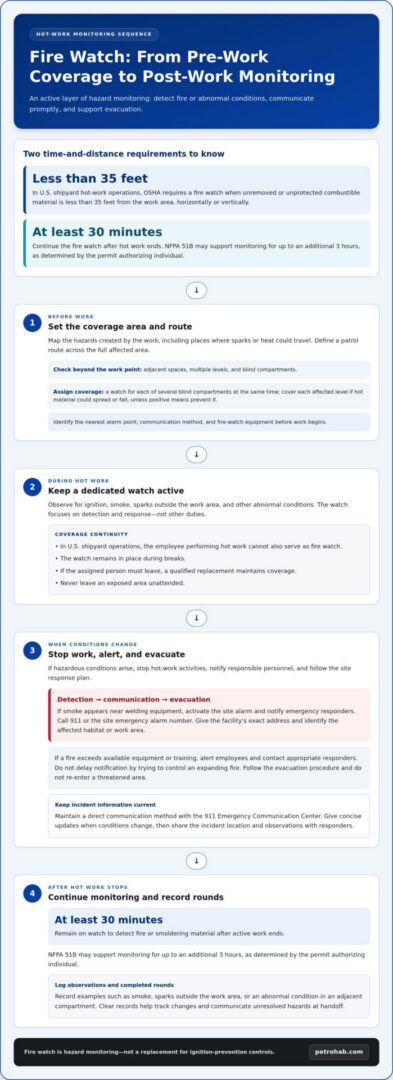
In a habitat, the fire watch monitors hot-work areas for ignition, smoke, and other abnormal conditions. Patrols must cover the hazards created by the work, including spaces where sparks or heat could travel.
Post-Work Fire Watch Duration
After hot work ends, the fire watch remains for at least 30 minutes, as required by the Occupational Safety and Health Administration for shipyard hot-work operations. This period allows the watch to detect fire or smoldering material after active work stops. NFPA 51B may support monitoring for up to an additional 3 hours, as determined by the permit authorizing individual. The required duration matters because a hazard can persist after welding or cutting has ended.
Hot Work Watch Procedures
Hot-work procedures assign a dedicated watch to observe the work area and respond to signs of fire. In U.S. shipyard operations, the employee performing hot work cannot also serve as the fire watch. The watch focuses on fire detection and response, without taking on other duties. This separation keeps surveillance active while personnel concentrate on the work.
Before and during work, define a patrol route that covers the entire affected area. Check adjacent spaces, multiple levels, and blind compartments where sparks or hot material could travel. If several blind compartments are involved, assign a watch to each one at the same time. If hot material could spread or fall across levels, assign coverage at each affected level unless positive means prevent that spread or fall.
During breaks, the watch remains in place. If the assigned person must leave, the employer assigns a qualified replacement so coverage continues. Stop hot-work activities when hazardous conditions arise, then notify responsible personnel and follow the site’s response plan. Never leave an exposed area unattended.
Record observations and completed rounds in the site’s fire-watch log. For example, note smoke, sparks outside the work area, or an abnormal condition in an adjacent compartment. Clear records help personnel track changes during the shift and communicate unresolved hazards at handoff.
Emergency notification and evacuation
The role of the fire watch in habitat operations includes recognizing when conditions require immediate escalation. If smoke appears near welding equipment, activate the site alarm and notify emergency responders. The watch’s priority is detection, communication, and evacuation, not firefighting beyond available equipment or training. Personnel need a clear warning and practical direction to leave the affected area.
For a fire or other emergency, call 911 or the site’s emergency alarm number. Maintain at least one direct communication method with the 911 Emergency Communication Center. Give the operator the facility’s exact address and describe the emergency, such as visible smoke or burning material. Naming the affected habitat or work area helps responders understand where the incident is occurring.
If a fire exceeds the capability of available extinguishing equipment, alert employees in the area immediately and contact appropriate emergency response personnel. Don’t delay notification by trying to control an expanding fire. The fire watch supports the response by reporting observed conditions and following the established evacuation procedure.
Another part of the role of the fire watch in habitat operations is supporting a reliable handoff. After alerting occupants, remain on the property to assist the fire department with information and establish contact with the owner or manager. Share the incident location, what you observed, and any changes noticed during the response.
Keep messages concise and update responders if conditions change. For example, report when smoke spreads beyond the initial work area rather than repeating an outdated location. Follow the site’s evacuation plan, avoid re-entering a threatened area, and keep communication channels available. These steps help personnel and responders act on the same incident information.
Fire watch training and equipment
Fire-watch training must prepare personnel to recognize ignition and respond within the limits of their assigned role. The Occupational Safety and Health Administration requires shipyard fire-watch personnel to be trained to detect fires in areas exposed to hot work under 29 CFR 1915.504(c)(2)(v). Shipyard employers must also train employees under 29 CFR 1915.508(b), (c), and (e). That preparation connects hazard recognition with the site’s emergency and suppression procedures.
Responsibilities vary with the work setting and its hazards. Industrial and construction sites apply relevant procedures to the work area, while marine shipyard hot-work operations have specific fire-watch requirements. In every setting, training should clarify who watches, what conditions require an alert, and how personnel communicate during a response.
In U.S. shipyard hot-work operations, OSHA requires a fire watch when unremoved or unprotected combustible material is less than 35 feet from the work area, horizontally or vertically. The need can also depend on whether combustible materials are protected and whether sparks or heat can reach exposed areas. An enclosed habitat requires attention to the work area and associated spaces where ignition hazards may be present.
Training must connect observation with equipment use. Fire-watch personnel should know where site alarm pull stations and fire extinguishers are located. Before work begins, identify the nearest alarm point, the communication method, and the equipment assigned to the area. A watch who cannot locate an alarm or extinguisher may lose time during an urgent response.
Equipment supports the role, but it does not replace training or evacuation procedures. Personnel need to know which conditions require an immediate alarm and when a fire exceeds available extinguishing equipment. For example, smoke spreading beyond the work area calls for prompt notification, not an attempt to manage an expanding fire alone. Clear instructions also help ensure unrelated duties do not interrupt active observation.
Review the worksite’s training and equipment arrangements whenever the work area or hazards change. Moving a hot-work task may affect access to alarms, extinguisher locations, and communication routes. Keeping these details up to date helps the fire watch recognize hazards and act without delay.
Fire hazard monitoring and surveillance
Effective surveillance tracks where ignition sources, combustibles, and sparks can intersect. In U.S. shipyard hot-work operations, the Occupational Safety and Health Administration requires a fire watch when unremoved or unprotected combustible material is less than 35 feet from the work area, horizontally or vertically. That distance applies above and below the work area, not only across the deck.
Map the hazard area before work begins, then monitor exposed materials and adjacent spaces. A spark passing through an opening or falling to another level can create a hazard outside the welder’s direct view. In shipyard work, assign a watch to each affected level unless positive means prevent hot material from spreading or falling. Provide simultaneous coverage for every blind compartment when multiple blind areas are involved.
Surveillance continues after tools stop. The Occupational Safety and Health Administration requires shipyard fire watches to monitor the hot-work area for at least 30 minutes after hot work is completed. NFPA 51B allows monitoring for up to an additional 3 hours after the established fire-watch period, as determined by the permit authorizing individual. These periods address distinct post-work monitoring decisions.
Use a defined route and record observations so changing conditions are not missed between rounds. For example, note smoke, a new spark path, or an abnormal condition in an adjoining space. University of Alabama fire-watch logs record the date, round completion time, observations, and the watch’s name and signature. Its procedure requires entries hourly or sooner after each completed round.
Stop hot-work activities when surveillance identifies a hazardous condition. Report what changed, where it happened, and whether nearby materials or spaces are exposed. This makes observation part of a controlled response, not a routine patrol without operational follow-through. A clear log also gives supervisors a record of coverage and unresolved hazards.
For hot work inside an enclosure, explore PetroHab Hot Work Safety Enclosures as part of the site’s hazard-control planning.
PetroHab: PetroHab Hot Work Safety Enclosure (HWSE)
PetroHab’s Hot Work Safety Enclosure (HWSE) provides a dedicated enclosure for hot-work operations in the oil and gas industry. It may suit projects that need a pressurized habitat for welding in a hazardous environment. Fire-watch patrols and emergency procedures remain essential parts of the site’s safety plan; an enclosure does not replace them.
PetroHab offers pressurized welding enclosures, Quadra-Lock Panels, and the Safe-Stop Automatic Shutdown System, which monitors differential pressure and gas levels. These products support different parts of habitat operations, from the enclosure itself to monitoring conditions. Select equipment to match the work environment and established hot-work controls.
For information about habitat options for a hot-work operation, visit petrohab.com.
Align Your Habitat Plan Before Work Begins
The next step is to connect the fire-watch plan to the specific hot-work environment. Before operations begin, assign clear responsibility for decisions when conditions change, and make sure the watch’s communication route fits the site’s emergency procedures. This keeps the role of the fire watch in habitat operations tied to the actual work area, rather than treated as a stand-alone assignment.
For projects using a hot-work enclosure, consider how the equipment fits into the site’s broader controls and operating procedures. PetroHab can discuss habitat requirements in relation to your work environment and planned controls. The fire-watch plan remains part of the site’s responsibility, alongside the selected equipment and established emergency procedures.
Contact PetroHab to discuss habitat and fire-watch planning. A clear plan gives your team a practical foundation for preparing work and protecting personnel.
Frequently Asked Questions
What is a fire watch?
A fire watch is assigned to observe an area for fire hazards and initiate the site’s response when danger appears. In hot-work operations, the watch focuses on conditions that could ignite during or after welding, cutting, or grinding. This is distinct from general supervision: the watch must remain attentive to the designated area and follow the site’s emergency plan.
What are the primary duties of a fire watch during habitat operations?
A fire watch monitors the work environment, notices changing hazards, and communicates concerns promptly. In habitat operations, that means considering how hot work affects nearby materials, adjacent spaces, and activity around the enclosure. The watch also supports coordination by passing relevant observations to the supervisor or emergency responders. Clear boundaries help ensure active observation is not interrupted by unrelated tasks.
What training and qualifications should a fire watch have?
A fire watch needs training that prepares them to recognize fire in areas exposed to hot work and understand the site’s response procedures. OSHA identifies fire detection as required training for shipyard fire-watch personnel under 29 CFR 1915.504(c)(2)(v). The person should also know how to raise an alarm, communicate the location and nature of a hazard, and identify when conditions require evacuation.
What equipment should a habitat fire watch carry and monitor?
Equipment depends on the site plan and assigned role. The watch needs access to the designated communication method and must know where site alarm controls and extinguishers are located. In a habitat operation using automatic shutdown equipment, the system may monitor gas levels and pressure. For example, the Safe-Stop Safety Shutdown System monitors these conditions; it does not replace the fire watch’s visual awareness.
How should a fire watch inspect a habitat for fire hazards before, during, and after work?
Before work, identify exposed combustibles, openings, adjacent spaces, and locations where sparks or heat could travel. During operations, keep observing those points as conditions change, including after equipment or materials are repositioned. After work ends, continue monitoring for signs of ignition throughout the required watch period. Record observations clearly so the next responsible person understands unresolved hazards and follow-up needs.
How should a fire watch respond to smoke, fire, or an alarm in a habitat?
Follow the site emergency plan: raise the alarm, notify emergency responders, and support evacuation. When calling 911, provide the facility’s exact address and describe the emergency, such as smoke inside a habitat or a visible fire. Don’t attempt to control a fire beyond the available equipment’s capability. Keep communication available and share relevant observations with responders without re-entering a threatened area.