ATEX vs IECEx: Understanding the Critical Differences for Hot Work Habitats
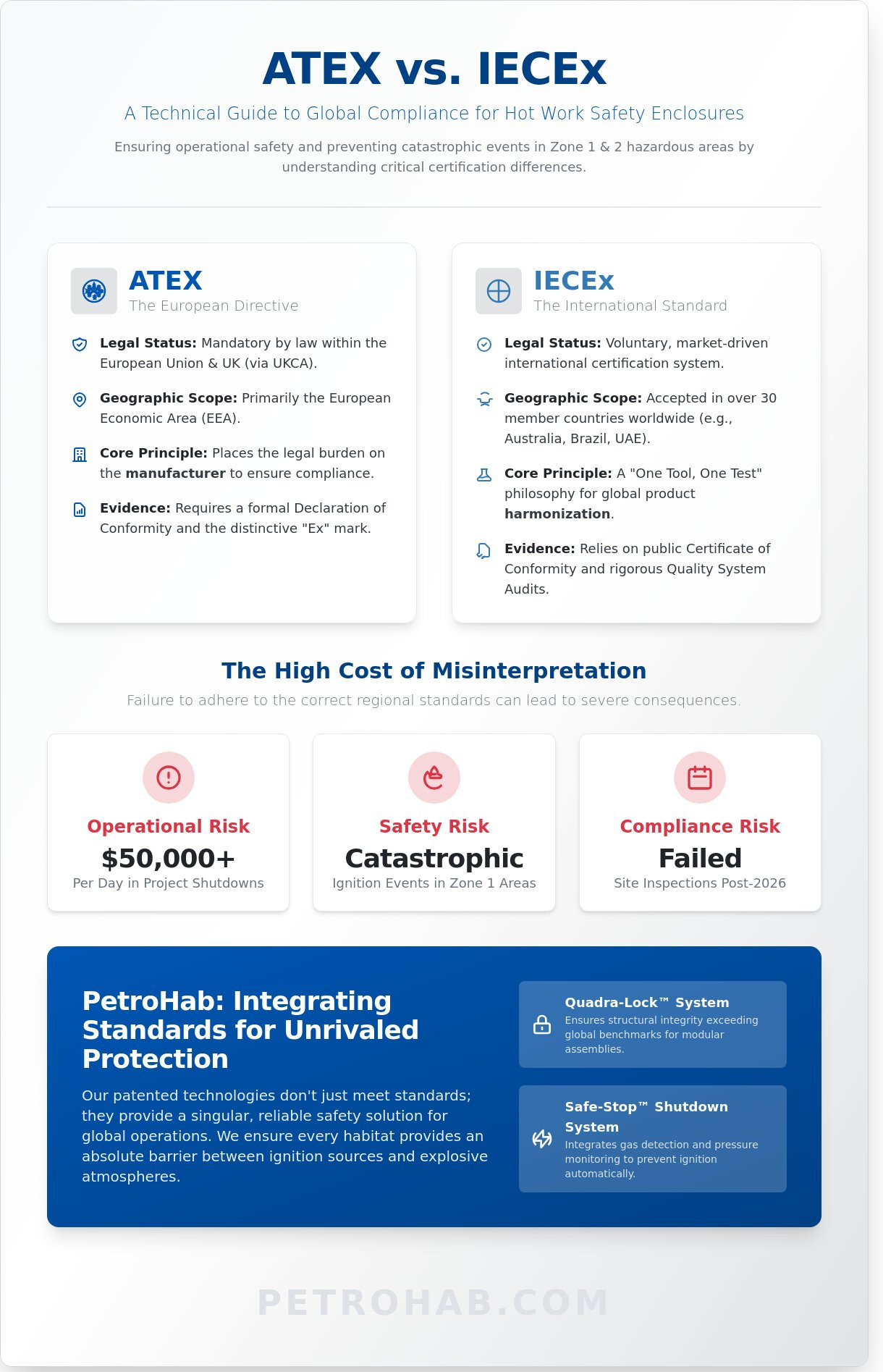
Relying on a single certification to cover global offshore operations is no longer a viable strategy for risk mitigation. A single misinterpretation of a marking string on a pressurized habitat can lead to a $50,000 per day project shutdown or a catastrophic ignition event in a Zone 1 area. You recognize that the safety of your personnel and high-value assets depends on equipment that withstands the most volatile conditions. Yet, the friction between regional mandates and international standards often leaves engineers questioning if their hardware will pass a 2026 site inspection. The complexity of ATEX vs IECEx compliance shouldn’t be the bottleneck that stalls your production schedule.
This guide provides a definitive technical comparison of ATEX vs IECEx standards to ensure your pressurized welding habitats remain compliant across every major energy hub. We’ll eliminate the ambiguity surrounding marking strings and quality audit requirements to give you absolute confidence in your safety systems. You’ll gain a clear framework for selecting equipment that meets the rigorous demands of the energy sector. We’ll examine the specific legal applications for each standard and explain how PetroHab LLC’s patented technologies, such as the Safe-Stop system, integrate these requirements into a singular, reliable safety solution.
Key Takeaways
- Distinguish between the mandatory EU legal frameworks and voluntary international certification systems to ensure operational compliance across global jurisdictions.
- Examine the critical technical nuances of ATEX vs IECEx to determine the precise certification path required for your specific asset and region.
- Master the complexities of certifying modular pressurized assemblies versus individual components to maintain absolute ignition source control.
- Identify regional safety requirements for offshore and onshore assets, from North Sea platforms to refineries in the Gulf of Mexico and Southeast Asia.
- Discover how patented engineering like the Quadra-Lock and Safe-Stop systems integrate these standards to provide unrivaled protection for high-value assets.
What are ATEX and IECEx? Definitions and Global Scope
In the high-stakes environment of offshore platforms and refineries, the distinction between ATEX vs IECEx is a fundamental pillar of industrial risk management. For safety managers operating in Zone 1 or Zone 2 hazardous areas, these certifications represent the technical integrity of hot work safety enclosures. They aren’t merely bureaucratic hurdles. They’re the engineering benchmarks that prevent catastrophic ignition events. PetroHab treats these standards as the baseline for our patented Petro-Wall and Safe-Stop systems. We ensure every habitat provides an absolute barrier between ignition sources and explosive atmospheres.
The 2026 regulatory landscape shows a clear trend toward stricter enforcement and higher transparency. Global energy markets no longer accept vague safety claims. They demand documented proof of compliance with international standards. While some overlap exists, the legal and technical applications of these two systems differ significantly. Understanding these differences is essential for maintaining operational continuity and protecting human life during critical maintenance windows.
ATEX: The European Directive
The ATEX directives, specifically Directive 2014/34/EU, govern the manufacture and use of equipment in potentially explosive atmospheres within the European Economic Area. This framework places the legal burden on the manufacturer to ensure equipment meets essential health and safety requirements. It’s a mandatory system that carries the weight of law in the EU and has been mirrored by the UKCA system in the United Kingdom. Notified Bodies play a critical role here; they conduct rigorous audits and type examinations to validate that every component of a pressurized habitat, from the fan units to the gas detection sensors, maintains its protective properties under duress. ATEX is the mandatory legal requirement for EU market entry as of 2026.
- Scope: Covers both electrical and non-electrical equipment, including mechanical components.
- Zoning: Defines hazardous areas based on the frequency and duration of the occurrence of an explosive atmosphere.
- Compliance: Requires a formal Declaration of Conformity and the distinctive “Ex” mark in a hexagon.
IECEx: The International Standard
While ATEX is regional, IECEx serves as the voluntary international certification system. It relies on the IEC 60079 series of standards to harmonize safety benchmarks across global borders. This system operates on a ‘One Tool, One Test’ philosophy. It allows a single set of test results to be accepted by participating member bodies in over 30 countries. This efficiency is vital for international equipment leasing. Habitats must move between jurisdictions like Australia, Brazil, and the Middle East without redundant testing. IECEx is often the preferred benchmark in regions where local directives don’t exist, providing a universal language for safety integrity.
The technical backbone of IECEx is the rigorous assessment of the manufacturer’s quality management system. It ensures that every product coming off the line is identical to the one that was tested. This level of consistency is why PetroHab prioritizes these certifications. Our commitment to unrivaled safety means our hot work safety enclosures meet the most demanding global criteria. We don’t just meet the standard; we use it as a foundation for our mission to eliminate workplace accidents in hazardous environments.
The choice between ATEX vs IECEx often depends on the geographic location of the asset and the specific safety protocols of the operator. However, the most resilient safety programs integrate both to ensure maximum flexibility and compliance. By 2026, the integration of these standards will be the gold standard in hot work safety, ensuring that every pressurized habitat operates with 100% reliability regardless of the environment.
ATEX vs IECEx: A Technical Comparison for Safety Engineers
Safety engineers operating in hazardous zones must distinguish between the regulatory mandates of ATEX and the market-driven framework of the IECEx international certification system. While both systems aim to prevent ignition in explosive atmospheres, their legal weight and procedural requirements differ. ATEX is a legal requirement within the European Economic Area, governed by Directive 2014/34/EU. It places the primary responsibility on the manufacturer to ensure compliance through a formal Declaration of Conformity. Conversely, IECEx is a voluntary certification scheme designed to facilitate international trade by providing a single, globally recognized standard. For global projects, maintaining both certifications isn’t just a preference; it’s a technical necessity for operational flexibility. The choice between ATEX vs IECEx often depends on the geographic location of the asset and the specific safety culture of the operator.
Legal Frameworks and Compliance Pathways
The distinction in manufacturer responsibility is critical for risk management. Under ATEX, a manufacturer issues a Declaration of Conformity based on an EU Type Examination certificate. This is a mandatory legal step for any equipment sold in Europe. Since January 1, 2023, the United Kingdom has fully implemented the UKCA marking. This requirement mirrors ATEX but requires separate documentation and certification through a UK Approved Body for the British market. Safety protocols for modular assemblies have become more rigorous as well. By 2026, updated standards for pressurized rooms, specifically EN IEC 60079-13:2017+A11:2021, will require even stricter integration of safety systems within the habitat shell. These rules ensure that the habitat acts as a single, cohesive safety device rather than a collection of separate certified parts.
Quality Assurance and Documentation
Rigorous auditing defines the integrity of a habitat manufacturer. ATEX requires a Quality Assurance Notification (QAN), while IECEx mandates a Quality Assessment Report (QAR). A reliable manufacturer must maintain both to ensure their systems meet the highest global benchmarks. These audits aren’t one-time events; they involve recurring inspections of manufacturing facilities every 18 to 36 months to verify that the production process matches the original certified design. Engineers should also demand the Ex Test Report (ExTR). This document provides the raw data from laboratory testing, offering a level of transparency that a simple certificate cannot match. To verify the status of any equipment, safety managers can access the IECEx online database. This portal provides real-time verification of a certificate’s validity, ensuring no expired or forged documents compromise site safety.
Identifying equipment in the field requires a clear understanding of marking strings. ATEX equipment features the distinctive hexagon ‘Ex’ symbol followed by equipment groups and categories, such as II 2G. IECEx markings are more streamlined, focusing on the protection concept, gas group, and temperature class. For example, a marking of Ex pxb IIC T4 Gb provides specific data on the pressurization method and the thermal limits of the system. For habitats, the ‘p’ indicates pressurization, which is the primary defense mechanism against gas ingress. When evaluating pressurized habitats for your next project, ensure the marking strings align exactly with your specific zone classification. This technical alignment is the only way to guarantee that ignition source control remains absolute during high-risk hot work operations.
Applying Standards to Hot Work Safety Enclosures (HWSE)
Certifying a Hot Work Safety Enclosure (HWSE) presents a sophisticated engineering challenge that goes far beyond the sum of its individual parts. While a single sensor might carry a component certificate, the true safety of a habitat relies on the integration of modular panels, pressurized air systems, and logic controllers. Regulatory bodies require that the entire assembly functions as a cohesive safety instrumented system. This holistic approach ensures that if one component fails, the secondary fail-safes immediately engage to prevent an ignition event. PetroHab manages this complexity by engineering every habitat to exceed the rigorous benchmarks established by international safety protocols.
The distinction between ATEX vs IECEx becomes most apparent when deploying these modular systems across different jurisdictions. Operators must ensure that the habitat’s critical safety systems, such as automatic shutdown and positive pressure maintenance, are not only compatible with local regulations but also offer the technical redundancy required for high-risk environments. A habitat that isn’t fully certified for its specific zone represents a liability that no safety manager should accept. Failure to maintain positive pressure or a delay in gas detection can result in catastrophic asset loss and the compromise of personnel safety.
Certification of Modular Systems
Modular systems require a unique certification strategy because their configuration changes with every project. PetroHab’s patented Quadra-Lock panels align with fire-resistant standards such as the 2016 IMO Fire Test Procedures Code. We maintain certification integrity during on-site assembly by using interlocking mechanisms that ensure a gas-tight seal regardless of the enclosure’s size. This modular flexibility allows for rapid expansion without compromising the structural or thermal protection required in Zone 1 and Zone 2 environments.
Gas Detection and Automatic Shutdown Systems
Effective hot work habitat technology relies on ATEX certified gas detection to monitor the intake air and the internal atmosphere of the habitat. These sensors are calibrated to detect hydrocarbons at 10% of the Lower Explosive Limit (LEL), triggering an immediate response from the automatic shutdown system. Because offshore projects often span multiple continents, the automatic shutdown system must be IECEx compliant to ensure global interoperability and adherence to IEC 60079-13 standards. Pressurized habitats mitigate ignition risks in hazardous zones by maintaining an internal air pressure at least 50 Pascals higher than the external atmosphere, which effectively blocks the entry of flammable gases.
- Manometer Precision: Our systems utilize high-accuracy manometers that monitor pressure differentials with a 2% margin of error, ensuring a continuously safe internal environment.
- Redundant Power: Shutdown systems include independent power backups to ensure the automatic shutdown system remains operational even during a total platform power failure.
- Zone 1 Requirements: All electrical components within the habitat’s control system meet the stringent “i” (intrinsic safety) or “d” (flameproof) protection methods.
- Thermal Integrity: Petro-Wall technology provides a thermal barrier capable of withstanding continuous temperatures of 540 degrees Celsius, far exceeding standard welding requirements.
Utilizing non-certified habitats in the oil and gas sector is an unacceptable risk to high-value assets and human life. Without a verified pedigree of ATEX vs IECEx compliance, there’s no guarantee that a system will perform under the thermal and mechanical stresses of a real-world blowout or gas release. PetroHab remains the gold standard in hot work safety by refusing to compromise on these technical benchmarks. Our commitment to rigorous testing ensures that every habitat we deploy acts as a definitive barrier between hazardous environments and the ignition sources inherent in hot work operations.
Selection Guide: Which Certification Do You Need for Your Asset?
Selecting the correct safety certification for a pressurized habitat depends on the asset’s operating environment and the regulatory framework of the host nation. Operators must evaluate the ATEX vs IECEx distinction based on where the asset is registered and where it’ll perform hot work. Safety isn’t a suggestion; it’s a legal and operational mandate. Choosing incorrectly leads to more than just paperwork delays. It introduces unacceptable risks to personnel and high-value infrastructure.
Regional Compliance Mapping
In Europe and the United Kingdom, ATEX remains the primary legal requirement. Since January 1, 2023, equipment destined for Great Britain must also carry the UKCA mark to comply with local statutory instruments. Conversely, the Americas present a more fragmented landscape. While the United States traditionally relies on the NEC and CEC Class/Division system, the Bureau of Safety and Environmental Enforcement (BSEE) increasingly recognizes the Zone system used by IECEx. In the Middle East and Southeast Asia, IECEx has emerged as the dominant benchmark. National oil companies in these regions use it to streamline safety protocols across diverse fleets.
Risk Management and Insurance Implications
Certification type directly impacts liability and insurance premiums. Underwriters from firms like Marsh or Lloyd’s of London often provide more favorable terms when an operator utilizes IECEx-certified equipment for hot work. This preference exists because the IECEx scheme ensures a continuous chain of custody regarding quality and maintenance. Non-compliance is expensive. A single failed safety audit on a North Sea platform can halt operations for 48 hours, costing upwards of $500,000 in lost production. For more information on securing the right equipment for your specific timeline, see our guide on Rental vs. Purchase: Which is Right for Your Project?
- Fixed Platforms: These assets typically adhere to the regulations of their host country. A fixed platform in the Norwegian Continental Shelf requires ATEX compliance without exception.
- FPSOs and Mobile Drilling Units: These vessels move across international borders. Dual-certified equipment is the gold standard here. It allows a vessel to transition from the coast of Brazil to West Africa without replacing its entire inventory of hot work safety enclosures.
- Onshore Refineries: Downstream facilities often follow corporate mandates rather than just regional laws. Major International Oil Companies (IOCs) like ExxonMobil and Shell frequently require IECEx certification globally to maintain a unified safety culture.
PetroHab provides modular, pressurized habitats that meet these rigorous standards. Our Petro-Wall and Safe-Stop systems are engineered to provide unrivaled protection in Zone 1 and Zone 2 environments. By utilizing dual-certified components, we ensure your global fleet remains flexible and compliant. This approach reduces the administrative overhead of cross-border equipment transfers by approximately 25%. It also ensures that your ignition source control measures remain intact regardless of the asset’s location.
The ATEX vs IECEx decision shouldn’t be left to chance. It requires a calculated assessment of the asset’s lifecycle and the specific hazards of the job site. Technical precision in equipment selection is the only way to guarantee operational integrity. PetroHab acts as a trusted advisor to ensure your project meets every requirement for hot work safety.
Ensure your next project meets the highest global safety standards. Contact PetroHab today to discuss our certified hot work safety solutions.
PetroHab’s Commitment to Global Safety Standards
PetroHab provides a definitive technological remedy for the risks associated with hot work in hazardous areas. While the industry often debates the administrative nuances of ATEX vs IECEx, our engineering team focuses on exceeding the physical safety requirements of both frameworks. We don’t view these certifications as hurdles to clear; we treat them as the baseline for our modular Hot Work Safety Enclosures (HWSE). By integrating patented Quadra-Lock technology, we’ve eliminated the structural vulnerabilities common in legacy habitat designs. This interlocking panel system provides a superior gas-tight seal, ensuring that positive pressure remains constant even in high-wind offshore environments. It’s a level of integrity that hook-and-loop fasteners simply cannot provide.
Our commitment to safety extends far beyond the hardware. We maintain a robust global footprint with certified technicians stationed in Houston, Texas, and Dundee, Scotland. These experts provide on-site supervision to ensure every deployment adheres to the rigorous standards mandated by international regulatory bodies. Choosing a certified partner like PetroHab is the only way to achieve the Gold Standard in hot work safety. This approach protects both human life and high-value assets from catastrophic ignition events by maintaining absolute control over the work environment.
Engineering for Rigorous Environments
PetroHab’s Safe-Stop and Safe-Zone systems represent the pinnacle of ignition source control. The Safe-Stop Worksite Safety System (WSS) acts as an automated guardian, monitoring the internal atmosphere of the habitat 24/7. If the internal pressure falls below 50 Pascals (0.2 inches of water column) or if gas detectors identify hydrocarbons at 10% of the Lower Explosive Limit (LEL), the system automatically terminates power to all hot work tools within 0.5 seconds. Our Petro-Wall panels are constructed from heavy-duty fiberglass cloth coated with high-temperature silicone. These materials are rated to withstand continuous temperatures of 540°C (1000°F) and intermittent sparks up to 1,100°C (2,012°F). This resilience is essential for maintaining integrity during intensive welding operations on offshore platforms or inside refineries where conditions are extreme.
- Automatic Shutdown: Power isolation occurs instantly upon loss of differential pressure or gas detection to prevent ignition.
- Fire Resistance: Panels comply with ANSI/FM 4950 standards for welding curtains, blankets, and pads.
- On-site Compliance: Our technicians provide mandatory training to ensure every operator understands the ATEX vs IECEx compliance protocols required for their specific geographic region.
Secure Your Next Hot Work Project
Safety audits require meticulous record-keeping and verified technical data to pass inspection. PetroHab simplifies this process by providing comprehensive documentation packages for every rental and installation. We offer specialized compliance consultations to help safety managers determine which specific HWSE configuration best suits their site’s hazardous zone classification. Don’t leave your site’s safety to chance or uncertified equipment providers. Our team is ready to assist you in maintaining operational excellence while mitigating the inherent risks of hot work. Use the link below to start your consultation or to obtain a detailed quote for your upcoming project. We’ve spent decades perfecting these systems so you can work with total confidence.
Request a Quote for Pressurized Welding Habitat Rental
Prioritize Compliance to Mitigate Industrial Risk
Navigating the technical requirements of ATEX vs IECEx is a critical step in mitigating risk for both offshore and onshore assets. While ATEX remains mandatory for European operations, IECEx provides the unified framework necessary for international projects. Selecting the correct certification ensures your Hot Work Safety Enclosure meets the rigid safety protocols required in Zone 1 and Zone 2 hazardous areas. PetroHab’s engineering team supports these global standards through our patented Quadra-Lock technology. This system provides a modular, interlocking solution that’s been proven in the field for over 10 years. Since our founding, we’ve maintained a record of zero-ignition incidents across every global operation. From our strategic hubs in Houston and the UK to our facilities in Brazil and SE Asia, we deliver compliant, pressurized habitats that protect your personnel and high-value equipment. Our systems aren’t just tools; they’re essential safety barriers designed for high-stakes environments. Trust our decade-plus history of field experience to keep your site operational and secure. We’re ready to help you meet your next safety milestone.
Ensure your next project is compliant-Contact PetroHab for ATEX/IECEx certified habitats today.
Frequently Asked Questions
Is IECEx accepted in the UK and Europe?
IECEx isn’t a standalone legal replacement for ATEX or UKEX in Europe and the UK. While the technical standards align, the EU requires ATEX certification under Directive 2014/34/EU and the UK mandates UKCA marking. Operators must verify that equipment possesses the specific regional certification marks required by law. PetroHab ensures its pressurized habitats meet these rigorous regional mandates to maintain operational integrity and legal compliance.
Can I use ATEX equipment in an IECEx zone without additional certification?
You can’t use ATEX-only equipment in an IECEx zone because IECEx is an international system that doesn’t automatically recognize regional ATEX certificates. Understanding the nuances of ATEX vs IECEx is critical for global compliance. Most international jurisdictions outside Europe require a valid IECEx Certificate of Conformity. Using non-compliant gear risks immediate shutdown by safety inspectors or catastrophic ignition events in hazardous areas.
What are the main differences between ATEX Zone 1 and Zone 2 for habitats?
Zone 1 defines an area where explosive atmospheres are likely to occur during normal operation, while Zone 2 only sees such atmospheres under abnormal conditions for under 10 hours per year. Pressurized habitats in Zone 1 require more frequent gas monitoring and higher-tier ignition source control. PetroHab’s Safe-Stop system provides the necessary redundancy to manage these elevated risks, ensuring hot work continues safely in both environments.
How often do ATEX and IECEx certifications need to be renewed for safety enclosures?
Product certifications don’t expire as long as the design remains unchanged, but the manufacturer’s Quality Assurance Notification (QAN) must be audited every 18 to 36 months. These audits ensure the production facility maintains the standards set during initial testing. PetroHab undergoes regular 3-year recertification cycles to guarantee every Petro-Wall panel meets the latest safety criteria defined by ISO 80079-34. This ensures the gold standard in hot work safety.
Does a pressurized habitat require full system certification or just component certification?
A pressurized habitat requires full system certification to ensure the integration of the enclosure, ventilation, and ignition source control functions correctly. Certifying individual components isn’t sufficient because the safety of the habitat depends on the interaction between the Petro-Wall panels and the Safe-Stop shutdown logic. A complete system certification provides a single point of accountability for safety managers and minimizes the risk of component incompatibility.
What happens if a safety habitat fails an ATEX audit on an offshore platform?
An audit failure results in the immediate cessation of all hot work activities and the potential revocation of the platform’s operating permit. In 2022, regulatory bodies increased scrutiny on habitat integrity, leading to fines exceeding $50,000 for non-compliance in some jurisdictions. Equipment must be decommissioned until a certified technician rectifies the faults and a successful re-inspection occurs. Failure isn’t an option when lives and billion-dollar assets are at stake.
Are PetroHab systems dual-certified for ATEX and IECEx?
Yes, PetroHab systems carry dual certification to provide maximum flexibility across global oil and gas markets. This dual approach simplifies the ATEX vs IECEx decision for engineers by providing a single, unrivaled solution that meets both European and international standards. By integrating these certifications into our modular design, we ensure that our hot work safety enclosures are ready for deployment on any offshore rig or refinery worldwide.
How do I verify the ATEX marking on a hot work safety enclosure?
You must locate the permanent nameplate which displays the CE mark followed by the 4-digit ID number of the Notified Body. The plate will also show the “Ex” hexagon symbol, the equipment group, and the category, such as II 2 G for Zone 1 applications. Cross-reference this data with the manufacturer’s Declaration of Conformity to confirm the certificate’s validity. Verifying these technical markers is a mandatory step in any professional safety protocol.