Automatic Shutdown Systems: A Technical Guide to Ignition Source Control
In Zone 1 and Zone 2 hazardous environments, a single second of manual delay during gas ingress can result in the total loss of a 500 million dollar offshore asset. Relying on human reaction time to manage ignition sources during hot work creates an unacceptable risk profile. You recognize that manual protocols are inherently flawed; they depend on a person’s ability to remain vigilant every second of a twelve hour shift. This technical guide demonstrates how an advanced automatic shutdown system provides a fail-safe barrier against ignition by replacing human hesitation with millisecond response times.
You’ll discover how PetroHab’s patented Safe-Stop technology integrates automated gas detection with immediate power isolation to ensure full compliance with ATEX and IECEx standards. We’ll examine the technical architecture of these systems, focusing on how they maintain operational integrity when hazardous gases threaten the work site. Protecting high-value assets requires precision. This article provides the technical roadmap for implementing that level of control and ensuring your facility meets the highest global safety benchmarks.
Key Takeaways
- Understand how an industrial automatic shutdown system serves as a definitive fail-safe by isolating ignition sources the moment hazardous conditions are detected.
- Examine the critical mechanics of gas detection and the technical significance of 10% and 25% LEL threshold settings in preventing combustion.
- Compare the response times of manual protocols against automated isolation to quantify the reduction of human error in explosive atmospheres.
- Review essential compliance standards such as ATEX and IECEx to ensure your ignition source control measures align with international safety requirements.
- Explore the technical advantages of the patented Safe-Stop system, engineered for rapid response and operational integrity in high-stakes offshore environments.
What is an Industrial Automatic Shutdown System?
An industrial automatic shutdown system is a safety-critical architecture engineered to isolate power and ignition sources immediately upon the detection of hazardous conditions. It’s distinct from standard process control shutdowns that manage operational variables like flow, level, or temperature. These systems focus exclusively on ignition source control. They serve as the primary defensive layer in high-risk environments where explosive gases may be present. To understand the broader engineering context, one might ask, What is an Industrial Automatic Shutdown System? and how does it align with international safety instrumented system (SIS) standards. In the oil and gas sector, these systems are mandatory for hot work in Zone 1 and Zone 2 areas as defined by IEC 60079-10-1.
Hot Work Safety Enclosures (HWSE) rely on these systems to maintain a controlled environment. When welding occurs in proximity to live hydrocarbon processing equipment, the risk of ignition is constant. Regulations require that any potential ignition source, from welding leads to grinders, is automatically neutralized if gas concentrations reach a specific threshold. This threshold is typically 10% of the Lower Explosive Limit (LEL). PetroHab’s Safe-Stop system provides this level of uncompromising oversight, ensuring compliance with ATEX and IECEx standards for habitat operations. It’s a definitive technological remedy for the unpredictable nature of offshore and onshore hazards.
Key Components of a Reliable Shutdown Architecture
A robust system relies on three primary hardware categories to maintain operational integrity. Each component must function in a fail-safe mode to ensure protection even if a component fails.
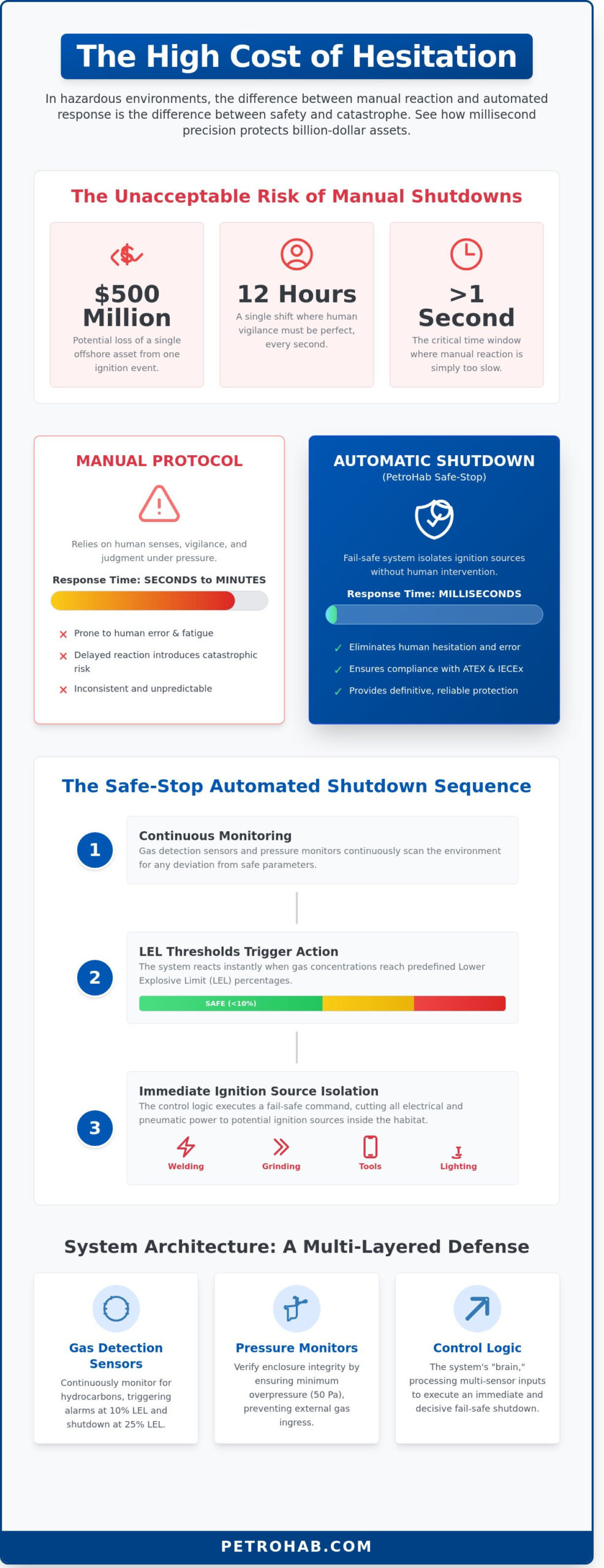
- Gas detection sensors: These units continuously monitor for hydrocarbons. They trigger audible and visual alarms at 10% LEL and initiate full power isolation at 25% LEL.
- Pressure monitors: These sensors verify the integrity of the enclosure. They ensure a minimum overpressure of 50 Pascals (0.2 inches water gauge), which prevents external gases from entering the workspace.
- Control logic: This serves as the system’s brain. It processes multi-sensor inputs to execute a fail-safe shutdown of all electrical and pneumatic power within the enclosure.
Ignition Source Control vs. General Safety
Ignition source control targets specific risks that general site safety protocols might miss. While general safety focuses on PPE and personnel movement, an automatic shutdown system manages the physical energy present at the work site. It isolates welding leads, power tools, and lighting systems within milliseconds of a breach. This rapid response is critical in high-risk environments where gas clouds can ignite in a fraction of a second. Manual intervention is too slow to prevent a disaster in these scenarios.
PetroHab integrates this logic directly into its pressurized welding habitats. By combining the physical barrier of the Petro-Wall with the electronic oversight of the Safe-Stop system, operators achieve a multi-layered defense. This integration ensures that human error or mechanical failure doesn’t result in a catastrophic event. It provides a level of risk mitigation that manual monitoring cannot match, acting as a seasoned veteran of safety on every job site.
The Mechanics of Automated Ignition Source Isolation
An automatic shutdown system serves as the definitive technical barrier between active ignition sources and potential fuel loads. The isolation sequence begins with real-time environmental monitoring through a distributed sensor network. When the system detects a deviation from safety parameters, the logic controller executes an immediate power termination sequence. This process is functional, direct, and engineered to remove the human element from critical decision-making during a gas release event.
Reliability in these systems stems from fail-safe design principles. In a fail-safe configuration, the system requires active signals and power to maintain the “run” state. If the system loses electrical power or pneumatic pressure, the internal relays or valves automatically revert to a closed, de-energized position. While electrical systems provide rapid data logging and diagnostic capabilities, pneumatic systems offer a robust alternative in high-vibration or extreme temperature zones. Most high-integrity habitats utilize a hybrid approach to ensure total isolation regardless of the failure mode.
Gas Detection and LEL Monitoring
Effective ignition source control relies on the integration of infrared and catalytic bead sensors. Infrared sensors provide high stability and don’t require oxygen to function, which makes them ideal for stagnant areas. Catalytic bead sensors offer broader detection ranges for various hydrocarbons. Strategic sensor placement is mandatory; technicians must position units to intercept both buoyant light gases and heavy vapors that settle near the deck. Selecting ATEX certified gas detection systems ensures that the hardware itself doesn’t become a hazard in a flammable atmosphere.
The system operates on two primary Lower Explosive Limit (LEL) thresholds. At 10% LEL, the system triggers local alarms to alert the workforce. If concentrations reach 25% LEL, the automatic shutdown system terminates all power to the enclosure. This 25% threshold provides a 4:1 safety factor, ensuring isolation occurs well before the atmosphere reaches a combustible state.
Pressure Loss and Habitat Integrity
Maintaining a positive pressure differential is the primary method for preventing gas ingress into a hot work area. The system monitors this differential using specialized manometers for pressurized habitats. If the internal pressure falls below a set threshold, typically 50 Pascals, the system initiates a shutdown sequence to mitigate the risk of outside gas entering the enclosure through seams or door openings. This pressure-based logic acts as a secondary layer of protection, complementing the gas detection array. For organizations looking to upgrade their current safety protocols, adopting these integrated shutdown solutions provides a measurable increase in operational security.
Comparing Automatic vs. Manual Shutdown Protocols
Manual gas monitoring relies on human observation and physical intervention. This creates a dangerous lag. In an environment where gas concentrations reach the Lower Explosive Limit (LEL), ignition can occur in less than 0.5 seconds. A manual response, involving detection, communication, and manual tool isolation, often takes 60 to 120 seconds. This delay represents an unacceptable risk profile. An automatic shutdown system removes the variable of human hesitation. It executes isolation protocols in milliseconds.
Audible and visual alarms serve as the primary tool for situational awareness. While manual systems may use a simple siren, integrated automated solutions provide multi-point alerts. These signals reach every worker inside the pressurized habitat simultaneously. This immediate notification ensures that personnel don’t waste time questioning the nature of the hazard. Every second saved during an evacuation directly correlates to a reduction in potential fatalities.
Mitigating Human Factors in High-Stress Environments
Technicians operating within hot work safety enclosures face high-pressure scenarios. Stress impairs cognitive function and reaction speed. Implementing automated fail-safes ensures that power isolation happens instantly if gas is detected, regardless of personnel awareness. This reduces the burden on safety watch personnel. They can focus on evacuation instead of reaching for a kill switch. The presence of a Safe-Stop system provides a psychological safety net. It allows workers to focus on the technical precision of their welding or grinding tasks without the constant fear of manual failure.
Reliability and System Availability
Automated systems demand rigorous maintenance but offer superior availability compared to manual checklists. PetroHab technology utilizes advanced voting logic, such as 2-out-of-3 (2oo3) sensor configurations. This specific architecture requires two sensors to confirm a hazard before triggering a shutdown. It reduces false trips by 40% compared to 1-out-of-1 systems. Higher up-time translates to improved project efficiency. Every incident is recorded. The automatic shutdown system provides a digital forensic trail through data logging. This history is essential for post-incident investigations and meeting ISO 9001 and ATEX compliance requirements.
Operational Integration and Compliance Standards
Reliability in hazardous environments depends on the seamless alignment of hardware with global safety frameworks. An automatic shutdown system functions as the primary barrier against catastrophic ignition. It must comply with international standards including ATEX Directive 2014/34/EU and the IECEx system. These certifications ensure that the equipment remains safe under specific fault conditions. ISO 13849-1 provides the necessary criteria for the safety-related parts of control systems, establishing the Performance Level (PL) required for offshore and onshore assets. Compliance isn’t a suggestion; it’s a fundamental requirement for operational integrity. PetroHab prioritizes these standards to ensure every unit provides unrivaled protection for high-value assets and human life.
Navigating ATEX and IECEx Requirements
Certification requirements for shutdown control panels are stringent. Every component in the safety chain, from gas detectors to PLC logic solvers, must meet the hazardous area classification. This ensures the system doesn’t introduce a secondary ignition source. It’s critical to use a hot work safety enclosure that’s fully compatible with the shutdown logic. PetroHab’s patented Safe-Stop technology maintains this compatibility, ensuring that if a gas excursion occurs, the ignition source is isolated instantly. Engineers must verify that all modular components carry valid certificates before deployment to maintain the integrity of the protection protocol.
PTW and Hot Work Best Practices
The automatic shutdown system fundamentally alters the risk assessment process within a Permit-to-Work (PTW) framework. It provides a technical control that lowers the risk profile of hot work activities. Safety managers must include system calibration logs and sensor response data in the permit documentation to ensure transparency. Before any work starts, technicians perform a “Bump Test.” This protocol involves exposing sensors to a known concentration of test gas to verify the system’s reaction time and alarm thresholds. It’s a non-negotiable step in the pre-operational phase. Personnel training is equally vital. Workers must understand the logic of the automatic shutdown system to avoid accidental triggers and respond correctly to genuine alarms. This knowledge prevents operational delays and ensures a swift response during an actual event.
Ensure your facility meets the highest safety benchmarks by partnering with the industry leader in ignition source control. Consult with the experts at PetroHab today.
Safe-Stop: PetroHab’s Patented Ignition Source Control
PetroHab engineered the Safe-Stop automatic shutdown system to provide an uncompromising layer of protection in the harshest offshore and onshore environments. This patented technology serves as the definitive barrier against ignition in hazardous areas. It monitors the environment with sub-second precision; any deviation from safety parameters results in an immediate cessation of hot work activities. Unlike generic alternatives, Safe-Stop features a modular design that facilitates rapid deployment on congested platforms where every square meter of space is critical.
The system’s durability is proven through its deployment in corrosive saltwater environments and high-heat refinery settings. By automating the monitoring process, operators eliminate the risk of human error. This reliability is vital for protecting high-value assets and human life. When integrated with a PetroHab Hot Work Safety Enclosure (HWSE), the Safe-Stop system creates a controlled environment that permits welding or grinding in proximity to live processes. This synergy provides a turnkey solution that meets the most rigorous ATEX and IECEx standards.
Operational efficiency is a direct result of this technology. During a 2023 refinery turnaround project, the implementation of Safe-Stop reduced scheduled downtime by 12% by allowing hot work to continue safely while adjacent units remained online. This level of control ensures that maintenance schedules remain on track without compromising site integrity. It’s a proactive approach to risk management.
Safe-Stop Technical Specifications
The Safe-Stop unit utilizes advanced sensors to monitor combustible gas levels and habitat pressure. Key technical features include:
- Gas detection calibrated to trigger at 10% of the Lower Explosive Limit (LEL).
- Pressure monitoring accuracy within 0.1 millibar to maintain habitat integrity.
- Dual-stage visual strobes and a 110-decibel audible alarm system.
- Compact, ruggedized stainless steel housing for maximum durability.
Its compact footprint is specifically designed for the limited-space constraints of offshore platforms. This ensures that safety equipment doesn’t obstruct critical walkways or egress routes. Personnel receive clear, immediate notification of any hazard through the integrated alarm interface.
Partnering with PetroHab for Global Hot Work Safety
PetroHab provides flexible procurement options to meet specific project needs. The Safe-Stop automatic shutdown system is available through equipment leasing for short-term turnarounds or direct purchase for long-term facility integration. Every deployment is backed by the expertise of certified technicians who provide on-site supervision and comprehensive training for local personnel. This commitment to technical support ensures that every system operates at peak performance. Contact PetroHab today for a Safe-Stop system quote to secure your facility with the industry’s most trusted ignition source control technology.
Prioritize Operational Integrity with Automated Ignition Control
Maintaining operational integrity in hazardous environments requires more than passive monitoring. It demands a proactive technological response to ignition risks. Implementing a robust automatic shutdown system ensures that ignition sources are isolated within milliseconds of a detected gas leak, eliminating the 30 to 60 second delay often associated with manual intervention. PetroHab’s engineering focuses on meeting the rigorous demands of the energy sector by integrating hardware that adheres to strict global compliance standards.
Our technology is built on the foundation of the patented Safe-Stop system, which provides ATEX and IECEx compliant protection across diverse climates. These systems have demonstrated their reliability on live offshore platforms worldwide, where equipment must function without fail under extreme pressure. By prioritizing these automated safeguards, safety managers protect both personnel and high-value assets from catastrophic events. We’re dedicated to providing the technical remedies needed for the industry’s most challenging environments.
Secure your site with the Safe-Stop Automatic Shutdown System
We’re ready to help you fortify your operations and achieve the highest standards of worksite safety.
Frequently Asked Questions
How fast does an automatic shutdown system respond to a gas detection event?
An automatic shutdown system reacts within milliseconds once the gas detector crosses the pre-set lower explosive limit threshold. The PetroHab Safe-Stop logic controller processes these signals and isolates power to all ignition sources in less than 5 seconds. It’s critical for maintaining the integrity of the pressurized habitat during unexpected gas excursions. This rapid isolation prevents hazardous gas from reaching active welding equipment or power tools.
Is an automatic shutdown system required for all offshore hot work?
Regulatory bodies like BSEE in the U.S. and the HSE in the UK mandate ignition source control for hot work in hazardous areas. An automated system is a primary requirement for any pressurized enclosure operating under IEC 60079-13 standards. These systems provide the necessary fail-safe mechanisms to protect personnel and assets on offshore platforms. Without automated isolation, a facility risks non-compliance with international safety protocols.
Can a shutdown system detect multiple types of hazardous gases simultaneously?
Yes, the Safe-Stop system utilizes modular sensor arrays to monitor up to 4 distinct gas types simultaneously. Standard configurations include sensors for methane, hydrogen sulfide, and oxygen levels. Each sensor communicates with the central control unit to trigger a shutdown if any individual gas reaches its programmed alarm set point. This multi-gas capability ensures comprehensive protection against both explosive and toxic atmospheres in any industrial environment.
What happens to the work progress when a shutdown is triggered?
When a shutdown occurs, the system immediately cuts electrical power to all tools and welding equipment inside the enclosure. Work stops instantly to eliminate any potential ignition source while the gas detection event is active. The system also triggers audible and visual alarms to alert technicians to evacuate. Operations can’t resume until the atmosphere is cleared and the system is manually reset by an authorized safety officer.
How often does an automatic shutdown system require calibration?
Calibration for an automatic shutdown system must occur at least every 180 days to ensure sensor accuracy and system reliability. Technicians should also perform bump tests before every shift to verify that the sensors respond correctly to known gas concentrations. Adhering to this 6-month schedule maintains compliance with ISO 9001 and manufacturer specifications. Regular maintenance ensures the system doesn’t suffer from sensor drift, which could lead to dangerous failures.
Is the PetroHab Safe-Stop system compatible with other habitat brands?
The PetroHab Safe-Stop system is engineered for universal compatibility with any high-quality pressurized habitat brand. Its modular design allows it to integrate seamlessly with existing hot work safety enclosures to provide superior ignition source control. It’s a flexible solution that ensures safety managers can upgrade their current infrastructure with PetroHab’s patented technology. This compatibility ensures that every site can reach the gold standard in hot work safety.
Does the system provide a log of all gas and pressure readings for audit purposes?
The Safe-Stop system includes an integrated data logger that records all gas concentrations and pressure readings at 1-minute intervals. This digital record provides a comprehensive audit trail for safety managers and regulatory inspectors. It captures every alarm event, system test, and operational parameter, ensuring full transparency. Managers don’t have to worry about manual record-keeping because these logs are essential for post-incident analysis and demonstrating ongoing compliance.