Blog Posts
Air Clean Room Environments for Hazardous Industrial Operations: A 2026 Technical Guide
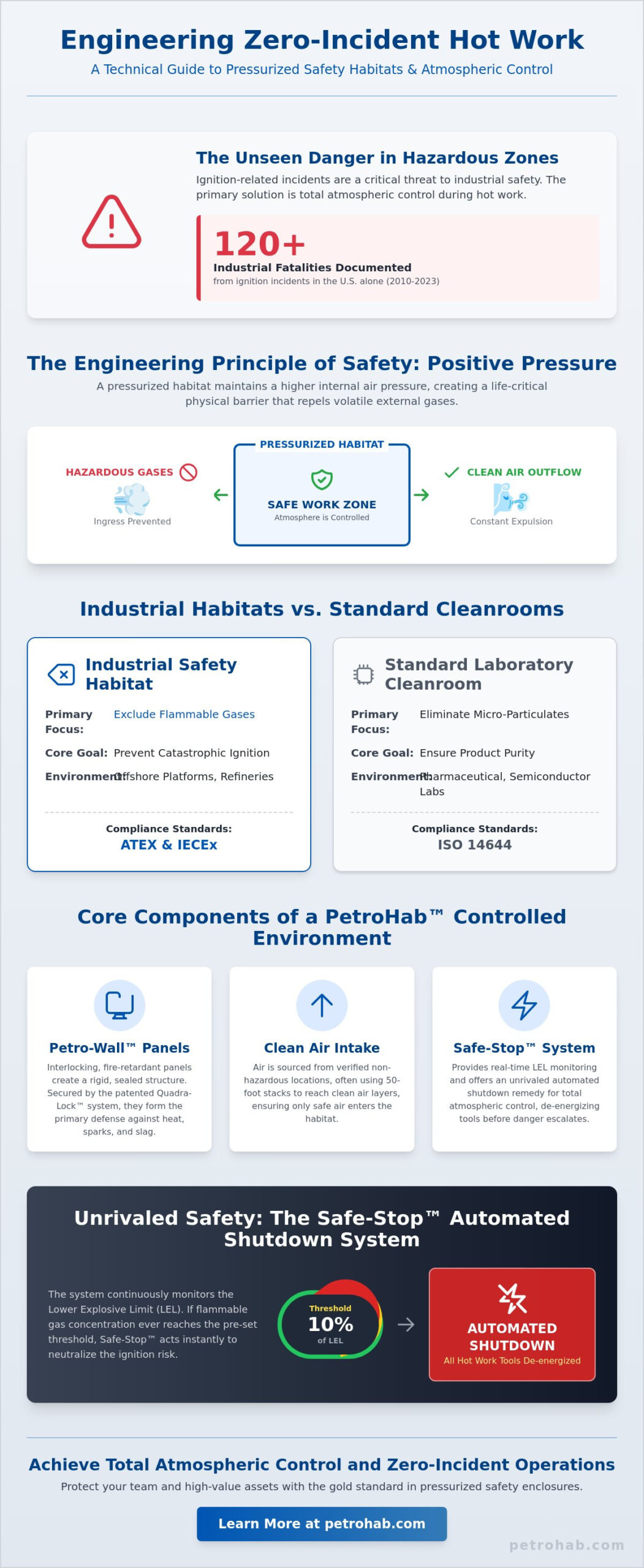
The Chemical Safety Board documented that ignition-related incidents in hazardous zones contributed to over 120 industrial fatalities between 2010 and 2023. In these high-stakes environments, deploying a specialized air clean room is the primary method for isolating hot work from volatile gases. You recognize that maintaining atmospheric control isn’t merely a regulatory hurdle; it’s a fundamental requirement for protecting your team and high-value assets. Compliance with ATEX and IECEx standards remains non-negotiable when your facility’s survival depends on precise ignition source control.
This 2026 technical guide demonstrates how advanced air clean room technology and pressurized habitats ensure atmospheric integrity and explosion prevention during critical maintenance. You’ll learn how to achieve zero-incident hot work operations while minimizing downtime through engineered safety enclosures. We’ll examine the deployment of patented Petro-Wall systems and Safe-Stop technology to maintain a controlled environment in the most volatile conditions.
Key Takeaways
- Understand the engineering principles of overpressure and how positive pressure maintains atmospheric integrity by preventing the ingress of hazardous external gases.
- Navigate the complex landscape of international safety certifications by distinguishing between ISO 14644 cleanroom requirements and ATEX or IECEx compliance for hazardous zones.
- Master the strategic implementation of an industrial air clean room by executing comprehensive site risk assessments and identifying certified air sources outside hazardous perimeters.
- Discover how patented PetroHab technologies, including the Safe-Stop system, offer an unrivaled automated shutdown remedy for total atmospheric control.
- Identify the operational differences between standard laboratory environments and high-stakes industrial safety habitats designed to protect human life and high-value assets.
Defining the Industrial Air Clean Room: Beyond Particulate Control
Industrial operations in volatile environments require more than simple ventilation. An air clean room in a hazardous sector, such as an offshore platform or a petrochemical refinery, serves as a critical barrier against catastrophic ignition. While standard Cleanroom Environments focus primarily on eliminating microscopic dust for semiconductor or pharmaceutical production, industrial safety habitats prioritize the exclusion of flammable hydrocarbons. By 2026, the industry has shifted toward a holistic definition of atmospheric integrity. It’s no longer sufficient to filter particulates; the system must ensure the total absence of combustible gases within the work area. This technical evolution prevents industrial disasters by maintaining a pressurized environment that physically blocks hazardous elements from entering areas where hot work occurs.
The role of atmospheric integrity is absolute. In high-hazard zones, a single spark meeting a gas pocket results in immediate loss of life and assets. PetroHab’s approach treats the air as a manageable safety component. We don’t just monitor the environment; we dictate its composition. This rigorous control is the gold standard in hot work safety, providing a documented layer of protection that satisfies both internal safety audits and international regulatory bodies. Every cubic meter of air inside the habitat is accounted for, ensuring that technicians operate in a space where the risk of explosion is engineered to zero.
The Evolution of Pressurized Safety Enclosures
The transition from basic welding screens to sophisticated modular habitats represents a decade of engineering progress. Early methods relied on rudimentary physical barriers that offered zero protection against gas ingress. Modern systems utilize modular designs that safety teams can deploy at remote sites in under six hours. These structures incorporate high-specification fire-resistant materials that meet rigorous ATEX and IECEx standards. The shift to modularity ensures that specialized enclosures adapt to complex piping geometries, providing a steady seal that maintains internal pressure even in extreme weather conditions. It’s a leap from passive shielding to active environmental management.
Core Components of a Controlled Air Environment
A functional industrial habitat relies on integrated hardware to maintain its protective status. PetroHab utilizes the patented Quadra-Lock system to secure fire-retardant panels, creating a rigid structure that withstands significant external pressure differentials. This mechanical integrity is the foundation of the air clean room.
- Primary Structure: Interlocking Petro-Wall panels provide the first line of defense against heat, sparks, and molten slag.
- Air Intake Systems: These units source air from verified non-hazardous locations, often utilizing 50-foot stacks to reach clean air layers far above potential leak points.
- Monitoring Hardware: Systems like the Safe-Stop provide real-time detection of LEL (Lower Explosive Limit) levels. If gas concentrations reach 10% of the LEL, the system automatically shuts down all hot work tools within the enclosure.
This technical architecture ensures that the pressurized enclosure remains a controlled environment. It protects human life and high-value assets from the ever-present risk of explosion. Reliability isn’t assumed; it’s manufactured through these specific, redundant components.
The Engineering Principles of Atmospheric Integrity
The operational integrity of an air clean room in a hazardous industrial setting depends on the uncompromising maintenance of an overpressure environment. This isn’t merely a technical preference; it’s a life-critical physical barrier designed to repel volatile gases and toxic vapors. By keeping the internal pressure higher than the external atmosphere, the habitat ensures that air flows exclusively from the inside out. This proactive displacement prevents the ingress of hydrocarbons, even if the structural seal is momentarily compromised during personnel transit or equipment movement.
Positive Pressure Mechanics
Calculated pressure differentials form the backbone of habitat safety. Maintaining a specific range between 0.1 and 0.5 inches of water column (w.c.) provides the necessary force to repel external contaminants without stressing the structural components of the enclosure. Technicians rely on manometers to provide constant, real-time verification of this integrity. If the pressure falls below the 0.1-inch threshold, the risk of gas entry increases, necessitating immediate corrective action or system shutdown via automated safety controls. Precision in air ducting placement is equally vital. Strategic positioning of intake and exhaust points eliminates “dead spots” where hazardous gases or heat could potentially accumulate. This ensures a uniform flow across the entire workspace, maintaining a consistent environment for all personnel.
- 0.1 to 0.5 inches w.c.: The engineered “sweet spot” for gas exclusion.
- Manometer Monitoring: Essential for continuous verification of the pressure boundary.
- Ducting Geometry: Prevents stagnant air pockets that can trap heat or fumes.
Filtration and Air Quality Standards
Atmospheric safety inside a pressurized habitat requires more than just pressure; it demands rigorous, multi-stage filtration. While standard HEPA filters effectively capture metallic dust and particulates, specialized chemical filters are necessary to neutralize complex industrial contaminants. During hot work operations, these systems must aggressively strip away welding fumes and ozone to maintain breathable air quality. Adhering to OSHA Hazardous Location Standards ensures that the ventilation equipment meets the strict requirements for Class I, Division 1 or 2 environments. High air exchange rates are also critical for worker thermoregulation. Rapid air turnover prevents the buildup of metabolic heat and process-generated warmth, which is vital for safety in confined or high-temperature areas. Utilizing a modular habitat solution allows for customized airflow configurations that adapt to the specific geometry of any industrial site, ensuring that every cubic foot of the workspace remains under total control. This methodical approach to air quality is why PetroHab remains the gold standard in hot work safety, providing an unrivaled level of protection for high-value assets and human life.
Compliance and Standards: ISO 14644 vs. ATEX and IECEx
High-stakes industrial operations require a dual-compliance approach that reconciles air purity with explosion prevention. Engineers must integrate particulate control with explosive atmosphere mitigation to maintain operational integrity. These hazardous environment standards define the structural requirements for every enclosure deployed in the field. Designing an air clean room for an offshore platform involves meeting the particulate limits of ISO 14644 while adhering to the ignition prevention mandates of ATEX and IECEx. Failure to align these protocols results in catastrophic risk. PetroHab provides the technical remedy through calculated engineering and rigorous field testing of its modular systems.
ISO 14644: The Particulate Benchmark
The ISO 14644-1:2015 standard classifies environments based on particle counts per cubic meter. In industrial manufacturing, classes 1 through 9 dictate the allowable concentration of airborne contaminants. Most pressurized hot work operations require at least an ISO Class 8 environment to protect sensitive equipment and weld quality. This classification limits particles of 0.5 μm to 3,520,000 per cubic meter. Achieving this involves rigorous validation procedures. Technicians use discrete-particle-counting light-scattering instruments to ensure the Cleanroom standards and classifications meet the operational requirements of the site. Regular monitoring prevents contamination that could compromise high-value assets or process performance.
ATEX and IECEx: The Safety Mandate
While ISO focuses on purity, ATEX and IECEx focus on ignition prevention. Zone 1 and Zone 2 classifications dictate the hardware requirements for any air clean room deployed in volatile areas. Fans, motors, and lighting must carry specific certifications to ensure they don’t become ignition sources. PetroHab utilizes pressurized welding habitats to maintain a positive pressure differential. This pressure acts as a physical barrier against flammable gases. Our Safe-Stop system provides an automated shutdown mechanism if pressure drops below 50 Pascals. This ensures that ignition sources remain isolated from hazardous hydrocarbons at all times. Compliance isn’t a suggestion. It’s the foundation of asset protection.
Bridging the gap between these standards requires specialized Air Handling Units (AHUs). These units must filter particulates to ISO Class 8 standards while remaining explosion-proof. PetroHab AHUs incorporate HEPA filtration and spark-arresting components. This dual-purpose design allows for hot work in areas that previously required total facility shutdowns. Key compliance factors include:
- Zone 1 Compliance: Mandatory for areas where an explosive atmosphere is likely to occur in normal operation.
- Zone 2 Compliance: Required for areas where an explosive atmosphere is unlikely but possible during abnormal conditions.
- Pressure Integrity: Maintaining a minimum of 50 Pa to exclude external gases from the enclosure.
- Component Certification: Every motor and fan must meet IEC 60079 series standards for explosive atmospheres.
Strategic Implementation in Refineries and Offshore Platforms
Implementing a pressurized air clean room within volatile environments like refineries or offshore platforms demands a rigorous, five-step technical framework. Safety managers can’t afford errors when ignition sources meet hydrocarbon risks. Precision is the only path to zero-incident operations.
- Step 1: Conduct a comprehensive site risk assessment and gas mapping. Engineers must identify prevailing wind patterns and potential leak points. This data determines the optimal placement of the enclosure to prevent gas ingress.
- Step 2: Identify a certified clean air source outside the hazardous perimeter. The intake must draw from an area confirmed to be free of flammable vapors. This ensures the internal atmosphere remains breathable and over-pressurized.
- Step 3: Deploy modular HWSE structures using Quadra-Lock technology. PetroHab’s patented Quadra-Lock system provides a secure, interlocking seal. It maintains structural integrity where traditional panel systems often fail.
- Step 4: Integrate automatic shutdown systems for real-time ignition control. Systems like Safe-Stop act as a digital sentry. They instantly de-energize all hot work tools if gas is detected or if the air clean room loses pressure.
- Step 5: Establish a Permit-to-Work (PTW) protocol for all personnel. Rigorous documentation ensures every technician understands the operational limits and emergency egress routes.
Offshore Challenges: Salt, Wind, and Vibration
Marine environments test the limits of safety equipment. On floating production storage and offloading (FPSO) units, habitats must withstand constant vibration and high wind loads. Corrosion resistance is non-negotiable for air intake systems exposed to salt spray. PetroHab designs focus on minimizing the physical footprint to keep walkways clear while maximizing internal workspace for critical repairs.
Refinery Turnarounds: Efficiency and Safety
Efficiency drives refinery turnarounds. Enabling hot work during live operations can reduce downtime by 25% or more compared to full plant shutdowns. Managing multiple enclosures across a large facility requires logistical precision. Partnering with certified hot work safety enclosure suppliers ensures that your fleet meets ATEX and IECEx standards. Petro-Wall panels provide the durability needed for these intensive, high-stakes schedules.
PetroHab Solutions: The Gold Standard in Controlled Air Environments
PetroHab’s Hot Work Safety Enclosure (HWSE) technology provides a definitive solution for industrial operations conducted within explosive atmospheres. While traditional enclosures often struggle with leakages and structural instability, the PetroHab air clean room utilizes a pressurized barrier to isolate ignition sources from hydrocarbon hazards effectively. This system creates a controlled environment where hot work can proceed without shutting down surrounding production lines. It’s a critical advantage that minimizes downtime and protects high-value assets.
The Safe-Stop system serves as the technological heart of the enclosure. This system provides an automatic shutdown of all hot work tools if it detects a loss of internal pressure or the presence of flammable gases. By removing the reliance on human reaction times, Safe-Stop ensures total atmospheric control. PetroHab offers these solutions through a global network, providing leasing, sales, and 24/7 on-site technical supervision. This comprehensive support model ensures that safety protocols are strictly followed in every geographic region, from offshore platforms to land-based refineries.
The PetroHab Advantage: Quadra-Lock and Fire Resistance
Structural integrity is the foundation of the PetroHab air clean room. The Quadra-Lock system uses patented interlocking panels to provide superior pressure retention. These panels are manufactured from ANSI/FM 4950 certified materials, which are rated to withstand extreme heat and prevent the escape of sparks or molten slag. Every panel is engineered for modularity; this allows safety managers to customize the habitat footprint to fit specific equipment layouts or confined spaces. Because the panels interlock securely, the risk of pressure loss is virtually eliminated, even in high-wind offshore environments.
Integration with Advanced Hot Work Safety Systems
Achieving 360-degree protection requires pairing the physical habitat with hot work safety systems that monitor conditions in real time. PetroHab’s systems include advanced data logging capabilities that record atmospheric readings at 5-second intervals. This data provides a transparent audit trail for compliance officers and safety engineers. Beyond the hardware, the role of professional training is paramount. PetroHab’s certified supervisors ensure that habitat integrity is maintained through every shift. They manage the technical nuances of ignition source control, ensuring that the pressurized environment remains uncompromised by external hazards or procedural errors.
- Patented Technology: Quadra-Lock panels ensure a gas-tight seal that outperforms standard welding drapes.
- Certified Safety: All materials meet ANSI/FM 4950 standards for fire resistance and durability.
- Rapid Response: Safe-Stop technology terminates power to ignition sources in less than 1 second upon gas detection.
- Global Reach: Technical supervision is available 24/7 to support international operations.
Securing Operational Integrity in 2026 and Beyond
Maintaining atmospheric integrity in 2026 requires more than basic filtration. It demands a rigorous fusion of ISO 14644 standards with the explosive atmosphere protections defined by ATEX and IECEx. PetroHab’s engineering team facilitates this by deploying patented Quadra-Lock technology. This system eliminates the gaps found in traditional enclosures, ensuring that every air clean room remains a strictly controlled environment even in high-risk zones.
Safety managers in Houston and Dundee now rely on these modular systems to mitigate ignition risks during critical hot work operations. By integrating ATEX and IECEx certified components, PetroHab provides a definitive technological remedy for the hazards inherent to offshore platforms and refineries. You don’t have to compromise on safety when high-value assets and human lives are at stake. Our global presence ensures that specialized engineering support is available where your operations need it most.
Request a Technical Consultation for Your Pressurized Air Environment
Your commitment to safety is the foundation of long-term operational excellence.
Frequently Asked Questions
Can an air clean room be used for welding in a Zone 1 hazardous area?
Yes, an air clean room designed as a Hot Work Safety Enclosure (HWSE) allows welding in Zone 1 areas by providing a pressurized barrier. PetroHab systems comply with IEC 60079-13 standards to ensure ignition source control. This technology isolates the welding arc from flammable gases present in the external atmosphere. By maintaining a constant flow of fresh air, the system prevents the ingress of hydrocarbons, ensuring compliance with offshore safety regulations.
How much positive pressure is required to maintain a secure work area?
A minimum differential pressure of 50 Pascals, or 0.2 inches of water gauge, is the industry standard for maintaining habitat integrity. PetroHab’s systems monitor this pressure 24 hours a day to prevent gas ingress. If the pressure drops below 25 Pascals, the Safe-Stop system initiates an immediate shutdown of all hot work equipment. This precise calibration ensures that the internal environment remains isolated from external hazardous vapors at all times.
What happens to the air environment if the automatic shutdown system is triggered?
When the Safe-Stop system is triggered, it immediately terminates power to all ignition sources like welding machines or grinders. The enclosure remains physically intact, but the pressurized environment is scrutinized by gas detection sensors. If the trigger resulted from gas detection at the air intake, the system stops the blowers to prevent drawing contaminants inside. This automated response mitigates risk within 0.5 seconds of a detected anomaly.
Is a modular HWSE more cost-effective than a permanent cleanroom for refineries?
Modular HWSEs offer superior cost efficiency for refinery turnarounds compared to permanent structures. Deploying a Petro-Wall system reduces mobilization time by 40 percent and eliminates the need for expensive structural modifications. Because these units are portable, they serve specific maintenance windows without the long term capital expenditure of a fixed facility. It’s a strategic choice that can reduce hot work related downtime by 30 percent during major scheduled outages.
What filtration levels are necessary for offshore air intake units?
Offshore air intake units require a multi-stage filtration process to handle salt spray and industrial particulates. Systems must utilize G4 rated pre-filters followed by F7 or F9 fine filters according to EN 779 standards. This configuration ensures that the air clean room receives air free from 90 percent of particles larger than 0.4 microns. High efficiency filtration protects both the internal equipment and the respiratory health of the technicians working inside the enclosure.
Can PetroHab air clean rooms be customized for high-temperature environments?
PetroHab’s air clean room solutions are engineered for extreme conditions using patented Petro-Wall panels. These panels are rated to withstand continuous temperatures up to 1,000 degrees Celsius, making them ideal for steam line repairs or furnace proximity. The modular design allows for the integration of specialized cooling units that maintain an internal ambient temperature of 22 degrees Celsius; this remains effective even when external temperatures exceed 50 degrees Celsius in tropical climates.
How do you verify the air quality inside a pressurized habitat during operation?
Air quality is verified through continuous real time monitoring using calibrated sensors for Lower Explosive Limits (LEL), Hydrogen Sulfide (H2S), and Oxygen (O2) levels. The system provides a digital readout every second to the habitat technician. We utilize dual redundancy sensors to ensure 99.9 percent uptime for safety monitoring. If O2 levels deviate from the 19.5 to 23.5 percent range, the system’s logic alerts personnel to evacuate immediately.
What are the training requirements for personnel operating within an air clean room?
Personnel must complete a certified 8 hour training course covering habitat operations and emergency response protocols. This curriculum includes hands on instruction for the Safe-Stop system and pressure differential monitoring. Operators don’t start work until they demonstrate proficiency in ISO 9001 procedures for assembly and disassembly. Every technician must pass a competency assessment every 12 months to maintain their certification for working in high risk industrial environments.