
Blog Posts
Climate Control Options for Welding Habitats: Managing Temperature and Pressure in 2026
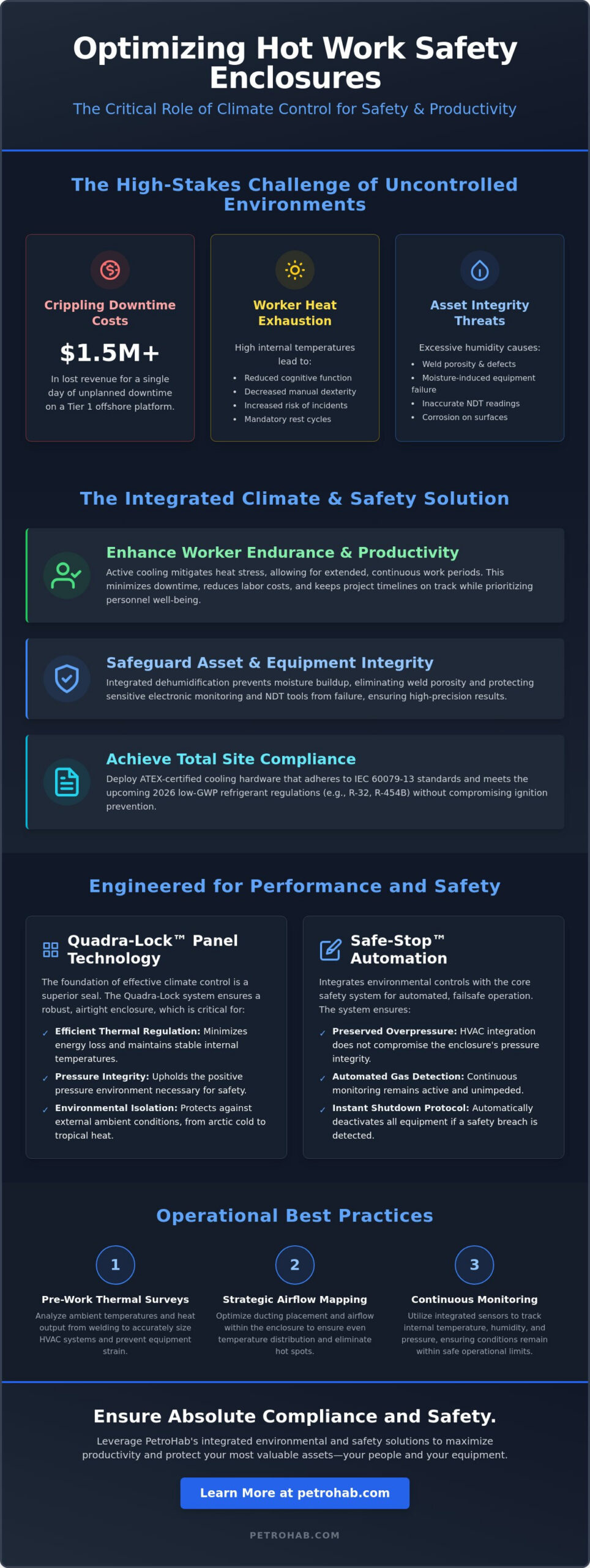
A single day of unplanned production downtime on a Tier 1 offshore platform can result in over $1.5 million in lost revenue, making operational efficiency as critical as the safety protocols that govern it. You recognize that maintaining the integrity of a pressurized Hot Work Safety Enclosure is only half the battle; the other half is ensuring that the personnel inside can perform high-precision tasks without the physical toll of extreme heat or humidity. Integrating effective climate control options for welding habitats is no longer a luxury. It’s a technical necessity to prevent heat exhaustion and protect sensitive equipment from moisture-induced failure.
This article provides the technical clarity you need to maintain optimal thermal conditions and worker productivity within pressurized habitats without compromising safety or overpressure integrity. You’ll gain a definitive understanding of how to integrate HVAC systems while adhering to the latest IEC 60079-13 standards and the 2026 refrigerant regulations that mandate low GWP alternatives like R-32 or R-454B. We examine the operational capabilities of the Quadra-Lock panel system in managing ducting and pressure, ensuring your site remains an environment of absolute compliance and safety through the engineering provided by PetroHab LLC.
Key Takeaways
- Implement advanced climate control options for welding habitats to mitigate worker heat exhaustion and maintain high-precision welding standards in confined environments.
- Ensure total site compliance by deploying ATEX-certified cooling hardware that meets the 2026 low-GWP refrigerant standards without compromising ignition prevention protocols.
- Learn to integrate environmental control units with the Safe-Stop Automatic Shutdown System to preserve overpressure integrity and automated gas detection.
- Utilize Quadra-Lock panel technology to achieve the airtight seal necessary for efficient thermal regulation and reduced operational downtime in extreme ambient temperatures.
- Apply strategic air-flow mapping and pre-work thermal surveys to optimize the internal environment of your Petro-Habitat for maximum safety and worker endurance.
The Critical Role of Climate Control in Hot Work Safety Enclosures
Climate control within a PetroHab LLC Hot Work Safety Enclosure (HWSE) represents the active management of temperature, humidity, and air quality to ensure operational stability. While a standard Positive pressure enclosure relies on a constant intake of fresh air to prevent gas ingress, this basic ventilation often fails to mitigate the intense thermal load generated by continuous welding operations. In confined industrial settings, the heat from a welding arc, combined with high ambient temperatures, can quickly exceed safe physiological thresholds for personnel.
Implementing robust climate control options for welding habitats is essential for maintaining both worker safety and technical compliance. Without active cooling, internal temperatures can rise to levels that trigger mandatory worker rest cycles, which directly increases project timelines and labor costs. Maintaining a stable internal environment is a prerequisite for high-stakes engineering where human endurance and equipment precision are non-negotiable. This stability allows for the continuous monitoring of safety parameters without the interference of thermal fluctuations.
To better understand the physical construction of these environments, watch this overview of habitat panel technology:
Mitigating Heat Stress in Hazardous Zones
Personnel operating within fire-resistant enclosures face significant physiological stress. When core body temperatures rise, cognitive function and manual dexterity decline, increasing the probability of hot work incidents. Regulatory standards often mandate frequent breaks in high-heat environments. However, active cooling solutions allow for extended work periods by keeping the habitat within a controlled range. This technical remedy ensures that safety managers can meet their duty of care while minimizing downtime. Thermal comfort isn’t a luxury; it’s a calculated risk mitigation strategy that protects the human assets on the front line of heavy industry. It ensures that the focus remains on the precision of the weld rather than the discomfort of the environment.
Protecting Asset Integrity through Humidity Control
Excessive humidity within a pressurized habitat poses a direct threat to both the weld and the tools used to monitor it. Moisture buildup can lead to weld porosity, a defect that compromises the structural integrity of the asset. Additionally, sensitive electronic monitoring equipment and Non-Destructive Testing (NDT) tools require stable environmental conditions to function with precision. Integrating dehumidification into the HWSE workflow prevents condensation on surfaces and internal components. By utilizing the superior airtight seal of Quadra-Lock panels, operators can maintain a consistent internal climate even in volatile offshore conditions. This level of environmental control ensures that climate control options for welding habitats deliver the reliability required by PetroHab LLC for the most demanding energy sector projects. It provides a stable atmosphere for critical inspections and high-precision joining.
Engineering the Thermal Environment: Cooling and Heating Options
Engineering a thermal environment within a pressurized enclosure requires more than just moving air. It involves a precise balance of heat extraction and pressure maintenance. While basic ventilation satisfies oxygen requirements, it rarely addresses the substantial thermal output of a welding arc. Operators must calculate the required BTU capacity by evaluating the habitat’s total volume, the ambient external temperature, and the expected heat output from the welding process. Failure to properly size these systems leads to equipment strain and potential non-compliance with OSHA hot work regulations regarding worker safety in confined spaces.
The selection between air-cooled chillers and direct expansion (DX) cooling systems depends on the scale of the operation. DX systems are generally preferred for portable Petro-Habitats because they’re compact and provide immediate cooling. However, for 2026 deployments, these units must utilize low Global Warming Potential (GWP) refrigerants such as R-32 or R-454B to remain compliant with the American Innovation and Manufacturing (AIM) Act. In contrast, air-cooled chillers use a water or glycol loop. They’re often more efficient for large scale projects involving multiple habitats, as they consolidate the refrigeration plant into a single, distant unit. In arctic or deep-water offshore environments, the focus shifts to heating. Explosion-proof electric heaters or steam-coil heat exchangers are necessary to prevent equipment freezing and maintain the ductile properties of the materials being welded.
Active Cooling: Portable Industrial AC Units
Selecting climate control options for welding habitats in Zone 1 or Zone 2 areas demands ATEX or IECEx certified hardware. These units are engineered with non-sparking components and sealed electronics to prevent them from becoming an ignition source. High-tier systems integrate HEPA and carbon filtration into the cooling cycle to scrub welding fumes and ozone from the recirculated air. Managing condensate drainage is a critical technical challenge. Drainage lines must be equipped with specialized traps or one-way valves to ensure that the positive pressure seal isn’t compromised, preventing the ingress of flammable gases through the water exit point.
Passive and Supplemental Cooling Strategies
Passive measures can significantly reduce the load on active HVAC systems. Utilizing reflective external covers over Quadra-Lock panels reduces solar heat gain by reflecting up to 90% of radiant energy in high-exposure offshore environments. High-volume air movers can also augment specialized HVAC systems by improving internal cross-flow. This ensures that cool air reaches the welder’s breathing zone rather than pooling at the floor. Optimizing air exchange rates is a delicate process. The system must move enough air to remove heat while maintaining the minimum 50 Pascal pressure differential required by IEC 60079-13. For projects with complex environmental variables, it’s advisable to consult with a safety engineer to determine the most effective equipment configuration for your specific site conditions.
Integrating HVAC with Pressurization and Gas Detection
Integrating climate control options for welding habitats requires a rigorous engineering approach to ensure the HVAC hardware doesn’t facilitate a bypass for flammable gases. In a pressurized environment, every penetration of the enclosure represents a potential vulnerability. This includes air supply and return ducts. To mitigate this risk, the air intake for the HVAC system must be situated in a verified gas-free area, typically far removed from the hazardous zone. This configuration ensures that only clean air is processed and delivered into the Petro-Habitat, maintaining the environmental integrity required for hot work.
The engineering must align with the ASHRAE Guide for HVAC in Hazardous Spaces, which emphasizes the necessity of specialized filtration and explosion-proof components. Maintaining the minimum pressure differential of 50 Pascals (0.2 inches of water column) is mandatory under IEC 60079-13 standards. Any climate control system must be calibrated to operate within these parameters. If the HVAC cycle causes the internal pressure to fluctuate below this threshold, the safety seal is effectively compromised.
The Safe-Stop Integration Protocol
The Safe-Stop Automatic Shutdown System must command an immediate HVAC shutdown upon the detection of any combustible or toxic gases to prevent the continued intake of hazardous air. Interlocking the fan controls directly with the habitat’s gas detection sensors ensures that the system isolates the enclosure the moment an alarm is triggered. Safety managers must monitor pressure drops caused by HVAC cycling or potential leaks in the ducting. If the Quadra-Lock panels detect a breach, the Safe-Stop system will terminate power to all equipment, including the cooling units, to prevent ignition.
Maintaining Positive Pressure with External Air Handlers
Utilizing external air handlers provides a dual benefit of thermal regulation and overpressure maintenance. These units act as the primary driver for the positive pressure seal, pushing conditioned air through fire-rated ducting. Digital manometers provide continuous, real-time verification of the environmental seal during HVAC operation. Redundancy planning is essential for high-value assets. If the primary air handler fails, the system must have a secondary air supply capable of maintaining the 50 Pascal differential. This ensures that even if climate control is lost, the protective overpressure remains intact, allowing for a controlled cessation of work.
Operational Best Practices for Managing Internal Climates
Selecting the correct climate control options for welding habitats begins with a comprehensive pre-work environmental survey. This technical assessment identifies site-specific thermal risks, such as proximity to high-temperature process piping or solar exposure in equatorial offshore zones. By quantifying these variables, safety engineers can determine the exact cooling load required to maintain a stable internal temperature. This data-driven approach prevents the deployment of undersized HVAC units that fail to keep up with the heat generated by intensive hot work. To ensure your project maintains peak operational efficiency, contact PetroHab LLC for an expert technical consultation on habitat environmental management.
Effective management also relies on the training of personnel and the rigorous maintenance of equipment. Workers must understand how the integrated climate and safety systems interact; specifically, they must know how to respond when an environmental alarm triggers an automated shutdown. In hydrocarbon-rich environments, cooling coils and filtration systems require routine inspection. Oil mist and particulates can quickly degrade the efficiency of HVAC heat exchangers, leading to system failure. Integrating advanced climate control options for welding habitats ensures that the internal environment remains within regulatory limits regardless of external ambient conditions through the safety protocols established by PetroHab LLC.
Optimizing Air Ducting Layouts
Strategic placement of air ducting is vital to eliminate “dead zones” where heat and welding fumes can accumulate. Intake ducts should be positioned at the lower levels of the enclosure, while exhaust points are located near the roof to capitalize on natural convection. The length and diameter of the ducting directly influence pressure maintenance. Excessive lengths increase friction loss and can drop the internal pressure below the required 50 Pascal threshold. When securing these penetrations through Quadra-Lock panels, technicians must use specialized collars to prevent air leakage. A secure seal ensures that the conditioned air remains within the enclosure, maximizing the cooling effect while protecting the overpressure integrity.
Monitoring Internal Air Quality (IAQ)
Managing the internal climate extends beyond temperature control to the monitoring of breathable air. While gas detection systems focus on LEL and H2S, operators must also track CO2 levels and welding fume concentrations. Maintaining a continuous air exchange rate is the only way to ensure that oxygen levels stay within the mandatory 19.5% to 23.5% range. Portable IAQ monitors serve as a critical supplement to fixed safety systems, providing real-time data on air quality at the welder’s breathing zone. This redundancy ensures that the environment remains safe for high-endurance tasks, even when high-intensity welding produces significant ozone and particulate matter.
The PetroHab LLC Advantage: Integrated Environmental and Safety Solutions
PetroHab LLC provides a unified safety architecture that treats environmental regulation as a fundamental component of ignition prevention. By integrating advanced climate control options for welding habitats with proprietary monitoring technologies, we eliminate the operational gaps often found in fragmented setups. Our systems don’t just cool or heat the workspace; they maintain the technical equilibrium required for safe hot work in the world’s most hazardous Tier 1 environments. This integrated approach ensures that thermal management never comes at the expense of overpressure integrity or gas detection reliability through the engineering oversight of PetroHab LLC.
Our engineered solutions are designed to withstand the most demanding industrial conditions. Petro-Habitats utilize components that are fully compliant with international safety standards, ensuring that every piece of climate control hardware is suitable for Zone 1 and Zone 2 applications. This commitment to technical excellence allows site engineers to deploy our systems with absolute confidence in their reliability and safety compliance. By consolidating the management of temperature, pressure, and gas detection into a single, cohesive workflow, PetroHab LLC reduces the complexity of hazardous area operations while maximizing worker endurance.
Engineered for Integrity with Quadra-Lock
The foundation of an efficient internal climate is the physical seal of the enclosure. Quadra-Lock panels utilize a patented interlocking mechanism that provides a superior airtight seal, significantly reducing air loss compared to traditional zip or velcro systems. This physical integrity minimizes the HVAC energy load, allowing cooling units to operate at peak efficiency even in ambient temperatures. Beyond thermal efficiency, these panels are engineered for extreme durability under significant thermal stress. This modular flexibility allows safety managers to scale climate control options for welding habitats from small, localized repairs to large-scale facility turnarounds without compromising the environmental seal or the protection of high-value assets.
A Partner in Global Hot Work Safety
PetroHab LLC leverages a global presence to provide localized expertise for complex climate-controlled setups. We understand that a habitat deployed in sub-zero environments requires a different technical configuration than one operating in high-humidity equatorial zones. Our comprehensive training programs ensure that your personnel are fully equipped to manage pressurized habitats in any weather condition. We provide technical supervision to ensure that the synergy between the Safe-Stop Automatic Shutdown System and specialized environmental control units is maintained throughout the project lifecycle. This global support network acts as a critical safety partner, protecting your personnel through every phase of hot work. For a definitive solution to your site’s thermal challenges, consult with PetroHab LLC engineers on your specific climate control requirements.
Securing Operational Continuity through Advanced Environmental Control
Managing the thermal load of a Hot Work Safety Enclosure is a technical imperative for maintaining site productivity and worker safety. The integration of ATEX-certified cooling units with the Safe-Stop Automatic Shutdown System ensures that ignition risks are mitigated while personnel operate in optimal comfort. Implementing effective climate control options for welding habitats protects your assets from the humidity and heat that compromise weld quality and equipment life. It’s about maintaining technical equilibrium in high-stakes environments.
PetroHab provides a global track record in Tier 1 oil and gas facilities, delivering reliability where it matters most. Our patented Quadra-Lock technology provides the superior airtight integrity necessary for efficient HVAC operation; meanwhile, our shutdown systems deliver 100% ignition control compliance. These solutions transform hazardous work environments into stable, controlled workspaces where precision engineering can thrive. Request a Technical Consultation for Your Climate-Controlled Habitat to ensure your next project meets the highest standards of safety and efficiency. Your team deserves the protection of a system engineered for the most demanding industrial conditions.
Frequently Asked Questions
Do I need a separate AC unit for my welding habitat in offshore environments?
Yes, separate AC units are necessary when ambient heat or welding intensity exceeds the capacity of standard ventilation. Basic air supply focuses on oxygen levels and pressure; however, it doesn’t actively remove the thermal load generated by the arc. Deploying specific climate control options for welding habitats ensures that workers don’t suffer from heat exhaustion. This is a primary cause of productivity loss in high-temperature offshore environments.
How does climate control affect the positive pressure inside a Petro-Habitat?
Climate control systems can impact pressure if the ducting is not properly sealed or if the fan speeds are not balanced. Every system must be calibrated to maintain the mandatory 50 Pascal (0.2 inches of water column) differential required by IEC 60079-13. The Quadra-Lock panel system helps maintain this pressure by providing an airtight seal that prevents excessive air leakage during the HVAC cooling cycle.
Are climate control units for welding habitats ATEX or IECEx certified?
Yes, all climate control hardware used in Zone 1 or Zone 2 hazardous areas must be ATEX or IECEx certified. These certifications confirm the equipment is engineered with non-sparking components and sealed electronics to prevent ignition. Using uncertified cooling units in a hazardous environment is a critical safety violation. It compromises the entire integrity of the Petro-Habitat and endangers personnel.
Can I use standard industrial heaters inside a pressurized welding habitat?
No, you cannot use standard industrial heaters because they represent an unacceptable ignition risk. Only explosion-proof heaters with appropriate hazardous area certifications are permitted within a pressurized enclosure. These specialized units are designed to operate safely in potentially flammable atmospheres. They’re also monitored by the Safe-Stop Automatic Shutdown System for immediate isolation if a gas breach is detected.
What is the ideal temperature to maintain inside a hot work safety enclosure?
The ideal internal temperature ranges from 68°F to 78°F (20°C to 25.5°C). Maintaining this range ensures that personnel can perform high-precision tasks without the physical strain of heat stress. When internal temperatures exceed these limits, safety protocols often require mandatory rest cycles. This results in significant operational downtime and increased labor costs for the facility operator during the project.
How do I prevent welding fumes from recirculating through the AC system?
Preventing fume recirculation requires the integration of high-efficiency HEPA and carbon filters within the HVAC unit air path. These filters capture ozone and welding particulates before the air is recirculated into the enclosure. This ensures that the internal air quality remains within safe breathing limits. It also protects sensitive electronic monitoring tools from the corrosive effects of welding byproducts.
Does PetroHab provide integrated cooling solutions with their HWSE rentals?
Yes, PetroHab provides integrated cooling and environmental control solutions specifically designed for use with our HWSE. These units are engineered to interface seamlessly with the Quadra-Lock panels and the Safe-Stop system. This integration ensures that the cooling hardware is automatically isolated if gas is detected. We provide a turnkey solution for safety managers who require both thermal management and absolute ignition control.
How much air exchange is required to maintain both pressure and thermal comfort?
Air exchange rates must be high enough to maintain oxygen levels between 19.5% and 23.5% while sustaining a minimum pressure of 50 Pascals. The specific volume depends on the thermal load of the welding process and the habitat size. Properly engineered climate control options for welding habitats balance these requirements. This ensures the environment remains breathable, pressurized, and thermally stable for the duration of the work.