Defining Safe Areas in Hazardous Industrial Environments: A Guide to Hot Work Safety
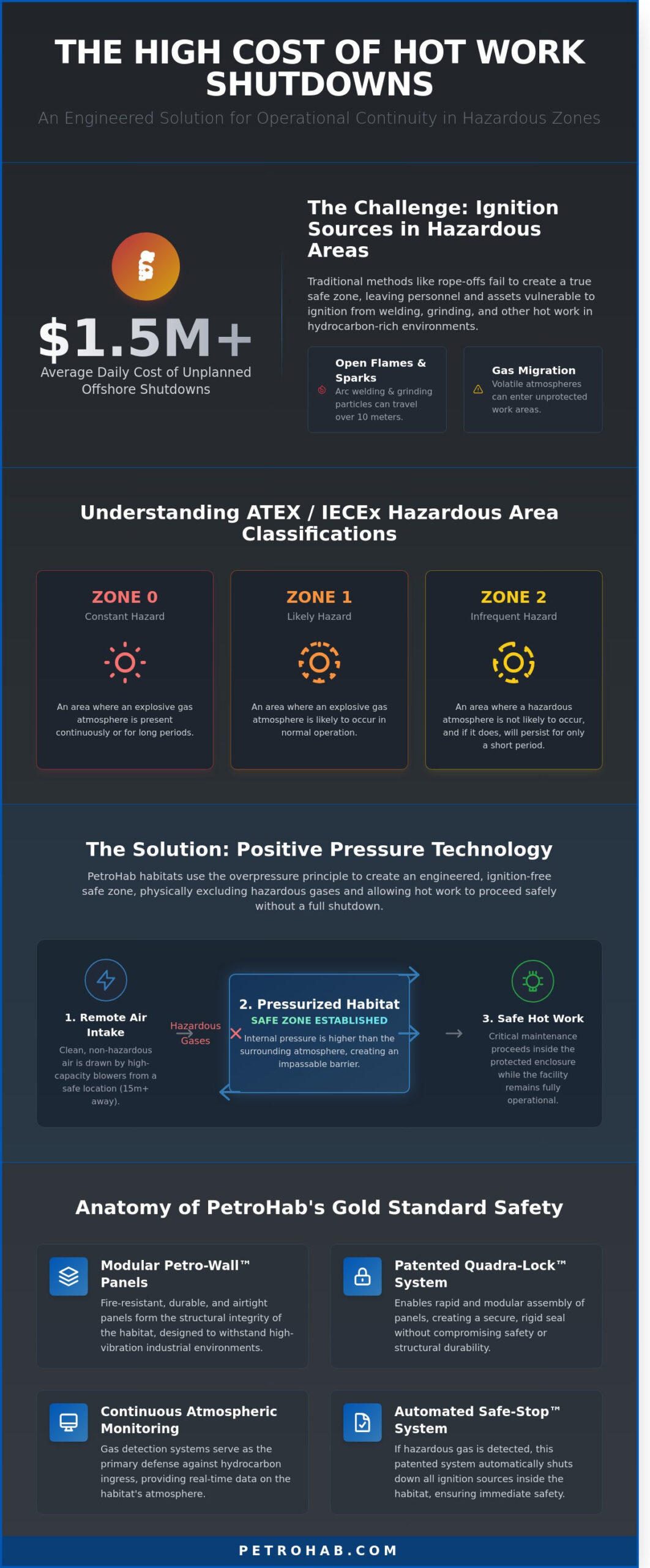
Unplanned facility shutdowns for minor hot work repairs cost offshore operators an average of $1.5 million per day according to recent industry benchmarks. You recognize that every hour of halted production represents a significant loss in operational efficiency and revenue. Maintaining a reliable safe zone within a Zone 1 or Zone 2 hazardous area is a technical challenge that demands more than simple caution. It requires a rigorous, engineered solution that provides an absolute barrier between ignition sources and explosive atmospheres.
You’ll learn how to utilize patented pressurized habitat technology to establish these protected environments; this allows critical maintenance to proceed without compromising site integrity. We’ll analyze the application of modular Petro-Wall systems and the automated safety protocols of the Safe-Stop system. This overview provides the technical framework necessary to achieve full compliance with ATEX and IECEx standards while ensuring your facility remains fully operational and your personnel remain protected.
Key Takeaways
- Understand the technical distinctions between ATEX/IECEx Zone classifications to implement precise risk mitigation strategies for industrial hot work.
- Learn how positive pressure technology utilizes remote air intake systems to exclude flammable gases and maintain a reliable safe zone for high-risk operations.
- Master the protocols for seal verification and leak testing to ensure the structural integrity of pressurized enclosures in Zone 1 and 2 locations.
- Identify how continuous atmospheric monitoring and automatic shutdown systems act as a primary defense against hazardous hydrocarbon ingress.
- Explore the engineering advantages of the patented Quadra-Lock system for achieving rapid, modular assembly without compromising safety or durability.
Understanding Hazardous Area Classifications and the Need for Protected Environments
Industrial hot work in volatile environments demands a rigorous approach to risk management. A protected area is a localized, engineered environment designed to isolate ignition sources from flammable gases. This isolation is critical because hydrocarbon-rich facilities operate under strict hazardous area classifications defined by ATEX and IECEx standards. Zone 0 represents a constant explosive atmosphere. Zone 1 identifies areas where such atmospheres are likely to occur during normal operations. Zone 2 covers locations where hazards are infrequent and short-lived.
Introducing a welding torch or a grinding tool into these zones without a certified safe zone strategy is unacceptable. Traditional rope-off methods don’t provide a physical or atmospheric seal. They fail to prevent gas migration or contain high-energy sparks. Relying on distance alone is a legacy practice that doesn’t meet modern ISO 17776 risk reduction requirements. True safety requires a pressurized barrier that maintains integrity even if the external environment changes.
Identifying Ignition Sources in Industrial Settings
Ignition hazards are categorized by their thermal characteristics. Open-flame sources, such as arc welding, present an immediate and obvious threat. Frictional sparks from grinding or needle gunning are more insidious. These particles can travel over 10 meters and remain hot enough to ignite a gas cloud. High-temperature surfaces, including uninsulated steam lines or engine exhausts, also serve as potential ignition points. PetroHab’s modular enclosures mitigate these thermal hazards by providing a physical barrier that contains every spark and isolates hot surfaces from the ambient atmosphere.
The Economics of Safety: Avoiding Costly Shutdowns
Safety and profitability aren’t mutually exclusive when using advanced engineering controls. A total facility depressurization for minor repairs can result in losses exceeding $2 million per day for a mid-sized offshore platform. Pressurized habitats allow technicians to perform hot work while the rest of the facility remains live. This operational continuity is achieved through integrated systems like our patented Safe-Stop technology.
By maintaining a safe zone through positive pressure, operators protect human life and high-value assets without the financial penalty of a full production halt. This approach converts a potential multi-day shutdown into a routine maintenance task. It ensures that safety remains the primary objective without compromising the facility’s bottom line. Our habitats are designed to be as durable and resilient as the sites they protect, ensuring unrivaled integrity in the field.
The Mechanics of Positive Pressure: Creating an Ignition-Free Workspace
Pressurized habitats rely on the overpressure principle to physically exclude hazardous gases from a workspace. By maintaining an internal pressure higher than the surrounding atmosphere, the system creates a barrier that hydrocarbons cannot penetrate. This mechanical isolation is critical for establishing a safe zone where welding, grinding, or cutting can proceed without the risk of atmospheric ignition. The system functions as an active guardian, ensuring that even if a gas leak occurs nearby, the flammable vapors are pushed away from the ignition source rather than toward it.
The integrity of this workspace starts with the air intake system. High-capacity blowers draw clean air from a remote, non-hazardous location, often situated 15 meters or more from the work area. This air is delivered through flexible ducting into the enclosure. To maintain this environment, the engineering of the enclosure itself must be uncompromising. Petro-Wall panels are constructed from fire-resistant materials that provide a durable, airtight seal. These panels are designed to withstand the high-vibration environments typical of offshore platforms and refineries, where lesser materials often fail at the seams.
Achieving and Maintaining the Pressure Differential
Maintaining the correct pressure differential is a technical requirement that leaves no room for error. Industrial safety enclosures must typically maintain a minimum pressure between 0.1 and 0.5 inches of water column. Technicians use manometers for pressurized habitats to verify constant overpressure and provide real-time data to safety managers. If the pressure falls below the 0.1-inch threshold, integrated sensors trigger an automatic shutdown of all hot work equipment. Beyond gas exclusion, high air exchange rates are vital. They facilitate the extraction of hazardous welding fumes and provide necessary cooling for personnel working in high-temperature climates.
Modular Design and Quadra-Lock Technology
Offshore piping geometries are rarely simple. Modular design is essential for building enclosures around complex valves, manifolds, and structural beams. While inferior habitats often rely on zippers or hook-and-loop fasteners, these represent significant points of failure. PetroHab utilizes patented Quadra-Lock technology to eliminate the “zipper” weakness. This interlocking system ensures that the panels remain joined even when subjected to external wind loads or high internal pressure. Each panel acts as a structural component, contributing to the overall stability of the safe zone during heavy-duty operations.
The result is a habitat that doesn’t just enclose a space but actively protects it. If you’re preparing for a high-stakes maintenance turnaround, pressurized safety enclosures offer the most reliable path to operational continuity and risk mitigation.
Maintaining Integrity in Zone 1 and Zone 2 Locations
Establishing a pressurized enclosure in Zone 1 or Zone 2 areas requires absolute precision. Technicians must verify the seal of every panel to prevent the ingress of hydrocarbons. A safe zone is only established when the internal pressure remains constant at a minimum of 0.1 inches of water column (25 Pa) above the external atmospheric pressure. Before any hot work commences, a rigorous leak test validates the enclosure’s isolation. This procedure involves monitoring the pressure differential while the habitat is fully sealed. It’s a mandatory step. This verification ensures that the internal environment remains protected from external flammable gases throughout the operational window.
PetroHab deployment requires certified technicians to oversee every stage of the installation. These experts ensure the modular Petro-Wall panels are configured to the specific geometry of the worksite. The habitat isn’t a standalone tool; it’s a critical component of the broader Permit-to-Work (PTW) system. Hot work permits are only issued after the technician confirms the Safe-Stop system is active and calibrated. This system is designed to shut down ignition sources within 0.5 seconds if a gas detection event occurs or if pressure is lost. This automation removes human error from the risk equation and maintains the integrity of the work area.
Environmental Challenges in Offshore Operations
Offshore platforms present extreme conditions that threaten habitat integrity. PetroHab systems utilize fire-retardant materials that exceed NFPA 701 standards, providing resistance to high-salinity environments and wind speeds up to 60 mph. Modular designs allow these enclosures to fit within the 2-meter clearances often found on production decks. In 2023, field data showed that modular habitats reduced setup time by 30% in congested offshore spaces compared to traditional scaffolding-based enclosures. These systems adapt to the cramped quarters of offshore platforms without compromising the safe zone required for welding or grinding.
Compliance with International Safety Standards
Operations must align with NFPA 51B and OSHA 1910.252 guidelines to protect personnel and assets. Electrical components within the enclosure, including lighting and ventilation fans, carry ATEX and IECEx certifications to ensure they don’t become ignition sources. Adherence to explosive atmosphere regulations is mandatory for all equipment deployed in hazardous areas. Safety managers must maintain a rigorous documentation trail, recording pressure logs and gas sensor calibrations every 12 hours. This discipline satisfies ISO 9001 audit requirements and ensures that every hot work session meets the gold standard of industrial safety.
Critical Monitoring: Gas Detection and Automatic Shutdown Protocols
Pressurized habitats create a physical barrier, but the integrity of a safe zone depends on active atmospheric monitoring. PetroHab systems don’t just enclose a workspace; they provide a managed environment where sensors act as the primary defense against hydrocarbon ingress. Continuous monitoring must occur both inside the enclosure and at the external air intake. This dual-zone strategy ensures that any gas plume is detected before it can penetrate the work area.
Choosing the Right Detection Technology
Safety managers face complex criteria when choosing the right ATEX certified gas detection system. Standard Lower Explosive Limit (LEL) sensors detect flammable gases by measuring heat release during combustion, whereas toxic gas detectors identify specific hazards like H2S. Sensors must be positioned strategically. We place them at high points for lighter gases like methane and low points for heavier hydrocarbons. This placement ensures the earliest possible warning, providing the lead time necessary to secure the safe zone and protect personnel.
The Safe-Stop Automatic Shutdown Mechanism
The Safe-Stop system provides a definitive technological remedy to the risk of ignition. It operates on a fail-safe logic: if any safety parameter is breached, power is cut immediately. Triggers include the detection of gas at 10% LEL, a loss of internal overpressure, or the activation of an emergency stop button. Our patented technology isolates power to welding machines and grinders within 60 milliseconds. This rapid response eliminates the ignition source before gas reaches concentrations that could lead to a flash fire or explosion.
Integrating Safe-Stop with the facility’s Emergency Shutdown (ESD) logic creates a redundant safety loop. If the platform’s main alarm sounds, the habitat shuts down automatically. After a shutdown event, rigorous re-clearing protocols are mandatory. Technicians must verify the atmosphere is 0% LEL using calibrated handheld monitors before resuming work. This uncompromising approach to risk mitigation defines the PetroHab gold standard, ensuring that human life and high-value assets remain protected under the most hazardous conditions.
PetroHab HWSE: The Gold Standard for Pressurized Habitat Safety
PetroHab’s Hot Work Safety Enclosures (HWSE) provide a definitive technological remedy for ignition source control in hazardous environments. These pressurized habitats isolate welding sparks and grinding debris from potential fuel sources. Our engineered solutions deliver an unrivaled level of protection by maintaining a constant overpressure within the workspace. The patented Quadra-Lock panel system serves as the foundation of this protection. This modular design utilizes flame-retardant panels that interlock without the need for mechanical fasteners or tools. This innovation increases assembly speed by 25% compared to legacy bolt-and-nut systems. The panels withstand extreme weather conditions, ensuring structural integrity on offshore platforms and at onshore refineries.
Global availability is a core component of our service model. PetroHab operates distribution and service centers in Houston, Dundee, and throughout the Asia-Pacific region. This network allows for the rapid mobilization of equipment to any major energy hub. We don’t just ship hardware. Every project benefits from the expertise of PetroHab-certified technicians. These specialists provide on-site supervision and comprehensive training for local crews. Their oversight ensures that the enclosure remains a verified safe zone throughout the duration of the hot work. This rigorous approach to training mitigates the risk of human error during complex maintenance cycles.
Tailored Solutions for Complex Projects
Industrial infrastructure often presents unique spatial challenges. PetroHab engineers develop custom configurations to accommodate non-standard piping, structural beams, and irregular deck layouts. We use precise CAD modeling to ensure a 100% seal around complex penetrations. Operators can choose between leasing options for specific turnarounds or direct purchase for permanent facility maintenance. In a 2022 North Sea project, our custom-engineered habitat reduced total project downtime by 14 days. This efficiency translated directly into increased operational uptime for the asset owner. Our habitats integrate seamlessly with existing site safety systems, providing a versatile solution for any structural configuration.
The PetroHab Commitment to Industrial Safety
Our mission focuses on the uncompromising protection of human life and high-value assets. PetroHab’s patented technologies, including the Petro-Wall and Safe-Stop systems, set the global benchmark for hot work safety. These systems provide continuous monitoring of internal pressure and atmospheric conditions. If the system detects a loss of pressure or the presence of flammable gas, the Safe-Stop technology automatically isolates the ignition source. This proactive control mechanism ensures that a safe zone is maintained even in the most volatile environments. We act as a critical safety partner for the energy sector, offering the technical precision required for high-stakes operations. Consult with a PetroHab safety expert to secure your next turnaround.
Establishing Operational Integrity in Hazardous Environments
Maintaining safety in Zone 1 and Zone 2 environments requires more than standard procedures. It demands a rigorous, engineering-led approach to ignition control. By utilizing positive pressure technology, operators effectively transform high-risk areas into a temporary safe zone where hot work proceeds without compromising facility integrity. PetroHab’s Hot Work Safety Enclosures (HWSE) deliver this protection through patented Quadra-Lock technology, which ensures a modular and interlocking seal against hazardous gases. These systems meet stringent ATEX and IECEx certification standards, providing a verified barrier that’s supported by global on-site supervision. When you integrate automatic gas detection with our Safe-Stop protocols, you eliminate the variables that lead to catastrophic failures. Protecting human life and high-value assets isn’t a matter of chance; it’s the result of deploying field-proven technology designed for the most demanding offshore and onshore sites. You can rely on our technical expertise to maintain continuous operations while adhering to the highest safety benchmarks. We’re ready to assist your team in achieving total site compliance today.
Secure Your Facility with PetroHab’s Gold Standard HWSE Solutions
Frequently Asked Questions
What is the primary purpose of a pressurized habitat in hot work?
The primary purpose of a pressurized habitat is to isolate ignition sources from flammable or explosive gases present in hazardous areas. By maintaining internal pressure higher than the external atmosphere, the enclosure creates a safe zone where welding or grinding occurs without risking ignition. It’s a technological solution that ensures hazardous vapors don’t enter the workspace even if a gas leak occurs nearby. This isolation is critical for maintaining operational uptime during maintenance.
How does a positive pressure environment prevent explosions during welding?
Positive pressure prevents explosions by ensuring that air only flows from the inside of the enclosure to the outside. This pneumatic barrier keeps hydrocarbon gases away from sparks generated during hot work. PetroHab systems maintain a minimum pressure differential of 50 Pascals to ensure integrity. If gas is detected near the intake, the system automatically triggers an emergency shutdown. It’s a reliable method that eliminates the risk of internal combustion.
Are pressurized habitats required for hot work in Zone 2 areas?
Industry regulations like IEC 60079-13 and ATEX directives require pressurized habitats for hot work in Zone 2 areas to mitigate the risk of accidental gas releases. While Zone 2 environments aren’t hazardous under normal operation, they pose a risk during equipment failure or leaks. Using a certified enclosure reduces the probability of ignition to less than 1 in 10,000. This provides a critical layer of protection for personnel and high-value assets.
What happens if the pressure inside a welding habitat drops suddenly?
If internal pressure drops below the 25 Pascal threshold, the Safe-Stop system immediately terminates power to all welding equipment and ignition sources. This automated response prevents hazardous gases from infiltrating the enclosure before a dangerous concentration can form. Operators must then identify the cause of the pressure loss and restore the 50 Pascal operating standard before work resumes. This fail-safe mechanism is a core component of PetroHab’s commitment to safety.
How often should gas detectors be calibrated in a hot work safety system?
Gas detectors within a hot work safety system require calibration every 180 days to maintain compliance with ISO 9001 standards and manufacturer specifications. Sensors used in PetroHab systems undergo rigorous testing to detect flammable gases at 10% of the Lower Explosive Limit. Regular calibration ensures that the detection system provides accurate, real-time data. This allows the automatic shutdown sequence to activate with 100% reliability during an actual gas ingress event.
Can a pressurized habitat be used for work other than welding?
Pressurized habitats are suitable for any industrial activity that generates heat or sparks, including abrasive blasting, grinding, and heat treatment. These enclosures transform a high-risk area into a temporary safe zone for various maintenance tasks. By containing sparks and UV radiation within the Petro-Wall panels, the habitat protects surrounding equipment and personnel from secondary hazards. This versatility makes it an essential tool for comprehensive facility turnarounds and offshore repairs.
What certifications should I look for when selecting a safety enclosure supplier?
You should prioritize suppliers who hold ATEX and IECEx certifications for their electrical components and enclosure designs. These international standards verify that the equipment is safe for use in explosive atmospheres. PetroHab maintains ISO 9001:2015 certification, ensuring that every panel and control system meets strict quality benchmarks. Selecting a supplier with these credentials guarantees that the system has passed independent safety testing and adheres to global industrial safety protocols.
How does the modular design of PetroHab enclosures assist in offshore environments?
The modular design of PetroHab enclosures allows for rapid assembly around complex piping and structural obstructions common on offshore platforms. Standard Petro-Wall panels measure 1 meter by 2 meters, providing the flexibility to scale the enclosure size to fit specific deck footprints. This adaptability reduces setup time by 30% compared to rigid structures. It ensures that safety managers can deploy a robust pressurized environment in confined spaces where traditional welding tents fail.