Blog Posts
Gaining JV Partner Alignment for Brownfield Habitat Tie-Ins
A brownfield habitat tie-in can lose coordination when partners share an objective but leave responsibilities, resources, and decision-making unresolved. Gaining joint venture partner alignment for brownfield habitat tie-ins starts with agreeing on the work objectives, defining each partner’s contribution, and setting clear governance for interfaces and changing conditions. Partner capabilities and working cultures should also suit the project’s operational and safety requirements.
Alignment takes more than a shared commercial goal. Partners need a common understanding of the work, clear accountability, and a practical way to manage differing priorities before they affect execution. This article explains how to set complementary goals, pool expertise and resources, and address governance and risk allocation. It also shows how relevant technical capabilities and cultural fit support a coordinated approach to brownfield tie-ins.
Key Takeaways
- Settle decision rights and responsibility for project interfaces before execution, so partners can address changes through an agreed governance process.
- Map each partner’s funding, personnel, and technical expertise to the work each is best equipped to support.
- Define shared outcomes alongside each partner’s strategic priorities, then use clear performance measures to track progress.
- Assess operational capabilities and working culture together; PetroHab’s Hot Work Safety Enclosure (HWSE) can support projects requiring a controlled enclosure for hot work.
Partner collaboration and alignment with project objectives
Gaining joint venture partner alignment for brownfield habitat tie-ins starts with a shared project basis. Before approving work, partners need consistent scope, production assumptions, operating limits, and decision pathways.
Tie-In Scope and Project Economics
A brownfield habitat tie-in connects new or modified equipment to an existing oil and gas facility. Partners should compare capital commitments, operating costs, production forecasts, and the assumptions behind each forecast. Review expected production impacts during shutdowns, facility capacity after the connection, and the value of incremental output. Agree on how benefits will be measured, not just on headline projections. Align shutdown windows with operations schedules and assess technical interfaces, environmental conditions, and process safety risks. In the United States, applicable permits and regulatory requirements depend on project scope, site, and activities. Identify relevant approvals and assign responsibility for obtaining them.
Governance and Approval Rights
Governance defines who makes decisions, which approvals partners retain, and how disagreements are resolved. Joint venture agreements should specify approval rights for scope changes, capital commitments, shutdown planning, and operating impacts. Assign leads for technical reviews and define who can authorize work at each interface. This matters when operating constraints affect timing or capacity. Record decisions, responsible parties, approval status, and rationale in a shared log so engineering and operations teams can follow consistent instructions.
Sources of Partner Misalignment
Misalignment often stems from different assumptions, risk thresholds, decision structures, or definitions of success. One partner may prioritize near-term production, while another emphasizes capital discipline or reduced disruption. Unresolved differences over shutdown windows, facility capacity, environmental exposure, or cost responsibility can delay approval. Compare assumptions directly and identify conflicting priorities. For example, assess each production forecast against the same schedule and facility constraints. Address cultural differences in escalation and decision-making before agreeing on shared performance measures.
Shared Information and Resolution Practices
For gaining joint venture partner alignment for brownfield habitat tie-ins, share engineering inputs, forecasts, capacity limits, shutdown assumptions, environmental assessments, risk registers, and permitting status. Agreements should define document ownership, update procedures, and access to decisions. Settle material responsibilities, cost allocation, approval rights, and responses to unforeseen conditions before signing. Scheduled reviews can resolve technical differences, record actions, and escalate open issues through named representatives. Clear records help distinguish factual disputes from competing priorities and support informed approvals.
Pooling partner resources, expertise, and funds
Resource pooling connects each partner’s capital and capabilities to defined tie-in work. Clear contribution terms show how the initiative will be funded, staffed, and delivered.
Partner Resource Contributions
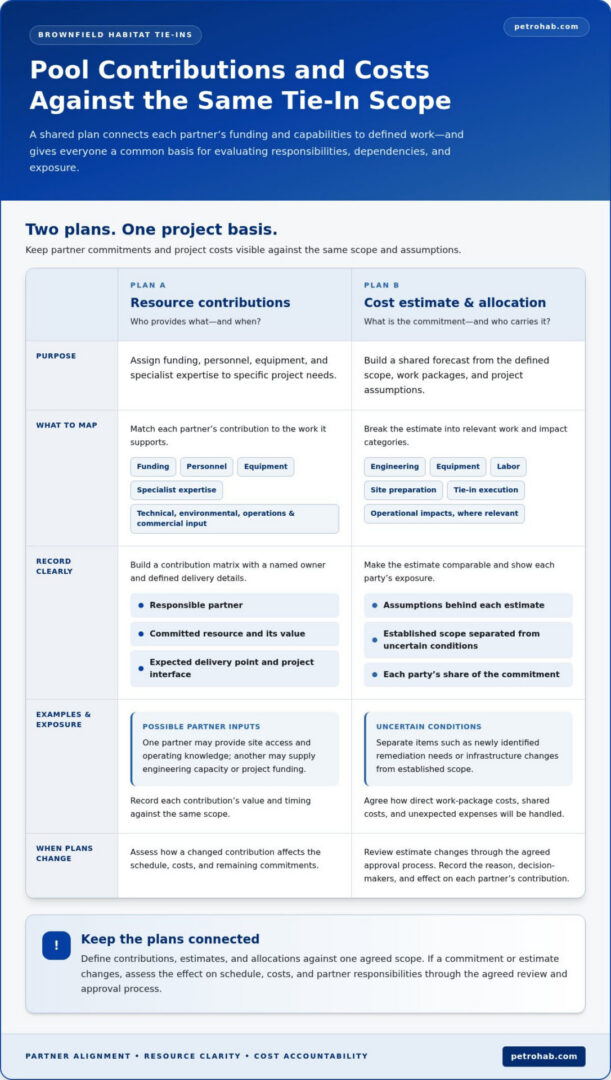
Resource pooling assigns funding, personnel, equipment, and specialist expertise to specific project needs. An agreed contribution plan can expose gaps before work packages advance. For example, one partner may provide site access and operating knowledge, while another supplies engineering capacity or project funding. Record each contribution’s value and timing against the same scope. This gives partners a common basis for evaluating responsibilities, dependencies, and remaining resource needs.
Build a contribution matrix that names the responsible partner, the committed resource, its expected delivery point, and its project interface. Include technical, environmental, operations, and commercial expertise where each affects execution. If a partner’s contribution changes, assess its effect on schedule, costs, and the remaining commitments. For tie-ins involving hot work, include habitat requirements in the scope review; habitat tie-in planning considerations can inform that resource discussion.
Tie-In Cost Estimation and Allocation
Cost estimation creates a shared forecast from the defined scope, work packages, and project assumptions. Partners need to understand both the total commitment and each party’s exposure. Break the estimate into engineering, equipment, labor, site preparation, tie-in execution, and operational impacts where relevant. Separate established scope from uncertain conditions, such as newly identified remediation needs or infrastructure changes. Document the assumptions behind each estimate so partners can compare like with like.
Allocate costs through an agreed framework that reflects contributions, risks, and the intended project structure. Partners should settle how they value contributions before negotiating specific commitments. Agreements can assign direct work-package costs to the responsible party and define how shared costs or unexpected expenses will be handled. Where appropriate, connect funding commitments to agreed project milestones. Review estimate changes through the same approval process, recording the reason, decision-makers, and effect on each partner’s contribution.
Defining complementary strategic objectives
Complementary objectives connect each partner’s strategic priorities to an agreed tie-in outcome. They can allow an operator to protect production continuity while another partner emphasizes disciplined capital deployment. Define the scope around the facility interface, expected operating state, and work boundaries. For example, distinguish restoring throughput from limiting operational disruption. Partners can then identify where their priorities support shared outcomes and where trade-offs need to be resolved.
Operators should define scope by identifying the assets and interfaces involved, work boundaries, operating constraints, assumptions, and intended outcomes. State what the tie-in must achieve, such as connecting specified equipment while preserving agreed facility operations. This gives partners a common reference for evaluating scope changes and helps distinguish essential work from additions that require renewed review and approval.
Translate those objectives into a target operating model, with target dates and financial commitments set out in the agreements. Specify how the facility is expected to operate after the tie-in, including responsibilities that continue across partner interfaces. Establish performance measures before the joint venture launches. For each measure, define its calculation method, reporting process, and owner. A production measure, for example, needs a shared baseline and agreed reporting assumptions.
Link each partner’s contribution and risk allocation to the objectives it supports. The venture’s structure should reflect the parties’ contributions, risk allocation, and intended exit. Partners can also tie capital commitments to agreed milestones that demonstrate progress or reduce project uncertainty. Review the objectives when operating assumptions change, and record whether the change affects scope, funding, or responsibilities. This keeps strategic priorities aligned with the project’s actual delivery path rather than relying on initial expectations alone.
Detailed exit strategy provisions in the transaction agreements help the venture and its partners respond to market changes. The manager in a joint venture agreement provides investment structuring and strategy to the business entity. Joint Ventures bring partners together to pool financial and human resources for projects addressing regional conservation priorities and objectives.
Differences in partner decision-making structures or risk appetites can increase JV complexity, so address known cultural differences through upfront negotiations and alignment on governance and performance monitoring. Before a JV launches, define detailed performance metrics and targets and specify how metrics will be calculated and reported. Real estate management services include pre-construction strategy, progress updates, scheduling, permitting, quality control, and close-out.
Selecting partners with relevant capabilities and cultural fit
Select partners by matching their demonstrated capabilities to defined tie-in work packages. An operator may contribute facility knowledge and operating access, while an engineering partner brings interface design expertise. Assess each party’s ability to plan around production constraints, environmental conditions, and process safety requirements. A capability matrix can show who leads each workstream and where specialist support is needed. Compare evidence of relevant experience against actual project demands, rather than relying on broad claims of expertise.
Capability alone isn’t enough. Differences in decision-making structures and risk appetites can increase joint venture complexity. During selection, examine how each party escalates operational issues, evaluates scope changes, and approves commitments. For example, compare whether partners expect consensus on technical changes or delegate decisions to designated leads. Discuss these differences before finalizing agreements, then establish governance and performance-monitoring practices that accommodate them. The aim is not identical cultures, but compatible ways of resolving issues that could affect execution.
- Technical fit: Match each partner’s engineering and operating expertise to defined interfaces and facility constraints.
- Risk approach: Compare how partners assess environmental findings, worksite hazards, and production disruption.
- Decision fit: Agree how representatives raise, document, and resolve operational issues.
Use these criteria to assess whether partners can implement their assigned work and coordinate across interfaces. Review proposed leads, decision pathways, and the resources each party will commit. A partner with strong technical credentials may still create delivery friction if its approval process conflicts with facility operating decisions. Address that gap through agreed escalation routes, named decision-makers, and shared performance measures before the venture begins. Record these arrangements in the governance documents.
For tie-ins that include hot work, consider how habitat requirements fit the operating environment and partner capabilities. Review habitat safety options as part of evaluating the work package and its technical interfaces.
Joint Ventures build partnerships with private landowners to conserve wildlife populations while sustaining and enhancing livelihoods. They also cooperate with industry to promote conservation in decision-making that supports healthy ecosystems and contributes to local and national economies.
Regular reviews help partners assess progress against agreed objectives and address emerging issues. Use these meetings to review performance, confirm responsibilities, track open actions, and update plans when project assumptions change.
PetroHab: PetroHab Hot Work Safety Enclosure (HWSE)
PetroHab Hot Work Safety Enclosure (HWSE) supports hot-work planning where brownfield tie-ins require welding in hazardous industrial environments. Its modular enclosure approach gives project teams a defined habitat to consider within the work scope and interface plan. The Safe-Stop Automatic Shutdown System monitors gas levels and pressure, adding an equipment-based safety control to the welding environment. Pressurized welding enclosures and Quadra-Lock Panels are also available for projects requiring these habitat components.
Include enclosure and shutdown-system requirements in partner discussions alongside operating constraints, work boundaries, and assigned responsibilities. This helps align the habitat configuration with the project’s technical scope and safety planning. For a brownfield tie-in involving hot work, review PetroHab’s HWSE options against the site requirements and planned work. Visit petrohab.com or contact PetroHab to discuss your project.
Carry alignment into execution
Gaining joint venture partner alignment for brownfield habitat tie-ins is more likely to last when agreements hold up under execution conditions, not just planning assumptions. Before work advances, partners can run a joint readiness review using a realistic change scenario, such as an unexpected interface constraint or a revised operating window. Trace how the issue moves from site teams to decision-makers, who has authority to respond, and how the agreed response reaches every affected work group.
This review turns governance into a working control. Record open actions, assign accountable owners, and keep the decision pathway visible as the project progresses. If teams can resolve the scenario using agreed roles and information, they have a stronger basis for coordinating the work. If not, address the gap before it creates avoidable execution friction.
For hot-work habitat requirements within your project scope, discuss your project with PetroHab. A deliberate readiness review and clear technical planning can help your partners move forward with greater coordination.