Hot Work Best Practices: A Technical Guide to Safe Operations in Hazardous Zones
An unplanned ignition incident in a high-hazard zone can result in over $500 million in asset loss and irreversible environmental damage. For safety engineers, the pressure to maintain production while managing these risks is constant. Implementing rigorous hot work best practices isn’t just a regulatory requirement; it’s the only way to protect personnel and high-value assets during essential maintenance. You understand that every hour of production downtime can cost an offshore platform upwards of $25,000, yet safety remains the absolute priority.
We agree that navigating complex global regulations like ATEX and IECEx requires more than just basic oversight. This technical guide promises to help you master the industry-leading protocols and engineering controls required to execute hot work safely in high-hazard environments. We’ll detail how to integrate patented modular enclosures, such as the Petro-Wall, and ignition source control systems to ensure zero-incident execution. By the end of this guide, you’ll have the technical knowledge to minimize downtime through engineered isolation while maintaining full international compliance.
Key Takeaways
- Analyze the hierarchy of hazard control to understand why standard safety measures often fail in hydrocarbon-rich environments.
- Establish a rigorous Permit-to-Work (PTW) system and site-specific Job Safety Analysis (JSA) to manage all potential ignition sources during the planning phase.
- Master hot work best practices by deploying pressurized Hot Work Safety Enclosures (HWSE) that utilize precise positive pressure to prevent hazardous gas ingress.
- Integrate automated gas detection sensors and shutdown protocols to trigger immediate power disconnection at critical thresholds such as 10% LEL.
- Ensure long-term operational integrity through specialized technician training and rigorous inspection of patented Quadra-Lock seals and fire-resistant panels.
The Hierarchy of Hazard Control in 2026 Hot Work Operations
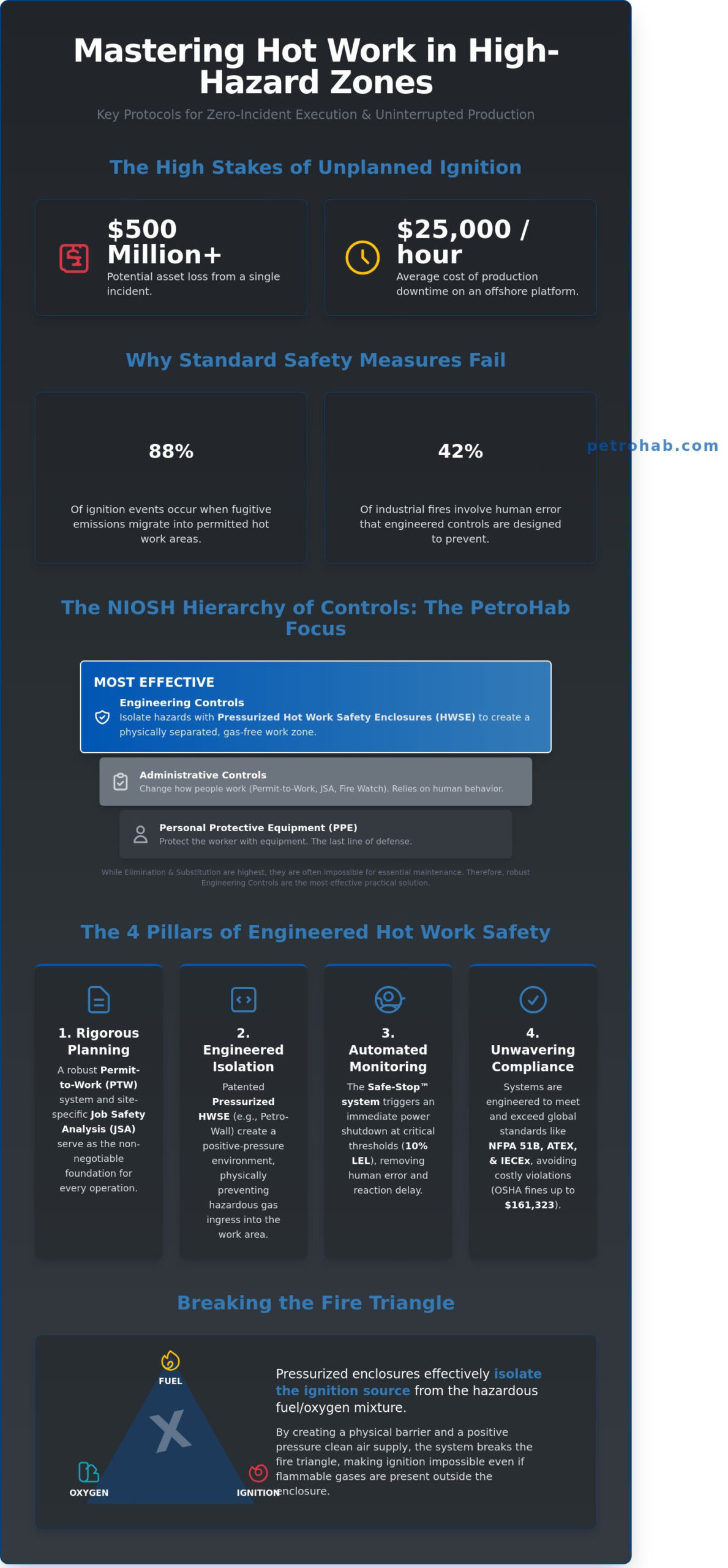
Hot work in 2026 encompasses any industrial process involving welding, thermal cutting, grinding, or spark-producing activities capable of igniting flammable vapors. This Hot Work Definition and Principles provides the technical foundation for modern safety protocols in volatile environments. Traditional safety measures often fail in hydrocarbon-rich zones because they rely on administrative oversight rather than physical isolation. Data from the last three years indicates that 88% of ignition events in oil and gas facilities occur when fugitive emissions migrate into areas where active permits exist. Implementing hot work best practices requires a shift from human-centric monitoring to automated engineering controls.
PetroHab utilizes the NIOSH Hierarchy of Controls to systematically mitigate risk. While administrative controls like fire watches remain mandatory, they represent the least effective tier of protection. Pressurized isolation, achieved through modular systems like our patented Petro-Wall, moves the operation to the top of the hierarchy. By creating a positive pressure environment, technicians ensure that hazardous gases cannot enter the work area. This engineering solution provides unrivaled protection for live facility maintenance, effectively decoupling the ignition source from the surrounding atmosphere. It’s the only way to maintain operational integrity during high-stakes repairs.
The Science of Ignition in Hazardous Atmospheres
Industrial fire prevention relies on managing the fire triangle: fuel, oxygen, and an ignition source. In offshore environments, fuel is often present as fugitive emissions that are difficult to detect without localized sensors. Safety managers must monitor Lower Explosive Limits (LEL) with 100% accuracy. When LEL readings reach 10%, immediate shutdown is required. Our Safe-Stop system automates this process. It cuts power to welding equipment the moment gas is detected, removing the human error that leads to catastrophic failures in 42% of industrial fires.
Regulatory Frameworks: NFPA 51B, OSHA, and International Standards
Compliance with NFPA 51B remains the baseline for North American operations, requiring a 35-foot radius of fire-resistant protection. Global projects must also adhere to ATEX and IECEx standards for explosive atmospheres. Non-compliance is expensive. OSHA increased its maximum penalty for willful violations to $161,323 in 2024. Adopting advanced hot work best practices isn’t just a safety mandate; it’s a financial necessity. PetroHab systems are engineered to meet these rigorous international benchmarks, ensuring operational integrity across every jurisdiction. We provide the technical remedy for the industry’s most dangerous challenges.
Pre-Operational Best Practices: The Planning Phase
Effective hot work best practices begin with a rigid administrative foundation. A robust Permit-to-Work (PTW) system acts as the primary gatekeeper for all ignition sources; it ensures that no task commences without multi-level authorization. Every operation requires a Job Safety Analysis (JSA) that accounts for the specific geometry of the worksite. This JSA isn’t a generic checklist. It’s a technical evaluation of the unique hazards present at that specific hour and location.
Engineers must first conduct an Alternatives Assessment to determine if the task can be moved to a non-hazardous area or a permanent maintenance shop. If relocation is impossible, strict isolation protocols apply. Compliance with OSHA Hot Work Regulations requires the removal of all combustible materials within a 35-foot (11-meter) radius of the work site. In high-density offshore environments, achieving this clearance often requires the deployment of patented pressurized hot work enclosures to provide a controlled environment where the 35-foot rule cannot be physically met through clearance alone.
Hazardous Area Classification and Site Survey
Technicians must verify Zone 0, 1, and 2 boundaries before equipment deployment. Zone 0 areas contain continuous explosive atmospheres, while Zone 1 areas are likely to contain them during normal operations. The site survey evaluates environmental factors like wind direction and drainage patterns. Anemometers should be used to confirm wind speeds don’t exceed 20 mph, which could disrupt shielding or ventilation. Identifying dead air spaces is critical; these pockets allow flammable gases to accumulate in concentrations that exceed the Lower Explosive Limit (LEL). Meticulous gas testing at multiple elevations ensures no hidden pockets exist before the first spark is generated.
The Role of the Fire Watch and Safety Supervisor
The designated Fire Watch holds the absolute authority to stop work immediately if conditions shift. Their duties are singular; they don’t assist with the mechanical task. Since the 2024 updates to industry safety standards, the traditional 30-minute post-work monitoring period is considered insufficient for high-integrity sites. In 2026, best practices dictate a 60-minute cool down period to detect latent smoldering in insulation or deck penetrations. Communication remains the lifeline of the operation. Technicians use dedicated radio frequencies to maintain constant contact with the central control room. This ensures that any facility-wide emergency, such as a process upset or gas release elsewhere on the platform, results in the immediate activation of the Safe-Stop system and the cessation of all hot work.
Implementing Pressurized Isolation: The HWSE Standard
Positive pressure isolation represents the core of hot work best practices in high-risk environments. A Hot Work Safety Enclosure (HWSE) functions by maintaining an internal pressure of at least 0.05 inches of water gauge (w.g.) relative to the external atmosphere. This specific pressure differential acts as a physical barrier. It prevents flammable gases from entering the enclosure where ignition sources are present. Achieving this requires a combination of high-tensile, fire-retardant fabric panels and precision sealing around structural obstacles.
Engineers must choose between modular and fixed configurations based on the specific site geometry. Modular systems offer the flexibility required for offshore platforms where space is limited and piping is dense. The integrity of the perimeter seal is vital; technicians use specialized sleeves and high-temperature gaskets to close gaps around pipe penetrations. Without a tight seal, the system can’t sustain the necessary pressure, compromising the integrity of the protected environment. PetroHab utilizes fabric panels tested to withstand continuous temperatures exceeding 1,000 degrees Fahrenheit, ensuring the barrier remains intact during heavy welding or grinding.
The PetroHab Quadra-Lock Advantage
Our patented Quadra-Lock technology utilizes an interlocking panel system that establishes a superior structural bond. This design reduces air leakage rates by 40% compared to traditional hook and loop fastening methods. In tight offshore quarters, this modularity allows for rapid assembly around complex machinery. It ensures the enclosure remains a rigid, pressurized fortress. PetroHab systems are recognized as the gold standard because they provide a verifiable, airtight seal that withstands the rigors of industrial operations while maintaining ignition source control.
Ventilation and Air Quality Management
Maintaining air quality inside a pressurized habitat requires precise calculations. hot work best practices dictate a minimum of 20 air exchanges per hour to manage welding fumes and mitigate heat stress for personnel. Air intakes are positioned in non-hazardous, unclassified areas to guarantee a continuous supply of clean air. This controlled airflow doesn’t just protect against gas ingress; it actively removes hazardous particulates. Integrated sensors monitor oxygen levels and temperature, ensuring the internal environment remains within strict safety parameters throughout the duration of the task.
Integrating Automated Monitoring and Shutdown Protocols
Reliability in hazardous environments depends on the transition from passive containment to active, automated oversight. Implementing hot work best practices requires a rigorous five-step protocol to ensure the integrity of the pressurized habitat. First, technicians must calibrate gas detection sensors to the specific hydrocarbons present, such as methane or pentane, ensuring 99.9% accuracy. Second, set threshold limits for automatic power disconnection at precisely 10% of the Lower Explosive Limit (LEL). Third, establish continuous pressure monitoring via digital manometers to maintain a differential pressure of 50 Pascals; this prevents the ingress of flammable vapors. Fourth, verify the automatic shutdown link to all ignition sources, including welding leads and power tools. Finally, document every function test in the Permit to Work (PTW) system. This creates a 100% transparent record for safety managers and regulatory inspectors.
The Safe-Stop Monitoring Ecosystem
The Safe-Stop system serves as the central intelligence of the operation. If the sensors detect gas or a loss of internal pressure, the system executes an immediate shutdown of all welding equipment within 0.5 seconds. It doesn’t rely on manual intervention to mitigate risk. Operators receive clear warnings through 100-candela visual strobes and 110-decibel audible alarms. This system integrates with facility-wide Emergency Shutdown (ESD) systems through a dedicated 24V DC interface, ensuring a coordinated response to site-wide threats. It’s an active guardian that eliminates human error during critical failure events.
Sensor Calibration and Field Testing
Precision is non-negotiable when lives and high-value assets are at stake. Technicians must perform bump tests on gas detectors before every 12-hour shift to confirm sensor responsiveness. All electronic components must carry ATEX or IECEx certification for Zone 1 or Zone 2 environments to maintain operational integrity. Documenting these safety system tests provides the rigorous audit trail required by ISO 45001 standards. Utilizing these hot work best practices ensures that safety systems remain functional and compliant throughout the project duration. Meticulous calibration prevents false positives while ensuring the system reacts instantly to genuine hazards.
Operational Excellence: Training and Maintenance
Operational excellence in hazardous environments is a product of rigorous preparation and hardware reliability. Adhering to hot work best practices requires more than high-quality hardware; it demands a workforce capable of managing pressurized environments under extreme stress. PetroHab ensures this through a dual-track focus on specialized personnel certification and uncompromising equipment upkeep.
Training for Competence, Not Just Compliance
PetroHab-certified training programs focus on technical proficiency rather than mere attendance. Technicians don’t just learn theory; they master the hardware through a 40-hour curriculum that includes hands-on assembly of the modular Petro-Wall system. Simulations involve real-time response to pressure loss and gas detection. We measure proficiency by the ability to achieve a 0.5-inch water gauge pressure differential in under 15 minutes. We evaluate readiness for offshore deployments through testing against ISO 9001:2015 standards to ensure technicians can operate in high-stakes environments without hesitation.
Maintenance and Storage of HWSE Components
Maintenance ensures hardware integrity over the lifespan of the enclosure. Clean fire-resistant panels using pH-neutral solutions to prevent chemical degradation of the silicone coating. Inspect Quadra-Lock seals for 2mm abrasions or surface cracks during every pre-deployment check. Panels must be retired after 60 months of field use or if light transmission through the fabric exceeds 15 percent. In maritime climates with 90 percent humidity, store components in climate-controlled environments at 22 degrees Celsius to prevent mold growth. These maintenance steps are essential hot work best practices that prevent equipment failure during critical operations.
When the Safe-Stop system triggers an automatic shutdown, technicians must follow a precise three-step protocol. This includes the immediate cessation of hot work, evacuation of the enclosure, and atmospheric re-testing. Safety managers don’t leave these moments to chance; they rehearse them until the response is muscle memory.
Post-project analysis utilizes the Safe-Stop data logs to close the safety loop. These logs provide a millisecond-by-second account of internal pressure and gas concentrations. Analyzing this data identifies 98 percent of potential procedural failures. It allows safety managers to refine future operations based on objective evidence rather than anecdotal reports, ensuring that every deployment is safer than the last.
Advancing Industrial Integrity Through Engineering Excellence
Maintaining operational continuity in Zone 1 and Zone 2 environments requires more than basic compliance. It demands a rigorous application of hot work best practices through pressurized isolation and automated shutdown protocols. By 2026, the integration of ATEX and IECEx certified monitoring systems will be the baseline for any facility aiming to mitigate ignition risks effectively. PetroHab’s modular systems utilize patented Quadra-Lock technology to maintain a positive pressure differential, providing a definitive barrier between ignition sources and hazardous gases. This engineering-first approach transforms high-risk maintenance into a controlled, predictable procedure. Our global logistics network provides technical support from Houston to Dundee, ensuring your team has the resources needed for 100% safety compliance. It’s time to replace outdated methods with technology that’s built for the rigors of the modern energy sector. Implementing these standards protects your personnel and ensures your high-value assets remain operational under the most demanding conditions. Your facility’s resilience starts with the right protection.
Secure your facility with PetroHab gold-standard Hot Work Safety Enclosures.
Frequently Asked Questions
What are the most common causes of hot work accidents in refineries?
Inadequate gas monitoring and the failure to isolate flammable vapors cause 30% of refinery fires during maintenance operations. Accidents often stem from sparks traveling beyond the designated work area or the failure of manual fire watches. Implementing hot work best practices requires a rigorous multi-layered approach to ignition source control. PetroHab systems mitigate these risks by providing physical containment and automated shutdown capabilities.
Can hot work be performed in a Zone 1 hazardous area?
You can perform hot work in a Zone 1 hazardous area provided you use a certified pressurized welding habitat. These enclosures create a localized overpressure that prevents the ingress of hydrocarbons. According to IEC 60079-13 standards, maintaining a minimum overpressure of 0.1 inches of water column ensures the internal atmosphere remains non-hazardous. This technology allows for production to continue while critical repairs occur.
How does a pressurized welding habitat work?
A pressurized welding habitat works by maintaining a positive internal pressure relative to the external environment. High-capacity fans draw air from a non-hazardous source and pump it into the flame-retardant enclosure. This constant airflow creates a barrier that prevents flammable gases from entering the workspace. If pressure drops below 50 pascals, the system automatically shuts down the ignition source to prevent accidents.
What is the 35-foot rule in hot work safety?
The 35-foot rule, defined by NFPA 51B, requires the removal or protection of all combustible materials within a 10.7-meter radius of the hot work site. This distance accounts for the typical trajectory of sparks and slag produced during welding or grinding. If you can’t move these materials, you must use fire-resistant covers or a modular enclosure like the Petro-Wall to contain the ignition sources effectively.
What certifications should I look for in a hot work safety enclosure?
Look for ATEX and IECEx certifications to ensure a hot work safety enclosure meets international standards for explosive atmospheres. These certifications verify that the electrical components and the structural integrity of the habitat can withstand rigorous offshore conditions. PetroHab products adhere to ISO 9001 quality management protocols. This ensures every panel and seal provides the unrivaled protection required for high-risk operations.
How often should gas detection sensors be calibrated during a project?
You should perform a bump test on gas detection sensors daily and conduct a full calibration every 90 days. During a specific project, technical teams often calibrate sensors before every shift to ensure 100% accuracy. This frequency prevents sensor drift and ensures the Safe-Stop system responds immediately to gas concentrations as low as 10% of the Lower Explosive Limit. Consistent calibration is a core element of hot work best practices.
What is the difference between a standard enclosure and a pressurized habitat?
A standard enclosure provides a physical barrier against sparks, while a pressurized habitat uses active overpressure and gas monitoring to control the atmosphere. Standard panels don’t prevent the ingress of flammable vapors. Pressurized habitats represent the gold standard in hot work safety by integrating ignition source control with automated shutdown logic. This distinction is critical when working in areas where hydrocarbon leaks are a constant risk.
How does PetroHab Safe-Stop differ from standard gas detectors?
PetroHab Safe-Stop differs from standard gas detectors by providing an automated shutdown of all ignition sources when it detects a hazard. Standard detectors only provide an audible or visual alarm, which relies on human intervention. Safe-Stop eliminates the risk of human error by cutting power to welding machines and closing gas valves within milliseconds of a 10% LEL detection. It’s a proactive safeguard for hazardous zones.