Hot Work Habitat Training: Engineering Competency for Hazardous Zones
In a Zone 1 hazardous environment, a single 0.5-second failure in ignition source control isn’t just a technical oversight; it’s a catastrophic risk to your high-value assets. You’ve seen how the integrity of a pressurized enclosure depends entirely on the technician monitoring the digital manometers. Reliable safety isn’t a product of chance. It’s the result of rigorous hot work habitat training designed to eliminate human error in volatile atmospheres. We’ve spent decades engineering solutions for these exact scenarios, ensuring that technical precision remains your strongest defense.
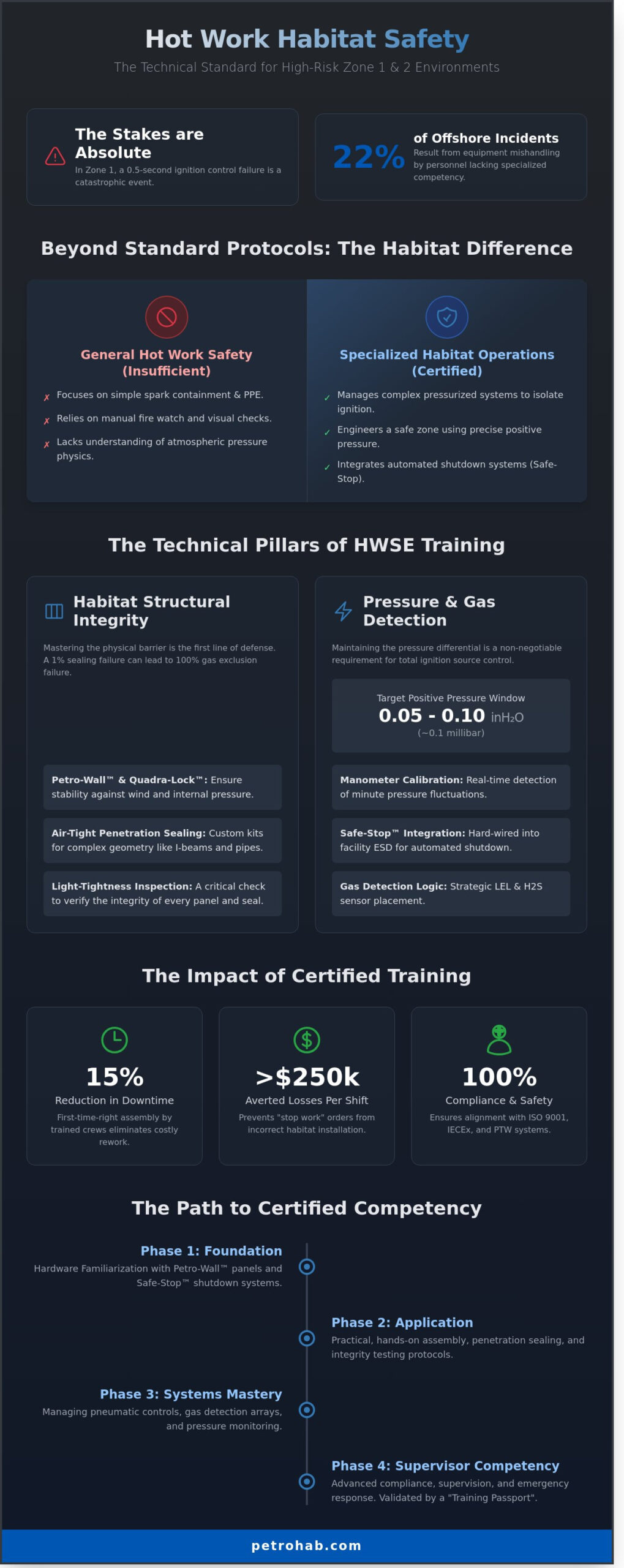
Industry data shows that 22% of offshore safety incidents result from equipment mishandling by personnel who lack specialized competency. This guide helps you master the technical requirements for operating pressurized welding habitats with absolute precision. We’ll explore the specific ATEX and IECEx operational standards that define a certified workforce. You’ll learn how to integrate our patented Petro-Wall and Safe-Stop systems into a zero-incident safety culture. This methodical approach ensures your team maintains full alignment with international safety protocols while protecting your crew and your bottom line.
Key Takeaways
- Understand why standard safety protocols fail in ATEX Zone 1 and 2 environments and how specialized training mitigates high-stakes hydrocarbon risks.
- Master the technical core of hot work habitat training, focusing on pneumatic control systems that maintain the precise positive pressure required for safe operations.
- Learn to differentiate between theoretical classroom knowledge and the practical, hands-on assessments necessary to manage modular fire-resistant enclosures.
- Identify the critical curriculum phases required to transition from hardware familiarization to advanced supervisor-level competency.
- Discover how implementing a rigorous “Training Passport” model ensures that every technician on a critical turnaround meets the gold standard of safety and compliance.
Why Hot Work Habitat Training is Critical for Hazardous Zones
Hot work habitat training isn’t a generic safety orientation. It’s a specialized engineering discipline designed for the rigors of ATEX Zone 1 and 2 environments. While standard welding safety focuses on personal protective equipment and spark containment, hot work habitat training equips technicians to manage complex pressurized systems that isolate ignition sources from volatile hydrocarbons. This training transforms a technician into a guardian of the “Safe Zone,” ensuring that high-heat activities occur safely within a live facility.
The stakes in the oil and gas sector are absolute. Relying on “good enough” training protocols in a refinery or offshore platform is a liability. Precision is the only acceptable standard. Professional training ensures compliance with international safety benchmarks, including ISO 9001 and IECEx standards. It also guarantees the integrity of the Permit to Work (PTW) system. A technician’s ability to monitor gas detection arrays and maintain enclosure pressure determines whether a facility remains operational or faces a catastrophic event.
The Difference Between General Hot Work and Habitat Operations
Standard fire watch training is insufficient for the physics of a pressurized environment. In a typical hot work scenario, the goal is to watch for sparks. In a habitat operation, the technician must manage a differential pressure of approximately 0.1 millibar. This positive pressure ensures that the internal atmosphere remains free of flammable gases. If the pressure drops, the hot work habitat training protocols dictate an immediate, automated shutdown of power through systems like Safe-Stop. This specialized focus on atmospheric physics distinguishes habitat experts from general safety personnel.
Risk Mitigation and Asset Protection
Properly trained personnel prevent catastrophic ignition in live hydrocarbon environments, protecting both human life and high-value infrastructure. Data from 2023 industrial safety audits indicates that first-time-right habitat assembly reduces operational downtime by 15% compared to untrained crews. When a modular Petro-Wall system is installed correctly the first time, it eliminates the need for costly rework and prevents “stop work” orders that can exceed $250,000 per shift in lost production. Mastery of these systems ensures that safety remains a constant, not a variable.
Core Competencies: The Technical Pillars of HWSE Training
Technical proficiency in hot work habitat training ensures that every Hot Work Safety Enclosure (HWSE) functions as a life-critical system rather than a mere physical barrier. Operators must understand the underlying engineering that permits high-heat activities in Zone 1 and Zone 2 environments. This involves a dual focus on mechanical assembly and sophisticated electronic monitoring logic. It’s not enough to simply build a tent; technicians must engineer a controlled environment that can withstand the volatile conditions of an active oil and gas facility.
Mastering Habitat Structural Integrity
The foundation of any safe habitat is the Petro-Wall panel system. Training emphasizes the correct application of Quadra-Lock technology to ensure structural stability against high wind loads and internal pneumatic pressure. Technicians learn to engineer air-tight seals around complex penetrations like I-beams, pipes, and gratings using specialized penetration kits. Every joint must be inspected for light-tightness; a 1% failure in sealing can lead to a 100% failure in gas exclusion. Identifying and remedying structural weaknesses before hot work begins is a core skill. Trainees use rigorous checklists to verify the integrity of every panel, ensuring the modular frame is anchored correctly to the platform deck. This meticulous approach allows teams to maintain the highest safety standards during offshore maintenance.
Managing Pressure and Gas Detection Systems
Maintaining the pressure differential is a non-negotiable requirement for ignition source control. Technicians must master the science of positive pressure, specifically targeting a window of 0.05 to 0.10 inches of water column. This specific pressure prevents flammable hydrocarbons from entering the work zone. Key competencies in this module include:
- Manometer Calibration: Precise setup of digital and analog sensors to detect minute pressure fluctuations in real-time.
- Safe-Stop Integration: Hard-wiring the habitat control system into the facility’s Emergency Shutdown (ESD) protocol to ensure total synchronization.
- Gas Detection Logic: Strategic placement of LEL (Lower Explosive Limit) and H2S sensors at both air intakes and inside the enclosure to account for varying gas densities.
- Emergency Response: Executing a 100% power isolation within milliseconds of a gas detection alarm or a sudden loss of habitat pressure.
Effective hot work habitat training prepares personnel to interpret sensor data accurately. They don’t just watch screens; they analyze the environment to prevent incidents before they occur. The Safe-Stop system acts as an intelligent gateway, ensuring that the power to welding machines or grinders is cut instantly if the internal pressure falls below the 0.05-inch water column threshold. This fail-safe mechanism remains the gold standard for protecting high-value assets and human life in hazardous zones.
Evaluating HWSE Training Programs: Passport vs. Site-Specific
Engineering a safe environment for high-risk operations requires more than advanced hardware; it demands verified human competency. PetroHab utilizes a “Training Passport” model to track technical proficiency across specific tiers of responsibility. Effective hot work habitat training must move beyond basic classroom theory. It requires rigorous practical assessments conducted within simulated hazardous zones to ensure every technician can manage ignition source control under pressure. These simulations replicate Class 1, Division 1 conditions, forcing trainees to respond to real-time pressure loss scenarios. This practical exposure is where theoretical knowledge transforms into operational reliability.
The 4-Level Competency Pathway
The pathway begins with Level 1: Habitat Awareness, which is designed for site managers and fire watches who must recognize system integrity. Levels 2 and 3 qualify Habitat Builders and Technicians to assemble patented Petro-Wall panels. Finally, Level 4: Supervisor designates the expert responsible for the initial site survey, system design, and the final safety sign-off before any ignition source enters the enclosure.
Site-Specific vs. Standardized Training
Standardized certifications provide a baseline, but they don’t account for the unique variables of an offshore platform versus an onshore refinery. Since 2021, over 90% of major energy producers have mandated OEM-specific training to ensure personnel understand the Safe-Stop automatic shutdown logic. Verifying 3rd party certifications against ISO 29993 standards ensures that trainers possess the technical depth required for high-stakes oversight and continuous personnel development.
Competency isn’t a one-time achievement. PetroHab mandates a 24-month recertification cycle to combat skill degradation. This schedule ensures that 100% of active technicians remain proficient in the latest hot work habitat training protocols and regulatory updates. Relying on outdated training is a risk no engineer should accept. By integrating on-site supervision with standardized passport levels, operators create a continuous development loop that prioritizes the protection of high-value assets and human life above all else. This methodical approach ensures that every individual on a site is an active guardian of industrial safety.
A Comprehensive Hot Work Habitat Training Curriculum
Rigorous hot work habitat training follows a structured, five-phase progression designed to eliminate human error in high-risk environments. This curriculum transforms technicians into safety specialists capable of managing pressurized environments in the presence of volatile hydrocarbons. The process begins with technical theory and concludes with a high-stakes practical verification of competency.
Theoretical Mastery of Hazardous Areas
Technicians must first master the science of atmospheric safety. This involves a granular analysis of Zone 0, 1, and 2 classifications, where Zone 0 represents a constant explosive risk and Zone 2 represents an intermittent one. Trainees study the fire triangle to understand how PetroHab systems disrupt the union of fuel, oxygen, and ignition sources. NFPA 51B establishes the standard for fire prevention during welding and cutting, serving as the regulatory baseline that HWSE operations must exceed to ensure ignition source control.
Phase 2 introduces the hardware that makes isolation possible. Trainees familiarize themselves with the modular Petro-Wall panels and the Safe-Stop automatic shutdown system. Understanding the 2024 ATEX and IECEx certification standards is mandatory at this stage. It’s not enough to know how the equipment works; operators must understand the engineering logic that allows these systems to operate safely in explosive atmospheres.
Hands-on Assembly and System Integration
The third phase focuses on the physical construction of the enclosure on a complex mock-up. Accuracy is the only metric of success here. Technicians follow a logical assembly sequence:
- Securing the flame-retardant panels to the existing infrastructure.
- Integrating the air intake ducting at a minimum distance of 15 meters from any potential gas source.
- Calibrating the gas detection sensors and the Safe-Stop control logic.
Phase 4 involves operational testing and troubleshooting. If the internal pressure falls below the 50 Pascal threshold, technicians must identify the failure point immediately. They practice resolving common issues like seal leaks, fan motor fluctuations, or sensor interference from nearby industrial equipment. Documentation is a critical component of this phase. Every pre-work safety check and maintenance log must meet ISO 9001:2015 quality standards to ensure a verifiable audit trail.
The final phase is a comprehensive assessment. Candidates must achieve a 90% score on the written technical exam and 100% accuracy during the practical hardware deployment. This ensures that every graduate is a seasoned veteran of the protocol before they ever step onto a live offshore platform. You can view our full range of certified training modules to see how we maintain these industry-leading standards.
PetroHab’s Approach to On-site Supervision and Training
Equipment alone doesn’t guarantee safety. Human error remains a primary risk factor in hazardous zones. PetroHab mitigates this through comprehensive hot work habitat training. We don’t just provide hardware; we deliver the technical expertise required to manage ignition sources in Zone 1 and Zone 2 environments. Our certified technician program establishes a rigorous benchmark. This Gold Standard ensures every operator understands the physics of pressurized enclosures. For critical turnaround projects, PetroHab technicians provide 24/7 oversight. This presence minimizes the 15% to 20% margin of error often seen with inexperienced crews handling complex modular configurations.
We recognize that many operators invest in their own fleet of habitats. To support this, we provide customized training modules specifically designed for client-owned PetroHab equipment. These modules aren’t generic safety briefings. They’re deep-dive technical sessions that cover the maintenance of Petro-Wall panels and the calibration of Safe-Stop sensors. By empowering your internal teams, we ensure the integrity of the habitat remains uncompromised throughout its operational lifespan. This specialized hot work habitat training reduces long-term maintenance costs by 25% through proper handling and storage protocols.
The Value of PetroHab Certified Supervision
Expert supervision removes the technical burden from client safety officers. While site safety managers focus on broad operational risks, our supervisors monitor the granular integrity of the Petro-Wall panels. They provide real-time solutions for structural obstructions; they ensure the Safe-Stop system integrates perfectly with the facility’s Fire and Gas logic. This precise configuration prevents accidental shutdowns. In high-output refineries, an unplanned trip can cost operators over $500,000 per hour in lost production. Our supervisors act as the final line of defense against such costly operational interruptions.
How to Get Your Team Certified
Training modules are available at our primary facilities in Houston, Texas, and Dundee, Scotland. These sessions cover assembly, maintenance, and emergency protocols for client-owned equipment. For large-scale deployments involving 50 or more personnel, we dispatch mobile training units to provide on-site instruction. This ensures your team maintains 100% compliance with ATEX and IECEx standards. Contact PetroHab today to schedule a competency assessment for your team and secure your hazardous work environment.
Advancing Safety Standards with Engineering Precision
Effective risk mitigation in Zone 1 and Zone 2 environments depends on the technical proficiency of your personnel. Comprehensive hot work habitat training bridges the gap between theoretical safety and field-proven execution. By mastering PetroHab’s patented Quadra-Lock technology, teams ensure 100% seal integrity across every modular panel installation. This isn’t just a procedural requirement; it’s a critical safety mandate validated by ATEX and IECEx certified systems. Our global support infrastructure, anchored by specialized hubs in Houston and Dundee, provides the engineering expertise needed to maintain operational continuity across offshore and onshore assets. Rigorous training protocols transform safety enclosures into active guardians of your high-value assets and personnel. You’ll find that investing in specialized competency reduces unplanned downtime and eliminates the margin for human error in volatile atmospheres. Establishing a culture of technical excellence starts with equipping your safety team with the right tools and knowledge. Our instructors leverage decades of industry experience to ensure your crew is prepared for the most demanding hazardous zone challenges.
Request a Training Proposal for Your Safety Team
Your commitment to engineering excellence ensures a safer and more productive future for every worker on site.
Frequently Asked Questions
Is hot work habitat training mandatory for offshore welding?
Hot work habitat training is mandatory for all personnel operating within Zone 1 or Zone 2 hazardous areas on offshore platforms. Regulatory bodies like the UK Health and Safety Executive and 100% of major operators in the Gulf of Mexico require valid competency certificates before authorizing pressurized enclosure use. This training ensures compliance with the ATEX 137 directive, protecting assets worth over $500 million from ignition risks.
How long does a typical HWSE technician certification last?
A standard Hot Work Safety Enclosure technician certification remains valid for 24 months from the date of issue. Technicians must complete a one day refresher course before this period expires to maintain their status. If the certification lapses by more than 30 days, the individual must repeat the full three day technical program. This cycle ensures that 100% of active personnel remain current with the latest Safe-Stop technology updates.
Can hot work habitat training be completed online?
You can’t complete comprehensive hot work habitat training entirely online because the practical assessment requires hands-on assembly of the Petro-Wall system. While theoretical modules covering gas detection and pressure differentials may be delivered digitally, 60% of the curriculum focuses on physical installation and emergency response drills. Candidates must demonstrate their ability to achieve a 50 Pascal pressure seal in a live environment to earn their credential.
What is the difference between a Habitat Awareness course and a Technician course?
The Habitat Awareness course is a four hour briefing designed for safety managers who oversee work permits, while the Technician course is a 16 hour technical certification. Awareness training focuses on five key safety principles of ignition source control without requiring physical installation skills. In contrast, Technician training requires candidates to master the mechanical assembly of modular panels and the electronic calibration of the Safe-Stop automatic shutdown system.
Does training cover different brands of habitats, or just PetroHab?
PetroHab training programs focus exclusively on our proprietary technology, including the patented Petro-Wall and Safe-Stop systems. While the fundamental principles of pressurized enclosures apply across the industry, our curriculum addresses the specific engineering tolerances of our modular panels. We provide training for 100% of the unique features found in PetroHab systems; this ensures that technicians can maintain the integrity of our specific ATEX and IECEx certified components.
What happens if a technician fails the practical competency assessment?
Candidates who fail the practical competency assessment must wait 48 hours before attempting a re-evaluation. If a technician fails the second attempt, they’re required to re-enroll in the full two day training program. Performance is measured against 12 specific safety benchmarks, including the ability to identify a 5% gas concentration breach within 10 seconds. We maintain these rigorous standards to ensure every certified professional is a reliable guardian of industrial safety.
How often do supervisors need to undergo recertification?
Supervisors must undergo recertification every two years to ensure they can manage complex hot work habitat training scenarios and emergency protocols. This process involves an eight hour assessment of their ability to supervise multiple units simultaneously. Since 2021, we’ve updated our supervisor curriculum to include advanced troubleshooting for integrated gas detection systems. Maintaining this biennial schedule ensures that 100% of site leads can execute critical ignition source control measures without hesitation.
Are PetroHab training programs recognized by international safety bodies?
PetroHab training programs are recognized globally and comply with ISO 9001:2015 quality management standards. Our certifications meet the rigorous safety requirements of 95% of the world’s leading oil and gas producers, including operators in the North Sea and the Middle East. Each course is designed to align with the technical specifications of IEC 60079-13, ensuring that our hot work habitat training delivers a gold standard of safety that transcends international borders.