Blog Posts
Hot Work Safety in Marine and Shipbuilding: Engineered Containment Strategies for 2026
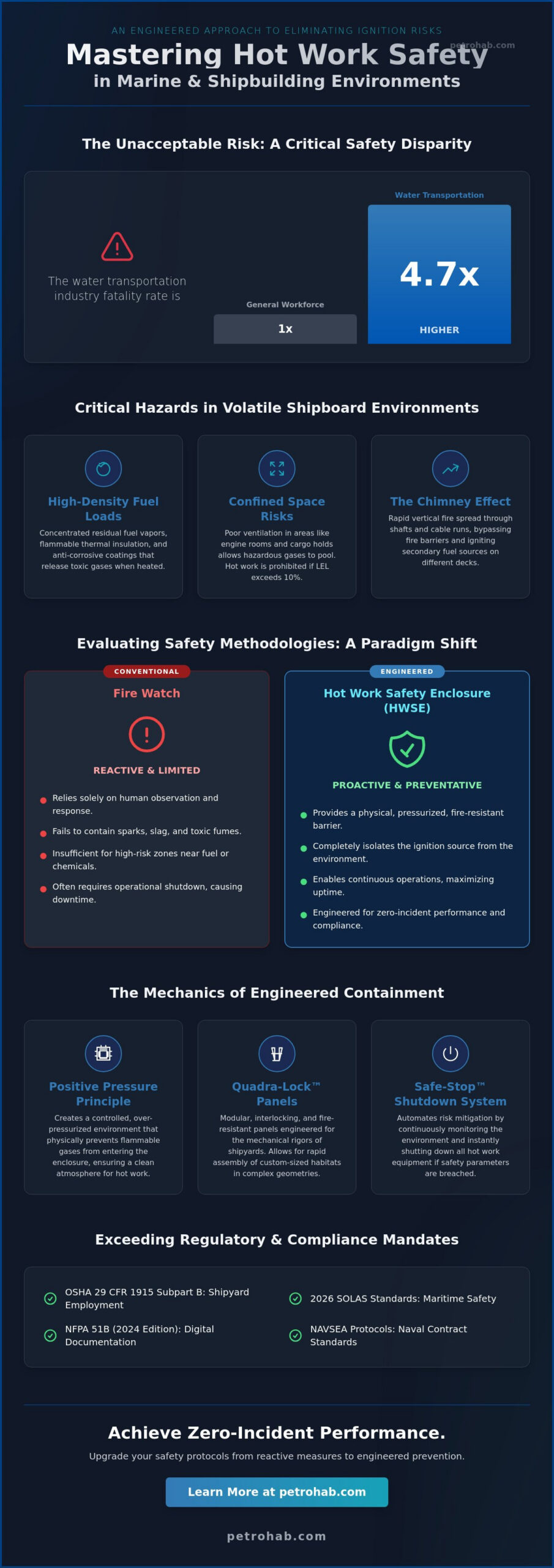
The water transportation industry faces a fatality rate 4.7 times higher than the general workforce, a statistic driven largely by the volatile nature of shipboard environments. Maintaining rigorous hot work safety in marine and shipbuilding is no longer just a procedural checkbox. It’s a critical engineering mandate. You recognize that fire risks in confined spaces and the resulting downtime during shipyard maintenance can cripple both your budget and your safety record. Relying on basic fire watches is often insufficient when high-value assets and personnel are on the line.
This article helps you master the technical requirements and advanced containment technologies necessary to eliminate ignition risks during maritime operations. We’ll explore the integration of pressurized welding enclosures and Safe-Stop automatic shutdown systems to maintain full compliance with OSHA 29 CFR 1915 and the latest 2026 SOLAS standards. You’ll learn how engineered solutions, including the deployment of Quadra-Lock panels, provide the robust isolation needed to achieve zero-incident performance. We’ll also examine the shift toward digital documentation required by the NFPA 51B 2024 edition to ensure your facility remains at the forefront of industrial safety and operational excellence.
Key Takeaways
- Identify and mitigate complex ignition risks associated with high-density fuel loads and hazardous vapors in confined shipboard spaces.
- Master the deployment of pressurized welding enclosures to maintain superior hot work safety in marine and shipbuilding operations.
- Understand the engineering principles of positive pressure and the role of Quadra-Lock panels in establishing reliable environmental containment.
- Compare the active, preventative protection of Hot Work Safety Enclosures (HWSE) against the reactive limitations of conventional fire watch methods.
- Optimize operational uptime and regulatory compliance using the Safe-Stop Automatic Shutdown System to automate risk mitigation.
Critical Hazards of Hot Work in Marine and Shipbuilding Environments
Hot work in the maritime sector encompasses any industrial process involving open flames or heat-producing tools, specifically arc welding, thermal cutting, and abrasive grinding. For a foundational technical perspective, see this Hot Work Safety Overview. Shipyards present a uniquely volatile environment due to high-density fuel loads. Unlike land-based facilities, vessels contain concentrated volumes of residual fuel vapors, flammable thermal insulation, and anti-corrosive coatings that release toxic gases when heated. Managing these variables is the first step toward achieving total hot work safety in marine and shipbuilding.
To better understand the specific hazards present in these environments, watch this helpful video:
The structural layout of a vessel significantly increases the risk of catastrophic ignition. Engine rooms and cargo holds are notorious for poor natural ventilation, which allows hazardous gases to pool in low-lying areas. An ignition event in a lower deck can trigger a rapid fire spread through vertical shafts and cable runs. This phenomenon, known as the chimney effect, can bypass traditional fire barriers and ignite secondary fuel sources several decks away from the initial work site. Safety managers must treat every ignition source as a potential fleet-wide threat.
Confined Space Risks and Flammable Atmospheres
Marine vessels consist of numerous restricted areas that present extreme atmospheric hazards. A confined space is defined as an area large enough for an employee to enter, with limited entry or exit points, that isn’t designed for continuous occupancy. Stagnant air pockets in double-bottom tanks or vessel hulls often trap flammable gases during construction or repair cycles. Rigorous monitoring of the Lower Explosive Limit (LEL) is mandatory before any ignition source is introduced. If gas concentrations exceed 10% of the LEL, hot work must be prohibited until the space is ventilated and re-tested to ensure personnel safety.
Regulatory Frameworks: OSHA and NAVSEA Compliance
Compliance with federal and naval standards is the baseline for operational survival. OSHA 29 CFR 1915 Subpart B dictates the specific requirements for managing dangerous atmospheres in shipyard employment. For naval contracts, NAVSEA protocols impose even more stringent standards for shipboard fire prevention to protect high-value military assets. In high-risk zones, such as those containing fuel piping or chemical storage, a Marine Chemist’s certificate is required to verify the space is “Safe for Hot Work.” Maintaining hot work safety in marine and shipbuilding involves strict adherence to these legal frameworks to mitigate legal and physical liability.
Engineered Containment: The Mechanics of Pressurized Welding Habitats
Administrative controls and permit systems provide a necessary framework, but they don’t physically isolate an ignition source from a volatile environment. In high-risk maritime zones, safety is an engineering challenge that requires a tangible barrier. The PetroHab Hot Work Safety Enclosure (HWSE) serves as this definitive boundary, creating a controlled environment within the hazardous confines of a vessel. Utilizing these pressurized habitats is the most effective method for ensuring hot work safety in marine and shipbuilding, particularly when repairs occur near fuel tanks or cargo holds.
The structural integrity of the enclosure relies on specialized Quadra-Lock panels. These components are engineered for extreme fire resistance and the mechanical rigors of shipyard environments. Their modular nature is a critical advantage for maritime technicians. It allows for the assembly of custom-sized habitats that can pass through standard shipboard hatches and navigate the tight geometry of engine rooms. This flexibility ensures that technical protection isn’t sacrificed due to spatial constraints.
Maintaining Positive Pressure for Ignition Prevention
Positive pressure is the primary mechanical defense against gas ingress. The system functions by maintaining an internal atmospheric pressure that is consistently higher than the surrounding environment. Overpressure is the mechanical state where internal force exceeds external pressure to ensure a gas-tight environment. To maintain this state, air intake units must be positioned in verified areas where the atmosphere is confirmed to be clean and free of contaminants. Continuous digital monitoring ensures that the pressure differential remains within strict safety parameters, providing a constant shield against the migration of flammable vapors into the work area.
Gas Detection and Automatic Shutdown Integration
Automation removes the risk of human error in high-stakes environments. Advanced habitats integrate ATEX-certified gas detectors directly into the control architecture. These sensors are calibrated to identify hazardous gas concentrations long before they reach the Lower Explosive Limit. If a breach occurs or gas is detected at the air intake, the Safe-Stop Automatic Shutdown System immediately terminates power to all welding and cutting equipment. This rapid response is a core requirement of OSHA Hot Work Regulations, which demand rigorous control over ignition sources in shipyard settings.
Redundancy is a mandatory feature for sub-deck operations. Relying on a single gas sensor is insufficient when working in deep vessel compartments where air circulation is minimal. Dual gas monitoring provides the necessary layers of protection to account for sensor calibration drift or localized gas pockets. By deploying these pressurized welding enclosures, safety managers can authorize hot work in proximity to live processes without compromising the vessel’s overall safety profile. This transition from reactive monitoring to active engineered containment represents the modern standard for industrial risk mitigation.
Evaluating Hot Work Safety: Habitats vs. Conventional Fire Watch
Conventional fire watch is a reactive strategy. A person with an extinguisher can only respond after ignition occurs. In the dense geometry of a vessel, a fire watch’s line of sight is often obstructed by machinery, piping, or bulkheads. This human limitation is a critical vulnerability in complex, multi-level shipbuilding projects where sparks can drop through deck penetrations unnoticed. Conversely, a pressurized habitat provides active protection. It prevents flammable gases from ever meeting the ignition source. This technical shift from human observation to engineered isolation is fundamental to modern hot work safety in marine and shipbuilding.
By utilizing a PetroHab Hot Work Safety Enclosure (HWSE), engineers can drastically reduce the “hot work area” footprint. In traditional setups, a large radius around the welding site must be cleared of all flammable materials and personnel. Engineered containment isolates the hazard at the source. This allows for a much smaller safety perimeter, freeing up the rest of the vessel for concurrent operations. Integrating these systems ensures that hot work safety in marine and shipbuilding becomes a predictable, manageable variable rather than a constant risk factor.
Efficiency Gains and Downtime Reduction
The primary economic driver for adopting habitats is the reduction of shipyard downtime. Habitats allow hot work to proceed without shutting down adjacent flammable operations, such as painting, coating, or fueling. During major vessel overhauls, these concurrent work streams can shave weeks off a project timeline. For a technical analysis of these performance improvements, consult the definitive guide to hot work safety enclosures. The ability to maintain production schedules while adhering to rigorous safety standards is a hallmark of operational excellence.
Risk Mitigation in High-Density Shipyards
Stray sparks and slag present a constant threat in high-density shipyard environments. These ignition sources frequently travel through pipe penetrations or unsealed bulkheads, starting fires in compartments far from the original work site. Traditional welding blankets often fail to provide complete coverage in these irregular spaces. Modular Quadra-Lock panels offer a superior alternative. They create a rigid, interlocking barrier that contains 100% of sparks and slag within the enclosure. This level of containment is essential for Tier 1 shipbuilders pursuing “Zero Incident” safety goals. Strict compliance with OSHA hot work regulations demands this proactive approach to hazard isolation, ensuring that protection is built into the workflow rather than added as an afterthought.
Operational Best Practices for Maritime Hot Work Safety
Achieving operational excellence in high-hazard environments requires a systematic transition from assessment to execution. It’s not enough to simply deploy equipment; safety managers must implement a rigid procedural framework that governs every stage of the ignition cycle. This process begins with a comprehensive marine hot work risk assessment. This technical evaluation identifies potential gas migration paths and thermal conductivity risks through metal bulkheads. Technicians must scrutinize every variable, including hidden insulation and residual vapors in adjacent compartments, to ensure total hot work safety in marine and shipbuilding.
The deployment of a pressurized welding enclosure must follow a calculated sequence. Once the work site is prepared, technicians assemble the habitat using Quadra-Lock panels to match the specific geometry of the shipboard compartment. After assembly, the system undergoes a mandatory pressurization test. This verification confirms that the internal atmosphere is completely isolated from external hazards. During operations, clear communication protocols are essential. Habitat workers and external safety supervisors must maintain constant contact through dedicated radio channels or visual signaling systems to ensure immediate response to any atmospheric changes.
Pre-Work Inspections and Perimeter Control
Before ignition, safety supervisors must verify the mechanical integrity of all seals and panel connections. Any pressure drop indicates a breach that could allow gas ingress. Perimeter control is equally vital. NFPA 51B standards require clearing a 35-foot (10.7m) radius of all flammable materials, a task that’s particularly challenging in the high-density environment of a ship’s engine room. For a detailed breakdown of these requirements, consult the 2026 guide to global compliance. Maintaining this radius ensures that stray sparks don’t encounter secondary fuel sources outside the primary containment area.
Personnel Training and Habitat Supervision
Technical competence is the foundation of site safety. Habitat technicians must be trained in the specific mechanics of positive pressure and the operation of automatic shutdown systems. Emergency egress procedures are a critical focus, especially in sub-deck environments where exit paths are restricted. Supervisors must remain on-site to monitor the modular setup and ensure that the system’s calibration remains accurate throughout the shift. This level of oversight is necessary to manage the complexities of modern maritime repairs. To enhance your facility’s safety profile, consider integrating pressurized habitats into your standard operating procedures. Post-work routines must also include a 60-minute fire watch to detect latent heat in bulkheads or insulation that could lead to delayed ignition.
PetroHab Solutions: Redefining Maritime Safety Standards
PetroHab provides the definitive engineered solution for hot work safety in marine and shipbuilding. The PetroHab Hot Work Safety Enclosure (HWSE) is specifically designed for the high-stakes environment of heavy industrial repairs. It transforms hazardous locations into controlled workspaces by physically isolating ignition sources from flammable atmospheres. This technology supports the global maritime industry through a robust infrastructure of leasing, sales, and comprehensive technician training. It ensures that every safety manager has access to the highest level of risk mitigation, regardless of the vessel’s location.
Our commitment to excellence involves meeting and exceeding the most rigorous international hazardous environment standards. By replacing traditional, less effective methods with engineered containment, we help shipbuilders achieve their zero-incident goals. The integration of advanced hardware and automated controls establishes a new benchmark for operational reliability in shipyard maintenance.
Quadra-Lock Technology and Modular Flexibility
The patented Quadra-Lock panel system is the foundation of our environmental containment strategy. These panels create airtight, fire-resistant seals that are essential for maintaining the positive pressure required to keep hazardous gases out. Modularity is a critical advantage in the shipbuilding sector. It allows technicians to build custom habitats around complex piping and within restricted compartments where rigid, pre-fabricated structures would fail. Quadra-Lock panels outperform standard welding curtains by providing a rigid, interlocking barrier that physically prevents the migration of sparks and hazardous gases into the surrounding vessel. This flexibility ensures that technical protection is never compromised by the unique geometry of a ship’s interior.
Safe-Stop: The Ultimate Fail-Safe for Shipbuilding
The Safe-Stop Automatic Shutdown System acts as the central nervous system of every enclosure. It continuously monitors internal pressure and utilizes ATEX-certified sensors to detect hazardous gases at the air intake. If gas is detected or if internal pressure drops below established safety thresholds, the system immediately terminates power to all welding and cutting equipment. This technical precision is vital for sub-deck maritime operations where gas pockets can form rapidly. Safe-Stop integrates seamlessly with our pressurized welding habitats to provide a total ignition control solution. It removes the element of human error, replacing reactive observation with automated engineering that protects both personnel and high-value assets. Contact PetroHab for a specialized maritime safety consultation to secure your next shipyard project and ensure full regulatory compliance.
Advancing Maritime Safety through Engineered Control
Elevating hot work safety in marine and shipbuilding requires a transition from administrative checklists to definitive technical barriers. The integration of positive pressure habitats and automated shutdown systems eliminates the inherent limitations of human observation. By isolating ignition sources at the granular level, you protect both your personnel and your high-value assets from the catastrophic risks of shipboard fires. This engineered approach ensures that production schedules remain intact without compromising on rigorous safety standards.
PetroHab provides the specialized infrastructure needed to achieve zero-incident performance in the most challenging maritime environments. Our patented Quadra-Lock panel technology ensures airtight integrity; meanwhile, the Safe-Stop Automatic Shutdown System delivers real-time fail-safe protection. With a strategic global presence in Houston, Brazil, and the UK, we’re positioned to support your operations wherever they’re located. It’s time to replace reactive monitoring with a proactive safety mandate that defines the future of industrial risk management.
Secure your shipyard operations with PetroHab’s Hot Work Safety Enclosures and lead your facility toward a safer, more efficient operational future.
Frequently Asked Questions
What is considered hot work in the maritime industry?
Hot work includes any industrial process involving open flames, sparks, or heat producing tools such as arc welding, thermal cutting, and abrasive grinding. In shipyards, this definition extends to brazing and any operation that generates sufficient thermal energy to ignite residual fuel vapors or combustible insulation within the vessel’s structure.
Can hot work be performed on a live vessel during cargo operations?
Yes, hot work can be performed on live vessels if engineered containment systems are utilized to physically isolate the ignition source. Pressurized welding enclosures allow critical repairs to proceed concurrently with other operations by maintaining a gas-tight barrier. This strategy is essential for maintaining hot work safety in marine and shipbuilding without requiring a complete operational shutdown.
How does a pressurized welding habitat prevent explosions in shipyards?
A pressurized habitat prevents explosions by maintaining an internal pressure higher than the surrounding atmosphere; this overpressure physically blocks the ingress of flammable gases. Utilizing Quadra-Lock panels ensures a rigid, airtight seal. If the pressure differential fails or gas is detected at the air intake, the system automatically terminates power to the ignition source to prevent a catastrophic event.
What are the OSHA requirements for hot work in shipyards?
OSHA 29 CFR 1915 Subpart B mandates rigorous atmospheric testing, the removal of flammable materials within a 35 foot radius, and the presence of trained fire watches. It also requires that spaces containing fuel or hazardous chemicals be certified “Safe for Hot Work” by a Marine Chemist. These regulations establish the baseline for hot work safety in marine and shipbuilding.
Is a fire watch required if a pressurized habitat is used?
Yes, a fire watch remains a mandatory regulatory requirement under OSHA and NFPA 51B standards even when utilizing advanced habitats. While the PetroHab HWSE provides the primary engineered protection, the fire watch serves as a secondary administrative control. They must monitor the work area for at least 60 minutes after the work is completed to detect latent heat or smoldering materials.
What happens if gas is detected near a hot work safety enclosure?
If integrated ATEX certified gas detectors identify hazardous vapors at the air intake, the Safe-Stop Automatic Shutdown System immediately cuts power to all welding and cutting tools. This rapid response prevents the ignition source from interacting with a compromised atmosphere. The system then remains in a fail-safe state until the environment is ventilated and confirmed safe for re-entry.
How much training is required to operate a PetroHab HWSE?
Operators must complete a comprehensive technical training program that covers assembly, pressurization protocols, and emergency egress procedures. PetroHab provides specialized training for safety supervisors and habitat technicians to ensure they can manage complex shipboard installations. This ensures that the system’s technical capabilities are supported by competent on-site management and rigorous safety protocols.
Can PetroHab habitats be used in extremely tight shipboard spaces?
Yes, the modular design of the PetroHab system allows for assembly in restricted engine rooms and deep vessel compartments. The Quadra-Lock panels are specifically sized to pass through standard manways and hatches, enabling technicians to build custom fit enclosures around existing shipboard geometry. This flexibility ensures that technical containment is available even in the most confined maritime environments.