
Blog Posts
How to Ensure a Proper Habitat Seal on Uneven Surfaces: An Industrial Safety Guide
A standard enclosure skirting is often the single point of failure when performing hot work on a grated deck or corroded concrete floor. In high-stakes ATEX Zone 1 or 2 environments, even a minor gap can lead to a dangerous loss of positive pressure or the ingress of flammable gases. Mastering how to ensure a proper habitat seal on uneven surfaces isn’t just a technical requirement; it’s a critical safety mandate for protecting personnel and high-value assets. When the substrate is irregular, relying on weight alone is insufficient to maintain the necessary 10 to 20 Pascals of internal pressure.
You understand that achieving a repeatable, gas-tight seal on a diamond plate or pitted floor is one of the most difficult challenges in habitat deployment. This guide provides the technical procedures required to maintain seal integrity on any irregular industrial substrate. You’ll learn how the synergy of Quadra-Lock panels and specialized fire-retardant skirting creates a reliable barrier against ignition sources. We’ll also examine the role of the Safe-Stop MSDS in ensuring total compliance with the NFPA 496: 2024 edition standard during welding operations.
Key Takeaways
- Understand why maintaining a minimum 0.05-inch water gauge pressure is critical to prevent floor-level gaps from becoming intake points for flammable gases.
- Identify the unique containment challenges posed by diamond plate micro-channels and the secondary sub-flooring requirements for grated decks.
- Follow a technical step-by-step procedure on how to ensure a proper habitat seal on uneven surfaces by conducting profile audits and deploying fire-retardant skirting.
- Discover how the rigid architecture of Quadra-Lock panels maintains constant downward pressure to prevent lateral shifting and seal degradation.
- Integrate the Safe-Stop Automatic Shutdown System to provide real-time pressure monitoring and an automated defense against containment failure.
The Physics of Positive Pressure: Why the Floor Seal is Critical
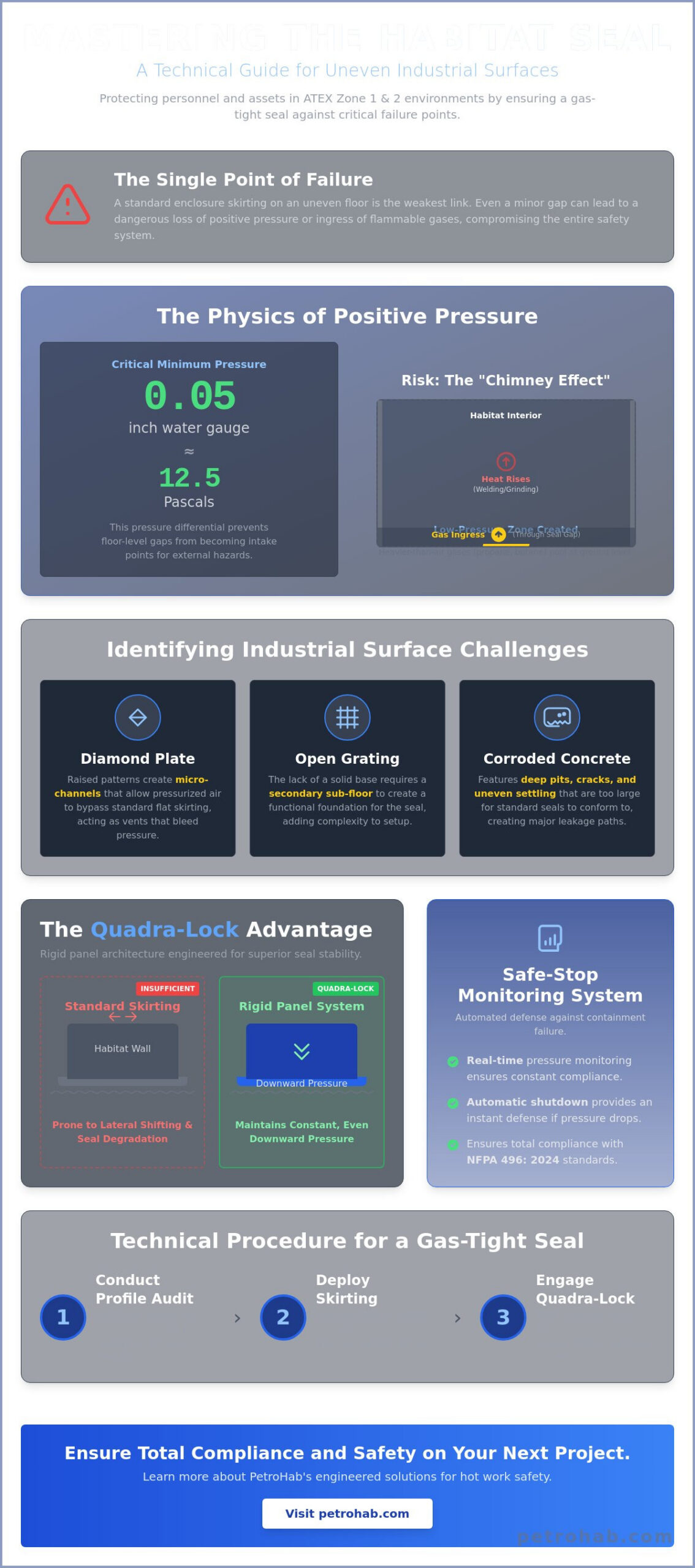
The integrity of a PetroHab Hot Work Safety Enclosure (HWSE) depends entirely on its ability to maintain a controlled internal atmosphere. Maintaining a minimum 0.05-inch water gauge pressure, which is approximately 12.5 Pascals, is a technical necessity for safety. This pressure differential ensures that the internal environment remains isolated from external hazards. Understanding how to ensure a proper habitat seal on uneven surfaces is the only way to prevent floor-level gaps from becoming unintentional intake points for flammable gases if internal pressure fluctuates.
A functional Positive pressure enclosure relies on a constant supply of clean air to displace potential contaminants. If the seal at the substrate interface is compromised, the system’s ability to maintain this barrier is diminished. This relationship between seal integrity and air changes per hour (ACPH) is direct. While high-volume fans provide the necessary ACPH for fume extraction, they also create significant outward force. Poorly weighted skirting on an irregular floor can lead to “blowouts,” where the air pressure actually lifts the seal and allows the internal atmosphere to escape rapidly.
To better understand the practical application of these containment principles, watch this technical overview:
The Chimney Effect and Gas Ingress Risks
Temperature differentials within the habitat create a phenomenon known as the chimney effect. As heat from welding or grinding rises, it can create a localized low-pressure zone at the base of the enclosure. If the floor seal is inadequate, this effect can pull external air into the habitat. This is especially dangerous in ATEX Zone 1 and Zone 2 areas where heavy gases, such as propane or butane, tend to pool near the ground. A gas-tight seal is the only reliable defense against these heavier-than-air hydrocarbons entering the work area and reaching an ignition source.
Pressure Differentials and Seal Resistance
The force exerted on a floor seal is a product of the internal pressure and the surface area of the skirting. Standard weather stripping or generic industrial foams often fail because they cannot withstand the constant mechanical load of industrial fan systems. To maintain safety, the seal interface must utilize fire-resistant materials that are flexible enough to conform to pits and ridges while remaining heavy enough to resist displacement. Rigorous compliance with international safety standards requires that these seals remain effective even when the habitat is operating at peak pressure capacity.
Identifying Industrial Surface Challenges: Grating to Diamond Plate
Industrial sites aren’t built with enclosure seals in mind. Refineries and offshore platforms present complex substrates like diamond plate, open grating, and aged concrete. Each surface type introduces specific leakage paths that can undermine the positive pressure required by NFPA 496. Knowing how to ensure a proper habitat seal on uneven surfaces begins with a rigorous assessment of these physical profiles. You can’t rely on a one-size-fits-all approach when the floor itself is working against your containment goals.
Diamond plate creates a series of micro-channels. These raised patterns allow pressurized air to bypass standard flat skirting. Without intervention, these channels act as vents. They bleed off internal pressure and potentially allow external gases to infiltrate the work area. Open grating represents an even greater challenge. Since there’s no solid base, the enclosure can’t simply rest on the floor. It requires a secondary sub-floor to create a functional foundation for the seal. This adds a layer of complexity to the initial setup phase.
Corroded concrete in older facilities often features deep depressions and uneven settling. These pits are often too large for standard seals to bridge. Additionally, structural penetrations like I-beams, cable trays, and pipes create complex geometries. These obstructions require custom solutions to maintain gas-tight integrity. Failing to account for these penetrations is a common cause of pressure loss in industrial environments.
Sealing on Open Grating and Mesh
To secure an HWSE on open grating, you must first establish a solid boundary. Use fire-retardant plywood or specialized heavy-duty rubber matting to construct a sub-base. This base must extend beyond the enclosure footprint. Apply high-tack industrial tape to seal the perimeter of the sub-base directly to the grating. Ensure the PetroHab skirting overlaps this sub-base by at least 6 inches. This provides a sufficient contact area for the pressure seal to perform as engineered.
Managing Diamond Plate and Corroded Substrates
For diamond plate and pitted concrete, high-density, fire-retardant foam inserts are essential. These inserts compress into the voids to block micro-channels. Perimeter weighting is equally vital. While magnetic strips work on clean steel, weighted sand-snakes are more versatile for irregular concrete or non-ferrous alloys. Before application, clear the surface of oil, scale, and debris. Proper surface preparation ensures the seal maintains the friction necessary to resist displacement under fan loads. For complex layouts, utilizing the modularity of Quadra-Lock Panels allows for tighter enclosure configurations that simplify the sealing process.
Step-by-Step: Techniques for Ensuring a Proper Habitat Seal
Establishing a gas-tight barrier on a compromised industrial floor requires a methodical, procedural approach. Relying on visual inspection alone is insufficient for high-risk welding operations. Understanding how to ensure a proper habitat seal on uneven surfaces requires following a rigorous five-step protocol designed to mitigate the risks of pressure loss and gas ingress.
- Step 1: Conduct a surface profile audit. Before HWSE assembly, safety engineers must map the floor profile. Identify height variations greater than 0.25 inches, such as pits, cracks, or weld seams, that could compromise the seal.
- Step 2: Deploy the primary fire-retardant skirting. Position the skirting with a minimum 12-inch overlap on the substrate. This generous overlap creates a larger friction surface to resist internal pressure.
- Step 3: Apply secondary sealing media. Fill irregular voids or micro-channels with high-density, fire-retardant foam or industrial-grade silicone. These materials act as a temporary gasket in areas where the skirting cannot fully conform.
- Step 4: Secure the seal with perimeter weighting. Use sand-filled fire-retardant tubes or lead-shot bags to apply constant downward pressure. Mechanical fasteners may be necessary for permanent or semi-permanent installations on steel decks.
- Step 5: Perform a smoke test. Verify gas-tight integrity using non-toxic smoke before any hot work begins. This visualization step identifies micro-leaks that are invisible to the naked eye.
Optimizing Skirting Overlap and Weighting
The geometry of the seal interface is critical. A “flap” design, where the skirting lays flat against the floor and extends outward, is technically superior to a “butt” seal on uneven surfaces. This design allows for minor habitat shifting without breaking the pressure barrier. When selecting weighting materials, lead-shot is often preferred over sand because its higher density allows it to conform more tightly to sharp corners and irregular pits. These technical nuances are essential for the effective deployment of Pressurized Welding Habitats: The Definitive Guide to HWSE Technology.
Verification via Smoke and Pressure Testing
Once the seal is weighted, technicians must conduct a non-toxic smoke test to visualize airflow. If smoke escapes the enclosure at the floor level, the seal is inadequate and needs adjustment. During this process, monitor the manometer for pressure fluctuations. A stable reading between 10 and 20 Pascals indicates a successful seal. Documentation of these tests, including the recorded pressure and the results of the smoke visualization, is a mandatory requirement for Permit-to-Work (PTW) compliance in hazardous environments.
The Quadra-Lock Advantage for Seal Stability
Soft-sided enclosures often fail on irregular industrial floors because they lack the structural rigidity to maintain constant contact pressure. When considering how to ensure a proper habitat seal on uneven surfaces, the architectural integrity of the enclosure is as vital as the skirting material. Quadra-Lock panels provide a rigid, interlocking framework that prevents the lateral shifting common in zipper or velcro-based systems. This stability ensures that once a seal is established, it remains undisturbed by mechanical vibrations or internal pressure loads.
The interlocking mechanism of Quadra-Lock panels generates inherent tension throughout the enclosure body. This tension isn’t merely for wall alignment; it translates into a consistent downward force that pins the sealing media against the substrate. While modularity allows for flexibility in size, it also enables “stepping” the habitat base. If a floor grade changes significantly, technicians can offset panels vertically to match the elevation. This prevents the bunching or stretching of fabric that typically leads to leak paths in non-modular systems.
Structural Integrity and Seal Retention
Vibrating platforms and offshore decks present a dynamic environment where flexible habitats often struggle. A rigid frame is essential for maintaining a seal under these conditions because it isolates the floor interface from the movement of the upper structure. The interlocking panels act as a unified defense against wind-induced seal failure, ensuring the enclosure doesn’t deform during high-velocity gusts. Quadra-Lock ensures structural stability in offshore conditions through its precision-engineered interlocking joints and high-strength composite construction.
Customizing HWSE Geometry for Complex Floors
Standard enclosures often require extensive modification to fit around structural obstructions. By utilizing 1-meter and 2-meter panels, engineers can navigate around I-beams and pipes with surgical precision. The seal is integrated directly into the Quadra-Lock base channel, which provides a mechanical anchor for the skirting. This configuration ensures maximum security even in high-traffic refinery areas where personnel movement might otherwise displace a temporary seal. For a deeper technical analysis of these systems, consult The Definitive Guide to Hot Work Safety Enclosures (HWSE) in 2026.
To secure your facility against ignition risks on irregular substrates, you should evaluate the modular capabilities of PetroHab HWSE systems for your next maintenance turnaround.
Monitoring Seal Integrity with Safe-Stop Systems
Physical containment provides the primary barrier, but mechanical redundancy offers the ultimate assurance of safety. The Safe-Stop Automatic Shutdown System serves as the definitive final layer of defense for any pressurized habitat. While the structural assembly of Quadra-Lock panels ensures a rigid foundation, the Safe-Stop system monitors the invisible variables of pressure and gas concentration. Even the most meticulous installation can face seal degradation due to mechanical vibrations or thermal expansion. High-precision pressure sensors detect micro-leaks that might otherwise go unnoticed by site personnel during active operations.
The system operates on a logic of immediate intervention. If the internal pressure falls below the pre-set safety threshold, typically 10 Pascals, the system executes an automated response. It immediately terminates power to all welding equipment and ignition sources within the enclosure. This proactive shutdown eliminates the risk of hot work continuing in a compromised atmosphere. Understanding how to ensure a proper habitat seal on uneven surfaces must include this digital oversight to compensate for the unpredictable nature of irregular industrial substrates.
Integrating Gas Detection with Floor Seals
Strategic placement of ATEX-certified gas detectors is mandatory, particularly near the floor seal interface where heavy hydrocarbons like propane or butane tend to accumulate. The Safe-Stop system differentiates between a simple pressure loss and an actual gas ingress event. If the sensors detect flammable gases at the external intake or the seal perimeter, the shutdown is instantaneous. This automated habitat monitoring reduces the reliance on human observation, which is often hindered by the noise and visual obstructions of a complex job site. It ensures that the enclosure remains an active guardian of the facility.
Maintenance and Inspections During Hot Work
Long-term maintenance projects require consistent vigilance to maintain seal integrity. Shift-change inspection checklists must include a physical audit of the floor skirting and weighting. If a leak is identified during a routine smoke test or via sensor alerts, the habitat must be re-sealed while hot work is paused. Technicians should ensure the Safe-Stop system is calibrated to the specific surface profile of the site. This calibration accounts for the baseline leakage rates inherent in uneven surfaces, ensuring that the system remains sensitive to genuine safety breaches without triggering false alarms. Constant verification is the only path to operational excellence.
Advancing Seal Integrity in Hazardous Environments
Maintaining gas-tight integrity on irregular industrial substrates is a technical challenge that requires a synergy of rigid engineering and automated oversight. You’ve seen that successful containment depends on understanding the physics of positive pressure and addressing the micro-channels created by diamond plate or grated decks. By following a structured audit and deployment protocol, you can significantly mitigate the risk of gas ingress during critical welding operations.
Mastering how to ensure a proper habitat seal on uneven surfaces is essential for protecting your personnel and high-value assets. Utilizing patented Quadra-Lock technology provides the structural stability needed to resist shifting, while Safe-Stop Automatic Shutdown integration provides the final layer of redundant protection. Our global offshore and refinery experience ensures that your site remains compliant with the highest international safety standards.
Take the next step in optimizing your facility’s risk mitigation strategy. Contact PetroHab for a Technical Consultation on Your Complex Habitat Needs. Secure your operations with the industry benchmark in pressurized containment.
Frequently Asked Questions
How do you seal a welding habitat on a diamond plate floor?
Sealing on diamond plate requires high-density, fire-retardant foam inserts to block micro-channels. These inserts compress under the weight of the skirting to fill the voids created by the raised metal pattern. Understanding how to ensure a proper habitat seal on uneven surfaces like this involves using weighted sand-snakes to maintain constant downward pressure across the entire perimeter of the enclosure.
Can a hot work safety enclosure be used on an open grated deck?
Yes, but you must first establish a solid sub-base using fire-retardant plywood or heavy-duty rubber matting. This base creates a continuous surface for the floor seal to rest upon. Without this sub-foundation, the enclosure cannot maintain the positive pressure required for safe operations in ATEX Zone 1 or 2 environments. The sub-base must be taped to the grating to prevent lateral air bypass.
What is the minimum pressure required to maintain a safe habitat seal?
The industry standard is a minimum internal pressure of 0.05 inches of water gauge, which is approximately 12.5 Pascals. Maintaining this specific differential ensures that the internal atmosphere remains higher than the external ambient pressure. This prevents flammable gases from entering the enclosure through any minor imperfections in the floor seal or structural penetrations.
What materials are best for sealing uneven surfaces in a hazardous zone?
The most effective materials are flexible, fire-retardant skirting systems combined with high-density foam or industrial silicone for deep voids. These materials must be resilient enough to withstand high-volume fan loads without displacing. Selecting the right media is a critical component of how to ensure a proper habitat seal on uneven surfaces where standard flat gaskets typically fail to conform.
How often should a habitat seal be inspected during a shift?
Physical audits should occur at every shift change and after any significant mechanical or environmental disturbance. While the Safe-Stop system provides continuous digital monitoring, technicians must visually verify the skirting overlap and weighting. This ensures that no lateral shifting has occurred that might compromise the gas-tight integrity of the setup during active hot work operations.
Does the Quadra-Lock system help with floor seal integrity?
The Quadra-Lock system significantly improves seal stability by providing a rigid, interlocking framework. Unlike soft-sided habitats that sag or shift, these rigid panels maintain constant downward tension on the floor skirting. This structural integrity prevents the enclosure from moving under wind loads or vibration, which keeps the floor seal firmly in place against the substrate.
What happens if the habitat seal fails during a welding operation?
If the seal fails and internal pressure drops below the safety threshold, the Safe-Stop system automatically terminates power to the welding equipment. This instantaneous response eliminates ignition sources before hazardous gases can reach the work area. The operation remains suspended until the seal is repaired, the habitat is re-pressurized, and a smoke test confirms total containment.
Are weighted sand-snakes enough to secure a seal on a windy offshore platform?
Weighted sand-snakes are effective for perimeter pressure but often require mechanical fasteners in high-wind offshore conditions. High-velocity winds can create aerodynamic lift that overcomes simple weighting. Integrating the skirting into the Quadra-Lock base channel provides a mechanical anchor that resists displacement even during severe weather events, ensuring the seal remains intact on open decks.