
Blog Posts
How to Execute SIMOPS Confidently Without Schedule Delays
Preventing SIMOPS schedule delays starts before work reaches the execution window. Building maintenance planner confidence in executing SIMOPS without schedule delays requires complete work packages, a clear picture of overlapping activities, and access windows coordinated with operations. When scope, labor, parts, tools, permits, or task sequence are unresolved, avoidable changes can put the schedule at risk.
This preparation matters because maintenance work often shares people, equipment, and operating areas with other activities. Planners need an agreed execution plan, while operations and supervisors need visibility into priorities, access requirements, and conditions that could interrupt work. Confidence comes from identifying constraints early, not assuming the schedule will hold.
This article explains how to prepare executable work packages, assess SIMOPS risks, and track schedule performance. It also covers common planning barriers and practical ways to coordinate access windows with operations, helping teams protect schedule integrity and personnel during simultaneous work.
Key Takeaways
- Build work packages around a defined scope, labor estimate, parts, tools, permits, and task sequence so crews can prepare for execution.
- Track schedule compliance alongside planning measures to identify where work is slipping and what is disrupting delivery.
- Coordinate access windows with operations, supervisors, and technicians so simultaneous activities and resource conflicts are visible before work begins.
- Assess overlapping work with a 5 x 5 risk matrix, clear coordination roles, and agreed stop-work criteria before releasing the schedule.
Work-package scope, labor, parts, tools, and safety requirements
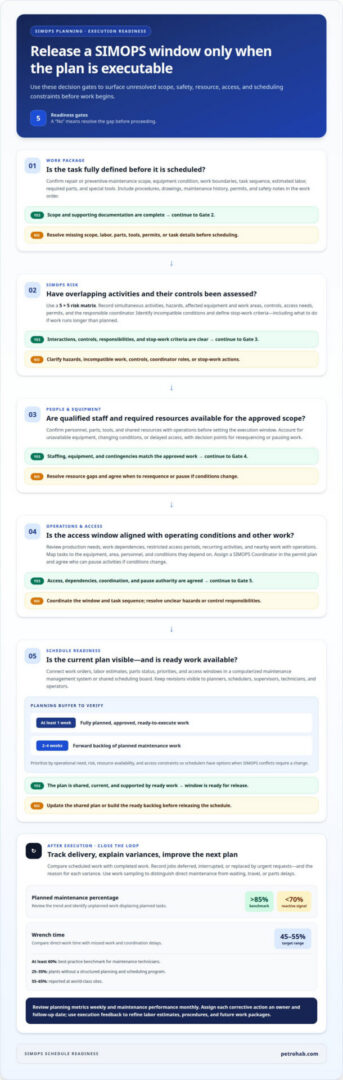
- Define the maintenance plan before scheduling. Describe the repair or preventive maintenance task, equipment condition, work boundaries, task sequence, estimated labor, required parts, and special tools. Include procedures, drawings, maintenance history, permits, and safety notes in the work order documentation. For covered process equipment, OSHA process safety management requirements call for inspection and test frequencies to follow manufacturers’ recommendations and good engineering practice.
- Assess the interactions in a 5 x 5 risk matrix. Record each simultaneous activity, its hazards, affected equipment and work areas, required controls, access needs, permits, and responsible coordinator. Identify conditions that could make activities incompatible, then define stop-work criteria and actions for work that runs longer than planned.
- Match staffing and equipment to the approved scope before setting the execution window. Assign qualified personnel, confirm parts and tools are available, and coordinate shared resources with operations. Include contingencies for unavailable equipment, changing conditions, or delayed access, with clear decision points for resequencing or pausing work.
- Use a computerized maintenance management system or shared scheduling board to connect work orders, labor estimates, parts status, priorities, and access windows. Keep revisions visible to planners, schedulers, supervisors, technicians, and operators so the current plan does not depend on separate, conflicting records.
- Prepare at least one week of fully planned, approved, ready-to-execute work. Maintain a forward backlog of two to four weeks of planned maintenance work, then prioritize jobs by operational need, risk, resource availability, and access constraints. This gives schedulers options when SIMOPS conflicts require a change.
- Measure performance through schedule compliance and work sampling. Record whether scheduled work was completed, then sample technician activities to distinguish direct maintenance from waiting, travel, or parts delays. Review the findings with supervisors and technicians; use execution feedback to improve labor estimates, procedures, and future work packages.
Schedule compliance and planning performance measures
- Measure schedule compliance by comparing scheduled work with completed work for each review period. Separate work completed as planned from jobs deferred, interrupted, or replaced by urgent requests. Record the reason for each variance, such as unavailable access, missing resources, or changed operating priorities. This shows whether schedule performance reflects planning quality or execution constraints.
- Track planned maintenance percentage alongside compliance. A planned maintenance percentage above 85% is a benchmark for a well-planned operation; below 70% typically signals reactive work is consuming most capacity. Review the trend, not one isolated result. If unplanned work rises, identify which priorities or recurring failures are displacing planned tasks.
- Measure wrench time to understand how technicians use their available work hours. A target range is 45-55% of technician time spent on direct work. Compare this measure with schedule compliance: low wrench time and missed work may point to delays, waiting, or coordination barriers. Use work sampling to distinguish those causes before changing labor estimates.
- Make supervisors accountable for explaining schedule variances and confirming execution priorities. Set clear expectations for reviewing assigned work, recording interruptions, and communicating changes to planners. Planning teams should review metrics weekly, while maintenance managers should review them monthly. These checkpoints let supervisors address emerging conflicts before they repeatedly affect planned work.
- Use each review to assign a corrective action, owner, and follow-up date. For example, if technicians repeatedly wait for an operating area, coordinate the access window before the next schedule is released. If reactive repairs displace the same preventive maintenance tasks, escalate the recurring failure for planning and prioritization. Track whether the change improves compliance in later reviews.
Plants without a structured planning and scheduling program have 25 to 35% wrench time, compared with 55 to 65% at world-class sites. A best-practice benchmark for maintenance technicians is to achieve at least 60% wrench time.
Coordination with operations for access windows
Coordinate each maintenance window with operations before releasing the schedule. A shared view of production needs, work dependencies, and changing conditions helps teams avoid preventable downtime.
-
Assess SIMOPS risks and execution confidence
Before assigning an access window, review the work area, operating conditions, and simultaneous activities with operations. Identify potential effects on production, and whether nearby work could change exposure or restrict access. Assign a SIMOPS Coordinator in the permit plan and agree who can pause activities if conditions change. Resolve unclear hazards or control responsibilities before execution.
-
Identify conflicts and schedule dependencies
Map each task to the equipment, area, personnel, and operating conditions it depends on. Ask operations to identify production constraints, restricted access periods, and recurring activities that could overlap. Sequence tasks so one does not block another, such as requiring an area to be cleared before equipment access. Keep planners, schedulers, supervisors, technicians, and operators aligned as plans change.
-
Plan SIMOPS steps to prevent delays
Agree on the access start, handover conditions, responsible contacts, and response if work overruns its window. Common causes of delay include unavailable access, shifting production priorities, resource conflicts, and tasks taking longer than planned. Set escalation and resequencing steps in advance, then communicate revisions to everyone affected. Review schedule compliance afterward and use recurring disruptions to improve coordination and reliability planning.
A common maintenance practice separates planner and scheduler responsibilities: planners build work orders, while schedulers fit work into crew time and coordinate access windows with operations. This clarifies who develops the work and who aligns its timing with operational access. Technicians and operators also shape important parts of planning and scheduling. Include their input as work orders are prepared and windows coordinated, so plans reflect the people doing the work and operating around it.
How can maintenance planners assess SIMOPS risks and confidence before execution?
- List every activity planned for the work area and execution window, including maintenance, production, and contractor tasks that could overlap or affect shared equipment. SIMOPS involves multiple groups working in the same area at the same time. Building maintenance planner confidence in executing SIMOPS without schedule delays starts with making visible the interactions that separate work orders can hide.
- Assess each interaction with a 5 x 5 risk matrix. Record the hazard, potential consequence, likelihood, affected people or equipment, and required controls. Note changing conditions, such as heavy wind above 20 kts, where relevant to the activity. Use the matrix to distinguish manageable risks from conflicts that require resequencing or additional controls.
- Review the planned sequence with operations and the people responsible for execution. Confirm the work area, access conditions, equipment status, and interfaces with nearby activities. Compare the expected sequence with actual operating constraints. An unresolved hazard, unclear control, or incompatible activity means the work is not ready and requires action before proceeding.
- Assign a SIMOPS Coordinator in the permit plan and define the coordination responsibilities. Specify what happens when an activity takes longer than expected, including who communicates the delay and how affected tasks are reviewed. Set stop-work criteria so teams know when changing conditions require simultaneous activities to pause.
- Use a documented readiness review to test execution confidence. Confirm that controls have owners, crews understand the sequence, and operations can support the agreed work window. Ask each responsible lead to identify outstanding constraints. To strengthen maintenance planner confidence in executing SIMOPS without schedule delays, resolve interface issues before marking the schedule ready.
- Reassess the plan when scope, conditions, or activity timing changes. Update the risk assessment and communicate revisions to affected groups before work continues. If a new task enters the area, check its interactions against the existing matrix and permit plan. This keeps execution decisions aligned with current site conditions.
PetroHab
PetroHab supports SIMOPS planning when maintenance requires hot work in hazardous industrial environments. Its PetroHab Hot Work Safety Enclosure (HWSE), pressurized welding enclosures, and Quadra-Lock Panels provide options for containing hot-work activities within the planned work area. The Safe-Stop Automatic Shutdown System monitors gas levels and pressure, supporting control during welding operations.
These products are relevant when hot work must be coordinated alongside production or other maintenance activities. They support worksite containment and monitoring, while planners and operations teams define access windows, permits, task sequence, and schedule contingencies. Matching an enclosure to the work scope helps integrate hot work into the SIMOPS plan without treating it as a substitute for coordination.
Contact PetroHab to discuss hot-work safety equipment for your operating environment.
Turn SIMOPS planning into execution readiness
Build maintenance planner confidence in executing SIMOPS without schedule delays by treating each work window as a controlled operating decision. Carry planning discipline into the field: keep decision ownership clear, communicate changes promptly, and pause when actual conditions no longer match the agreed plan. This gives teams a practical basis for protecting personnel and aligning work with operating priorities.
When planned hot work requires an engineered enclosure or related equipment, PetroHab’s products can support worksite controls within the broader SIMOPS plan. Equipment contributes to risk management but does not replace coordination among maintenance, operations, and other teams. Keep those responsibilities explicit as the execution plan moves from preparation to the worksite.
Contact PetroHab to discuss your planning needs and identify equipment that fits your hot-work requirements. With clear decisions and coordinated execution, your team can move forward with greater confidence.
Frequently Asked Questions
How should maintenance, operations, and contractors coordinate SIMOPS activities?
Coordinate through a shared pre-job brief and a single, current execution plan. Maintenance can confirm its sequence, operations can communicate process constraints, and contractors can report crew or equipment changes before entering the work area. Agree on the communication channel, who authorizes access, and how handovers will be recorded. This gives each group the same view when conditions or priorities shift.
What permit-to-work and isolation rules apply to SIMOPS?
Use the site’s permit-to-work and isolation procedures to control each task and its interfaces with simultaneous work. The SIMOPS permit plan should name a coordinator, set stop-work criteria, and specify actions when activities overrun. Before work begins, align affected permits and isolation boundaries, clarify who controls changes, and communicate revised conditions to every team in the area.
Which SIMOPS KPIs measure schedule performance and planning confidence?
Track schedule compliance alongside SIMOPS indicators such as access-window variance, permit holds, interruptions, and work resequenced because of activity conflicts. Record planned and actual start and finish times, then classify each deviation by cause. To assess planning confidence, monitor unresolved readiness constraints and feedback from supervisors and technicians. Together, these measures help distinguish planning gaps from operating changes without relying on a single metric.
What industry standards and regulations govern SIMOPS planning in the United States?
For covered process equipment, OSHA process safety management requirements call for inspection and test frequencies to follow manufacturers’ recommendations and good engineering practice. The SIMOPS permit plan should designate a coordinator, specify responses to overruns, and define stop-work criteria.