Blog Posts
NFPA 51B Hot Work Compliance Reference for Permit and Fire Watch Rules
A hot-work permit is only as effective as the fire-safe work area it controls. On multi-contractor sites, NFPA 51B hot work compliance requires written authorization before work begins outside designated fire-safe areas and clear responsibility for issuing permits and keeping records. Crews also need coordinated controls for the work, its hazards, and fire-watch duties.
Coordinating hot work can be challenging when contractors share a worksite, but a permit is more than a form: it connects authorization to actual site conditions. This guide explains how to organize permits and fire watches so responsibilities stay clear as work progresses.
Learn the key fire-watch requirements, what a written permit should document, and how fire-safe work areas inform hot-work decisions. The focus is practical: how permit control, hazard assessment, and site conditions work together to reduce ignition risk.
Key Takeaways
- Coordinate permit authority and records across contractors so each hot-work task has clear authorization and accountability.
- Build permit details around the work activity, site hazards, and controls needed before hot work starts.
- Assess the surrounding area for combustibles and other fire hazards, including conditions beyond the immediate work point.
- See how a PetroHab Hot Work Safety Enclosure (HWSE) can support controlled hot work in demanding industrial environments.
What Are the Fire Watch Requirements?
A fire watch monitors hot-work areas for ignition hazards during and after the task. The role connects permit controls to conditions around activities such as welding and grinding.
Fire Watch Responsibilities and Training
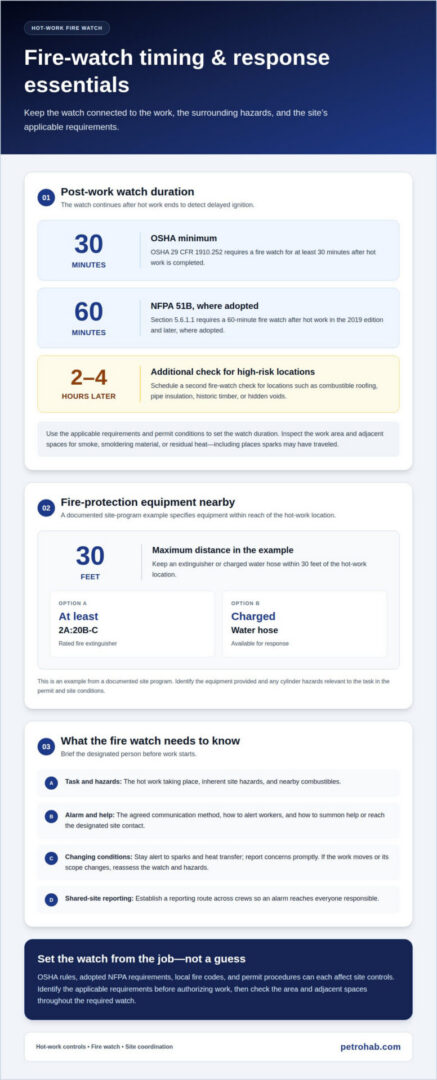
A fire watch is a designated person who monitors the work area for fire hazards. NFPA 51B requires the watch to understand the site’s inherent hazards and the hot work taking place. Before work starts, brief the watch on the task, nearby combustibles, alarm method, and how to summon help. This supports informed observation without assuming a specific formal training credential.
Assign responsibilities clearly when contractors share a worksite. The fire watch should stay alert to sparks, heat transfer, and changing conditions, and promptly report concerns. If the work moves or its scope changes, reassess who is watching the affected area and which hazards they need to monitor.
Fire Watch Equipment and Communication
Fire-watch equipment is the fire-protection equipment available to respond to an incipient fire. A documented site-program example specifies an extinguisher rated at least 2A:20B-C, or a charged water hose, within 30 feet of the hot-work location. The permit and site conditions should identify the equipment provided and any cylinder hazards relevant to the task.
Agree on a communication method before welding or grinding begins. The fire watch must be able to alert workers and the designated site contact if smoke, sparks, or ignition occurs. On a multi-contractor site, establish a reporting route across crews so an alarm reaches everyone responsible.
Post-Work Watch and Thermal Checks
A post-work fire watch continues after hot work ends to detect delayed ignition. According to the Occupational Safety and Health Administration, OSHA 29 CFR 1910.252 requires a fire watch for at least 30 minutes after hot work is completed. Where adopted, NFPA 51B Section 5.6.1.1 requires a 60-minute fire watch after hot work, 2019 edition and later.
Use the applicable requirement and permit conditions to set the watch duration. During the watch, inspect the work area and adjacent spaces for smoke, smoldering material, or residual heat, including locations where sparks may have traveled. For high-risk locations such as combustible roofing, pipe insulation, historic timber, or hidden voids, schedule a second fire-watch check 2-4 hours after work completion.
The Occupational Safety and Health Administration lists NFPA 51B-1962 as the edition incorporated by reference in OSHA’s 29 CFR 1910.252(a)(1). OSHA rules, adopted NFPA requirements, local fire codes, and permit procedures can each affect site controls, so identify the applicable requirements before authorizing work.
What Must the Hot Work Permit Form Contain?
A hot-work permit documents authorization and controls for a specific task. On a multi-contractor site, it should identify the work, location, responsible parties, and required precautions. The permit also provides a record for coordinating simultaneous work and reviewing conditions before ignition-producing tasks begin.
Hot Work Authorization
Hot-work authorization is written approval to perform a defined task in a specific area. Welding, cutting, grinding, heat treating, and open-flame work can create ignition hazards, so permit procedures establish when approval is required. An authorized issuer must issue a written permit before welding, cutting, or open-flame work begins.
A practical form links the task to its location and the people responsible for controls. Record the contractor and work crew, the work description, the permit’s issue and expiry conditions, and the fire-prevention measures selected. For example, identify whether cutting occurs near combustible material, then document the planned protection and fire-watch arrangements. This supports NFPA 51B hot work compliance by tying authorization to site-specific conditions.
Permit-Authorizing Individual
A permit-authorizing individual is designated by management to issue hot-work permits and maintain records. This role provides a clear approval point when contractors share a site.
Before issuing a permit, the individual should review the proposed task, location, and hazard assessment, then confirm that required controls are addressed. The form should record the issuer’s identity, authorization, and any conditions attached to the work. If the task or work area changes, route revised conditions through the site’s permit process before work proceeds. This keeps NFPA 51B hot work compliance connected to the actual job, rather than a general approval.
Useful form fields make each authorization traceable without treating one template as universal. Include the work area, task, contractor, permit issuer, start conditions, hazards identified, precautions, fire-watch assignment, and closeout record. For work outside designated fire-safe areas, written authorization is required under OSHA 1910.252(a)(2) and NFPA 51B. Link each record to its task so site teams can distinguish concurrent work and document completion.
Written permit requirements outside designated hot-work areas
Written authorization connects hot-work approval with the task, site hazards, controls, and contractors involved.
Permit Coordination Across Contractors
Permit coordination is the process of aligning authorizations and safeguards among crews sharing a worksite. OSHA 1926.352 is cited for hot-work permit coordination on multi-trade construction jobsites. On an occupied site, record the work location and schedule, then communicate the affected area and controls to the relevant contractors and site contacts.
For example, when one crew is cutting while another works nearby, coordinate the activities through the site permit process. This helps identify overlapping work and makes clear which authorization and precautions apply to each crew.
Hazard Assessment and Combustible Protection
A pre-permit hazard assessment identifies ignition hazards and the controls needed before work starts. NFPA 51B-2024 Chapter 5 sets out the pre-permit hazard assessment for hot work. Under NFPA 51B, combustibles within 35 feet of hot work must be removed or protected.
Survey beyond the immediate work point: check above, below, and on the opposite side of walls. Openings can let sparks or heat reach concealed spaces or combustible construction. Remove nearby combustibles where practicable; otherwise, protect them before authorizing work. These checks help prevent ignition outside the immediate work area.
Permit Records and Retention
A permit record documents authorization, task conditions, and closeout for a specific hot-work job. Include the location, work description, contractors, issuer, identified hazards, precautions, and completion details. Link each record to its task so concurrent permits are easy to distinguish.
Most insurance carriers require cancelled hot-work permits to be retained for at least 12 months. Three to five years of retention is common for claims-defense purposes in some jurisdictions and with some carriers. Set retention procedures to match applicable obligations and preserve completed records.
Work Monitoring and Permit Suspension
Work monitoring verifies that permit conditions and fire-prevention controls remain effective during hot work. Assigned site personnel should communicate changes, such as a moved work point, new nearby activity, or failed protective measure.
Site procedures should pause hot work when conditions no longer match the permit or required controls are unavailable. Reassess the hazards, update the authorization, and resume only when necessary safeguards are restored. In occupied buildings, inform relevant contractors and site contacts about the pause and affected area.
Fire-safe work areas
A fire-safe work area is a location prepared to control ignition risks before hot work begins. NFPA 51B requires hot work to take place only in areas that are fire safe or have been made fire safe. The practical test is whether the task can proceed without exposing nearby combustibles, openings, or adjacent spaces to sparks, flame, or heat.
Work-area controls should reflect the process, not just the equipment producing heat. A university permit schedule sets a 35-foot distance for welding, 15 feet for brazing, and 10 feet for soldering. These task-specific distances show why a site procedure should identify the operation before setting its area controls. They are not interchangeable measurements.
For a fixed hot-work area, provide at least one ABC dry chemical extinguisher rated a minimum of 2A:20-BC. Keep the area orderly and account for gas cylinders: unconnected cylinders stored in a designated hot-work area or shop are limited to a one-day supply. These controls support a prepared workspace, but they do not replace an assessment of the actual task and surroundings.
Atmospheric conditions can also change whether work should proceed. In a university hot-work zone, a combustible gas detector reading above 10% LEL requires ventilation and a retest before work proceeds. If readings remain above that threshold, do not treat the area as ready for ignition-producing work. Reassess the atmosphere and controls before restarting.
The central takeaway is to make fire safety a condition of the work area, not merely a permit entry. Identify the hot-work method, clear or protect combustibles, address cylinders and fire protection, then verify conditions before starting. For practical guidance on preparing a controlled hot-work area, review fire-safe work-area controls.
PetroHab LLC: PetroHab Hot Work Safety Enclosure (HWSE)
PetroHab LLC manufactures and supplies Hot Work Safety Enclosures (HWSE) for hazardous hot-work environments, including oil and gas operations. A pressurized enclosure can help establish a controlled work area when site conditions make ordinary controls difficult to apply on their own.
PetroHab HWSE products use fire-retardant materials and patented Quadra-Lock® panel technology. The Safe-Stop Safety Shutdown System monitors differential pressure and gas levels. These systems complement, rather than replace, permit authorization, hazard assessment, and fire-watch procedures. Site teams should continue applying the controls required for each task and location.
If a pressurized enclosure fits your project’s site plan, contact PetroHab to discuss its Hot Work Safety Enclosures and lease or purchase options.
Build Hot-Work Controls Into the Next Work Plan
Make NFPA 51B hot work compliance part of project planning, not a task addressed only when a crew is ready to begin. Before work is scheduled, establish who owns permit coordination, how site conditions will be communicated, and how changes will reach every affected contractor. Clear ownership helps keep decisions connected as work areas and project phases change.
Use each completed job to improve the next plan. Capture practical lessons from permit closeout, contractor handovers, and site conditions, then incorporate them into work procedures and briefings. This keeps controls relevant to the actual environment rather than relying on a form alone.
For industrial projects where a dedicated hot-work enclosure may support the site plan, discuss your requirements with PetroHab LLC. Contact PetroHab LLC about hot work safety and take the next step toward a more controlled work plan.
Frequently Asked Questions
How Do Multi-Contractor Job Sites Handle Hot Work Permits?
A coordinated process makes each active job and its responsible crew visible to site control. For example, a shared permit register can list work locations, contractors, permit status, and scheduled activities. Before a shift handoff, communicate open permits and changed conditions to incoming supervisors. This reduces confusion when crews work near the same equipment or building area.
What Are the Most Common Hot Work Citations and Fire Losses?
Common compliance gaps include hot work without required authorization, inadequate protection of combustibles, and interruptions in fire-watch coverage. Sparks or heat can ignite nearby materials or reach concealed spaces. A practical review considers the work method, surrounding combustibles, openings, and adjacent areas. Avoid assuming that one failure explains every incident; site conditions and task controls shape the risk.
What Has to Happen Before the Permit Is Issued?
Before issuing a permit, define the task and location, assess hazards, and identify the controls needed for that work. The permit issuer should consider nearby operations, combustibles, openings, and other changes that could affect the work area. For example, moving the work location may create different exposure pathways than those identified in the original assessment. The authorization should reflect the conditions where the task will actually take place.
What Is the 35-Foot Rule for Hot Work?
The rule calls for combustibles within 35 feet of hot work to be removed or protected. The distance is only useful if the assessment accounts for how sparks and heat can travel. Check areas above and below the work, openings, and the opposite side of walls. For example, a wall opening can expose combustible material beyond the visible work area.
What Records Have to Be Kept for Hot Work?
Keep permit records that show what work was authorized, where it occurred, who approved it, and how the job was closed. Most insurance carriers require cancelled hot-work permits to be retained for at least 12 months. Three to five years of retention is common for claims-defense purposes in some jurisdictions and with some carriers. Organize records so a specific permit can be retrieved by location or contractor.
When Does Hot Work Require a Written Permit?
Written authorization is required for hot work outside a designated fire-safe area under OSHA 1910.252(a)(2) and NFPA 51B. The permit should be issued before work begins and tied to the task and work location. A site’s permit process should also account for local requirements and overlapping work, so authorization matches the actual conditions rather than a general approval.