NFPA 51B Standard: The Definitive Guide to Hot Work Fire Prevention in 2026
Can a single stray spark from a grinding wheel compromise a multi-billion dollar offshore asset in less than 60 seconds? In the high-stakes environment of oil and gas production, this isn’t a theoretical concern; it’s a daily risk management reality. You recognize that bridging the gap between aggressive production targets and uncompromising safety mandates is a complex, technical challenge. The 2026 updates to the NFPA 51B standard demand a precise approach to ignition source control that leaves no room for ambiguity or procedural failure.
You’ll master the core requirements of this standard to ensure absolute fire safety and regulatory compliance during your industrial hot work operations. We provide a technical breakdown of the 35-foot rule, mandatory permit protocols, and the practical application of pressurized habitats to isolate hazardous areas. This guide details how to implement patented technologies to maintain operational integrity. You’ll gain the technical knowledge required to protect your personnel and high-value assets from catastrophic fire events while ensuring your site remains a model of disciplined, operational excellence.
Key Takeaways
- Master the 2026 regulatory landscape to ensure your industrial operations maintain absolute compliance with the NFPA 51B standard.
- Implement the mandatory 35-foot rule and rigorous Fire Watch protocols to systematically eliminate ignition risks in high-stakes environments.
- Utilize the hierarchy of controls to authorize hot work by prioritizing relocation and isolation over hazardous exposure.
- Streamline your Hot Work Permit (HWP) lifecycle and gas testing procedures to achieve maximum operational integrity and risk mitigation.
- Discover how patented Petro-Wall and Safe-Stop technologies exceed minimum requirements to provide unrivaled protection for personnel and high-value assets.
Understanding the NFPA 51B Standard for Hot Work Safety
The NFPA 51B standard serves as the primary technical foundation for fire prevention in industrial settings. It dictates how personnel manage heat, oxygen, and fuel sources during high-risk operations. In 2026, the complexity of industrial sites requires a rigorous application of these protocols to prevent catastrophic ignition events. Hot work involves any process producing sparks or open flames, including welding, brazing, and abrasive grinding. Proper management of the fire triangle is the core objective. By isolating the ignition source within a pressurized habitat, operators effectively neutralize the risk of vapor ignition in volatile atmospheres. This standard isn’t just a suggestion; it’s the industry benchmark for operational integrity.
The Evolution and Scope of NFPA 51B
Since its inception, the NFPA 51B standard has significantly reduced fire-related fatalities across the energy sector. It applies to diverse environments, from land-based refineries to offshore oil and gas platforms. The standard distinguishes between two primary zones. A Designated Area is a permanent location engineered for fire resistance, such as a maintenance shop with noncombustible floors. Conversely, a Permit-Required Area is any temporary site where flammable materials might be present, necessitating strict ignition source control and specialized enclosures. The scope of the standard covers several hazardous activities:
- Welding and Allied Processes: Arc welding, oxy-fuel gas welding, and plasma cutting.
- Heat-Treating: Any application of heat for metal strengthening or stress relief.
- Grinding: Mechanical processes that generate high-velocity sparks.
- Thermal Spraying: Coating processes that utilize molten materials.
Why Regulatory Compliance is Non-Negotiable
Regulatory bodies like OSHA incorporate the NFPA 51B standard into their enforcement frameworks, specifically through 29 CFR 1910.252. Non-compliance isn’t just a safety risk; it’s a massive financial liability. In 2026, penalties for willful safety violations can surpass $161,000 per instance. Beyond fines, a single fire can cause billions in downtime and equipment replacement costs. Following the standard protects high-value assets and the lives of the workforce. Implementing patented systems like Petro-Wall ensures that operations remain within legal limits while providing unrivaled protection for personnel and high-value infrastructure. It’s a calculated strategy for risk mitigation that every safety manager must prioritize to maintain a functional, compliant site.
Core Requirements: The 35-Foot Rule and Fire Watch Protocols
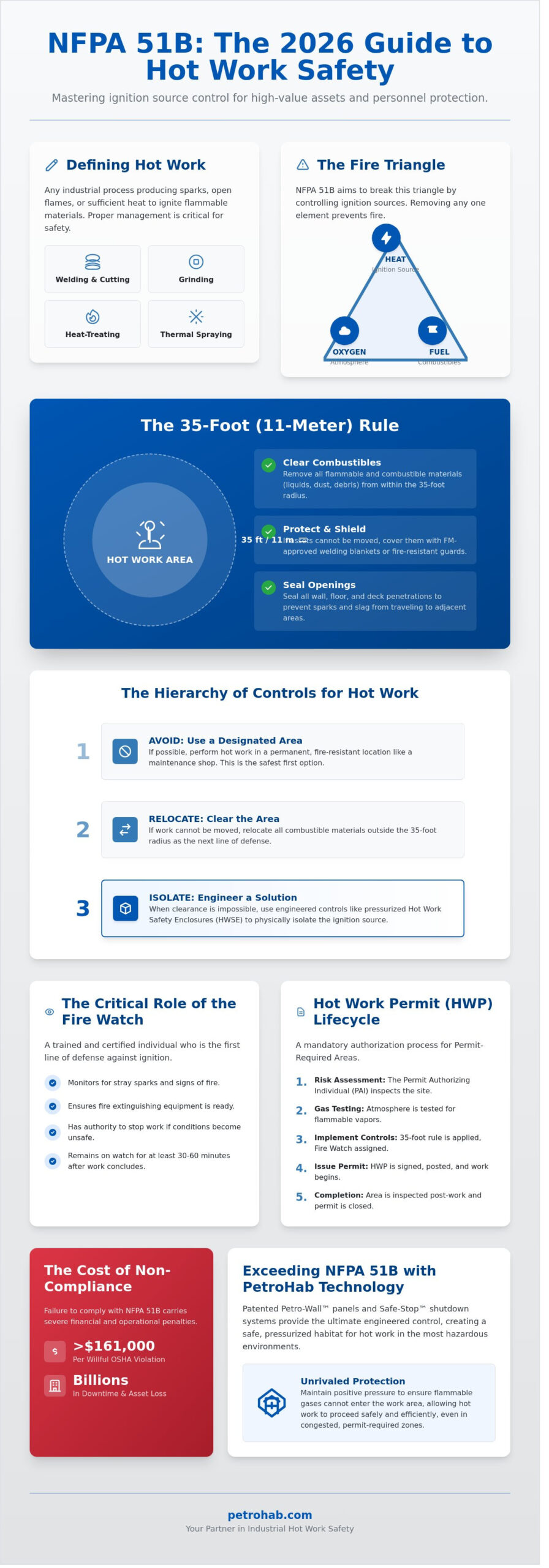
Compliance with the NFPA 51B standard hinges on the rigorous application of spatial separation and active monitoring. The 35-foot (11-meter) rule serves as the primary defensive perimeter for all hot work operations. Within this radius, the Permit Authorizing Individual (PAI) must ensure that all combustible materials are either removed or shielded. This includes clearing floor dust, moving flammable liquids, and protecting non-removable assets with FM-approved welding blankets or curtains. Fire extinguishing equipment, such as portable extinguishers or dedicated hose lines, must be staged and ready for immediate deployment by trained personnel.
Implementing the 35-Foot (11-Meter) Rule
Effective ignition source control requires a systematic sweep of the work area. If combustibles cannot be relocated, they must be covered with fire-resistant guards. The NFPA 51B, Standard for Fire Prevention is explicit about the vulnerability of wall penetrations and floor openings. Sparks and slag can migrate through these gaps, igniting fires in adjacent spaces or on lower decks. Sealing these voids with fire-stop materials or fire-resistant covers is a critical step in maintaining site integrity. In congested industrial environments where a 35-foot clearance is physically impossible, utilizing hot work safety enclosures allows operators to isolate the ignition source. These modular systems contain sparks within a controlled environment, providing a definitive technological remedy for high-risk zones.
The Critical Role of the Fire Watch
A certified Fire Watch is not a passive observer. It’s a specialized role required by the NFPA 51B standard Section 5.4 whenever combustibles are within the 35-foot radius or when openings in walls or floors expose combustibles in adjacent areas. The individual assigned must be trained in the use of fire extinguishing equipment and have the authority to stop work if hazardous conditions arise. Their duties encompass the entire duration of the hot work and a mandatory 30-minute post-work monitoring period. This window is essential for identifying smoldering fires that may not be immediately visible. In complex environments like offshore platforms or refineries, the PAI may extend this monitoring period to 60 minutes or longer to ensure total risk mitigation. For those seeking the highest level of protection, integrating engineered ignition source control systems provides an unrivaled layer of safety that complements these human-led protocols.
The Hierarchy of Controls: Avoid, Relocate, and Isolate
The NFPA 51B standard establishes a rigorous decision-making framework designed to eliminate ignition sources before they manifest. This protocol follows a logical hierarchy: avoid, relocate, and isolate. Safety managers shouldn’t view these as suggestions. They’re mandatory steps for risk mitigation in high-hazard environments. The process begins with a fundamental question: can the hot work be eliminated? If the answer is no, the focus shifts to moving the work to a controlled environment. Only when relocation is technically impossible does the standard permit isolation techniques to manage the risk on-site.
Avoidance and Relocation Strategies
Safety professionals must first evaluate cold-work alternatives. Using mechanical fasteners, hydraulic shears, or cold-cutting tools eliminates the ignition source entirely. When hot work is unavoidable, the next priority is moving the task to a permanent, designated welding shop. These areas are specifically designed to be free of combustibles. Relocating work provides a clear financial benefit. It typically reduces operational costs by 18% because it removes the requirement for specialized fire watch personnel and continuous gas monitoring associated with temporary permits. By following the NFPA 51B-2019 guidelines for relocation, operators ensure that the welding environment is inherently stable and detached from production hazards.
Isolation via Pressurized Welding Habitats
When assets are fixed, such as piping on an offshore platform, isolation becomes the primary defense. Traditional welding screens are insufficient in these scenarios. They block sparks but fail to prevent the migration of flammable gases. Modern pressurized welding habitats provide the highest tier of isolation available to the energy sector. These Hot Work Safety Enclosures (HWSE) create a physical barrier that separates the ignition source from the surrounding atmosphere with uncompromising reliability.
The core mechanism of these systems is positive pressure. By maintaining an internal pressure that’s consistently higher than the external atmosphere, the habitat ensures that outside air cannot enter the enclosure. This prevents gas ingress even if a leak occurs nearby. The structural integrity of the enclosure is paramount. PetroHab’s patented Quadra-Lock modular panels are essential for this task. Unlike standard zip-together systems, these panels interlock to maintain a rigid, airtight seal. This engineering precision ensures the NFPA 51B standard is met through active ignition source control. When combined with automated shutdown systems like Safe-Stop, these habitats provide a definitive technological remedy to the risks of on-site hot work.
- Positive Pressure: Keeps flammable vapors out by maintaining higher internal air pressure.
- Modular Integrity: Quadra-Lock panels prevent the gaps often found in flexible, fabric-only screens.
- Risk Reduction: Provides a controlled environment that allows production to continue safely in adjacent areas.
Operational Implementation: Permits and Risk Assessment
Compliance with the NFPA 51B standard requires a rigorous administrative framework that transcends simple paperwork. The Permit Authorizing Individual (PAI) carries the legal and operational responsibility for certifying that conditions are acceptable for hot work. This individual determines if the work is necessary and ensures that all combustible materials are cleared within a 35-foot radius. In complex industrial environments, the Hot Work Permit (HWP) isn’t a standalone document. It functions as a critical component of the broader Permit-to-Work (PTW) system, synchronizing with isolation certificates and vessel entry permits to prevent conflicting activities. The PAI’s liability is significant. They’re accountable for the decision to authorize hot work in areas not specifically designed for it. This role requires the authority to halt operations immediately if environmental conditions shift, such as a change in wind direction or an unexpected equipment leak.
The Hot Work Permit Lifecycle
The HWP process follows a strict three-phase sequence to ensure zero-incident performance. Adherence to these steps is non-negotiable for high-stakes energy operations.
- Step 1: Pre-work inspection and combustible clearance. Technicians must clear all flammable debris and seal floor openings within 35 feet. If the object being worked on cannot be moved, fire-resistant barriers like the Petro-Wall must be deployed to contain sparks.
- Step 2: Continuous gas monitoring and atmospheric testing. Atmospheric testing must confirm that combustible gases are below 10% of the Lower Explosive Limit (LEL) before any arc is struck. Monitoring continues throughout the duration of the task to detect volatile shifts.
- Step 3: Post-work sign-off and site restoration. Site restoration requires a minimum 60-minute fire watch after completion. The PAI must conduct a final physical inspection of the area to ensure no smoldering embers remain before the permit is officially closed.
Managing Ignition Sources in Hazardous Zones
Differentiating between designated shop areas and hazardous zones is vital for asset integrity. While some environments are designed for permanent hot work, most maintenance occurs in high-risk locations requiring specialized pressurized habitats. These systems must align with international regulations, specifically the technical nuances of ATEX vs IECEx standards. PetroHab’s Safe-Stop system provides an automated layer of protection that manual oversight cannot match. If the internal pressure of a habitat drops or gas is detected by external sensors, the system instantly isolates power to the ignition source. This technology eliminates human error and ensures the NFPA 51B standard is maintained in volatile conditions. By neutralizing the ignition source in milliseconds, operators protect both personnel and multi-million dollar assets from catastrophic failure.
Safeguard your facility by integrating the gold standard in hot work safety today.
Exceeding NFPA 51B with PetroHab HWSE Technology
Compliance with the NFPA 51B standard represents the minimum threshold for industrial safety. PetroHab engineering pushes beyond these baseline requirements to deliver a comprehensive Hot Work Safety Enclosure (HWSE) that eliminates the margin for human error. While the standard dictates fire watches and spark containment, PetroHab systems provide a pressurized, controlled environment that isolates ignition sources from combustible atmospheres. This technical approach reduces operational downtime by 25% on average compared to traditional containment methods. It ensures that critical maintenance proceeds without compromising the integrity of the facility or the safety of the personnel involved.
Engineering Integrity with Quadra-Lock Panels
The Petro-Wall system utilizes patented Quadra-Lock panels to create a seamless, airtight barrier. These panels interlock on all four sides to prevent the escape of sparks or slag, which contribute to 40% of industrial hot work accidents. The fire-resistant materials exceed the NFPA 51B standard by maintaining structural integrity at temperatures that would melt standard welding blankets. In complex offshore environments, the modular architecture allows for custom configurations around structural steel. Safety teams can assemble these enclosures in 30% less time than conventional methods, providing immediate protection in hazardous locations.
The Safe-Stop Advantage: Real-Time Ignition Control
The Safe-Stop system provides a digital safety net through automatic gas detection and ignition source control. If the system detects a 10% Lower Explosive Limit (LEL) concentration of hydrocarbons, it immediately terminates power to all tools within the enclosure. Integrated manometers monitor internal pressure levels to maintain a positive pressure differential of 0.10 inches of water column. This constant monitoring prevents external gases from entering the enclosure. This technology provides a level of protection that manual fire watches simply can’t replicate, ensuring 24/7 technical oversight during the entire duration of the hot work activity.
PetroHab on-site supervisors oversee every installation, providing a layer of accountability that goes beyond simple equipment rental. These seasoned experts ensure 100% compliance with both internal protocols and international safety regulations like ATEX and IECEx. This professional oversight minimizes the risk of catastrophic failure and protects high-value assets from avoidable fire damage. For safety managers who prioritize the protection of personnel and the continuity of operations, it’s the only logical solution for high-risk environments. Contact our engineering team today to integrate the gold standard of ignition control into your next maintenance turnaround.
Advancing Operational Integrity Through Superior Hot Work Control
Adhering to the NFPA 51B standard isn’t just a regulatory formality; it’s a critical operational necessity for protecting personnel and high-value assets. The 35-foot rule and rigorous fire watch protocols form the baseline of every effective fire prevention strategy. However, relying solely on traditional methods often falls short in complex 2026 industrial environments. Integrating the hierarchy of controls ensures that risks are mitigated through relocation or isolation before work begins, reducing the probability of ignition events to near zero.
PetroHab provides the definitive technological remedy for high-stakes ignition source control. Our Hot Work Safety Enclosures (HWSE) utilize patented Quadra-Lock technology to maintain pressurized integrity in hazardous areas. With global ATEX and IECEx certifications, our systems are deployed by Tier 1 oil and gas operators across 6 continents to eliminate fire risks. We don’t settle for minimum compliance; we provide absolute protection through engineering excellence. You can trust our modular systems to safeguard your most critical infrastructure during intensive maintenance cycles.
Ensure NFPA 51B Compliance with PetroHab HWSE Solutions
Let’s work together to eliminate workplace accidents and secure your site’s future.
Frequently Asked Questions
What is the 35-foot rule in NFPA 51B?
The 35-foot rule requires the removal or protection of all flammable materials within a 10.7 meter radius of the hot work point. If combustibles can’t be relocated, they must be shielded with fire-resistant covers or guarded by specialized welding curtains. This perimeter ensures that sparks and slag, which often travel significant distances, don’t ignite secondary fires. In 2026, maintaining this distance remains a critical baseline for preventing industrial incidents.
Does NFPA 51B require a written hot work permit for all operations?
The NFPA 51B standard mandates a written hot work permit for all operations conducted outside of a permanent, designated area. This document ensures that the Permit Authorizing Individual (PAI) has verified that all safety precautions, including gas testing and equipment checks, are in place before work starts. It’s a non-negotiable requirement for maintenance and construction activities in high-risk environments like refineries or offshore platforms.
How long must a fire watch stay on-site after hot work is completed?
A fire watch must remain on-site for at least 30 minutes after all hot work operations are finalized to monitor for smoldering fires. The PAI may extend this duration to 60 minutes or longer if the specific hazards of the site, such as hidden combustible construction, warrant additional vigilance. This post-work period is vital because 25 percent of hot work fires originate from sparks that smolder undetected for long periods.
Can a pressurized habitat satisfy NFPA 51B isolation requirements?
A pressurized habitat, such as a PetroHab enclosure, satisfies and exceeds NFPA 51B isolation requirements by creating a controlled environment that physically separates the ignition source from the surrounding atmosphere. These modular systems use positive pressure to prevent the ingress of flammable gases. When integrated with a Safe-Stop system, the habitat provides automatic shutdown capabilities, ensuring the highest level of ignition source control available in the industry.
What are the training requirements for a Permit Authorizing Individual (PAI)?
Training requirements for a PAI include a comprehensive understanding of the hot work permit system, the specific hazards of the site, and the proper use of fire protection equipment. The PAI must demonstrate the ability to evaluate the work area and ensure all 12 safety checks on the permit are met. Annual refresher training is a standard industry practice to maintain technical proficiency and safety leadership in 2026.
Is NFPA 51B mandatory for offshore oil and gas platforms?
The NFPA 51B standard is mandatory for offshore oil and gas platforms through federal regulations like BSEE 30 CFR Part 250 and internal corporate safety management systems. Offshore environments present extreme risks where fire can lead to catastrophic loss of life and assets. Adhering to these protocols is essential for maintaining operational integrity and ensuring that every welding or cutting task is performed under rigorous oversight.
What is the difference between a designated area and a permit-required area?
A designated area is a permanent, fire-resistant location, such as a maintenance shop, specifically designed for hot work. In contrast, a permit-required area is any location not originally intended for hot work where temporary hazards exist. While designated areas don’t require daily permits, permit-required areas demand a full risk assessment and the issuance of a formal permit before any ignition source is introduced to the site.
How does NFPA 51B address welding on metal walls or ceilings?
NFPA 51B requires that when welding on metal walls, partitions, or ceilings, the PAI must verify that no combustibles are present on the opposite side. Heat conduction through metal can easily ignite materials like insulation or stored chemicals located in adjacent rooms. If the other side can’t be cleared, a fire watch must be stationed there to monitor for heat transfer and potential ignition throughout the process.