
Blog Posts
Noise Reduction Inside a Pressurized Habitat: Engineering and Operational Strategies
Did you know that the ventilation systems required to maintain positive pressure can often push internal decibel levels past the OSHA Action Level of 85 dBA? Safety managers recognize the inherent conflict between sustaining a life-saving atmospheric seal and protecting personnel from the debilitating effects of auditory fatigue. Excessive noise isn’t merely a distraction; it’s a primary safety hazard that compromises verbal communication and degrades the focus required for precision welding. Achieving effective noise reduction inside a pressurized habitat requires a calculated synergy between rigid structural engineering and optimized airflow management.
You’ll discover how to mitigate these hazardous noise levels while maintaining the acoustic integrity of your hot work safety enclosure. We’ll examine the technical capabilities of Quadra-Lock panels and how they contribute to a quieter working environment for welders. This technical overview provides a roadmap for adhering to international safety standards, including the NIOSH Recommended Exposure Limit, while ensuring your Petro-Habitat operates with maximum efficiency. By the end of this guide, you’ll have the engineering and operational strategies necessary to protect your personnel and your high-value assets without sacrificing communication clarity.
Key Takeaways
- Identify the primary sources of acoustic hazards, including high-velocity intake fans and the “echo chamber” effect inherent in enclosed, fire-resistant environments.
- Compare the Sound Transmission Class (STC) of flexible materials versus rigid Quadra-Lock panels to understand how structural integrity prevents low-frequency noise.
- Implement engineering solutions for noise reduction inside a pressurized habitat by optimizing airflow ducting and utilizing acoustic silencers.
- Establish operational best practices through baseline noise surveys and the implementation of hearing conservation programs that meet OSHA and NIOSH standards.
- Learn how PetroHab HWSE systems integrate ignition prevention with advanced acoustic management to ensure global safety compliance and operational excellence.
Acoustic Challenges in Pressurized Hot Work Safety Enclosures
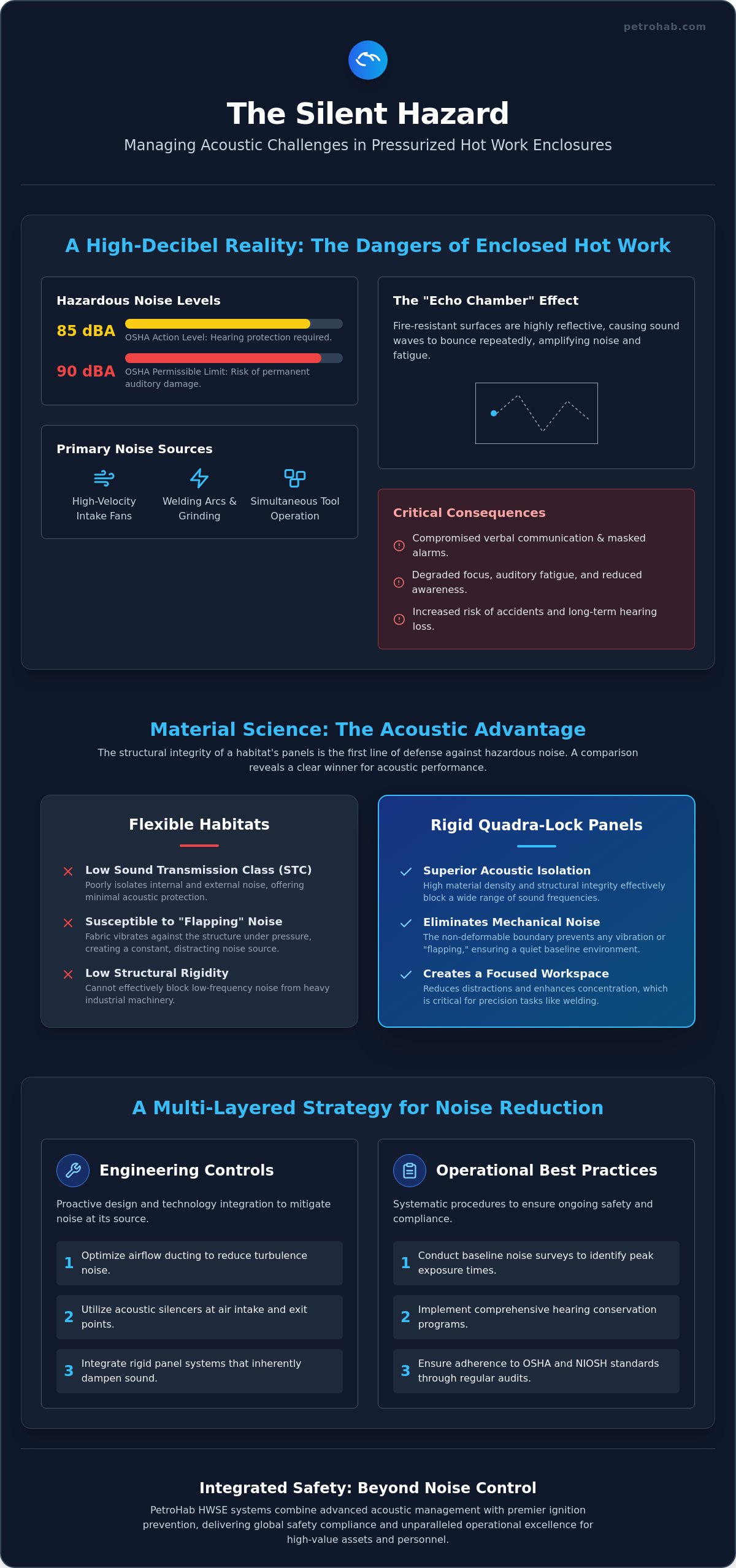
Industrial safety protocols often prioritize atmospheric containment over acoustic comfort. However, the internal environment of a pressurized habitat presents unique auditory challenges that can compromise personnel safety. Primary noise sources include high-velocity intake fans, grinding tools, and welding arcs. These components operate simultaneously within a confined space, creating a cumulative sound pressure level that frequently exceeds the OSHA Action Level of 85 dBA. When these levels reach the Permissible Exposure Limit of 90 dBA, the risk of permanent auditory damage and cognitive fatigue becomes a critical operational concern.
The “echo chamber” effect exacerbates these decibel levels. Fire-resistant surfaces used in habitat construction are typically non-porous and highly reflective, causing sound waves to bounce repeatedly rather than being absorbed. This acoustic reflection results in significant worker fatigue and a dangerous reduction in situational awareness. Implementing effective noise control strategies is essential for maintaining compliance with international decibel limits and protecting the long-term health of the workforce during extended hot work shifts.
To better understand how sound interacts with enclosed environments and different materials, watch this technical demonstration:
The Conflict Between Ventilation and Silence
Maintaining positive pressure requires constant, high-volume air turnover to prevent the ingress of flammable gases. This technical necessity creates a direct conflict with the goal of noise reduction inside a pressurized habitat. High-decibel air turnover rates generate significant turbulence noise at both air ducting entry and exit points. Additionally, the slightly higher air density required for pressurization can alter sound propagation, often making high-frequency noises from welding arcs feel more piercing to the operator. Engineers must balance the need for 50 pascals of pressure with the acoustic limitations of the workspace.
Communication Risks in High-Noise Environments
In these high-decibel environments, the risk of masked alarms or misunderstood verbal instructions increases exponentially. If a welder can’t hear a gas detector alarm or a supervisor’s emergency command, the enclosure becomes a liability. While non-verbal communication systems and hand signals are vital, they aren’t substitutes for a controlled acoustic environment. Relying on advanced hot work safety systems ensures that automated shutdowns occur even when human communication fails, but the fundamental engineering of the habitat must still address the noise at its source to prevent accidents.
Material Science: Rigid Panels vs. Flexible Habitats
Flexible habitats often rely on PVC or glass fiber composites. While these materials meet basic fire-retardancy standards, they possess a low Sound Transmission Class (STC). This leads to poor acoustic isolation from external shipyard or refinery noise. Under high-pressure conditions, flexible tents are susceptible to “flapping” noises. This occurs as the fabric vibrates against the support structure or itself. Rigid panels eliminate this mechanical noise source entirely by providing a stable, non-deformable boundary. This stability is crucial for maintaining a professional workspace where focus is paramount.
Traditional Engineering controls for noise reduction often suggest the use of acoustic foam. However, industrial hot work environments prohibit these materials due to their high flammability and potential for toxic off-gassing. The engineering challenge is to achieve noise reduction inside a pressurized habitat using only materials rated for extreme temperatures. PetroHab’s modular panels are rated to withstand continuous temperatures of 1,000°F (538°C) and intermittent exposure to molten slag up to 1,500°F (815°C). This allows them to serve as both a thermal and an acoustic barrier simultaneously without introducing fire risks.
Sound Reflection and Absorption in HWSE
Effective noise management requires a distinction between sound insulation and sound absorption. Insulation blocks sound from passing through a wall, while absorption deadens sound within the room. Flexible materials provide negligible insulation against low-frequency industrial drones. In contrast, the density of Quadra-Lock panels provides a superior barrier against external industrial noise. While fire-retardant coatings are essential for safety, they can increase sound reflection. This makes the structural density of the panel the most critical factor for decibel management. High-energy tasks like grinding require this mass to prevent sound energy from permeating the workspace.
The Quadra-Lock Advantage for Acoustic Stability
The proprietary interlocking mechanism of the Quadra-Lock system does more than ensure a gas-tight seal. It prevents vibration-induced noise at the seams. In flexible systems, gaps and loose joints often rattle under the force of high-velocity ventilation. Rigid panels maintain their acoustic integrity over the duration of long-term projects, resisting the wear that typically degrades the sound-blocking capabilities of fabric enclosures. For more technical specifications on these components, safety managers should consult our Quadra-Lock panel technology guide. Ensuring your team works in a stable, quiet environment is a prerequisite for operational excellence. Explore our range of pressurized habitats to see how rigid engineering improves site safety.
Engineering Solutions for Airflow and Ventilation Noise
Strategically positioning intake fans is the first line of defense against excessive decibel levels. Moving the primary noise source further from the welder reduces direct sound pressure levels. Engineers calculate the distance required to maintain 50 pascals of pressure while minimizing the acoustic impact. Integrating silencers or acoustic baffles within the air ducting system dampens sound energy before it reaches the personnel. These components effectively trap high-frequency vibrations while allowing for the necessary air turnover. This technical approach ensures that safety protocols don’t interfere with the operator’s ability to focus.
Air velocity adjustments provide another technical lever for noise reduction inside a pressurized habitat. High air speed often generates more noise than the volume of air itself. By increasing duct diameters and reducing velocity, operators can maintain the required pressure with a lower acoustic signature. The Safe-Stop Automatic Shutdown System supports this balance. It monitors pressure differentials and gas levels with precision, ensuring that safety isn’t compromised when ventilation is optimized for noise control rather than just raw power. This precision monitoring allows for a more controlled and quieter internal environment.
Optimizing Air Ducting Geometry
Smooth-bore ducting is superior to corrugated alternatives in every industrial application. Corrugated walls create micro-turbulence that generates a constant, high-pitched whistle. Smooth surfaces promote laminar flow, which is quieter and more efficient for moving air. Sweeping curves must replace 90-degree bends. Sharp turns create localized pressure drops and turbulence, which increases the acoustic signature of the system. PetroHab air ducting is designed specifically to minimize these friction losses and maintain a stable internal environment for high-precision hot work.
Active vs. Passive Noise Control
Passive control remains the primary strategy in hazardous environments. This involves utilizing the inherent mass of Quadra-Lock panels and the integrity of airtight seals to block sound. While active noise-canceling headsets provide individual protection, they don’t replace the need for engineered habitat quietness. Automated shutdown systems like Safe-Stop provide a secondary benefit. They reduce the operational demand on ventilation. Precise monitoring means there’s less need for “over-venting,” which directly translates to a quieter and more focused workspace for the entire crew. This synergy between monitoring and ventilation is a hallmark of modern safety engineering.
Operational Best Practices for Managing Decibel Levels
Operational excellence in hazardous environments requires more than just high-performance hardware; it demands a rigorous methodology for managing decibel levels. Before any hot work begins, technicians must conduct a baseline noise survey to establish ambient sound levels. These measurements are then compared against operational noise once ventilation fans and tools are active. This data ensures that the noise reduction inside a pressurized habitat remains within the parameters defined by your hearing conservation program. Continuous monitoring during the shift identifies spikes in sound pressure that could indicate equipment malfunction or a breach in acoustic integrity.
Managing the time-weighted average (TWA) of noise exposure is a critical safety function. Because OSHA utilizes a 5-dB exchange rate, every 5 dBA increase halves the permissible exposure time. To mitigate these risks, safety managers should implement the following protocols:
- Mandatory Hearing Protection Zones: Define and mark areas inside and within a 3-meter radius of the HWSE where double hearing protection is required.
- Personnel Rotation: Limit individual shifts for grinders and welders to ensure no single worker exceeds the 8-hour TWA of 85 dBA.
- Visual Signaling Systems: Since high decibel levels mask auditory warnings, use strobe lights or clear hand signals for emergency stop (E-Stop) procedures.
- Real-Time Dosimetry: Equipping personnel with personal noise dosimeters provides immediate feedback on cumulative exposure levels.
Training and Site Supervision
The habitat technician plays a dual role in monitoring both pressure differentials and acoustic safety. This specialist ensures that the intake fans operate at the lowest possible RPM required to maintain the 50-pascal pressure seal. Acoustic safety must be integrated into the Permit-to-Work (PTW) process, treating noise as a physical hazard equivalent to heat or toxic gas. Effective risk mitigation depends on rigorous on-site supervision and training to ensure all personnel understand the limitations of verbal communication in high-noise environments.
Equipment Maintenance and Acoustic Integrity
Mechanical wear is a primary contributor to rising noise floors. Worn fan bearings or imbalanced impellers generate low-frequency vibrations that Quadra-Lock panels are designed to block, but the source must be addressed to prevent structural fatigue. Technicians should inspect acoustic seals during every shift change. A loose seal doesn’t just leak pressure; it creates a “whistle” effect that increases the overall decibel level. Tool maintenance is equally vital; dull grinding discs or poorly maintained welding leads increase the time required for hot work, thereby increasing the total duration of noise exposure for the crew. For professional-grade containment solutions that prioritize both safety and operational comfort, contact PetroHab for a technical consultation on our HWSE systems.
PetroHab’s Commitment to Safe and Productive Environments
PetroHab engineers systems that mitigate the complex risks associated with industrial hot work. While ignition prevention remains the core objective, the technical reality is that noise reduction inside a pressurized habitat is essential for operational integrity. Our Hot Work Safety Enclosures (HWSE) utilize rigid engineering to address both ignition and acoustic hazards simultaneously. By maintaining a quiet and stable environment, we reduce the cognitive load on personnel. This directly correlates to a lower incidence of workplace accidents and higher operational precision. Our holistic approach ensures that your facility maintains the highest level of protection for both high-value assets and human life.
Adherence to hazardous environment standards is a continuous engineering requirement rather than a static goal. PetroHab habitats are designed to meet and exceed global regulatory frameworks, including the 2026 guidelines for global compliance. Prioritizing worker comfort and communication clarity provides a significant long-term ROI. Reduced auditory fatigue leads to higher precision in welding and grinding. Clear acoustic paths ensure that safety protocols are followed without ambiguity, even in the most demanding industrial settings.
The Synergy of Quadra-Lock and Safe-Stop
These proprietary technologies work in tandem to create a controlled and quiet environment. Quadra-Lock panels provide the physical mass necessary to block external noise and dampen internal reflections. Simultaneously, the Safe-Stop Automatic Shutdown System monitors the atmosphere with precision. It eliminates the need for the excessive, high-decibel ventilation often required by inferior, less-monitored systems. This synergy is critical in extreme offshore conditions. In these environments, space is limited and ambient noise from drilling operations is constant. We provide the most resilient safety systems in the industry to protect your crew.
Next Steps: Sourcing and Consultation
Requesting technical specifications for acoustic performance is a standard part of a rigorous procurement process. We encourage safety managers to consult with our engineering team to develop habitat configurations tailored to specific site noise profiles. Utilizing certified technicians ensures that every panel and seal is optimized for both pressure and sound attenuation. Don’t settle for standard enclosures when high-stakes environments demand specialized engineering. Contact PetroHab today to discuss your project requirements and implement a safety solution that defines operational excellence.
Securing Your Acoustic and Atmospheric Integrity
Effective noise reduction inside a pressurized habitat requires an integrated approach that combines material science with precise airflow engineering. Rigid Quadra-Lock panels provide superior sound transmission characteristics compared to flexible alternatives, effectively eliminating mechanical flapping while blocking external industrial noise. When paired with optimized ducting geometry and real-time dosimetry, these systems ensure compliance with OSHA and NIOSH standards without compromising the critical positive pressure seal.
Safety managers must treat acoustic hazards with the same technical rigor applied to ignition risks. PetroHab’s global track record in offshore and refinery environments demonstrates the reliability of our patented technologies. Our systems maintain international certifications, including ATEX and IECEx standards, ensuring your safety protocols remain uncompromising. Protecting your personnel and high-value assets is a mission defined by meticulous engineering and operational excellence.
Consult with PetroHab for Your Specialized HWSE Needs to implement a safety solution tailored to your project’s unique environmental profile. Your commitment to safety excellence ensures a more productive and secure industrial future.
Frequently Asked Questions
What is the maximum recommended decibel level inside a pressurized habitat?
The maximum legally enforceable limit for occupational noise exposure is 90 dBA as an 8-hour time-weighted average (TWA) per OSHA standards. Employers must implement a hearing conservation program when the 8-hour TWA reaches the Action Level of 85 dBA. Following the NIOSH Recommended Exposure Limit of 85 dBA represents a higher standard of worker protection and is the benchmark for operational excellence in high-stakes environments.
Can noise reduction materials be added to an existing HWSE without voiding certification?
Adding uncertified materials to a Hot Work Safety Enclosure (HWSE) can compromise its fire-resistance rating and void its ATEX or IECEx certification. Noise reduction inside a pressurized habitat should rely on engineered components like Quadra-Lock panels; these are already tested for thermal and acoustic integrity. Any modifications must use materials that withstand continuous temperatures of 1,000°F to maintain the system’s status as a certified safety barrier.
How does positive pressure affect the way sound travels inside a welding habitat?
Positive pressure increases air density, which can slightly enhance the propagation of high-frequency sounds from welding arcs or grinding tools. This environment often makes piercing noises feel more intense to the operator. Engineers must account for these changes when designing ventilation systems; the 50-pascal pressure differential required for safety can exacerbate the acoustic challenges already present in a confined industrial workspace.
Do rigid panels provide better noise insulation than flexible enclosures?
Rigid panels provide significantly better noise insulation than flexible enclosures due to their higher Sound Transmission Class (STC) and structural mass. Flexible PVC or glass fiber materials often vibrate or “flap” under high-pressure ventilation, creating additional mechanical noise. Quadra-Lock panels eliminate this vibration and provide a denser barrier that blocks external refinery or shipyard noise more effectively than fabric-based systems.
How can I ensure clear communication between the welder and the safety watch?
Clear communication is maintained through a combination of visual signaling protocols and non-verbal communication systems. Because high-velocity ventilation can mask verbal instructions, safety managers should use strobe lights or hand signals for emergency stop commands. Conducting a baseline noise survey allows you to identify frequencies where verbal communication is impossible, necessitating the implementation of pre-defined visual safety codes before hot work commences.
Does increasing the air turnover rate for safety always increase the noise level?
Increasing the air turnover rate doesn’t always increase noise if the system is engineered to manage air velocity. High-velocity air creates turbulence noise, but using larger diameter ducting allows for the same volume of air to move at a lower speed, reducing decibel levels. Automated systems like Safe-Stop optimize ventilation based on real-time atmospheric data, preventing the “over-venting” that typically leads to excessive and unnecessary acoustic hazards.
Are there specific ATEX-certified tools that generate less noise for hot work?
Specialized pneumatic and electric tools are available with integrated silencers, but they don’t replace the need for engineered habitat controls. While using quieter tools reduces the noise floor, the cumulative sound from the ventilation and the welding arc often remains high. The primary strategy for noise reduction inside a pressurized habitat must focus on the enclosure’s ability to block and absorb sound rather than relying solely on tool selection.
What role does air ducting play in the overall acoustic profile of the habitat?
Air ducting geometry is a critical factor in the habitat’s acoustic profile because corrugated walls generate micro-turbulence and high-pitched whistling. Smooth-bore ducting promotes laminar flow, which significantly reduces the sound generated by moving air. Replacing sharp 90-degree bends with sweeping curves further minimizes pressure drops and turbulence, ensuring the ventilation system operates quietly while maintaining the required 50-pascal pressure differential.