Blog Posts
Online Maintenance Audit Services for National Oil Companies
Auditor approval rests on evidence, not simply on the fact that maintenance is online. To persuade national oil company auditors to approve online maintenance, show how the approach meets applicable requirements, prioritizes risk, supports practical corrective actions, and preserves accessible digital records. Clear, traceable controls let auditors assess the process on its merits.
A change in how maintenance is delivered can invite scrutiny, particularly when asset integrity and personnel safety are at stake. Build an audit-ready case by aligning the process with relevant obligations, planning reviews around risk, presenting actionable recommendations, and organizing records so decisions and work histories are traceable. Explain where online maintenance fits into hazardous industrial operations and where physical safeguards remain essential. Keep the discussion grounded in evidence and operational control.
Key Takeaways
- Build an approval case around applicable compliance obligations and traceable maintenance records.
- Prioritize audit scope by asset criticality, failure history, and operational risk.
- Make recommendations practical by linking each finding to a corrective action and accountable owner.
- Show how digital maintenance evidence supports oversight, while addressing the physical safeguards needed for hazardous work.
Oil and gas regulatory compliance
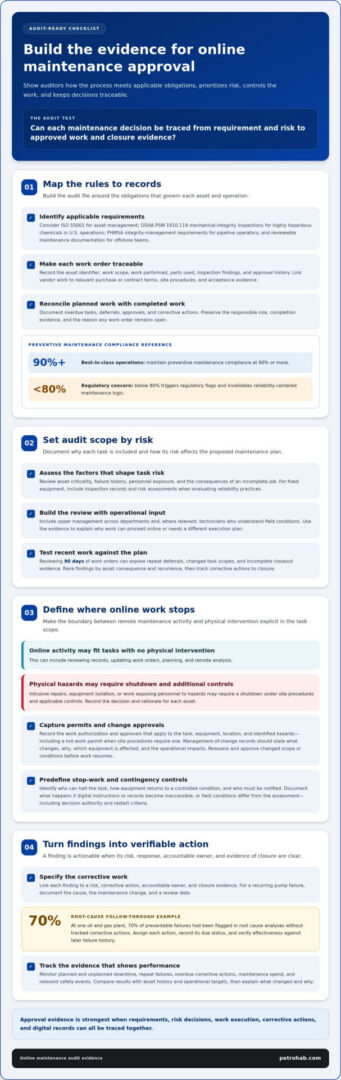
Build the audit file around the rules governing each asset and operation. ISO 55001 is identified as an asset management standard relevant to oil and gas maintenance audits, according to the International Organization for Standardization. For U.S. operations, OSHA PSM 1910.119 addresses mechanical integrity inspections for highly hazardous chemicals. Offshore teams should organize maintenance records so they are easy to review against applicable documentation expectations. Pipeline operators should connect preventive and mitigative measures to PHMSA integrity management requirements.
Online maintenance may include reviewing records, updating work orders, planning, and remote analysis when a task needs no physical intervention. Intrusive repairs, equipment isolation, or work that exposes personnel to hazards may require a shutdown under site procedures and applicable controls. Define this distinction in the task scope and record the decision and rationale for each asset.
Preventive maintenance compliance gives auditors a measurable view of execution. Best-in-class oil and gas operations maintain preventive maintenance compliance of 90% or more. Below 80%, preventive maintenance compliance triggers regulatory flags and invalidates reliability-centered maintenance logic. Compare scheduled work with completed work, then document overdue tasks, deferrals, approvals, and corrective action. A digital record should preserve the responsible role, completion evidence, and any reason the work order remains open.
Work-order quality matters as much as closure status. For each job, record the asset identifier, scope, work performed, parts used, inspection findings, and approval history. Link vendor work to the relevant purchase or contract terms, site procedures, and acceptance evidence. This allows auditors to trace what was authorized, delivered, and accepted instead of relying on a completion label alone.
When comparing online and shutdown maintenance, assess the planned work against production constraints and risk controls. Online execution may avoid taking equipment out of service for tasks that require no physical intervention, supporting uptime and limiting shutdown-related disruption. The cost effect depends on downtime avoided, labor, materials, and scope, so document these factors for each decision. An audit should also track infrastructure efficiency and operating costs, downtime, outages, and maintenance costs.
Audit planning and risk assessment
Set the audit scope around asset integrity, maintenance history, and operational consequences. A documented plan lets auditors trace why each task was included.
Permit and Management-of-Change Approvals
Permit requirements depend on the task, equipment, location, and hazards identified at the site. Before maintenance begins, record the applicable work authorization and approvals, including a hot-work permit when site procedures require one. A management-of-change review should document what is changing, why, which equipment is affected, and the operational impacts. If the scope or conditions change, record the reassessment and approval before work resumes.
Risk Assessment Requirements
Assess each task against asset criticality, failure history, exposure to personnel, and consequences of an incomplete job. For fixed equipment, review inspection records and risk assessments as part of evaluating reliability practices. Use those records to explain why the proposed work can proceed online or needs a different execution plan. Include input from upper management across departments and, where relevant, technicians who understand field conditions.
Failure Safeguards and Contingency Plans
Define stop-work triggers before work begins. Identify who can halt the task, how equipment will be returned to a controlled condition, and who must be notified. Specify the response if digital instructions or records become inaccessible, or field conditions differ from the assessment. Document contingency actions, decision authority, and restart criteria so auditors can trace the response.
Build the audit sample from recent work orders and compare planned scope with actual execution. Reviewing 90 days of work orders can expose repeat deferrals, changed task scopes, and incomplete closeout evidence. Then rank findings by asset consequence and recurrence, assign an accountable owner, and track corrective actions to closure. This links the risk assessment to a verifiable maintenance decision rather than a general statement of intent.
An IT maintenance audit assesses a company’s maintenance strategy and identifies opportunities for improvement. Maintenance history and susceptibility to failure can also reveal whether systems are over-maintained or under-maintained.
Actionable audit recommendations
Turn every audit finding into a work item with a defined risk, corrective action, owner, and closure evidence. For example, a recurring pump failure should prompt a documented cause, a maintenance change, and a review date. This gives operations teams a clear action and enables auditors to verify whether controls changed.
Connect reliability, safety, and cost measures to asset performance under the proposed online maintenance process. Track planned and unplanned downtime, repeat failures, overdue corrective actions, maintenance spend, and relevant safety events. Compare results with the asset’s history and operational targets, then explain what changed and why. These measures help auditors assess whether online work preserves integrity and reduces avoidable disruption.
Root-cause records need follow-through. In one oil and gas plant example, 70% of preventable failures had been flagged in root cause analyses without tracked corrective actions. Convert each analysis into an assigned action, record its due status, and verify effectiveness against later failure history. A closed investigation without evidence of action does not demonstrate control.
Write recommendations so supervisors can implement them without interpreting audit jargon. Specify the affected equipment, observed gap, required control, accountable role, and evidence of completion. Distinguish immediate containment from longer-term corrective work. For example, an unresolved equipment condition may call for an operating restriction while engineering assesses a permanent repair.
- Reliability: Compare repeat failures, work completion, and downtime by asset.
- Safety: Record task hazards, control deviations, and follow-up actions.
- Cost: Track maintenance labor, materials, and outage-related costs using consistent categories.
Close the audit loop with a management review. Confirm that each recommendation has an owner, risk-based priority, and completion evidence, then verify that the action addressed the original finding. If it did not, document the revised action and rationale. This creates a traceable basis for review and helps leaders decide whether to continue, change, or stop the online maintenance process.
NOC auditor requirements for online maintenance
Auditors need evidence that online maintenance follows controlled procedures and produces traceable records. When seeking approval from national oil company auditors, present the defined scope, affected asset register, task approvals, risk basis, and completed work evidence. For each sampled job, connect the maintenance request to its authorization, execution record, inspection result, and closeout decision.
Digital records should show who entered or approved information and when each change occurred. Include revision histories for procedures and work instructions, along with a clear link between each record and its equipment identifier. Auditors should be able to trace a work order from its initial scope through field completion and supervisor review without relying on disconnected files.
Show how the process controls access and preserves evidence. Provide role assignments, approval histories, and records of exceptions or deferred work. Explain how teams retrieve current instructions and identify superseded versions. A sample audit trail should show that a technician used the authorized procedure and the designated role reviewed the completed task.
- Scope: Asset list, task boundaries, and the basis for online execution.
- Authorization: Relevant permits, risk assessments, approvals, and management-of-change records.
- Execution: Work order, inspection results, deviations, and completion evidence.
- Oversight: Revision history, access records, exceptions, and corrective-action status.
Auditors may compare system records with field evidence. Reconcile a selected work order with equipment tags, inspection findings, and supporting contractor documentation. Explain discrepancies with a recorded correction, not an informal verbal account. A concise evidence index helps reviewers find records and follow the decision path.
A practical step in persuading national oil company auditors to approve online maintenance is mapping each audit question to a named record and responsible role. For hazardous hot-work activities, align maintenance evidence with physical work controls. Discuss hazardous-work enclosure needs as part of that control review.
PetroHab: PetroHab Hot Work Safety Enclosure (HWSE)
PetroHab Hot Work Safety Enclosure (HWSE) is a purpose-built option for maintenance involving hot work in oil and gas environments. Include the enclosure in the work scope when auditors need to assess how welding activity is separated from surrounding operations. The Safe-Stop Safety Shutdown System monitors differential pressure and gas levels, and can be equipped with oxygen and/or carbon-dioxide detectors. PetroHab’s enclosure panels join using patented Quadra-Lock® technology.
For maintenance planners, the practical next step is to align the selected equipment with the job hazard analysis, permit controls, and audit evidence. Document the task, safeguards, and responsible approvals so reviewers can understand how the work is controlled. PetroHab’s pressurized welding enclosures may suit projects requiring a pressurized habitat.
Contact PetroHab to discuss hot-work enclosure requirements for your operation.
Move from audit planning to operational readiness
Align the audit case with the work your site needs to perform. Define where online maintenance fits, identify tasks involving hazardous hot work, and match operational controls to the planned activity. This gives decision-makers a clear basis for reviewing the approach before implementation.
For hot-work scopes, PetroHab offers the PetroHab Hot Work Safety Enclosure (HWSE), Safe-Stop Automatic Shutdown System, and Quadra-Lock Panels. These offerings can be considered as part of the physical safeguards supporting a maintenance plan, alongside the site’s own procedures and approval process. A well-structured case for persuading national oil company auditors to approve online maintenance connects operational needs to relevant controls without treating digital records as a substitute for field safeguards.
Contact PetroHab about audit readiness and discuss the enclosure requirements for your operation. A disciplined next step keeps the review focused on evidence, work scope, and personnel protection.
Frequently Asked Questions
What regulations and standards govern online maintenance in the oil and gas industry?
Applicable requirements depend on the asset and operating context; no single standard covers every online maintenance task. ISO 55001 is an asset management standard relevant to maintenance audits, according to the International Organization for Standardization. OSHA PSM 1910.119 addresses mechanical integrity inspections for highly hazardous chemicals. Offshore maintenance documentation requirements include BSEE / BOEM SEMS, while PHMSA integrity management covers documented preventive and mitigative measures for pipeline operators.
How do auditors assess safety risks for maintenance performed while equipment is operating?
Auditors assess task hazards, asset condition, operating constraints, and the controls protecting personnel and equipment during work. They may compare the planned task with current field conditions, then review how changes in pressure, gas readings, or equipment status would prompt a stop or revised plan. Evidence should link the risk assessment to the work authorization and the recorded decision to proceed online.
How have national oil companies approved online maintenance programs in the United States?
Support approval with evidence that the program meets applicable requirements, prioritizes risk, and preserves traceable maintenance records. Present the task scope, asset register, approvals, risk basis, and completed work evidence. Explain when a task needs physical intervention or a shutdown under site procedures.