
Blog Posts
Pressure Differential Monitoring Best Practices for Welding Habitats
A pressure reading can look acceptable right up to the moment a leak, open access point, or ventilation change alters a habitat’s pressure balance. That is why pressure differential monitoring best practices treat the reading as an operating control to verify, not a standalone safety guarantee. The practical questions are where to measure, what a change means, and which response to follow.
For welding teams and safety managers, dependable monitoring also means keeping pressure data separate from gas and oxygen readings. Differential pressure indicates the relationship between conditions inside and outside the habitat. It does not identify hazardous gases or confirm breathable air. Each measurement serves a different purpose, and none should replace the others.
This guide explains how to select meaningful measurement points, use suitable instruments, interpret fluctuations, and keep consistent monitoring records. It also shows how to establish clear escalation steps without relying on an isolated reading or an assumed threshold. Pressure monitoring fits into a broader habitat safety approach, where gas monitoring, shutdown capability, enclosure integrity, and trained operation work together to support risk control.
Key Takeaways
- Define inside and outside measurement points so readings are meaningful and repeatable.
- Choose gauges, transmitters, or switches according to the required monitoring function, and follow project documentation for setup.
- Apply pressure differential monitoring best practices by treating trend checks, alarm notification, and automatic shutdown as separate functions.
- Record pre-work checks, active readings, changes, responses, and shift handover details to support consistent operations.
- Integrate pressure monitoring with gas monitoring, Safe-Stop shutdown capability, enclosure integrity, and trained operation.
What Pressure Differential Monitoring Reveals in a Pressurized Welding Habitat
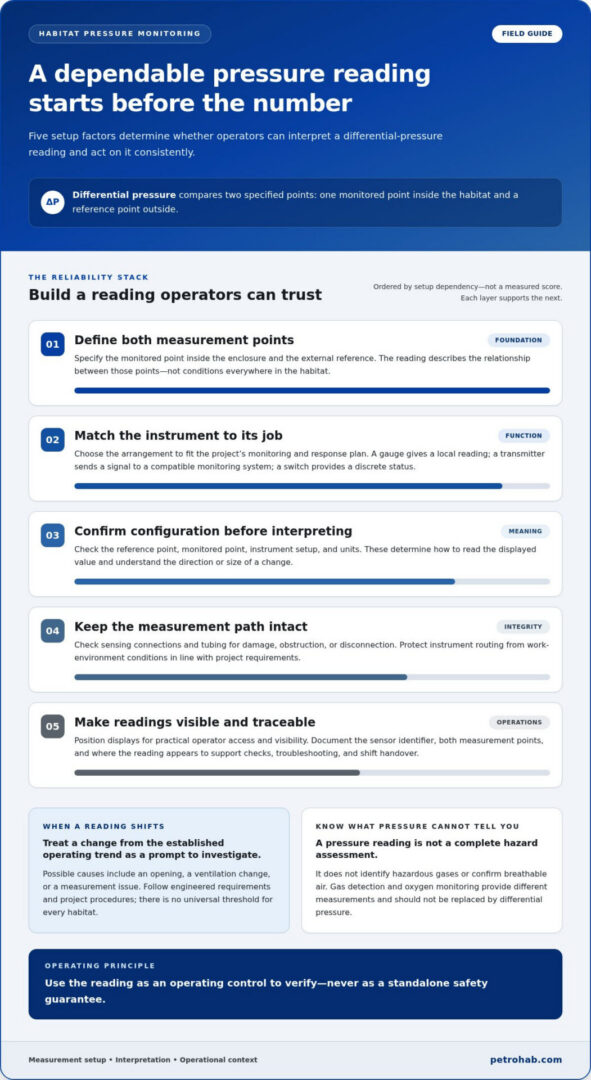
Differential pressure is the pressure difference between two specified points. In a pressurized welding habitat, an instrument compares pressure at a monitored point inside the enclosure with pressure at a reference point outside it. The reading shows the relationship between those points, not the pressure condition everywhere in the habitat.
That relationship matters because positive pressure supports outward airflow at openings and helps limit the entry of hazardous gases from the surrounding area. A reading can help operators recognize a change that may affect containment, but it cannot prove that the habitat is fully safe or identify every hazard.
This overview of a Positive pressure enclosure describes the principle behind using a pressure difference to support environmental separation. For a visual look at habitat setup and air disturbance, watch this video:
What does a differential pressure reading mean?
The instrument’s reference and monitored points determine how to interpret the displayed value. If the monitored point is inside the habitat and the reference is outside, the reading indicates whether internal pressure is higher or lower than pressure at that external point. Confirm the instrument’s configuration and units before interpreting the direction or size of a change. A shift from the established operating trend can prompt investigation. Possible causes include an opening, a ventilation change, or a measurement issue. There is no universal threshold for every habitat. Applicable limits must come from the engineered requirements and project procedures.
Why monitor pressure in a pressurized welding habitat?
Pressure data gives the operating team an observable indicator of the habitat’s pressure relationship. It can help identify a change early enough for personnel to follow the approved response and investigate whether enclosure integrity or operating conditions have changed. These pressure differential monitoring best practices depend on treating a reading as one piece of evidence, not a complete hazard assessment.
Pressure monitoring is distinct from gas detection and oxygen monitoring. A differential pressure instrument measures a pressure relationship. It does not identify flammable or toxic gases or establish oxygen concentration. Those hazards require their corresponding monitoring controls. In PetroHab pressurized welding habitats, pressure and gas monitoring form part of a broader safety approach. Understanding how pressurized welding habitats support containment helps clarify why pressure readings matter and why they must be interpreted alongside other controls and operating procedures.
How Differential Pressure Instruments Measure Habitat Conditions
A differential-pressure instrument compares pressure at two sensing points. One point connects to the habitat side of the measurement, and the other provides the reference, often the surrounding environment. The instrument processes that difference and presents it as a local reading, a signal to a monitoring system, or a discrete status from a switch. The result is meaningful only when operators know which points are being compared.
A differential-pressure transmitter converts the pressure difference between two sensing points into a signal that a compatible monitoring system can display or use. That signal does not explain the cause of a change by itself. Correct interpretation depends on the instrument configuration, its reference point, and the condition of the sensing connections.
Gauge, transmitter, or pressure switch: what is the difference?
A gauge provides a local reading for operator observation. A transmitter communicates a measurement signal to a compatible monitoring system, where it can be displayed or incorporated into system functions. A pressure switch operates as a discrete device. Its function depends on the system design and how the switch is configured. These devices serve different roles, so the selected arrangement should match the project’s monitoring and response plan.
Where should measurement points and displays be considered?
Engineered system drawings should define the measurement points and reference used for the reading. A sensor placed where it does not represent the intended pressure relationship can mislead operators. Damaged, obstructed, or disconnected tubing can also compromise the measurement path, as can conditions that affect the tubing. Displays should be positioned for practical operator access and visibility, while instrument routing should be protected from the work environment in line with project requirements.
Document the sensor identifier, the monitored and reference points, and where the reading appears. This gives operators a shared basis for checks, troubleshooting, and shift handover. Project documentation and manufacturer guidance should govern instrument setup and testing. For broader offshore operating context, consult the UK Health and Safety Executive’s HSE offshore safety information.
These details are central to pressure differential monitoring best practices: a dependable reading starts with a defined measurement arrangement, not simply a visible number. PetroHab’s pressurized habitats integrate pressure and gas monitoring as part of a broader operating system. Explore PetroHab pressurized habitats to see how habitat equipment can support project safety planning.
Pressure Differential Alarms: What Readings Can and Cannot Tell You
A trend, an alarm, and an automatic shutdown serve different purposes. Trend monitoring helps operators recognize movement from an established operating condition. An alarm notifies the team that a defined condition has been reached and requires the site-approved response. Automatic shutdown is a separate system function that may act on configured inputs. An alarm alone does not confirm that shutdown has occurred, and a pressure reading alone does not establish that the habitat atmosphere is acceptable.
The IEC 60079-13:2017 standard addresses pressurized rooms for explosive atmospheres. Project requirements and procedures should define the applicable limits and responses. Do not assume a universal alarm setpoint or response time.
How should operators interpret a pressure differential alarm?
Treat the alarm as a condition requiring action, not as a diagnosis. Follow the approved site response and escalation procedure. Operators should check the displayed reading and instrument status, then consider relevant operating conditions, such as changes to ventilation or enclosure access. Record the alarm, checks, actions, and outcome according to project procedures. Do not dismiss an alarm solely because another indicator appears normal.
Why pressure monitoring cannot replace gas or oxygen monitoring
Each method observes a different condition. Pressure data describes the relationship between two points. Gas detection identifies the presence or concentration of targeted gases, while oxygen monitoring measures oxygen concentration. One reading cannot substitute for another. For details on atmospheric checks, see the separate discussion of habitat air-quality monitoring.
| Monitoring method | What it indicates | What it cannot establish alone |
|---|---|---|
| Pressure differential | Pressure relationship between specified points | Whether hazardous gases are present or oxygen concentration is acceptable |
| Gas detection | Presence or level of the gases the system is designed to detect | Whether the habitat maintains its required pressure relationship |
| Oxygen monitoring | Oxygen concentration at the measurement point | Whether pressure containment or targeted gas conditions are satisfactory |
Reliable pressure differential monitoring best practices keep these functions distinct and connected within the operating plan. PetroHab Hot Work Safety Enclosure systems monitor pressure and gas levels, while the Safe-Stop Automatic Shutdown System provides automatic shutdown capability. These controls support risk management, but operators still need clear procedures, competent interpretation, and the full set of required atmospheric monitoring.
Pressure Differential Monitoring Best Practices for Daily Operations
Consistent monitoring depends on a routine that defines who checks the system, what gets recorded, and how abnormal conditions are escalated. Apply the project’s approved procedures and manufacturer guidance throughout the work. They govern inspection and test intervals, operating limits, and the required response. Do not substitute generic thresholds or assumed schedules.
What should a pre-work monitoring check include?
Before hot work begins, the assigned operator should verify the instrument identification and visible condition, then confirm system readiness against the project procedure. Check that the sensor and reference points match the documented arrangement and that the reading can be interpreted correctly. Inspect accessible connections and tubing for visible damage or disconnection, following the approved inspection method.
Address alarms and shutdown interfaces through approved functional checks. Record the applicable operating limits from project documentation, along with the initial reading and check results. If the instrument’s status or reading is uncertain, escalate the issue through the site procedure before relying on the measurement.
How should teams manage readings, alarms, and shift handovers?
Assign monitoring, alarm response, and escalation responsibilities before work starts. During operations, follow the specified monitoring routine and use the site-approved reporting process to record meaningful changes, alarms, instrument faults, checks, actions, and the personnel responsible. Records should let the incoming team understand what happened and what remains unresolved.
At handover, communicate the current status, recent pressure changes, outstanding alarms or instrument issues, actions already taken, and any relevant operating changes. Do not treat an unexplained reading as resolved just because the shift has changed.
- Abnormal reading: Follow the approved response and escalation procedure. Report the condition and document actions.
- Instrument fault: Treat the reading as unreliable, notify the responsible personnel, and follow project instructions for the fault.
- Uncertain condition: Escalate rather than assume the habitat remains within its required operating condition.
These pressure differential monitoring best practices create a traceable link between measurement, operator decisions, and handover. The routine should fit the habitat system and the project’s operating plan. Explore PetroHab safety systems for equipment designed to integrate pressure and gas monitoring into habitat safety.
Integrating Pressure Monitoring with PetroHab Habitat Safety Systems
Pressure monitoring is most useful within a coordinated habitat safety plan. The plan should connect measurement points and operating limits to gas monitoring, alarm responsibilities, approved procedures, and clear operator actions. A pressure change can prompt investigation, while gas monitoring observes atmospheric hazards. Neither function replaces the other.
PetroHab’s Safe-Stop Automatic Shutdown System provides automatic shutdown capability. Its role should be understood within the project’s specific system design, including how monitoring inputs, alarms, and shutdown functions are configured. Do not assume a sequence or response logic from the system name alone. The approved project documentation should define system behavior and the actions personnel take when conditions change.
How monitoring supports a wider hot work safety system
Reliable operation depends on more than equipment. Operators need procedures that explain how to read indicators, respond to alarms, report faults, and coordinate with other controls. Training helps personnel apply those procedures consistently and understand the limits of each monitoring function. For a broader view of coordinated controls, refer to the guide on advanced hot work safety systems.
These pressure differential monitoring best practices align equipment, procedures, and operator responsibilities. PetroHab Hot Work Safety Enclosure systems include pressure and gas monitoring, with automatic shutdown capability through Safe-Stop. The specific arrangement and shutdown logic must follow the project’s engineered design and operating plan.
What to document when planning or reviewing a habitat monitoring setup
Keep the setup information clear enough for operators, supervisors, and incoming shifts to use consistently. Review and document:
- Sensor identification, measurement points, and the pressure reference point.
- Applicable operating limits and alarm conditions from project documentation.
- Who monitors readings, receives alarms, and leads escalation.
- Equipment status, required functional checks, and the approved process for recording results.
- Response actions, reporting routes, and handover requirements.
- Training needs so assigned personnel can interpret readings and follow procedures.
Use this record during project planning and whenever the monitoring arrangement or operating conditions change. It creates a practical reference for checking that equipment, alarm responsibilities, and response procedures remain aligned. PetroHab provides habitat equipment, on-site supervision, and training to support project implementation.
To discuss habitat solutions for your project requirements, discuss PetroHab habitat solutions.
Strengthen Your Habitat Monitoring Plan
Dependable pressure monitoring starts with clearly defined measurement points, instruments, and project-specific operating limits. Trend checks, alarms, and automatic shutdown have distinct roles, and pressure readings must be considered alongside gas and oxygen monitoring. Consistent pre-work checks, clear escalation responsibilities, and complete shift records help teams respond to changes without treating a single reading as proof of overall safety.
These pressure differential monitoring best practices work best within an integrated habitat safety plan. PetroHab manufactures modular Hot Work Safety Enclosures and pressurized welding habitats, and its Safe-Stop Automatic Shutdown System provides automatic shutdown capability. Equipment, supervision, and training can support implementation around the requirements of industrial projects.
Make your monitoring approach part of a coordinated risk-control strategy. Discuss PetroHab habitat safety solutions and take the next step toward a more consistent operating plan.
Frequently Asked Questions
Is pressure differential monitoring enough to confirm a welding habitat is safe?
No. A pressure reading describes the relationship between defined measurement points, not every hazardous condition inside or around the habitat. Gas detection, oxygen monitoring, work authorization, and site procedures address separate controls. No single instrument reading proves overall safety. Operators must interpret readings within the project’s approved limits and response procedures, and use the full set of required controls to assess conditions before and during hot work.
What does a low pressure differential indicate in a pressurized welding habitat?
A lower-than-expected reading indicates a condition that needs assessment against the habitat’s approved operating criteria. It does not identify the cause. Operating changes, instrument condition, or pressure-system issues may warrant consideration, but do not diagnose the problem from the reading alone. Follow site procedures, verify the instrument’s status, and escalate abnormal or unresolved conditions through the designated reporting route before relying on the measurement.
How often should pressure differential monitoring be checked?
There is no universal checking interval. Frequency depends on the engineered system, project procedures, operating conditions, and manufacturer guidance. Define the monitoring routine before work begins, including checks required during operations and at handover. Pressure differential monitoring best practices also include documenting relevant readings, alarms, and changes according to the approved plan, so the team can trace conditions and actions across shifts.
What is the difference between a differential pressure gauge and a pressure transmitter?
A differential pressure gauge provides a local visual reading for an operator. A transmitter sends a measurement signal to a compatible display or monitoring system. The appropriate instrument depends on the system design and how operators need to observe or use the measurement. These descriptions do not establish a specific range, accuracy, or certification. Use verified project documentation and equipment information for those details.
What should operators do when a pressure differential alarm activates?
Follow the site-approved response and escalation procedure. The response should account for the alarm condition, instrument status, work status, and relevant signals from other monitoring systems. Do not assume a universal shutdown sequence or response time. Record the alarm, checks, and actions taken through the approved process. Resume work only when the applicable procedure permits it and required conditions have been addressed.
Can pressure differential monitoring replace gas detection in a welding habitat?
No. Pressure monitoring measures the relationship between specified points, while gas detection checks for targeted gases. A pressure reading cannot establish gas concentration, and a gas detector alone does not confirm the habitat’s pressure relationship. The project safety plan should define how these controls work together, including alarm responsibilities and approved response actions. Treat each measurement as a distinct input to the operating decision.
What information should be recorded during pressure differential monitoring?
Follow the site’s approved records process. Depending on project requirements, record the time, instrument identification, reading, alarms, operating changes, checks performed, actions taken, and responsible personnel. Keep entries factual and traceable, so another operator can understand the condition and response. Project procedures and applicable equipment documentation should define the required format and frequency, rather than a generic template.