
Blog Posts
Refinery Turnaround Delay Liquidated Damages: Costs and Scope
A missed turnaround date doesn’t automatically make every day of delay chargeable. Liquidated damages are amounts agreed in the contract, often calculated at a daily rate when work is not completed by the contractual date. Protecting a refinery turnaround superintendent against schedule delay liquidated damages starts with separating contractor-caused delay affecting key milestones from owner-directed scope changes, access constraints, and other delays addressed by the contract.
That distinction matters during a shutdown, when added work or changes to the sequence can affect both the completion date and responsibility for delay. A liquidated-damages clause is a financial remedy, not a substitute for defining milestones, extension rights, and the events that trigger liability.
This article explains how delay and performance liquidated damages work, how scope changes can affect delay exposure, and how project records can support a reasoned damages assessment. It also covers contract terms that shape the outcome, including caps, exclusions, and responsibility for delays involving multiple parties.
Key Takeaways
- Understand how liquidated damages turn defined schedule risks into pre-agreed financial remedies, and why the rate should reflect a reasoned forecast of loss.
- See how shutdown scope changes can affect timing and responsibility when added work or revised instructions are documented promptly.
- Learn which project records help explain a damages estimate, including the basis for the rate and the delay’s impact on key milestones.
- Identify contract terms that shape delay exposure, such as trigger dates, time extensions, caps, and how responsibility is allocated among project parties.
What Are Liquidated Damages?
Liquidated damages are amounts agreed in a contract for defined delays or performance shortfalls. In a refinery turnaround, a clause may set a daily rate when contractor-caused delay pushes completion beyond the agreed date. The clause turns a specified risk into a predictable remedy, but it does not automatically make every late day chargeable.
A reasonable rate should reflect a documented forecast of the owner’s anticipated loss, not an arbitrary amount intended to force performance. Relevant impacts may include extended project management, inspection, or other delay-related costs. The contract should link the rate to the milestone and loss it addresses. An amount applied regardless of breach or impact may appear punitive rather than compensatory.
Reasonableness can depend on the governing law. In Texas, Phillips v. Phillips, 820 S.W.2d 785 (1991), established a two-prong test: when the contract was made, harm must have been difficult or impossible to estimate, and the agreed amount must have reasonably forecast just compensation. Texas courts may also review the relationship between agreed and actual damages at breach. In New York, liquidated damages substitute for actual damages rather than adding to them.
A superintendent is not automatically personally liable when a project misses a date. The contract identifies the responsible parties; personal exposure depends on the individual’s contractual commitments and applicable law. Assess any delay claim against the signed agreement, not the job title alone.
The contract’s governing-law provision chiefly determines which state law applies, and enforceability varies. Texas applies the test above, while New York examines whether the amount reasonably relates to anticipated or actual loss. Contract terms define milestones and substantial completion, such as by specifying dates or completion criteria. There is no universal refinery rule.
Insurance does not automatically cover delay, defective performance, or the cost of correcting a contractor’s own work. Review the policy terms and distinguish claims alleging insured damage from those based only on delay or a contractual promise. After receiving notice, preserve schedules, instructions, change records, and the delay timeline. Document the cause promptly and notify the owner when responsibility is disputed.
Change-of-scope review during shutdowns
A shutdown instruction that adds work can change the schedule, cost, and allocation of delay responsibility. The contract’s change process links revised scope to milestones and any request for time relief.
Delay Relief and Time Extensions
Time relief adjusts a contractual deadline when an excusable event affects performance. Owner-caused delays, weather, supply-chain disruption, or another cause outside a contractor’s control may qualify if the contract provides an extension process. The superintendent should link the event to the affected work and milestone. Without that link, a dispute may hinge on whether the delay actually moved substantial completion.
Documenting Delays and Change Orders
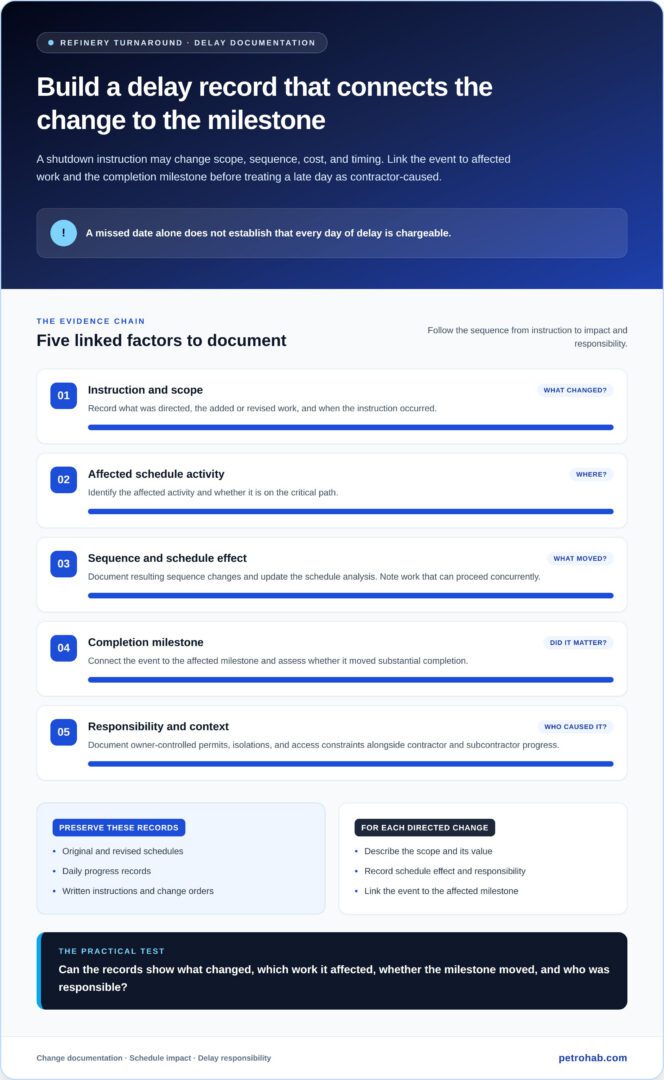
Delay documentation creates a dated record linking an event to its schedule impact and the party responsible. For each owner instruction or change order, record what was directed, the added or revised work, the timing, and the effect on the current schedule. Identify the affected activity and whether it is on the critical path. This helps distinguish actual delay from work that can proceed concurrently.
During a refinery shutdown, an added inspection or repair may require crews or equipment planned for another task. Record the instruction and resulting sequence change, then update the schedule analysis and identify the affected completion milestone. Document owner-controlled permits, isolations, and access constraints alongside contractor and subcontractor progress. These details help allocate responsibility instead of treating every late activity as contractor-caused.
Construction contracts should specify how changes are valued, how notices are delivered, and how extensions are assessed. Promptly document the scope, value, schedule effect, and responsibility for each directed change. Preserve the original and revised schedules, daily progress records, and written instructions. If the owner assesses financial damages, this evidence can support a focused response and help determine whether the clause applies to the actual delay.
Scope control also interacts with hot-work planning: added work can change where welding takes place and what safeguards are needed. For projects using hot-work enclosures, PetroHab’s Safe-Stop Automatic Shutdown System monitors gas levels and pressure in hazardous environments.
Refinery turnaround contractors should document change orders and instructions that affect scope or timing. When a customer directs additional work during a shutdown, promptly record the changed scope, its value, and responsibility.
Estimating and justifying damages
A defensible liquidated-damages estimate links the agreed amount to expected project loss. For a turnaround, the parties need a clear calculation basis tied to delay and completion.
Estimating and Justifying Delay Damages
Estimate the owner’s expected delay losses using project-specific records, not an amount selected without analysis. Consider how an overrun could affect management, inspection, and other documented costs. The Boston Central Artery/Tunnel Project illustrates one approach: estimates used historical data, adjusted for the probability of impact, plus management and other costs. Documenting the calculation and assumptions supports a reasoned basis if a breach is disputed.
Rates and Caps for Turnaround Delays
There is no single refinery-turnaround rate or cap established for every contract. A construction reference describes $20-$25 per day for each $100,000 of contract price as a reasonable amount, but it is not a refinery-specific standard. Oil and gas contracts often cap liquidated damages; the cap may be a fixed sum or a percentage of the final contract price or contractor’s fee.
For a shutdown, assess the proposed daily amount against the losses the owner expects if a defined milestone slips. A rate with no reasonable relationship to anticipated harm may invite a penalty challenge. The contract should identify which delay triggers the charge, how excusable delays affect the completion date, and whether separate milestones carry separate amounts.
Assess the cap alongside total exposure and the structure of the available remedies. A cap limits recovery under the clause, so the parties should define what happens when it is reached. They may also specify correction obligations, escalation procedures, or termination rights. If liquidated damages are the sole remedy for contractor-caused delay, carve-outs should preserve any operational remedies the parties intend to retain.
Keep the estimate, supporting records, assumptions, and contract language aligned. A documented calculation explains why the amount was agreed, while a clear cap defines its financial boundary. Together, these terms make delay exposure more predictable and give the parties a concrete basis for evaluating a claim.
Owners should keep records explaining how liquidated damages were calculated. In a Western European refinery project dispute, the owner argued that contractual liquidated damages did not adequately cover lost production and other costs.
Purpose and operation of construction-delay liquidated damages
Construction-delay clauses turn defined schedule risks into agreed financial remedies. A disciplined approach to protecting a refinery turnaround superintendent against schedule delay liquidated damages begins with the contract’s actual allocation of responsibility.
Contract Terms Creating Superintendent Exposure
A liquidated-damages provision identifies the responsible party, the milestone that triggers payment, and how the amount accrues. A superintendent’s title alone does not establish personal liability; the signed contract identifies the parties’ obligations, subject to governing law. For example, a contractor agreement may impose daily damages after a stated completion date, while separate terms allocate responsibility for subcontractor delays. Focus on the contract language, not the job title.
Clauses Limiting Schedule-Delay Liability
Protective clauses define excusable delay, extensions of time, liability caps, and the scope of the damages remedy. They matter when owner-caused delays, weather, or supply-chain disruptions affect performance. Clauses aimed at protecting a refinery turnaround superintendent against schedule delay liquidated damages can tie charges to contractor-caused delay affecting critical milestones and prevent multiple recoveries for the same impact.
Specify notice procedures and the records needed to support an extension. A force majeure clause should explain which covered events extend the contract time. If liquidated damages are the sole remedy for contractor-caused delay, state whether operational remedies remain available, such as correction obligations or termination rights after a cap is reached. Clear terms distinguish schedule relief from other contractual responses.
Delay Events Affecting Liquidated Damages
Force majeure provisions may grant time relief for covered events. Concurrent delay requires examining whether multiple parties caused overlapping schedule impacts. If the contract lacks an extension mechanism, shared responsibility can complicate enforcement. Acceleration is a separate issue: a liquidated-damages clause provides a financial remedy but does not, by itself, require a party to accelerate work or correct performance problems. The agreed terms determine how these events affect deadlines and damages.
For a refinery turnaround, define the trigger milestone, qualifying delay events, extension process, and cap. Keep schedule obligations distinct from hot-work controls. For gas-level and pressure monitoring during hot work, review the Safe-Stop Automatic Shutdown System as an operational safeguard, not a substitute for schedule protections.
PetroHab
PetroHab LLC supports refinery turnaround teams with hot-work safety equipment for hazardous work environments. Its offerings include the PetroHab Hot Work Safety Enclosure (HWSE), pressurized welding enclosures, Quadra-Lock Panels, and the Safe-Stop Automatic Shutdown System. These solutions address hot-work containment and ignition-prevention needs; they do not replace schedule controls, contract terms, or delay documentation.
Consider this equipment when shutdown work involves welding in hazardous areas and the work plan calls for a pressurized enclosure or automatic monitoring of gas levels and pressure. Coordinating hot-work controls with the turnaround plan helps teams manage operational hazards while tracking scope, milestones, and responsibility separately.
Contact PetroHab LLC to discuss hot-work safety equipment for your turnaround.
Align Schedule Control With Field Execution
A practical approach to protecting a refinery turnaround superintendent against schedule-delay liquidated damages connects contract administration with field coordination before work begins. Establish a clear route for schedule decisions, safety constraints, and scope changes to reach the people responsible for execution. This helps align operational controls with the approved work plan without treating safety measures as negotiable schedule shortcuts.
During planning, bring turnaround leadership and hot-work safety planning into the same discussion. PetroHab LLC’s hot-work safety equipment can support welding in hazardous environments, while project agreements govern contract and schedule responsibilities. Define how the work environment will be controlled and how schedule changes will be communicated and recorded.
For a discussion about hot-work safety needs in your turnaround, contact PetroHab LLC about turnaround planning. A disciplined plan gives the team a clear starting point for coordinated execution.