Blog Posts
Selecting a Hot Work Safety Enclosure Provider: The 2026 Engineering Guide
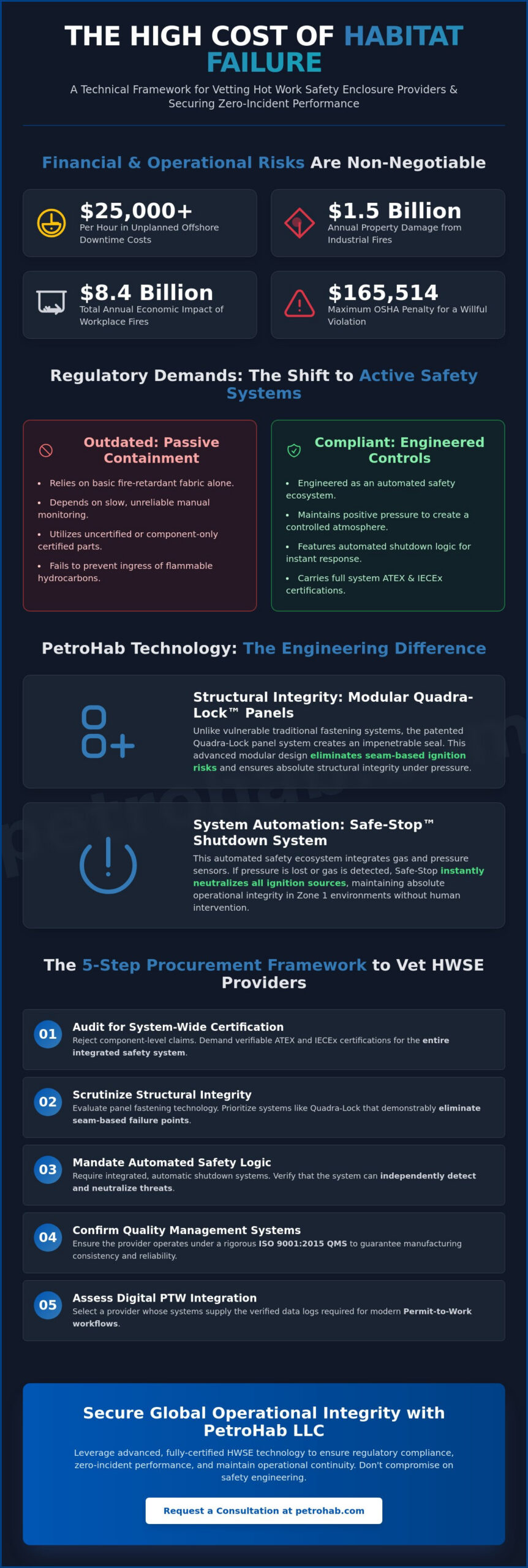
With unplanned offshore downtime costs exceeding $25,000 per hour, the failure of a single habitat isn’t just a safety breach; it’s a catastrophic operational loss. You likely already know that in Zone 1 environments, the margin for error is non-existent. Selecting a hot work safety enclosure provider requires more than just reviewing fire-retardant hardware. It demands a rigorous audit of life-critical engineering systems that can withstand the $1.5 billion in property damage industrial fires cause annually.
You’re probably tired of navigating conflicting certification claims and the complexity of managing hot work permits under the 2024 and 2025 NFPA 51B updates. This guide provides the definitive framework to master the technical and regulatory criteria needed to vet HWSE providers and secure zero-incident performance. We’ll examine the critical engineering benchmarks for pressurized habitats, including the structural integrity of modular Quadra-Lock panels and the functional reliability of the Safe-Stop automatic shutdown system. This ensures your operations remain fully compliant with current ATEX and IECEx standards.
Key Takeaways
- Understand why 2026 regulatory standards demand a shift from basic containment to engineered controls to mitigate the high financial stakes of habitat failure.
- Master a five-step procurement framework for selecting a hot work safety enclosure provider that prioritizes technical certification validity and system automation.
- Identify the engineering vulnerabilities of traditional fastening systems and how modular Quadra-Lock panels eliminate seam-based ignition risks.
- Evaluate the logic of integrated gas detection and the Safe-Stop automatic shutdown system to maintain absolute operational integrity in Zone 1 environments.
- Learn how to verify comprehensive ATEX and IECEx certifications for entire safety systems to ensure compliance with global industrial safety protocols.
The Critical Role of HWSE Providers in 2026 Risk Mitigation
Industrial safety in 2026 isn’t a matter of simple containment. It’s a rigorous engineering discipline. Selecting a hot work safety enclosure provider now involves evaluating a provider’s ability to integrate with active risk mitigation strategies. Traditional methods often fail to account for the volatile nature of Zone 1 environments where a single spark can trigger millions in property damage. Total economic impacts from workplace fires reach approximately $8.4 billion annually, making the selection of a high-performance habitat a critical financial decision.
The financial stakes are absolute. An hour of unplanned downtime on an offshore platform costs upwards of $25,000. When you factor in OSHA’s 2026 maximum penalty of $165,514 for willful violations, the cost of a sub-standard habitat becomes untenable. A failed enclosure isn’t just a technical glitch; it’s a breakdown in the entire safety chain. You need a partner like PetroHab LLC that understands the granular details of ignition prevention and environmental containment.
To better understand this concept, watch this helpful video:
Modern systems function as automated safety ecosystems. You must ensure your provider aligns with the latest hazardous environment standards to maintain global compliance. This integration transforms the enclosure from a static barrier into a dynamic guardian of your high-value assets. PetroHab LLC ensures that safety is engineered into the workflow rather than added as an afterthought. Selecting a hot work safety enclosure provider that offers integrated technology ensures that safety is a proactive component of your operational strategy.
The Shift from Passive to Active Protection
Active protection defines the 2026 safety landscape. A positive pressure enclosure creates a controlled atmosphere by maintaining higher internal pressure than the surrounding hazardous zone. This prevents the ingress of flammable hydrocarbons. While older standards relied on manual monitoring, current regulations prioritize automated shutdown logic. Systems provided by PetroHab LLC ensure that ignition sources are neutralized instantly if pressure is lost or gas is detected.
HWSE and the Modern Permit-to-Work (PTW) System
Digital Permit-to-Work (PTW) systems are now the industry standard for streamlining hot work approvals. Top-tier providers supply the verified safety protocols and real-time data logs required to satisfy these digital workflows. This documentation is essential for reducing “shut-in” requirements on offshore platforms, allowing production to continue while maintenance occurs. It also ensures that your site remains ready for rigorous audits from BSEE and OSHA, providing the transparency required in high-stakes environments.
Engineering Benchmarks: Auditing Technical Standards and Certifications
Technical precision is the only metric that matters. When selecting a hot work safety enclosure provider, you must verify that ATEX and IECEx certifications apply to the entire system. Component-level certification is insufficient for high-stakes environments. A provider’s commitment to a rigorous ISO 9001:2015 Quality Management System (QMS) ensures that every Quadra-Lock panel and control module meets a repeatable standard of excellence. PetroHab LLC maintains this internal discipline to prevent the “one-off” failures that lead to catastrophic accidents and massive operational losses.
Compliance with OSHA hot work regulations requires more than basic fire-retardant fabric. It demands a holistic approach to ignition prevention. You should also evaluate a provider’s R&D pipeline to ensure they are pioneering advanced hot work safety systems that anticipate future regulatory shifts. Stagnant technology is a liability in a landscape of evolving hazards. Professional providers like PetroHab LLC view safety as an ongoing engineering challenge rather than a finished product.
Global Compliance Benchmarks for 2026
When selecting a hot work safety enclosure provider, distinguish between “compliant” and “certified.” Some vendors use the term “compliant” to mask a lack of formal testing. Certified systems undergo rigorous third-party verification by accredited bodies. This is the only acceptable proof of engineering excellence in Zone 1 and Zone 2 areas. Demand full certification dossiers during the audit process to ensure the equipment won’t fail under operational stress. These documents should clearly state the specific hazardous atmospheres and temperature classes the system is rated to handle.
Structural Integrity and Environmental Resilience
Offshore environments subject habitats to extreme external forces. HWSE structural integrity is the ability to maintain 0.1 inches of water column pressure under external stress. Enclosures must withstand high-wind resistance while maintaining this internal positive pressure. Material science plays a critical role here. Panels must meet NFPA 51B fire-resistance ratings to prevent thermal degradation during high-temperature welding operations. The 2025 update to NFPA 51B clarified requirements for fire-resistant fabric technologies, making it essential to audit the provider’s material choices for current-year compliance.
Rigorous testing ensures that the enclosure remains a reliable barrier against volatile hydrocarbons. If a provider cannot produce documented evidence of climate-specific testing or high-temperature material resilience, they aren’t a safety partner; they’re an equipment vendor. It’s worth reviewing the technical specifications of pressurized habitats to understand the engineering delta between generic tents and specialized safety systems. PetroHab LLC prioritizes empirical data over marketing promises to ensure absolute site safety.
Structural Integrity: Why Modular Quadra-Lock Systems Outperform Traditional Habitats
Structural integrity determines the success or failure of a positive pressure system. Traditional habitats often rely on Velcro or zipper-based fastening systems. These components represent significant engineering flaws. They are prone to degradation from UV exposure and industrial chemicals, leading to inevitable seam failure. In high-wind offshore environments, these “weakest links” compromise internal pressure and jeopardize site safety. Selecting a hot work safety enclosure provider that utilizes a mechanical interlocking system is essential for maintaining a reliable barrier against ignition sources.
The transition from fabric-based fasteners to engineered panels marks a critical evolution in industrial protection. Mechanical seals provide the consistency required for high-stakes operations. When you evaluate the physical durability of a system, you’re auditing its ability to function as an active guardian. A provider must demonstrate that their enclosure maintains its seal even under the extreme external stress of coastal or deep-water locations. Reliability isn’t a marketing claim; it’s a result of uncompromising material science.
The Quadra-Lock Advantage in High-Risk Zones
Quadra-Lock panels provide a superior mechanical seal compared to generic alternatives. These interlocking panels eliminate the gaps and leak paths associated with traditional fabric-based fasteners. This technology ensures that the pressurized welding habitat maintains the required positive pressure without fluctuation. These modular panels are engineered for reusability and resilience. They resist the corrosive effects of salt spray and volatile hydrocarbons common in energy sectors. Adhering to established Hot Work Safety Program Standards requires a system that exceeds minimum requirements through robust mechanical engineering. Modularity also reduces setup time, allowing for rapid deployment in restricted offshore footprints without compromising the integrity of the pressurized seal.
Customization for Complex Industrial Geometries
Industrial sites rarely offer uniform spaces for habitat installation. Habitats must often encapsulate complex geometries like valves, flanges, and structural beams. Selecting a hot work safety enclosure provider with deep custom engineering capabilities is vital for these scenarios. Modular Quadra-Lock panels allow for precise adaptation to non-standard configurations, ensuring that protrusions don’t create dangerous leak paths. Specialized air ducting must also be integrated to maintain proper ventilation and cooling within these custom-shaped enclosures. A provider’s ability to engineer these site-specific solutions reflects their competence as a safety partner. They must understand the granular details of your infrastructure to provide a definitive technological remedy for ignition hazards.
The 2026 Procurement Framework: 5 Steps to Selecting a Provider
Procuring a habitat system is an audit of a life-critical safety barrier. You aren’t just renting hardware; you’re integrating into a provider’s engineering ecosystem. Selecting a hot work safety enclosure provider demands a methodical five-step framework to ensure zero-incident performance in high-stakes environments. This process moves beyond surface-level quotes to scrutinize the technical and logistical foundations of the service provided by firms like PetroHab LLC.
- Step 1: Audit Technical Certifications. Verify the validity of ATEX and IECEx certificates for the current year. Ensure the certification covers the entire system, including the control modules and the enclosure panels.
- Step 2: Analyze Automation Logic. Evaluate how the system handles gas detection and pressure loss. The logic must be fail-safe and require no manual intervention to neutralize ignition sources.
- Step 3: Verify Global Logistics. Assess the provider’s ability to deploy equipment across multiple continents. Local stockpiles are essential for minimizing lead times and avoiding the high costs of international shipping delays.
- Step 4: Scrutinize the Human Element. Review the depth of technician training programs. On-site supervisors must be certified to manage the specific complexities of Zone 1 hot work permits.
- Step 5: Review Operational History. Examine the provider’s track record in environments similar to your site. Offshore expertise doesn’t always translate to onshore refinery complexities, and vice versa.
Vetting the Automation and Shutdown Logic
Automation is the primary defense against human error. A system like the Safe-Stop Automatic Shutdown System must integrate seamlessly with the facility’s existing emergency shutdown (ESD) protocols. This connectivity ensures a site-wide response to detected hazards. Dual-redundancy in gas detection sensors is mandatory for Lower Explosive Limit (LEL) monitoring. The system must trigger an immediate shutdown of all ignition sources if internal pressure deviates by more than 1% from the established setpoint. This precision prevents the ingress of flammable gases before they reach dangerous concentrations.
Assessing Service and Support Capabilities
Equipment is only as effective as the personnel managing it. Certified on-site supervision acts as a critical safety barrier. These experts manage the daily operational integrity of the habitat, ensuring that Quadra-Lock panels remain secure and pressure stays constant. If you’re considering a long-term leasing project, evaluate the provider’s ability to train your own personnel. PetroHab LLC maintains a global fleet to support your operations across multiple continents, providing consistent safety standards regardless of location. Evaluate the full technical specifications of the Safe-Stop Automatic Shutdown System to ensure your next project meets these rigorous benchmarks. Selecting a hot work safety enclosure provider with this level of support reduces the administrative burden on your safety managers.
PetroHab LLC: Securing Global Operational Integrity Through Advanced HWSE Technology
PetroHab LLC has spent over a decade refining the science of environmental containment in the most demanding industrial sectors. We don’t just supply hardware; we engineer site-specific safety solutions that act as active guardians of your personnel and high-value assets. Selecting a hot work safety enclosure provider is a decision that defines your facility’s risk profile during critical maintenance windows. Our commitment to zero-incident performance aligns with the uncompromising safety missions of the world’s leading energy firms.
We deploy the Quadra-Lock and Safe-Stop ecosystem to provide unrivaled asset protection in Zone 1 environments. This integrated approach moves beyond basic containment to create a fail-safe work environment. PetroHab LLC provides comprehensive support that begins at the engineering design phase and continues through on-site certified supervision. This end-to-end involvement ensures that the technical benchmarks for pressure maintenance and gas detection are met without compromise. By partnering with a seasoned veteran of the field, you eliminate the technical ambiguities that often lead to operational delays.
The PetroHab LLC Product Ecosystem
The Petro-Habitat serves as the foundational component of our containment strategy. It integrates with the Safe-Stop ASD to create a complete safety solution that neutralizes ignition sources the moment a hazard is detected. For tiered risk environments, PetroHab LLC offers specialized systems like Petro-Shield and Petro-Lite. These options allow safety managers to scale protection based on specific site hazards without abandoning the core principles of ignition prevention. Our engineers specialize in customized engineering for the most challenging offshore and refinery applications. We ensure that even the most complex geometries remain fully encapsulated and pressurized.
Taking the Next Step in Asset Protection
Securing your operational integrity begins with a technical consultation. We analyze your specific site hazards and turnaround requirements to develop a tailored protection plan that meets 2026 regulatory standards. You can access the global network of PetroHab LLC offices and certified technicians to ensure consistent support regardless of your project’s geography. This global reach guarantees that equipment stockpiles and expert supervision are available when you need them most. Your next turnaround demands the highest level of technical precision and a partner that understands the granular details of industrial hazards. Secure your operational integrity by selecting PetroHab LLC as your HWSE partner.
Securing Your Industrial Assets for a Zero-Incident Future
Mastering the complexities of Zone 1 hot work requires a transition from passive containment to active, engineered protection. Auditing technical standards and verifying mechanical seal integrity ensures your facility avoids the catastrophic financial and human costs associated with habitat failure. Selecting a hot work safety enclosure provider is the single most important variable in your risk mitigation strategy. It’s a choice that determines the operational safety of your entire site during critical maintenance periods.
PetroHab LLC offers the definitive solution through Patented Quadra-Lock Interlocking Technology and Global ATEX/IECEx System Certification. Our Houston-Based Engineering combined with a Global Logistics Reach ensures that your site receives the highest standard of ignition prevention regardless of location. We provide the stoic reliability and technical precision required to protect your personnel and high-value assets during high-stakes maintenance windows. This commitment to engineering excellence transforms your safety protocols into a resilient barrier against environmental hazards.
Request a Technical Consultation for Your 2026 Turnaround to align your next project with the industry benchmark for safety excellence. We look forward to securing your operational integrity and supporting your mission for an accident-free workplace.
Frequently Asked Questions
What is the most important certification to look for in an HWSE provider?
System-wide ATEX and IECEx certifications are the primary benchmarks for safety. You must verify that the entire assembly, including the control modules and enclosure panels, is certified for use in Zone 1 environments. Component-level certification is insufficient because it doesn’t account for the operational integrity of the integrated system under hazardous conditions.
How do modular Quadra-Lock panels differ from traditional welding habitats?
Traditional habitats rely on Velcro or zippers, which degrade and create leak paths. Quadra-Lock technology uses a mechanical interlocking system to provide a superior, airtight seal. This engineering choice eliminates the weakest links found in fabric seams and ensures the enclosure maintains consistent positive pressure even in high-wind offshore conditions.
Can an HWSE provider help us obtain BSEE waivers for offshore welding?
A qualified provider assists by supplying the technical documentation and engineering proof required for regulatory exceptions. BSEE and OSHA often grant waivers to the 35-foot rule when a pressurized habitat is used. The provider must deliver a comprehensive safety dossier that demonstrates the system’s ability to isolate ignition sources from volatile hydrocarbons.
What is the role of an Automatic Shutdown System (ASD) in hot work safety?
The Safe-Stop ASD acts as the central nervous system of the habitat. It continuously monitors internal pressure and detects flammable gases at the Lower Explosive Limit (LEL). If the system detects a 1% deviation in pressure or the presence of gas, it instantly terminates power to all welding equipment and ignition sources within the enclosure.
Does a provider need to be on-site for the entire duration of the hot work?
Certified on-site supervision is a critical safety barrier. These technicians manage the daily operational integrity of the habitat and ensure the ASD remains fully functional. Their presence is often a requirement for hot work permits in high-risk zones, as they provide the specialized expertise needed to respond to pressure fluctuations or equipment alarms.
How does a pressurized habitat maintain safety in Zone 1 environments?
The system maintains an internal atmosphere with higher pressure than the external environment. This positive pressure prevents the ingress of flammable gases. If a breach occurs, the air flows outward, ensuring that hydrocarbons cannot reach the ignition source. The system is designed to shut down immediately if this pressure differential is compromised.
What are the key questions to ask an HWSE manufacturer during the vetting process?
When selecting a hot work safety enclosure provider, ask for current-year certification validity and the specific temperature class of their equipment. You should also inquire about the redundancy level of their gas sensors and their technician’s training protocols. A reliable provider will offer empirical data regarding their system’s performance in extreme climates rather than vague marketing claims.
Is it better to lease or purchase hot work safety enclosures for long-term projects?
Leasing is often the preferred choice for major turnarounds because it guarantees access to the latest technology and certified support. Selecting a hot work safety enclosure provider for a lease agreement removes the burden of maintenance, storage, and recertification from your internal team. This ensures that every piece of equipment on your site meets the most current engineering and safety standards.