The Comprehensive OSHA Hot Work Guidelines Checklist for 2026
A single spark in a pressurized hydrocarbon environment doesn’t just threaten a compliance audit; it risks a catastrophic failure of a $150 million asset and the lives of every technician on the platform. You’ve likely found that interpreting the 2026 OSHA hot work guidelines alongside NFPA 51B creates a technical overlap that’s difficult to implement during active production cycles. It’s a high-stakes balancing act where even a minor oversight in ignition source control leads to unacceptable liability and project downtime.
This article provides a rigorous technical breakdown of the latest OSHA requirements and demonstrates how to deploy engineered safety controls in the most volatile industrial settings. You’ll gain access to a definitive checklist designed to streamline personnel training and ensure your site meets the gold standard in hot work safety. We’ll analyze the specific integration of patented technologies, such as Petro-Wall modular enclosures and Safe-Stop automated shutdown systems, to provide a clear path toward total risk mitigation. This structured approach ensures your facility maintains operational integrity while adhering to the most stringent ATEX and ISO standards.
Key Takeaways
- Master the technical requirements of 29 CFR 1910.252 to properly distinguish between designated work areas and permit-required high-hazard zones.
- Implement a rigorous pre-operational checklist that enforces the 35-foot rule for combustible clearance and establishes protocols for continuous atmospheric monitoring.
- Define the mandatory components of a compliant hot work permit system, including specific fire watch durations and equipment requirements for dedicated personnel.
- Discover how engineered safety controls, such as pressurized habitats, allow for the execution of welding and cutting tasks while exceeding current OSHA hot work guidelines.
- Develop a framework for annual auditing and specialized training to ensure continuous safety compliance and the protection of high-value industrial assets.
Understanding the Foundation of OSHA Hot Work Guidelines
OSHA defines hot work under 29 CFR 1910.252 as any activity involving welding, brazing, or cutting that produces a source of ignition. This Hot Work Overview establishes the baseline for fire prevention in industrial environments. Compliance isn’t optional. It’s a legal mandate to protect assets and personnel. In 2026, the rigorous application of these OSHA hot work guidelines remains the primary defense against catastrophic ignition events on high-pressure sites. Every spark represents a potential failure of containment, making technical precision the only acceptable standard for safety managers.
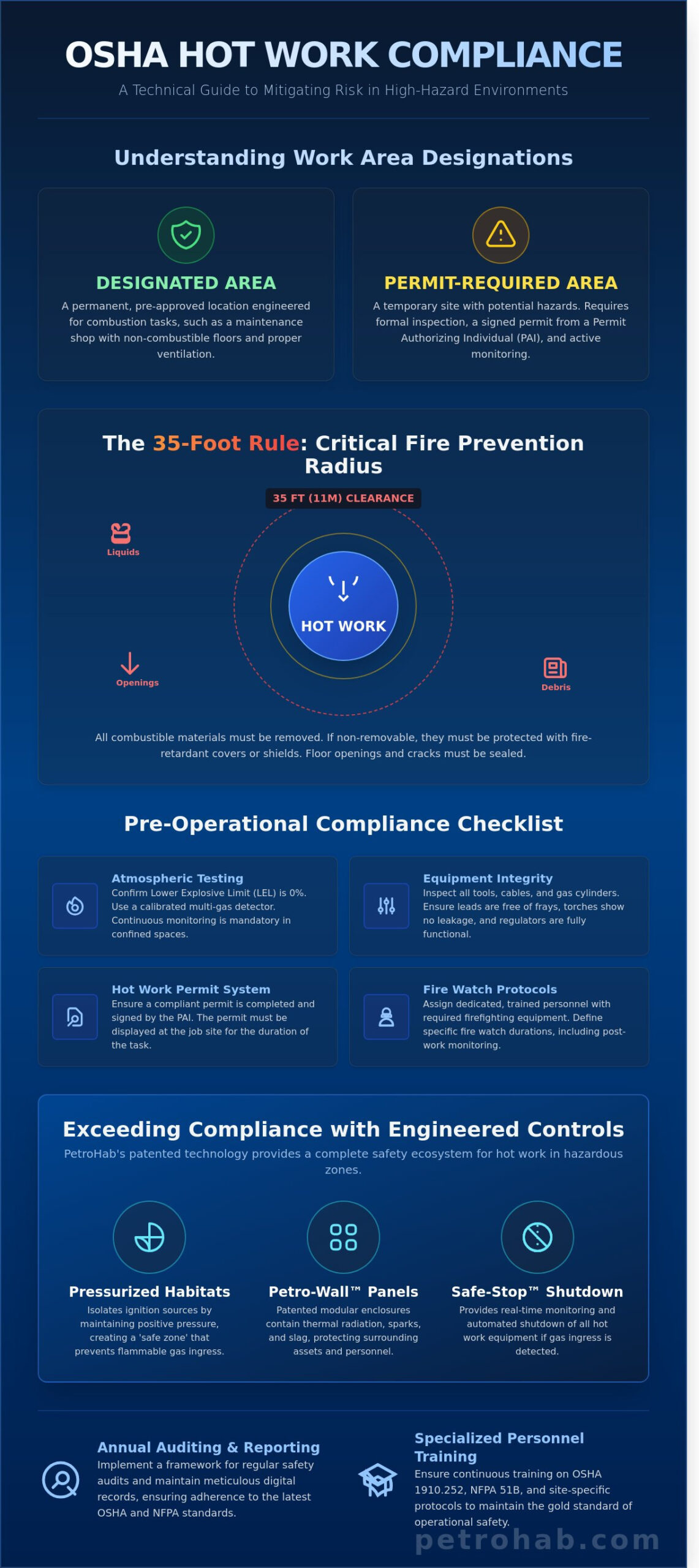
The legal distinction between designated areas and permit-required areas is a cornerstone of risk mitigation. A designated area is a permanent location engineered specifically for combustion, such as a maintenance shop with non-combustible floors. In contrast, permit-required areas are temporary sites where hazardous conditions exist. The Permit Authorizing Individual (PAI) holds the responsibility for inspecting these sites before any work begins. They verify that combustible materials stay at least 35 feet away from the work point. The PAI’s signature confirms that risk mitigation protocols, such as our pressurized habitats, are active and monitored.
Core Regulatory Standards to Monitor
Adherence to OSHA 1910.252 provides the general framework for welding safety. However, industry leaders integrate this with the NFPA 51B standard to achieve comprehensive fire prevention. For offshore operations, OSHA 1917.152 dictates specific requirements for maritime environments. These regulations ensure that gas-free certifications and atmospheric testing occur before work begins on oil and gas platforms. We utilize ATEX and IECEx certified components to ensure our systems exceed these baseline requirements, providing a gold standard in ignition source control.
Scope and Application of Guidelines
Guidelines strictly prohibit work in non-permissible areas, such as those with non-remediable explosive atmospheres or where sprinkler systems are impaired. A site-specific hazard assessment is legally required whenever conditions deviate from standard operating procedures. The 2026 updates emphasize digital reporting for industrial safety, requiring 100% accuracy in logging ignition source control measures. Utilizing technology like our patented Petro-Wall ensures that thermal radiation remains contained within a controlled environment. Modern OSHA hot work guidelines now expect real-time monitoring through systems like Safe-Stop, which provides an automated shutdown if gas ingress is detected. This methodical approach ensures that human error doesn’t lead to asset loss.
Pre-Operational Hazard Assessment: A Compliance Checklist
Compliance with OSHA hot work guidelines begins long before a technician strikes an arc or lights a torch. A rigorous pre-operational assessment identifies latent hazards that standard operating procedures often overlook. Technicians must conduct a comprehensive sweep of the work area to ensure it meets the stringent requirements of the OSHA Hot Work Standard. This process includes verifying the mechanical integrity of every tool. Leads must be free of frays or exposed wiring; torches must show no signs of leakage; and gas cylinders must be secured in an upright position with regulators fully functional.
Atmospheric testing is the next critical pillar of industrial safety. A calibrated multi-gas detector must confirm that the environment is free of flammable vapors before any work starts. The Lower Explosive Limit (LEL) must remain at 0% throughout the duration of the task. If the work occurs in a confined space, continuous monitoring is mandatory to detect shifting gas pockets. Safety managers often prioritize the use of pressurized hot work habitats to isolate the ignition source from the surrounding environment effectively.
Site Evaluation and Preparation
The 35-foot rule is a critical fire prevention radius that requires the removal or shielding of all combustible materials within 35 feet of the hot work site. When materials are non-removable, they must be protected with flame-retardant covers or metal shields. NFPA 51B data shows that sparks can travel over 35 feet when falling from heights. You must seal all floor openings, cracks, and ductwork within this radius to prevent spark migration to lower levels. PetroHab’s modular wall systems provide a physical barrier that exceeds standard fire-blanket performance, ensuring that slag and sparks are contained within the immediate work area.
Managing Combustible and Flammable Materials
Isolation is the primary defense against fire in high-stakes environments. All flammable liquids must be moved to a dedicated storage cabinet at least 35 feet away from the ignition point. In 2024, industrial incidents involving improper gas cylinder storage accounted for 12% of hot work accidents. Utilizing fire-resistant tarpaulins and specialized enclosures creates a controlled environment that mitigates these risks. Engineers must also account for ATEX zone classifications during the pre-work assessment. Understanding whether an area is Zone 1 or Zone 2 dictates the level of ignition source control required. Adhering to these OSHA hot work guidelines ensures that high-value assets and personnel remain protected under the most hazardous conditions.
The Hot Work Permit System and Fire Watch Protocols
The hot work permit (HWP) is the primary administrative control used to prevent ignition in hazardous environments. It functions as a mandatory safety contract that defines the operational boundaries for every task involving open flames, sparks, or heat. Adhering to OSHA hot work guidelines requires a systematic approach where documentation and physical surveillance work in tandem to eliminate risk. PetroHab provides the technological framework to support these protocols, ensuring that human oversight is backed by engineered integrity.
Anatomy of a Compliant Permit
A compliant permit must be site-specific and task-specific. Required fields include the exact date of the operation, a detailed scope of work, and the specific hazard mitigation steps taken, such as gas testing and the deployment of a hot work safety enclosure. Signatures from the Permit Authorizing Individual (PAI), the hot work operator, and the fire watch are non-negotiable. These signatures verify that the area is prepared and that the atmosphere is within acceptable limits according to EPA Hot Work Requirements. For 2026, industry best practices dictate that facilities maintain permit records for a minimum of 12 months to facilitate safety audits and process improvements. Integrating the permit with our patented Petro-Wall system ensures that the physical barriers described in the documentation are actually in place and pressurized before work begins.
Fire Watch Duties and Responsibilities
The fire watch is a dedicated safety officer whose sole responsibility is the detection and suppression of incipient-stage fires. This individual must have no other concurrent duties, as even a 10-second distraction can allow a spark to escalate into a catastrophic event. In 2026, the duration for fire watch monitoring has increased to meet more rigorous standards. While the historical minimum was 30 minutes, current high-risk protocols now mandate a 60-minute continuous watch after the hot work concludes. This extension is based on data showing that 15% of smoldering fires in industrial settings are not detected until 45 minutes after work has stopped.
The fire watch must be equipped with the following:
- Fully charged Class ABC fire extinguishers or equivalent suppression tools.
- Direct communication links, such as intrinsically safe radios, to the PAI and the hot work operator.
- Specific training in the activation of the Safe-Stop system to immediately terminate the ignition source if a hazard is detected.
A final inspection must be conducted 4 hours after the work is completed in high-value asset areas to confirm that no latent heat remains. These OSHA hot work guidelines create a multi-layered defense, combining the vigilance of trained personnel with the unrivaled protection of pressurized habitat technology. This methodical approach ensures that every spark is contained and every thermal threat is neutralized before it can impact the facility.
Engineered Controls: Using Pressurized Habitats for OSHA Compliance
OSHA hot work guidelines mandate the isolation of ignition sources from flammable atmospheres. Pressurized Hot Work Safety Enclosures (HWSE) represent the gold standard in meeting these rigorous 2026 safety requirements. These systems don’t just provide a physical barrier; they utilize active pressure differentials to ensure hazardous gases cannot enter the workspace. By maintaining an internal pressure of 0.05 inches of water column (12.5 Pascals) higher than the external environment, the habitat creates an impenetrable atmospheric seal. This engineered control allows welding and grinding to occur in close proximity to live hydrocarbon processes.
The primary objection to habitat deployment is often centered on initial equipment costs. This perspective ignores the massive financial impact of facility-wide shutdowns. A typical offshore production platform can lose $350,000 to $700,000 in daily revenue during a full maintenance outage. Utilizing a PetroHab habitat eliminates the need for these costly shutdowns. The investment in a pressurized system is typically recovered within the first 12 hours of operational uptime. Safety managers prioritize these habitats because they mitigate the risk of catastrophic ignition while maintaining the facility’s economic output.
Positive Pressure Mechanics and Gas Detection
The integrity of a pressurized habitat depends on constant monitoring and automated responses. Precision manometers track the pressure differential between the enclosure and the external environment. These devices serve as the primary diagnostic tool for the HWSE integrity. PetroHab integrates its Safe-Stop system with gas detection arrays located at the air intake and inside the enclosure. If the system detects flammable gas at concentrations as low as 10% of the Lower Explosive Limit (LEL), it automatically shuts down all power to the hot work equipment. Positive pressure creates a protected internal environment that effectively displaces hazardous external atmospheres. This automated fail-safe ensures that human error cannot override critical safety protocols.
Modular Enclosures in High-Hazard Zones
Rapid deployment is essential in high-stakes energy environments. PetroHab utilizes patented Quadra-Lock panels that allow technicians to construct a compliant enclosure around complex piping and structural steel in under 4 hours. These panels provide a spark-proof seal that exceeds standard fire blanket capabilities. When operating in Zone 1 or Zone 2 areas, engineers must distinguish between ATEX vs IECEx certifications for all electrical components. Using certified fans and lighting ensures the habitat itself doesn’t become an ignition source. High-clarity, fire-retardant windows maintain 360-degree visibility for the fire watch, while high-capacity blowers provide 2,000 cubic feet of fresh air per minute to ensure personnel safety.
Ensure your facility meets the latest 2026 safety standards by integrating unrivaled ignition source control. Secure your site with PetroHab pressurized habitats today.
Implementation and Training: Ensuring Continuous Safety Compliance
Compliance with 2026 OSHA hot work guidelines requires more than a signature on a permit. It demands a rigorous, data-driven approach to personnel competency and procedural integrity. PetroHab’s Safe-Stop technology provides the mechanical foundation; however, human oversight remains the primary defense against catastrophic ignition. Effective implementation begins with a shift from passive compliance to active risk management.
Training programs must evolve to address the complexities of modern hazardous environments. In 2025, industry data indicated that 15% of hot work incidents resulted from improper gas detector calibration or placement. We eliminate this risk through hands-on assessments and expert-led habitat training. Every operator must demonstrate proficiency in managing ignition source control systems before they enter a pressurized enclosure.
Third-party contractors often introduce variables that compromise site safety. Every contractor must integrate into the facility’s OSHA framework. This means verifying their training records against ISO 45001 standards and ensuring they understand the specific telemetry of the Petro-Wall system. Maintaining a unified safety culture prevents the communication gaps that lead to accidents.
Personnel Certification and Training
Rigorous training for Permit Authorizing Individuals (PAIs), fire watches, and operators is non-negotiable. 2026 standards require annual recertification that includes practical drills within pressurized habitats. These drills simulate emergency shutdowns and loss of differential pressure. We don’t just teach theory; we verify competency through real-world scenarios. This ensures that every team member can act decisively when the Safe-Stop system triggers an alert.
Auditing and Safety Program Evolution
Systematic audits of the Permit-to-Work (PTW) system ensure that safety protocols remain effective. Managers should review telemetry and gas monitoring logs every 30 days to verify that internal pressures consistently stayed 50 pascals above the external atmosphere. These logs provide an empirical record of compliance and highlight areas for procedural refinement. Updating site procedures to reflect ATEX and IECEx standards ensures the facility stays ahead of global safety trends.
Near-miss data is a strategic asset for continuous improvement. If a gas sensor triggers an automatic shutdown, the event shouldn’t just be logged; it must be analyzed to prevent recurrence. Using this data to refine safety protocols can reduce operational downtime by 12% while maintaining the highest level of protection. This methodical approach ensures full alignment with OSHA hot work guidelines across all departments, cementing PetroHab’s role as the gold standard in industrial safety.
Securing Operational Integrity Through Advanced Hot Work Compliance
Adhering to OSHA hot work guidelines requires a systematic integration of hazard assessments, strict permit protocols, and engineered safety enclosures. Compliance isn’t a static goal; it’s a continuous operational requirement that protects personnel and high-value assets in volatile energy environments. By utilizing pressurized habitats, you effectively mitigate ignition risks at the source while maintaining production schedules. PetroHab provides the technical foundation for these rigorous 2026 standards. Our systems feature patented Quadra-Lock technology and ATEX and IECEx certified components to ensure absolute integrity during every welding or grinding task. We support your facility with global on-site supervision and specialized training to maintain safety benchmarks across all project phases. You don’t have to navigate these complex mandates alone. Our team brings decades of field experience to your specific site challenges. Consult with a PetroHab expert to implement OSHA-compliant HWSE technology. Your commitment to safety ensures a more resilient and productive future for your entire operation.
Frequently Asked Questions
What is the OSHA 35-foot rule for hot work?
The OSHA 35-foot rule requires that all combustible materials within a 35-foot radius of the hot work site be removed or protected. Under 29 CFR 1910.252, if you can’t move these materials, you’ve got to use flameproofed covers or metal guards to shield them. PetroHab’s Petro-Wall panels provide a modular, fire-resistant barrier that exceeds these safety requirements. These enclosures ensure sparks don’t migrate into hazardous areas or ignite nearby debris.
Is a fire watch required for all hot work operations?
A fire watch isn’t required for every single task, but OSHA 1910.252(a)(2)(iii)(A) mandates one if combustibles are within 35 feet of the point of operation. You also need a fire watch if wall or floor openings expose combustible materials in adjacent rooms or hidden spaces. PetroHab’s technical experts recommend a fire watch for all high-risk operations to ensure an immediate response to ignition. This role is essential when sparks can’t be fully contained.
How long must a fire watch remain on-site after work is completed?
A fire watch must remain on-site for at least 30 minutes after all hot work operations are finished to detect any smoldering fires. This duration is mandated by OSHA 1910.252(a)(2)(iii)(G). Many safety managers extend this period to 60 minutes to align with NFPA 51B standards for higher-risk environments. It’s a non-negotiable requirement that ensures the site remains stable once the immediate ignition source is removed. This period allows for the cooling of hot surfaces.
What are the primary OSHA standards for welding and cutting?
The primary OSHA hot work guidelines for welding and cutting are found in 29 CFR 1910 Subpart Q for general industry and 29 CFR 1926 Subpart J for construction. These regulations detail the mandatory protective measures for oxygen-fuel gas welding and arc welding. Compliance requires rigorous adherence to fire prevention protocols and personal protective equipment standards. Using a Petro-Wall enclosure helps facilities meet these technical requirements by providing a certified, fire-retardant workspace for technicians.
Can pressurized habitats be used to meet OSHA hot work requirements?
Pressurized habitats are a primary engineering control used to adhere to OSHA hot work guidelines in hazardous environments. Systems like the PetroHab habitat utilize the Safe-Stop automatic shutdown system to monitor gas levels and maintain positive pressure. This technology creates a controlled environment that isolates ignition sources from flammable gases. It’s the gold standard for maintaining operational integrity during offshore welding or grinding tasks where explosive atmospheres are a constant threat.
What happens if hot work is performed without a valid permit?
Performing hot work without a valid permit results in immediate work stoppage and potential OSHA citations exceeding $16,131 per violation as of 2024. Beyond financial penalties, unauthorized work voids insurance coverage and increases the risk of catastrophic asset loss. Safety managers must verify that every permit identifies specific hazards and required mitigation tools. This documented process is a critical component of industrial risk management and ensures that every technician understands the site-specific hazards.
Who is responsible for authorizing a hot work permit?
The Permit Authorizing Individual (PAI) is the designated person responsible for inspecting the area and signing the hot work permit. This individual must confirm that all fire prevention measures, such as the deployment of a PetroHab habitat, are in place before work begins. The PAI has the authority to halt operations if conditions change. Their signature confirms that the site meets the technical safety standards required for high-risk industrial activities and protects the facility.
How often should hot work safety equipment be inspected?
Hot work safety equipment must be inspected daily or before the start of every work shift to ensure operational integrity. 29 CFR 1910.252 requires operators to check torches, hoses, and regulators for leaks or damage. PetroHab’s Safe-Stop systems undergo even more rigorous testing to maintain their ATEX and IECEx certifications. Regular maintenance prevents equipment failure and ensures that ignition source controls function perfectly in volatile environments. Technicians shouldn’t use any gear that shows signs of wear.