Blog Posts
The Essential Daily Pressurized Habitat Inspection Checklist for 2026
A daily inspection isn’t a formality; it’s the active verification of a dynamic safety barrier that separates ignition sources from explosive atmospheres. In the high-stakes environment of offshore and refinery operations, you recognize that safety is a continuous process rather than a static state. Maintaining a rigorous daily pressurized habitat inspection checklist is the only definitive method to ensure your site remains compliant with the January 2026 ATEX Interpretive Guidelines and updated OSHA reporting standards. Reliance on inconsistent shift routines introduces unacceptable risk to personnel and high-value assets.
You need a system that guarantees zero incidents during hot work and provides a full audit trail for safety compliance. This article delivers a comprehensive daily inspection framework designed to maximize the uptime of your PetroHab Hot Work Safety Enclosure. We’ll detail the technical requirements for Quadra-Lock panel integrity, the calibration of Safe-Stop automatic shutdown systems, and the implementation of digital documentation via QR codes. By following this methodical approach, you’ll transform your inspection routine into a reliable shield against industrial hazards and ensure your pressurized habitats function with absolute reliability.
Key Takeaways
- Verify the structural integrity of Quadra-Lock Panels and flame-retardant seals to ensure the physical barrier remains an effective containment system.
- Validate the operational logic of the Safe-Stop Automatic Shutdown System through mandatory lamp tests and differential pressure set-point verification.
- Execute a rigorous daily pressurized habitat inspection checklist to maintain compliance with the 2026 ATEX interpretive updates and OSHA documentation standards.
- Confirm atmospheric safety by performing bump tests on gas detectors and auditing the location of air intake ducting relative to hazardous vents.
- Strengthen your audit trail by synchronizing daily inspection records with active Hot Work Permit (PTW) protocols and required site authority signatures.
The Critical Role of a Daily Pressurized Habitat Inspection Checklist
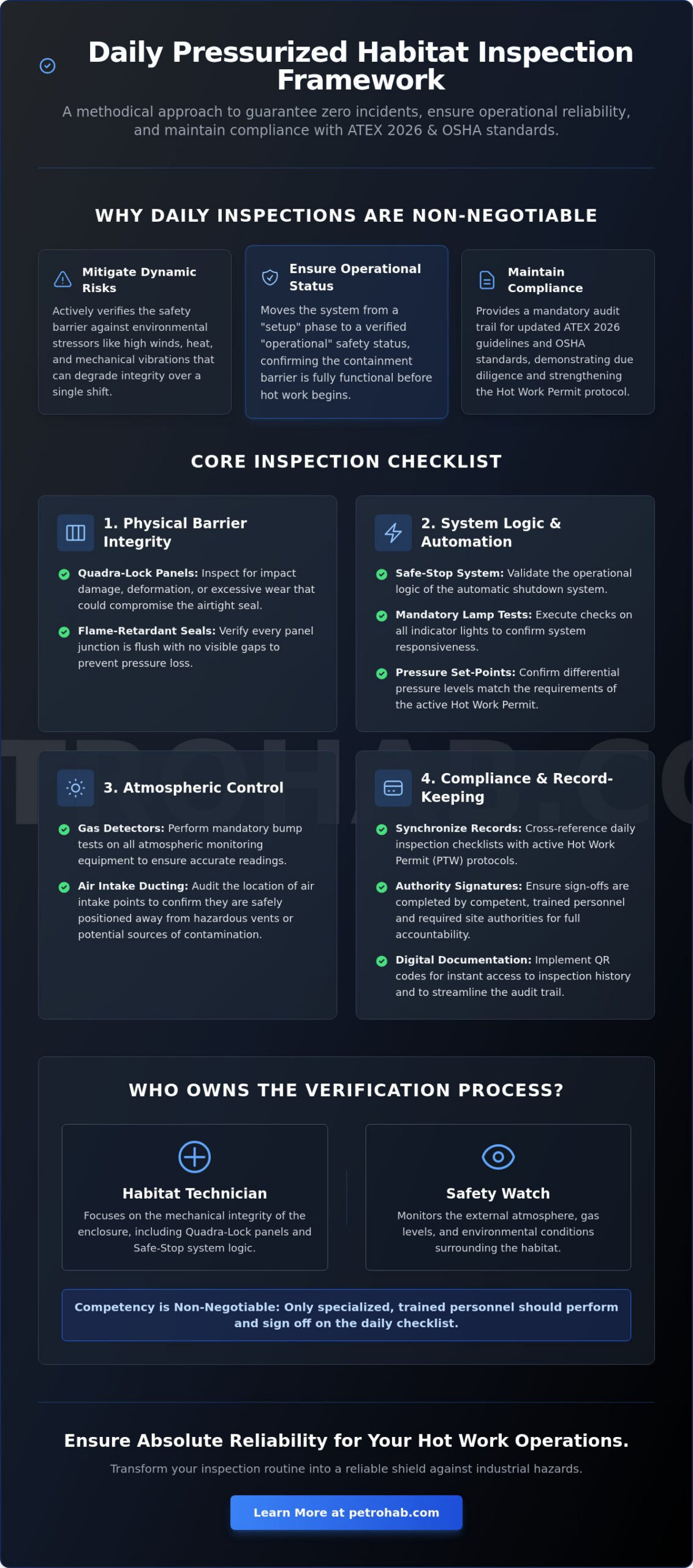
A pressurized habitat isn’t a static structure; it’s a managed safety barrier governed by IEC 60079-13 standards. In the high-velocity environment of a refinery or offshore platform, this barrier serves as the definitive line between a controlled ignition source and a potentially explosive atmosphere. Utilizing a daily pressurized habitat inspection checklist is the only method to verify that this barrier remains functional. This process is a mandatory component of the hot work safety enclosure lifecycle, moving the system from a “setup” phase into a verified “operational” safety status. Without this daily validation, the integrity of the containment cannot be guaranteed.
Environmental shifts occur constantly in heavy industry. High winds can stress structural components, while ambient heat and mechanical vibrations from nearby machinery can degrade seal performance or loosen fasteners. A daily frequency is required because a habitat that was secure at 08:00 may face different physical stressors by the following morning. Engineers and safety managers rely on these systematic checks to account for these dynamic variables, ensuring that the overpressure remains constant and the ignition risk remains at zero.
To better understand this concept, watch this helpful video:
Understanding the Barrier Concept in Hazardous Zones
Passive containment relies on the physical strength of the enclosure, but active overpressure protection is what truly secures the site. In the “Swiss Cheese” model of accident prevention, the pressurized habitat acts as a critical layer that stops hazards from aligning. If the physical barrier or the pressure system fails, the risk of catastrophic ignition increases. In ATEX Zone 1 or 2 environments, skipping the daily pressurized habitat inspection checklist carries severe legal and safety implications. Regulatory bodies view these inspections as essential evidence of due diligence under ATEX directive safety standards, making documentation as vital as the hardware itself.
The Personnel Responsible for Daily Verification
Safety is a shared responsibility, but specific roles must own the verification process. The Habitat Technician focuses on the mechanical integrity of the Quadra-Lock panels and Safe-Stop logic, while the Safety Watch monitors the external atmosphere. Competency is non-negotiable. Only personnel with specialized training in pressurized enclosures should sign off on the daily checklist. This accountability ensures that shift-handover briefings are technical and precise. When one crew replaces another, the handover must include a detailed review of the habitat’s current integrity and any environmental changes observed during the previous shift.
Physical Barrier Integrity: Inspecting Quadra-Lock Panels and Seals
The physical barrier of a pressurized welding habitat is the primary containment layer for ignition sources. Maintaining this barrier requires a granular approach during every shift. Your daily pressurized habitat inspection checklist must begin with a rigorous mechanical assessment of all Quadra-Lock panels. These panels are engineered to withstand industrial stressors, but they must be inspected for signs of impact, deformation, or excessive wear that could compromise the airtight seal. Structural integrity is the foundation of the entire safety system.
Inspect every panel junction to ensure that the flame-retardant seals are flush and show no visible gaps. Even a minor separation can lead to pressure loss, forcing the system to work harder and potentially triggering an unnecessary shutdown. Verify that all panel interlocks are fully engaged. High-vibration environments, common on offshore platforms or near heavy rotating equipment, can cause mechanical fasteners to migrate over time. A tactile check of these connections ensures the structure remains rigid and compliant with the IEC 60079-13:2017 standard.
The airlock system and door-closing mechanisms are critical for maintaining differential pressure. Inspect the seals around the door frame for tears or compression set. Door hinges and latching hardware must operate smoothly to ensure the enclosure remains pressurized during personnel transit. If you identify components nearing their service limit, integrating genuine PetroHab Quadra-Lock Panels ensures the enclosure maintains its original safety rating and protective capabilities.
Visual Inspection of Fire-Resistant Materials
Surface health is a direct indicator of barrier performance. Examine the face of each panel for chemical degradation or thermal damage that might have occurred during the previous shift’s hot work. Oil and grease buildup pose a significant fire risk; all surfaces must be clean. Strictly prohibit “quick fixes” like adhesive tape or non-rated sealants. Any unauthorized modification voids the safety certification and introduces unknown variables into the hazard mitigation plan.
Seal Integrity and Penetration Management
Penetration points for welding leads, power cables, and piping are high-risk areas for air leakage. Ensure all sleeves are tightened and secured with fire-stop materials where necessary. On grating or uneven flooring, the interface between the habitat and the deck requires extra scrutiny. Listen for “whistling” sounds, which indicate high-velocity air escaping through a compromised seal. If leaks are detected, they must be remediated immediately to maintain the required overpressure and prevent the ingress of flammable gases.
System Logic and Automation: Validating Safe-Stop Functionality
Active safety in a pressurized enclosure relies on the seamless integration of sensors and shutdown logic. While the physical panels provide the barrier, the Safe-Stop Automatic Shutdown System acts as the operational brain. Precision is paramount. A daily pressurized habitat inspection checklist serves as the primary verification protocol for this system, ensuring that the electronic components respond instantly to atmospheric threats. Technicians must begin by performing a comprehensive ‘Lamp Test’ on the control panel. This step confirms that all visual indicators are functional; a single failed bulb could mask a critical alarm state during an actual emergency.
The differential pressure set-point is the technical core of the system’s protective capability. For most industrial applications, this is maintained at 50 Pascals or 0.2 inches of water. During the inspection, verify that the system maintains this baseline and simulate a low-pressure event by briefly adjusting the threshold or creating a controlled leak. The system must trigger both audible and visual alarms immediately. This validation confirms that the hot work safety systems are not just active, but calibrated to the specific environmental conditions of the site.
Emergency stop (E-Stop) functionality requires testing from both the internal and external stations. These buttons must remain unobstructed and easily accessible to all personnel. Finally, confirm that the Safe-Stop logic communicates correctly with the main plant shutdown system. In the event of a facility-wide gas detection, the habitat must receive and process that signal to terminate all internal hot work sources. This interconnectedness is what separates a professional safety enclosure from a simple tent.
Testing the Automatic Shutdown Logic
Validation of the shutdown logic goes beyond simple alarm activation. You must verify that the power to the welding machine or heat source is severed within milliseconds of a triggered event. This rapid response prevents ignition before flammable gases can penetrate the enclosure. Simultaneously, check the fail-safe status of the air intake dampers. These must close automatically if the system loses power or detects a hazard. Additionally, ensure the Safe-Stop system is properly grounded to mitigate the risk of static discharge in explosive atmospheres.
Manometer and Sensor Calibration Checks
Redundancy is a fundamental engineering requirement for high-stakes environments. Always compare digital manometer readings against a secondary mechanical gauge to ensure accuracy. Inspect all sensor intake ports for blockages caused by dust, moisture, or industrial debris. A blocked port can lead to false pressure readings and system failure. Document the baseline ‘clean air’ pressure reading at the start of every shift to establish a clear operational history for the audit trail.
Atmospheric Control: Gas Detection and Ventilation Verification
Atmospheric integrity is the functional counterpart to structural containment. While previous sections detailed the physical strength of Quadra-Lock panels and the electronic precision of Safe-Stop logic, atmospheric control focuses on the fluid dynamics of safety. This process ensures the internal environment remains breathable and free of accumulated toxins or flammable vapors. A daily pressurized habitat inspection checklist must prioritize the verification of gas detection systems and ventilation flow rates to confirm the enclosure is actively purging contaminants rather than just maintaining a static pressure reading.
Daily bump testing of all internal and external gas detectors is a non-negotiable requirement. You must challenge each sensor with a known gas concentration to verify response time and alarm activation. This procedure accounts for sensor drift and potential poisoning from industrial chemicals common in refinery environments. Additionally, inspect the entire length of the PetroHab Air Ducting for kinks, tears, or blockages that could restrict airflow. The location of the air intake ducting requires constant re-verification; it must remain at a confirmed intake point within a non-hazardous area, far from process vents or exhaust outlets that could introduce flammable vapors into the enclosure.
Ventilation efficiency is determined by the air change rate, with industry standards recommending a minimum of 20 air changes per hour. This high volume of fresh air is necessary to extract welding fumes and prevent the buildup of localized heat pockets. During your inspection, verify that the blower unit maintains this flow and inspect the spark arrestors on the ventilation exhaust. Carbon buildup on these arrestors can restrict flow and increase backpressure, reducing the system’s ability to maintain the required overpressure. To ensure your site meets these rigorous standards, consider the integrated atmospheric controls of the PetroHab Hot Work Safety Enclosure (HWSE).
Gas Detector Placement and Sensitivity
Sensor placement must reflect the specific molecular weights of potential hazards. Position detectors to account for both “heavy” gases like H2S, which settle near the floor, and “light” gases like Methane, which rise toward the ceiling. Ensure the external reference detector remains unobstructed by scaffolding, weather cladding, or other equipment. Verify that all LEL alarm thresholds are calibrated to 10% LEL, adhering to local site regulations and international best practices. This sensitivity provides the Safe-Stop system with sufficient lead time to terminate hot work before a hazardous concentration is reached.
Ventilation and Heat Stress Management
With OSHA’s 2026 focus on the “Heat Injury and Illness Prevention in Outdoor and Indoor Work Settings” standard, managing the internal temperature of the habitat is a regulatory necessity. Measure the internal temperature at the start of each shift to ensure it remains within safe limits for technicians. If the blower unit exhibits excessive noise or vibration, it may indicate mechanical fatigue that could lead to a ventilation failure. Always direct exhaust air away from other personnel or ignition-sensitive equipment to prevent secondary hazards. Proper ventilation management protects both the asset and the health of the personnel working within the enclosure.
Compliance and Record Keeping: Integrating Checklists with PTW Protocols
Compliance serves as the final, critical layer of hazard mitigation. While physical barriers and automated logic provide the front-line defense, the administrative record establishes the legal and operational validity of the entire system. A daily pressurized habitat inspection checklist must be meticulously integrated with the site’s Permit-to-Work (PTW) protocols. Each entry should cross-reference the active Hot Work Permit number, ensuring that the specific welding or cutting operation is performed within a verified environment. This isn’t a suggestion; it’s a regulatory requirement for high-risk industrial sites where the margin for error is zero.
Accountability is established through formal sign-offs. Every completed checklist requires the signatures of both the Habitat Technician and the Area Authority. This dual-verification process confirms that the enclosure meets the technical standards required for the shift. Maintaining a ‘Life of Project’ folder for these daily logs is essential for satisfying OSHA or HSE audits. These records provide a chronological history of the habitat’s integrity, proving that safety wasn’t assumed but actively verified every day. Beyond audit readiness, this data allows engineers to identify trends in pressure loss or component wear, facilitating proactive maintenance before a failure occurs. You’ll find that consistent data entry often reveals environmental stressors that might otherwise go unnoticed.
The Audit Trail for Hot Work Operations
Modern facilities are transitioning from paper-based logs to digital documentation. The January 2026 ATEX interpretive updates now explicitly allow for digital safety instructions and declarations of conformity via QR codes. Digital logging provides a timestamped, tamper-evident record that is far more resilient than paper during an investigation. If an incident occurs, these daily logs serve as the primary defense for the operator, demonstrating that all safety systems were functional at the start of work. Closing out a daily log at the end of a shift is just as important as the initial check. It confirms the habitat was left in a secure state for the next crew.
Corrective Action and Non-Conformance Reporting
Safety protocols are only effective if they’re enforced without compromise. Every individual involved in the operation holds ‘Stop Work’ authority. If any item on the daily pressurized habitat inspection checklist is marked as a ‘Fail’, all hot work must cease immediately. Whether it’s a compromised Quadra-Lock panel or a Safe-Stop sensor that fails its bump test, the hazard must be remediated before power is restored. Documenting the repair and the subsequent ‘Return to Service’ test is mandatory. This ensures the audit trail remains unbroken and the habitat’s status as a managed safety barrier is never in doubt. Finally, verify that the latest revision of the emergency response plan is posted at the habitat entrance for immediate reference during a crisis.
Securing the Future of Hazardous Hot Work
Operational excellence in heavy industry is the direct result of disciplined, technical repetition. Implementing a daily pressurized habitat inspection checklist transforms a temporary enclosure into a verified safety barrier that meets the rigorous 2026 ATEX interpretive guidelines and updated OSHA standards. By validating the mechanical integrity of Quadra-Lock panels and the millisecond response times of Safe-Stop logic, you effectively neutralize the risk of catastrophic ignition during critical maintenance. This systematic verification ensures that your protective systems function exactly as engineered, regardless of environmental shifts or vibration-induced wear.
Precise documentation remains your final safeguard. Synchronizing these daily checks with your internal Permit-to-Work protocols creates a transparent audit trail that protects both your personnel and high-value assets. This methodical approach is the hallmark of a proactive safety culture and a requirement for modern industrial compliance. If you’re ready to enhance your site’s risk mitigation strategy with industry-leading hardware, Request a Quote for PetroHab Pressurized Habitat Leasing and Supervision. Our solutions are defined by patented Quadra-Lock Technology, Safe-Stop Automatic Shutdown Systems, and Global 24/7 Technical Support. Secure your operations today and maintain absolute control over your hazardous work environments.
Frequently Asked Questions
Why is a daily pressurized habitat inspection required if we have automated sensors?
Automated sensors monitor atmospheric variables, but physical inspections identify mechanical degradation that electronic systems cannot detect. A daily pressurized habitat inspection checklist ensures structural integrity, such as loose panel interlocks or compromised seals, which prevents sensor-triggered shutdowns before they occur. This proactive approach maintains maximum uptime and verifies that the Safe-Stop system’s physical environment remains within its engineered design parameters.
What is the minimum pressure required for a welding habitat to be considered safe?
The standard operational minimum is 50 Pascals (0.2 inches of water) of differential pressure relative to the external atmosphere. This overpressure prevents the ingress of flammable gases into the enclosure. While some specialized configurations might vary, maintaining 50 Pascals provides a necessary safety margin that accounts for minor environmental fluctuations without triggering an immediate shutdown of hot work equipment.
How often should I bump test the gas detectors on a PetroHab system?
You must bump test all internal and external gas detectors daily before the start of each shift. This verification ensures that sensors respond accurately to known gas concentrations and that the Safe-Stop Automatic Shutdown System processes the alarm signal correctly. Daily testing is a mandatory requirement to account for sensor drift or potential poisoning from industrial chemicals, ensuring the system remains a reliable guardian.
What are the most common points of pressure loss in a modular habitat?
Pressure loss typically occurs at penetration points for welding leads, floor-to-structure interfaces, and door seals. In modular systems, mechanical vibrations can cause panel interlocks to migrate, leading to minor gaps at the junctions. Regular inspection of these specific areas is a core component of the daily checklist. Identifying and sealing these leaks immediately prevents the blower unit from overworking and ensures consistent overpressure.
Can hot work continue if the differential pressure drops below 25 Pascals?
No, hot work must cease immediately if the differential pressure falls below the safety threshold established in the site risk assessment. While 50 Pascals is the standard baseline, dropping below 25 Pascals typically triggers the Safe-Stop system to automatically terminate power to ignition sources. Operating below these levels compromises the barrier’s ability to exclude flammable gases, violating international safety standards like IEC 60079-13.
Who is legally authorized to sign the daily habitat inspection checklist?
The checklist requires signatures from both the qualified Habitat Technician and the Area Authority or Site Safety Manager. This dual-verification ensures that the equipment has been technically validated and that the site management has authorized the hot work to proceed within that environment. Proper sign-off is essential for maintaining a compliant audit trail that satisfies OSHA and HSE regulatory reporting requirements.
What is the difference between a pre-shift check and a full weekly audit?
A pre-shift check focuses on immediate operational readiness, such as bump tests and seal integrity. In contrast, a full weekly audit is a deeper technical review that includes checking documentation logs, verifying the calibration dates of all sensors, and inspecting the structural health of the Quadra-Lock Panels. The daily check ensures shift-to-shift safety, while the weekly audit ensures long-term compliance and equipment longevity.
How do I verify the integrity of Quadra-Lock panels after a high-wind event?
Perform a comprehensive visual and tactile inspection of all panel interlocks and structural fasteners to ensure no mechanical displacement occurred. High winds exert lateral forces that can stress panel junctions and compromise seals. You must also monitor the manometer for any new pressure fluctuations that suggest high-velocity air leaks. If structural deformation is found, the affected components must be replaced before hot work resumes.