The Essential Guide to the Permit to Work for Hot Work in 2026
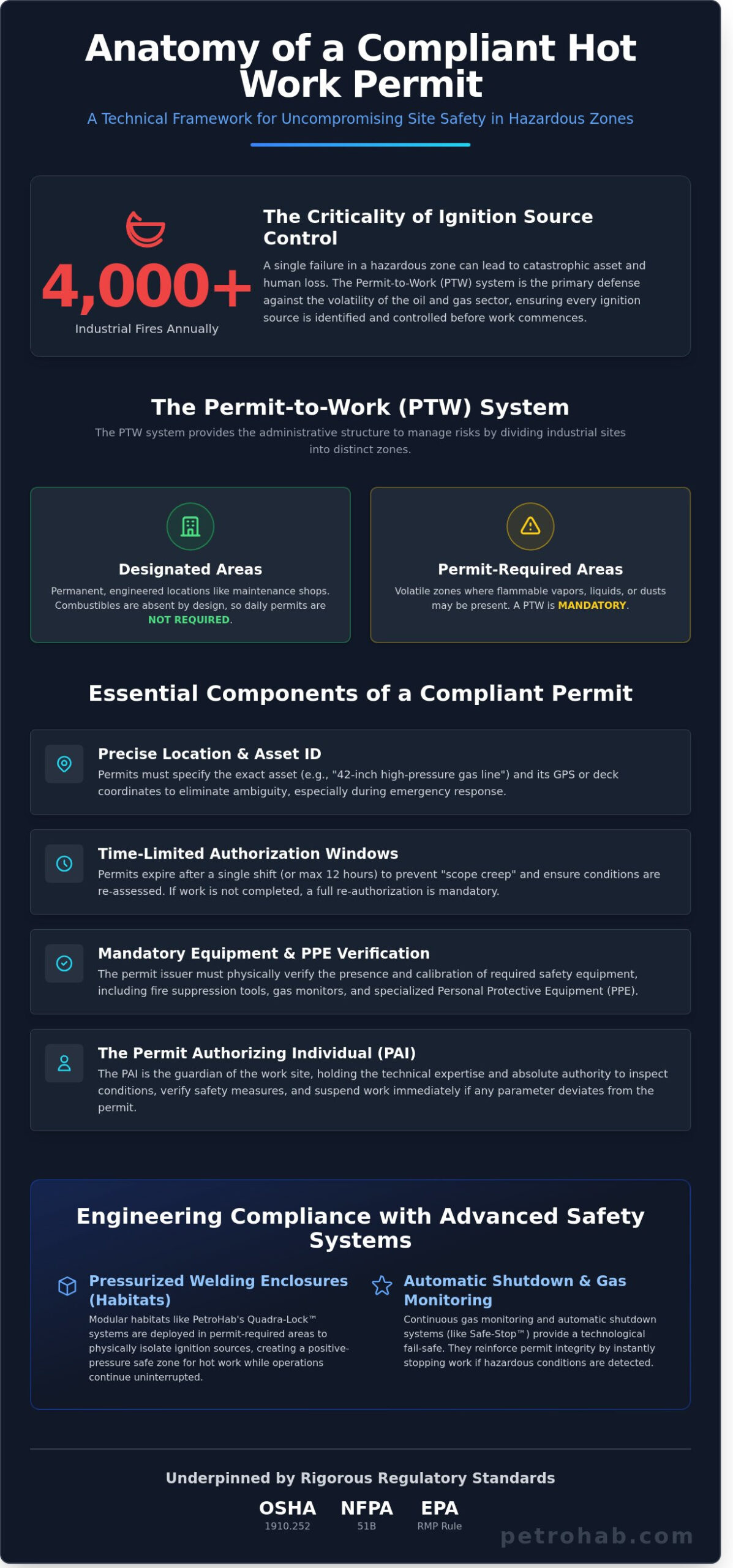
A single failure in ignition source control within a hazardous zone leads to catastrophic asset loss and the loss of human life. NFPA data confirms that hot work triggers over 4,000 industrial fires annually, and by 2026, the mandate for precise risk documentation under OSHA 1910.252 will be more stringent than ever. You understand that managing a permit to work hot work system isn’t merely a bureaucratic requirement; it’s a critical line of defense against the inherent volatility of the oil and gas sector.
This guide provides the technical framework necessary to integrate patented Hot Work Safety Enclosures and Safe-Stop systems into your existing protocols. You’ll master the procedural steps for deploying modular pressurized habitats to eliminate operational downtime while maintaining uncompromising site integrity. We’ll examine how to synchronize these technologies with current ATEX and IECEx standards to ensure your facility achieves a streamlined, compliant PTW process that withstands the most rigorous safety audits.
Key Takeaways
- Define the technical boundaries between designated areas and permit-required zones to ensure rigorous oversight of all spark-producing activities.
- Master the essential components of a permit to work hot work, including the critical implementation of time-limited authorization windows for maximum site safety.
- Integrate pressurized welding enclosures into your workflow by conducting habitat integrity checks and zone-specific risk assessments.
- Deploy automatic shutdown systems and continuous gas monitoring to establish a technological fail-safe that reinforces permit integrity in hazardous environments.
- Utilize modular Quadra-Lock technology to engineer compliance into complex layouts, ensuring unrivaled protection for high-value assets and personnel.
Understanding the Hot Work Permit-to-Work (PTW) System
A hot work permit is a documented authorization that grants permission to perform tasks involving open flames, sparks, or heat. In the high-stakes environments of offshore platforms and refineries, this document serves as a critical safety contract. It ensures that every potential ignition source is identified and controlled before work begins. The Permit-to-Work (PTW) system provides the administrative structure necessary to manage these risks, turning hazardous variables into controlled operational steps. Without a valid permit to work hot work, technicians risk catastrophic fire events or explosive vapor ignition.
Industrial sites are divided into two distinct zones. Designated areas are permanent locations, such as maintenance shops, engineered specifically for welding and cutting. These areas don’t require daily permits because they lack combustible materials by design. Conversely, permit-required areas include any location where flammable vapors, liquids, or dusts may be present. In these volatile zones, the PTW becomes the cornerstone of hot work safety enclosure implementation. The permit defines the exact coordinates where a pressurized habitat must be deployed to isolate ignition sources from the surrounding atmosphere.
The legal hierarchy governing these permits is rigorous. OSHA 1910.252 sets the baseline for fire prevention, while NFPA 51B provides the technical standards for fire watches and site preparation. For facilities handling hazardous chemicals, the EPA Risk Management Plan (RMP) Rule adds another layer of oversight. These regulations work in tandem to ensure that every permit to work hot work is backed by a thorough risk assessment and a clear chain of command.
Regulatory Foundations: OSHA and EPA Requirements
Compliance begins with 29 CFR 1910.252(a), which dictates that management must establish a safe area for hot work or ensure that fire hazards are moved or shielded. The EPA RMP Rule 40 CFR Part 68 influences documentation by requiring facilities to track all maintenance activities that could lead to an accidental release. Under these standards, employers must keep permit records on file for at least one year after work completion. This documentation provides a forensic trail for safety audits and incident investigations, ensuring that site integrity remains a measurable metric rather than a vague goal.
The Role of the Permit Authorizing Individual (PAI)
The PAI acts as the primary guardian of the work site. This individual holds the technical expertise to evaluate hazardous environments and the authority to deny permit issuance if conditions are unfavorable. Before any work starts, the PAI conducts a physical inspection to verify that combustible materials are removed or covered with fire-resistant tarps. They ensure that specialized systems, like the patented Petro-Wall or Safe-Stop technologies, are correctly configured. If site conditions deviate from the permit’s parameters, such as a change in wind direction or a detected gas leak, the PAI has the absolute authority to suspend work immediately. Their role is not merely clerical; it’s a position defined by an uncompromising commitment to risk mitigation.
Essential Components of a Compliant Hot Work Permit
A rigorous permit to work hot work acts as a technical contract between the safety manager and the operator. It defines the operational boundaries and ensures every variable is controlled before a single spark is generated. In 2026, compliance isn’t merely about ticking boxes; it’s about establishing a verifiable audit trail for risk mitigation. Every permit must specify the exact asset, such as a 42-inch high-pressure gas line, and its precise GPS or deck coordinates to prevent any ambiguity during emergency response.
Authorization windows are strictly time-limited to ensure safety integrity. Most industrial protocols now mandate that permits expire at the end of a single shift or every 12 hours. This prevents “scope creep” where changing atmospheric conditions might render initial gas tests invalid. If the work isn’t completed within the window, a full re-assessment is mandatory. This procedural discipline is a core pillar of EPA hot work requirements, which demand that permits remain on-site and active only for the duration of the specific task.
Mandatory equipment lists on the permit must include verified fire suppression tools and specialized PPE. Before work begins, the permit issuer must verify the presence of:
- Calibrated multi-gas detectors for continuous LEL monitoring.
- Dedicated fire extinguishers with current inspection tags (dated within the last 30 days).
- Pressurized hot work safety enclosures to contain sparks and slag.
- Flash-back arrestors on all oxy-fuel equipment.
Hazard Identification and Site Preparation
Site preparation follows the 35-foot rule established by NFPA 51B. All combustible materials within a 10.7-meter radius must be removed or shielded with fire-rated welding blankets. If the site contains floor openings or wall penetrations, these must be sealed with non-combustible materials to prevent sparks from migrating to lower levels. Documenting the “as-found” status on the permit to work hot work ensures that the area is returned to a safe state once the job concludes, maintaining the site’s structural and operational integrity.
Fire Watch and Post-Work Monitoring
The fire watch is a dedicated safety role, not a secondary task for a helper. This individual must have a clear line of sight to the work and the authority to stop operations instantly if hazards emerge. The 30-minute post-work inspection protocol is a non-negotiable legal requirement. In high-risk environments like offshore platforms, this monitoring period often extends to 60 minutes to detect smoldering fires that may stay dormant in insulation or wall cavities. Clear communication protocols, including pre-defined hand signals or intrinsically safe radios, ensure the welder and fire watch act as a synchronized unit.
How to Integrate HWSE into the Hot Work Permit Process
Integrating Hot Work Safety Enclosures (HWSE) into the permit to work hot work system transforms a standard administrative task into a rigorous engineering control. This process begins with a technical assessment of the hazardous zone classification. If the site is classified as a Zone 1 or Zone 2 environment, the permit must mandate a pressurized enclosure to isolate ignition sources. Safety managers must verify that the enclosure meets OSHA 29 CFR 1910.252 fire prevention standards before any welding or grinding commences. This regulatory alignment ensures that all ignition source controls are documented and legally compliant.
The second step involves a physical integrity inspection. The permit issuer confirms the habitat is fully sealed and the air intake is located in a verified non-hazardous area. Third, the permit must document the specific pressure requirements, typically maintaining a minimum of 0.1 inches of water gauge (25 Pascals) above ambient pressure. Finally, the PTW must link the Safe-Stop automatic shutdown system to the work activity. This ensures that if pressure drops below the safety threshold or gas is detected, the welding power source terminates within 5 seconds. This logical sequence of checks mitigates risk before the first spark is generated.
Upgrading the PTW with Positive Pressure Technology
A positive pressure habitat creates a controlled environment by forcing air into the enclosure at a higher pressure than the surrounding atmosphere. This prevents flammable gases from entering the workspace. The permit should specify a minimum of 20 air changes per hour to ensure toxic fumes are effectively exhausted. Inspectors must verify the fire-resistance of the modular Petro-Wall panels. These panels are rated to withstand temperatures exceeding 1,000 degrees Celsius, providing unrivaled protection that standard welding curtains cannot match.
Documenting Habitat Integrity in the Permit
The permit to work hot work documentation must include a section for initial manometer readings. This establishes a safety baseline for the duration of the shift. Operators use the patented Quadra-Lock system to secure panel joints; the permit checklist requires a visual and tactile verification of these seals. All flexible air ducting must be inspected for kinks or leaks. The intake must pull from a known safe air source located at least 15 meters away from potential vent points. This logistical detail is a critical permit condition that prevents the recirculation of hazardous vapors into the pressurized habitat.
Monitoring and Auditing: Maintaining Permit Integrity
The integrity of a permit to work hot work isn’t established at the moment of signing; it’s maintained through relentless vigilance. In Class I, Division 1 and 2 areas, the presence of flammable gases or vapors is either a constant or a likely occurrence. Continuous gas monitoring isn’t merely a recommendation. It’s a technical necessity. Relying on periodic manual checks leaves dangerous gaps in the safety perimeter. Automated systems provide the real-time data required to ensure the environment remains within the strict parameters defined by the permit.
The Role of Safe-Stop Automatic Shutdown Systems
PetroHab’s patented Safe-Stop system functions as the technological guardian of the work site. This system monitors both the Lower Explosive Limit (LEL) and the internal pressure of the hot work safety enclosure. If gas levels reach 10% of the LEL or if habitat pressure drops below the required 50 Pascal threshold, the system triggers an immediate shutdown. It disconnects power to all ignition sources, such as welding machines and grinders, within milliseconds. This automated response eliminates the lag inherent in human reaction times. While a traditional fire watch is essential, Safe-Stop removes the burden of constant technical monitoring from the individual, providing a fail-safe that operates with absolute precision.
Auditing the PTW During Operations
Maintaining the permit to work hot work
PetroHab Solutions: Engineering Compliance into Every Permit
PetroHab provides the definitive pressurized welding habitat solutions required for high-risk industrial environments. By 2026, the increasing complexity of offshore and onshore facilities demands more than just procedural checklists. It requires physical barriers that integrate directly into the permit to work hot work process. PetroHab’s systems are engineered to meet stringent ATEX and IECEx standards, ensuring absolute reliability where flammable gases represent a constant threat. We provide professional on-site supervision and rigorous training programs to ensure every habitat deployment optimizes the Permit to Work (PTW) workflow. This technical oversight reduces human error and reinforces the safety culture of the entire asset.
Patented Technology for Unrivaled Safety
The Quadra-Lock panel system represents a significant advancement in habitat integrity. Unlike traditional zip-up or velcro systems that degrade over time, Quadra-Lock uses a patented interlocking mechanism that effectively eliminates gaps. It works. This ensures the positive pressure required to prevent hydrocarbon ingress is maintained even in high-wind environments exceeding 100 kilometers per hour. Our specialized materials are tested to withstand continuous exposure to sparks and slag without compromising the enclosure’s structural integrity. PetroHab offers bespoke customization for unique industrial maintenance challenges. Whether dealing with complex piping arrays or restricted deck space, our modular panels adapt to the specific geometry of the worksite.
Reducing Downtime through Engineered Safety
Integrating a Hot Work Safety Enclosure (HWSE) into the permit to work hot work allows operators to conduct welding, grinding, or cutting on live facilities. This prevents the need for total plant shutdowns, which often result in massive revenue losses. By implementing proactive ignition source control, PetroHab delivers a clear ROI through maintained operational continuity. Our systems act as a critical safeguard, allowing maintenance teams to work safely while production remains active. The precision of our Safe-Stop and Petro-Wall technologies ensures that any loss of pressure or detection of gas immediately halts work. To enhance your facility’s safety margins, start by consulting with PetroHab specialists for your next project.
Strengthening Operational Integrity for 2026 and Beyond
Managing a rigorous permit to work hot work system requires more than just administrative oversight; it demands the integration of engineered controls that eliminate human error. Maintaining permit integrity throughout 2026 hinges on your ability to monitor environmental conditions in real-time while adhering to ISO-standardized safety protocols. By utilizing ATEX and IECEx compliant hardware, facilities ensure their ignition source control meets the highest international safety benchmarks. These technical standards aren’t just suggestions. They’re the foundation of industrial risk mitigation.
PetroHab’s Hot Work Safety Enclosures provide a definitive technological remedy for hazardous environments. Our systems utilize patented Quadra-Lock™ technology to ensure structural stability and Safe-Stop™ automatic shutdown systems to mitigate risks instantly. These solutions transform a standard permit into a robust safety protocol that protects high-value assets and human life. Using these modular systems allows for a seamless transition between various operational requirements without sacrificing protection. It’s time to elevate your site’s safety standards with equipment designed for the most demanding offshore and onshore conditions.
Secure your site with PetroHab’s industry-leading Hot Work Safety Enclosures.
Your commitment to safety ensures every worker returns home and every asset remains secure.
Frequently Asked Questions
What is the primary purpose of a permit to work for hot work?
The primary purpose of a permit to work hot work is to control ignition sources and prevent fires or explosions in hazardous environments. It ensures that a formal risk assessment is conducted before any task involving open flames or sparks begins. This document serves as a critical safety check; it’s the primary method for verifying that combustible materials are removed and that technical controls, such as PetroHab’s patented Petro-Wall, are in place.
How long is a hot work permit typically valid?
A hot work permit is typically valid for a single shift or a maximum of 12 hours, according to NFPA 51B standards. If the work exceeds this duration or if a shift change occurs, the permit must be revalidated by the authorizing supervisor. This strict timeframe ensures that environmental conditions are reassessed frequently; it’s essential for maintaining the integrity of the work area throughout the project and ensuring that all safety protocols remain active.
Can a hot work permit be issued for an entire facility?
No, a permit to work hot work cannot be issued for an entire facility; it must be specific to a designated area and task. OSHA 1910.252 requires that permits define the exact location where spark-producing activities will occur. Broad permits don’t account for localized hazards like gas pockets or flammable storage, which is why PetroHab advocates for site-specific ignition source control and localized habitat deployment to protect your high-value assets.
What happens if the fire watch needs to leave the area?
If the fire watch must leave the area, all hot work must stop immediately. The work can’t resume until a qualified replacement is present or the original fire watch returns. OSHA regulations and PetroHab safety protocols dictate that the fire watch must remain on-site for at least 60 minutes after work concludes to monitor for smoldering fires or heat signatures, ensuring the site remains secure after tools are powered down and stored.
Is a hot work permit required for grinding and soldering?
Yes, a permit is required for grinding and soldering because both activities generate sufficient heat or sparks to ignite flammable vapors. Any process that produces an ignition source falls under hot work regulations. Utilizing a pressurized habitat allows these tasks to proceed safely in Class 1 Division 1 environments; it’s the most effective way to isolate the work from the external hazardous atmosphere by managing risk within a controlled, modular enclosure.
How does a pressurized habitat change the hot work permit requirements?
A pressurized habitat, such as those featuring PetroHab’s Safe-Stop system, adds a technical layer of protection that simplifies the permit process without bypassing it. The system provides continuous atmospheric monitoring and automatic shutdown capabilities. If gas is detected at 10 percent of the Lower Explosive Limit (LEL), the Safe-Stop system immediately terminates power to the ignition source; it’s a critical tool for ensuring compliance with ISO 9001 standards and protecting high-value assets from disaster.
What are the penalties for non-compliance with hot work permit regulations?
Penalties for non-compliance include OSHA fines exceeding $15,000 per serious violation and up to $156,259 for willful or repeated offenses as of 2024. Beyond financial costs, failure to follow permit protocols risks catastrophic asset loss and fatalities. Adhering to the gold standard in hot work safety protects your personnel and prevents the legal liabilities associated with industrial accidents; it’s a necessary step for maintaining your site’s operational excellence and safety integrity.