Blog Posts
Welding Near Pressurized Vessels: A 2026 Guide to Ignition Control and Habitat Safety
A single spark near a live pressure vessel is more than a safety risk; it’s a potential $165,514 willful OSHA penalty and a catastrophic threat to your facility’s structural integrity. You recognize that halting production for minor maintenance is a logistical failure that hemorrhages revenue, yet the risk of ignition in Zone 1 environments often makes this downtime feel unavoidable. It’s entirely possible to execute welding near pressurized vessels with zero incidents by employing rigorous engineering controls rather than simple fire blankets.
This 2026 guide details the mandatory ASME Section VIII and IX updates and demonstrates how PetroHab HWSE systems, powered by Quadra-Lock panels and Safe-Stop technology, provide the isolation necessary for full regulatory compliance. We’ll analyze the latest digital traceability requirements from the NBIC and the specific moment-arm revisions in the 2025/2026 ASME code. You’ll gain the technical insight needed to protect your high-value assets and your personnel while keeping your facility online. By mastering these specialized habitat protocols, you can eliminate the fear of ignition and ensure your hot work meets the gold standard of industrial safety.
Key Takeaways
- Understand how positive pressure habitats isolate ignition sources from flammable atmospheres to ensure total environmental control during hot work.
- Learn to align operational protocols with NFPA 51B standards and Permit-to-Work systems to maintain rigorous compliance in high-pressure environments.
- Discover the specialized technical protocols required for welding near pressurized vessels that prevent containment loss without requiring a facility shutdown.
- Evaluate the integration of Safe-Stop automatic shutdown systems with continuous gas detection to eliminate the risk of human error in hazardous zones.
- Implement PetroHab HWSE solutions featuring Quadra-Lock panels to maintain production uptime while upholding the highest global safety certifications.
The Critical Risks of Hot Work Near Pressurized Vessels and Live Systems
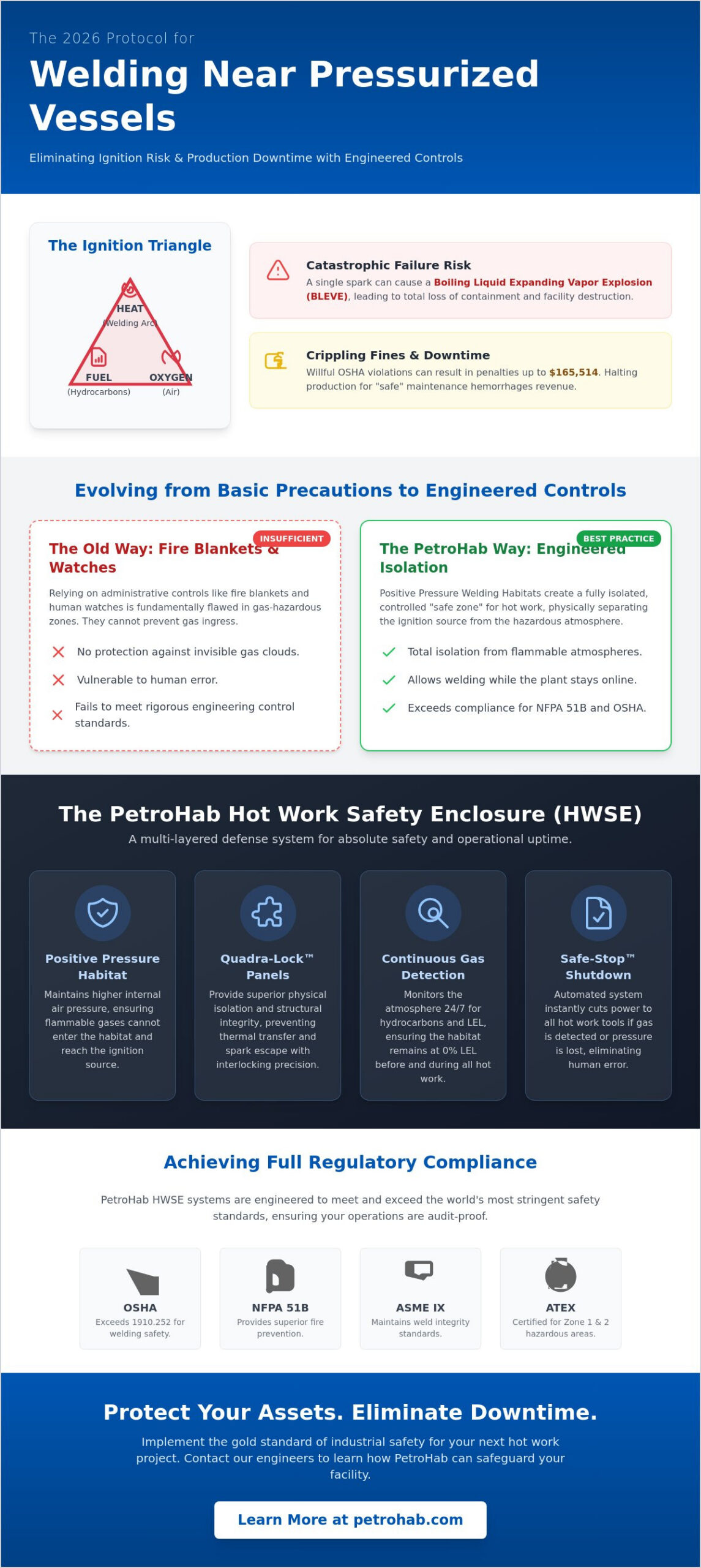
Hot work in a live industrial environment introduces a lethal variable: the ignition triangle. While standard fabrication occurs in controlled workshops, welding near pressurized vessels in a refinery or offshore platform means performing work where fuel sources are constant. The ignition triangle requires only heat, fuel, and oxygen to initiate a combustion event. In these high-stakes settings, the fuel is often present as hydrocarbon gases or fugitive emissions, and your welding arc provides the high-energy heat source. The risk is not merely a localized fire but a catastrophic loss of containment.
A breach in containment during hot work isn’t just a safety failure; it’s an instantaneous release of immense stored energy. When you weld on a depressurized, purged vessel, the primary concern is weld integrity. However, when performing hot work in the vicinity of live, pressurized lines, the surrounding atmosphere becomes the primary hazard. Traditional fire blankets are fundamentally insufficient for gas-hazardous zones. They might catch a spark, but they offer zero protection against gas ingress. They cannot stop a gas cloud from reaching the arc. This is why Pressurized Welding Habitats are the only viable engineering control for these environments.
To better understand the technical nature of these environments, watch this video:
Identifying Hazardous Zones and Atmosphere Risks
Industrial sites are categorized into ATEX Zone 1 and Zone 2. Zone 1 identifies areas where an explosive atmosphere is likely to occur during normal operation. Zone 2 represents areas where such an atmosphere is unlikely but possible. Fugitive emissions from aging seals, valves, or flanges can create invisible pockets of fuel that drift toward your work site. The Lower Explosive Limit (LEL) is the minimum concentration of a flammable gas in the air that can ignite. Most hot work permits strictly mandate that the atmosphere remains at 0% LEL before any arc is struck.
Thermal Radiation and Pressure Integrity
Localized heat from a welding arc can compromise the metallurgical properties of nearby pressurized steel. If the temperature of a pressurized vessel rises significantly, the internal pressure increases while the vessel wall weakens. In extreme failure scenarios, this leads to a Boiling Liquid Expanding Vapor Explosion (BLEVE). This is a violent rupture that can destroy entire modules. Mitigation requires physical isolation using Quadra-Lock panels to ensure thermal transfer and sparks never reach the live asset. We must treat every live vessel as a potential energy release point that requires absolute environmental separation.
Compliance and Safety Standards for Hot Work in High-Pressure Environments
Regulatory compliance isn’t a suggestion. It’s a strict operational mandate. The 2026 OSHA penalties for willful violations reach $165,514, a figure that underscores the high cost of negligence in high-risk environments. NFPA 51B serves as the foundational standard for fire prevention during welding, cutting, and other hot work. It dictates a rigorous management of combustibles within a 35-foot radius. When welding near pressurized vessels, this radius often encompasses live hydrocarbon streams, which means you can’t rely on basic fire watches alone. You must implement engineering controls that isolate the ignition source from the fuel.
The Permit-to-Work (PTW) system acts as your primary administrative safeguard. It ensures that all stakeholders verify the isolation of pressurized assets and atmospheric conditions before a single arc is struck. Compliance with OSHA’s general requirements for welding is mandatory for all onshore industrial facilities. This standard requires that if the object being welded cannot be moved, all fire hazards in the vicinity must be removed or shielded with flameproof covers or curtains. In the context of pressurized vessels, this shielding must be gas-tight and pressurized to prevent the ingress of flammable vapors.
The Legal Framework for Offshore and Onshore Welding
Managing compliance requires understanding the jurisdictional shift between onshore and offshore work. While OSHA governs land-based refineries, the Bureau of Safety and Environmental Enforcement (BSEE) oversees offshore operations under 30 CFR Part 250. BSEE regulations are often more stringent, requiring continuous atmospheric monitoring and dedicated fire watches with immediate access to suppression equipment. For a comprehensive breakdown of these international benchmarks, review our Hazardous Environment Standards guide. These rules ensure that maintenance doesn’t compromise the safety of the entire platform.
Certification Requirements for Safety Equipment
In 2026, safety managers don’t just look for “fire-rated” gear; they demand certified systems. Any equipment entering a Zone 1 or Zone 2 area must carry ATEX or IECEx markings. These “Ex” ratings confirm that components like gas detectors and automatic shutdown systems are intrinsically safe or flameproof. They won’t become an ignition source if a gas release occurs. Third-party verification is the only way to guarantee habitat integrity. Our PetroHab HWSE systems utilize Quadra-Lock panels that meet these rigorous fire-resistance and pressure-retention metrics. This level of certification provides the technical assurance that your hot work safety enclosure will perform under the most extreme industrial conditions.
Engineering Ignition Control: The Role of Pressurized Welding Habitats
Engineering ignition control is the definitive barrier between a high-energy welding arc and a flammable atmosphere. While administrative controls like permits are necessary, they don’t physically prevent gas ingress. Pressurized welding habitats provide a technological solution by creating a controlled environment within a hazardous zone. This evolution in Hot Work Safety Enclosures (HWSE) has shifted the industry away from unreliable fire blankets toward total environmental isolation. By keeping the “outside” out, these systems allow for welding near pressurized vessels without the inherent risk of an external gas cloud reaching the ignition source.
The core principle relies on maintaining a positive pressure differential. This pressure ensures that air only flows from the inside of the habitat to the outside. If a seal is compromised or a door is opened, the internal air pushes outward, preventing any flammable vapors from entering the work area. This methodology aligns with EWI’s In-service Welding Guidelines, which emphasize the need for rigorous environmental management when working on active assets. It’s a proactive engineering remedy that replaces the uncertainty of traditional maintenance methods with calculated reliability.
Maintaining Positive Pressure Integrity
A PetroHab HWSE utilizes specialized Air Intake Units (AIU) and flame-retardant ducting to draw fresh air from a remote, gas-free location. This air is then pumped into the enclosure to create the necessary overpressure. A pressure differential of just 0.1-inch water gauge is sufficient to prevent the ingress of hydrocarbon gases and ensure a breathable atmosphere for the technicians. You can learn more about how how positive pressure habitats ensure worker safety by reviewing our technical breakdown of HWSE airflow mechanics. This constant exchange of air also mitigates the buildup of welding fumes, protecting the health of the crew while securing the facility.
Quadra-Lock Technology vs. Traditional Enclosures
Traditional enclosures often rely on zippers or hook-and-loop fasteners that degrade and leave gaps. Our patented Quadra-Lock panels utilize an interlocking system that ensures a tight, high-integrity seal across the entire structure. These modular panels are rated for extreme fire resistance, often meeting ANSI/FM 4950 standards. This modularity is critical when fitting habitats around complex manifold geometries or large vessel skirts. The ability to customize the footprint allows us to isolate the work area precisely, even in the most congested offshore modules. It’s this adaptability that makes the Quadra-Lock system the gold standard for maintaining pressure integrity during critical hot work operations.
Operational Protocol: Executing Safe Hot Work Near Pressurized Assets
Execution of hot work in hazardous environments demands absolute operational discipline. When welding near pressurized vessels, manual monitoring is insufficient. You need an integrated system that links the physical enclosure with electronic gas detection and power control. This ensures that the moment a hazard is detected, the ignition source is neutralized before an incident occurs. PetroHab HWSE systems provide this security by creating a synchronized safety ecosystem where the habitat and the welding equipment communicate in real time.
Continuous gas detection for H2S, LEL, and oxygen levels is a non-negotiable requirement. These sensors must be positioned at the air intake to monitor the incoming air and inside the enclosure to detect any internal leaks. Proper ingress and egress procedures are equally vital to the integrity of the operation. Technicians must use airlock-style entries to ensure the internal overpressure remains constant. If internal pressure drops below the mandatory 0.1-inch water gauge threshold, all hot work must cease until the differential is restored. This protocol prevents gas from migrating into the workspace during shift changes or material transfers.
Automated Ignition Source Control
Manual shut-offs rely on human reaction times. In high-pressure gas releases, those seconds are the difference between a controlled event and a catastrophe. The Safe-Stop system removes the risk of human error by providing a direct interface between the habitat’s atmosphere and the welding power source. If LEL levels reach a pre-set limit or if the internal pressure fails, the system instantly terminates power to the welding leads. This is the core of Advanced Hot Work Safety Systems. Manometers and pressure sensors act as the primary triggers, ensuring the habitat remains a controlled environment even if external conditions shift suddenly.
Pre-Work Checklists and Supervision
Before striking an arc, supervisors must verify the structural integrity of the Quadra-Lock panels and the calibration of all gas sensors. Every shift change requires a formal re-inspection of the enclosure seals to confirm no gaps have formed due to vibration or thermal expansion. Personnel training must cover more than just welding; it must include emergency egress and Safe-Stop reset protocols. These checklists ensure that every safety layer is active before work begins. To ensure your facility meets these rigorous operational standards, consult with a PetroHab safety expert regarding custom habitat configurations and automated shutdown integration.
Emergency response protocols must be clearly defined and rehearsed. If the system detects gas or a loss of pressure, the Safe-Stop system triggers an audible and visual alarm. Personnel must evacuate the habitat immediately through designated exits. The supervisor then manages the atmospheric recovery process, ensuring the enclosure is fully purged and re-pressurized before any work resumes. This methodical approach to emergency management protects both the workforce and the high-value pressurized assets they are maintaining.
PetroHab Solutions: Maximizing Safety and Reducing Downtime in 2026
PetroHab stands as the definitive authority in hot work safety. Our systems represent the global gold standard for welding near pressurized vessels. We protect high-value assets and human lives through engineered solutions that prioritize risk mitigation over convenience. Our commitment to safety is reflected in our patented technologies and rigorous adherence to ATEX, IECEx, and ISO standards. These certifications aren’t just labels; they’re linguistic anchors for the technical quality we deliver to safety managers and engineers. We provide the stoic reliability required for the high-stakes environment of the oil and gas industry.
The primary operational advantage of the PetroHab HWSE is the elimination of costly facility shutdowns. Every hour of lost production in a refinery or offshore platform represents a significant financial loss. We allow you to perform critical maintenance while the plant remains live and pressurized. This capability turns a high-risk liability into a managed, routine operational task. Our reach extends across six continents, providing leasing and sales support to the world’s most remote energy hubs. Whether your site is in the North Sea or the Middle East, our logistics network ensures you have the protection you need.
Custom Engineering for Complex Facilities
Industrial layouts are rarely uniform. PetroHab designs custom habitat configurations to fit the intricate geometries of offshore modules and refinery manifolds. Our Quadra-Lock panels offer unrivaled durability in extreme conditions. They withstand corrosive maritime salt spray and the intense heat of desert environments without compromising pressure integrity. In one specific application on a live pressurized line, our technicians successfully deployed a habitat that allowed for welding near pressurized vessels while maintaining a 0% LEL atmosphere throughout the project. This success was achieved through precise engineering and the total environmental isolation provided by our modular system.
The PetroHab Advantage: Beyond the Habitat
Reliability isn’t just about the hardware. It’s about the technical expertise behind the system. We provide on-site supervision and certified training programs to ensure your team operates the Safe-Stop system with absolute competence. Our 24/7 technical support ensures that global operations never stall due to safety equipment concerns. For a deeper understanding of our technology, consult our Definitive Guide to HWSE. We don’t just sell enclosures. We act as your critical safety partner, delivering the engineering integrity required for 2026 industrial standards. Our mission is to eliminate workplace accidents through superior technology and uncompromising safety protocols.
Advancing Operational Excellence in High-Stakes Environments
Executing hot work in gas-hazardous zones is no longer a matter of chance; it’s a matter of engineering. You’ve seen that the integration of physical barriers and automated shutdown systems is the only way to maintain safety without sacrificing production uptime. By prioritizing positive pressure isolation and continuous atmospheric monitoring, you fulfill the strict requirements of 2026 OSHA and ASME standards. These protocols ensure that maintenance remains a managed risk rather than a potential catastrophe.
PetroHab remains the active guardian of your industrial site. Our patented Quadra-Lock technology and ATEX and IECEx certified Safe-Stop systems provide the calculated reliability you need to perform welding near pressurized vessels with absolute confidence. We’ve been trusted by global oil and gas majors for over 15 years to protect human life and high-value assets. Don’t let maintenance needs compromise your facility’s integrity. Secure your facility with PetroHab’s patented hot work safety solutions. We’re ready to help you uphold the highest global safety standards on every project.
Frequently Asked Questions
Can you weld on a pressurized vessel while it is in service?
Yes, performing hot work on in-service vessels is possible through rigorous adherence to API 2201 and ASME Section IX protocols. It requires total environmental isolation to prevent the ignition of external gas clouds or fugitive emissions. Using a pressurized habitat provides the necessary engineering control to separate the welding arc from the live asset. This allows critical repairs to proceed without halting facility production or compromising site safety.
What is the safe distance for welding near a pressurized vessel?
NFPA 51B defines a standard fire prevention radius of 35 feet for combustible materials. However, welding near pressurized vessels in Zone 1 or Zone 2 areas requires more than just physical distance. You must implement a Hot Work Safety Enclosure to prevent flammable vapors from migrating toward the work area. This ensures that even if a gas release occurs nearby, the ignition source remains isolated within a controlled, pressurized environment.
How does a pressurized welding habitat prevent explosions?
A pressurized habitat prevents explosions by maintaining a positive pressure differential, typically 0.1-inch water gauge, between the enclosure and the external atmosphere. This overpressure ensures that air only flows from the inside out. It creates a physical barrier that prevents flammable gases from entering the workspace. By keeping fuel sources away from the welding arc, the system effectively eliminates the risk of an external atmospheric ignition.
What happens if the pressure inside the habitat drops during welding?
If the internal pressure falls below the safety threshold, the Safe-Stop system triggers an immediate, automated shutdown. It cuts all power to the welding leads and any other potential ignition sources within milliseconds. This failsafe mechanism ensures that the work area is neutralized before any external gases have the opportunity to ingress. The system also activates audible and visual alarms to alert personnel to the loss of pressure integrity.
Are PetroHab habitats ATEX and IECEx certified?
Every PetroHab HWSE and Safe-Stop system is engineered to comply with ATEX and IECEx certifications for hazardous zone operations. These international standards verify that our electronic components and structural materials are safe for use in potentially explosive atmospheres. We prioritize these certifications to provide safety managers with the technical assurance that our equipment meets the most stringent global requirements for offshore platforms and onshore refineries.
What gas detection is required for welding near live vessels?
Continuous gas detection for Lower Explosive Limit (LEL), Hydrogen Sulfide (H2S), and Oxygen (O2) is a mandatory requirement for these operations. Sensors are strategically placed at the air intake unit and inside the habitat to provide real-time atmospheric data. These detectors are hardwired to the automatic shutdown system, ensuring that any detection of hazardous gas concentrations results in an immediate termination of all hot work activities.
How long does it take to set up a modular Quadra-Lock habitat?
The assembly of a standard modular Quadra-Lock habitat typically takes between 2 and 6 hours depending on the configuration’s complexity. The interlocking panel system is designed for rapid deployment without the need for specialized tools or extensive training. This modularity allows the habitat to be fitted around complex vessel skirts and manifold geometries, significantly reducing the downtime associated with traditional site preparation and enclosure construction.
Can a habitat be used for hot work other than welding, such as grinding?
Habitats are suitable for any hot work activity that generates heat, sparks, or open flames, including grinding, torching, and abrasive blasting. The fire-resistant Quadra-Lock panels are designed to contain sparks while the pressurized atmosphere prevents external gas ingress. This makes the enclosure an essential safety tool for a wide range of maintenance tasks in hazardous environments, providing consistent protection regardless of the specific tool being used.