Blog Posts
Achieving the Zero Hot Work Incidents Goal: A Technical Framework for 2026
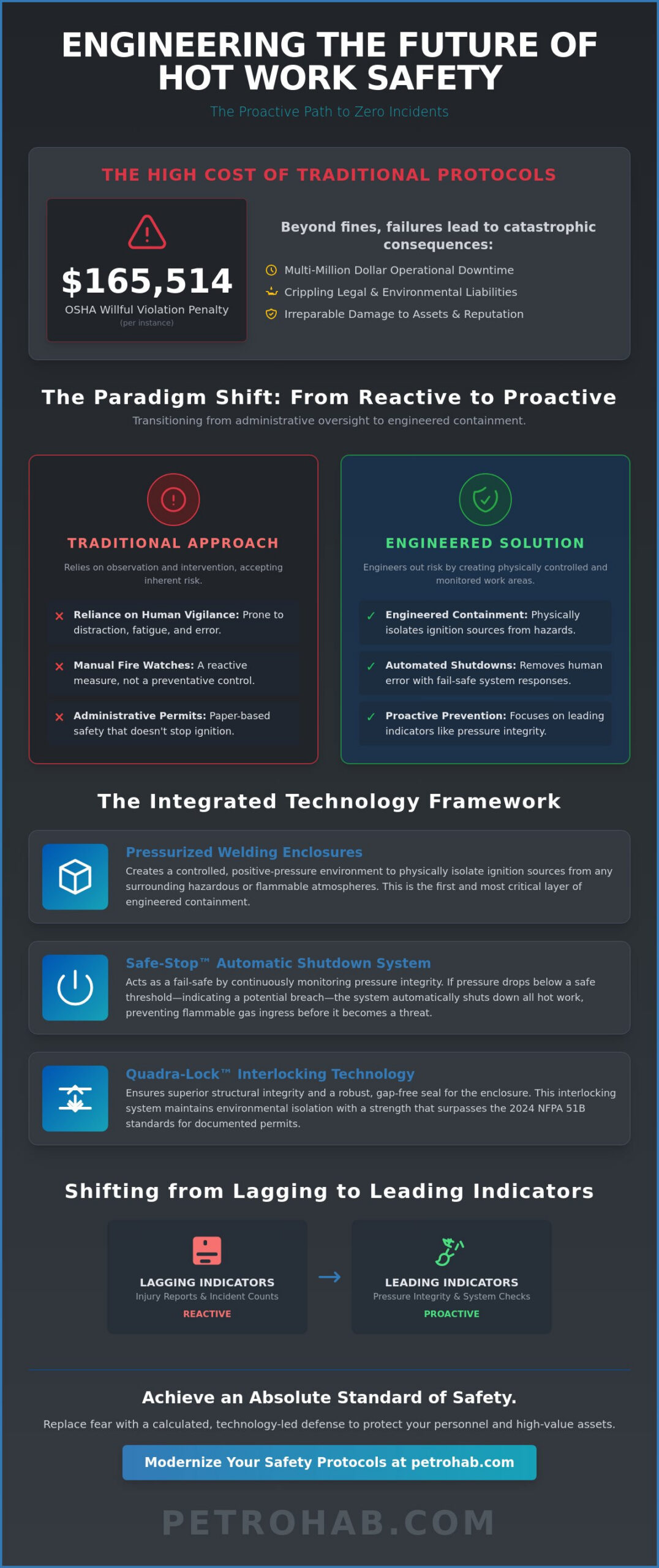
Is achieving the zero hot work incidents goal a realistic operational target, or is it merely an aspirational metric for safety reports? With OSHA willful violation penalties reaching $165,514 per instance in 2026, the financial and human cost of failure is absolute. You recognize that relying on manual fire watches and antiquated protocols creates a dangerous vulnerability in high-stakes environments. Human error remains the most volatile variable in any welding or cutting operation. This article outlines the engineering and systemic strategies required to transition from reactive monitoring to proactive ignition prevention.
You’ll discover a technical roadmap that eliminates hot work accidents by prioritizing engineered controls over administrative ones. We examine the critical role of pressurized welding enclosures and the Safe-Stop automatic shutdown system in maintaining environmental integrity. By integrating Quadra-Lock interlocking technology, you can achieve a level of containment that surpasses the 2024 NFPA 51B standards for documented permits. This framework provides the validation needed to modernize your safety protocols and protect your personnel and high-value assets with uncompromising precision. It’s time to replace fear with a calculated, technology-led defense.
Key Takeaways
- Shift your safety paradigm from administrative oversight to engineered containment to eliminate ignition sources in hazardous environments.
- Identify the specific failure points of manual fire watches and learn how automation addresses the inherent volatility of human error.
- Master the transition from lagging injury metrics to leading indicators, such as pressure integrity, which is essential for achieving zero hot work incidents goal.
- Examine the physics of positive pressure and how the Safe-Stop automatic shutdown system provides a definitive remedy against flammable gas ingress.
- Gain technical insights into the structural superiority of Quadra-Lock technology for maintaining the environmental isolation required during high-stakes maintenance.
The Philosophical and Operational Imperative of Zero Hot Work Incidents
The objective of achieving zero hot work incidents goal represents a fundamental shift in industrial safety management. It moves beyond the passive monitoring of work sites and establishes a rigorous, uncompromising commitment to the absolute elimination of ignition sources in hazardous environments. While many organizations adopt “zero harm” as a high-level philosophy, the practical reality of high-stakes maintenance requires a technical framework that accounts for the volatility of energy and chemical processing. Hot work, which encompasses welding, grinding, and thermal cutting, demands a safety standard significantly higher than general industrial tasks. The presence of open flames or high-temperature sparks in proximity to volatile hydrocarbons leaves no margin for error.
Understanding Hot Work Fundamentals is essential for any safety manager tasked with protecting high-value assets. These activities introduce extreme heat and sparks into areas where containment is critical. Traditional methods often rely on administrative controls like fire watches and permit systems. However, 2026 industry standards demand a more resilient, technology-led approach that removes the possibility of human oversight.
To better understand the critical nature of these protocols, watch this helpful video:
The foundation of this strategy rests on the deployment of a specialized hot work safety enclosure. These systems don’t just provide a physical barrier; they create a controlled environment where risks are calculated and neutralized. By utilizing pressurized habitats engineered by PetroHab LLC, operators can isolate the ignition source from the surrounding hazardous atmosphere. This containment strategy ensures that the achieving zero hot work incidents goal is an operational reality rather than a statistical ambition. It provides a definitive technological remedy to the problem of environmental volatility.
Eliminating the “Acceptable Risk” Fallacy
The industrial sector can no longer tolerate the “acceptable risk” of minor flash fires or smoldering debris. In 2026, the catastrophic potential of a single failure in a pressurized environment is too high to ignore. Managing risk through observation is inherently flawed because it assumes human intervention will be fast enough to prevent a disaster. We must engineer out risk by using redundant containment systems and automated safety triggers. Transitioning from manual oversight to automated protection ensures that safety isn’t dependent on human vigilance alone. This shift prioritizes asset protection and personnel safety above all else.
The Economic Impact of Hot Work Failures
A single ignition event carries costs that far exceed immediate property damage. OSHA penalties for willful violations now reach $165,514 per instance, but that is only a fraction of the total liability. Downtime in the energy sector can result in losses of millions of dollars per day. Legal liabilities, environmental cleanup costs, and increased insurance premiums create a long-term financial burden that can cripple operations. Investing in premium safety systems like Petro-Habitats and pressurized welding enclosures provided by PetroHab LLC improves asset integrity and ensures operational continuity. The return on investment for high-grade safety technology is realized the moment an automated system prevents a potential disaster. Reliability in safety leads to reliability in production.
Analyzing the Root Causes: Why Traditional Hot Work Safety Fails
Traditional safety protocols often fail because they treat human vigilance as a fail-safe mechanism rather than a known variable. While the OSHA Hot Work Standard provides a necessary regulatory baseline, compliance alone does not equate to absolute risk elimination. Many facilities rely on fire blankets and non-pressurized barriers. These tools offer a false sense of security. They lack the physics required to prevent gas ingress and cannot stop a flammable vapor cloud from reaching a welding arc. To move toward achieving zero hot work incidents goal, we must address the systemic weaknesses inherent in manual safety processes. Passive protection is a gamble that high-stakes environments cannot afford.
The concept of systemic redundancy is the only viable alternative to these traditional failures. This involves layering multiple technical controls so that the failure of one component does not lead to an ignition event. By combining the structural integrity of Quadra-Lock panels with automated sensors, we create a barrier that functions independently of human observation. This architecture ensures that even if a manual fire watch is momentarily compromised, the technological safeguards remain active and effective.
The Human Error Factor in Hazardous Zones
Human Performance Improvement (HPI) data confirms that even the most disciplined technicians are prone to error. In complex industrial environments, highly trained welders make an average of five errors per hour. This isn’t a lack of skill; it’s a physiological reality. Fatigue, extreme ambient heat, and high decibel levels degrade cognitive performance over time. When safety depends solely on a fire watch’s eyes, a single second of distraction can lead to catastrophe. True protection requires a shift toward systems that operate with stoic reliability, ensuring safety is never dependent on individual vigilance alone.
Gaps in Traditional Atmospheric Monitoring
Manual gas monitoring presents a dangerous lag time between detection and intervention. By the time a handheld sensor alarms and a worker reacts, the ignition threshold may already be exceeded. Industrial facilities also contain dead spots where localized gas pockets can accumulate undetected by centralized sensors. Integrating advanced hot work safety systems directly into the containment area is the only way to close these gaps. These systems provide continuous, automated detection that triggers immediate remedies without human intervention. You can evaluate your current containment strategy to identify where these critical gaps exist in your own operations.
Transitioning from Lagging to Leading Indicators in Ignition Control
Traditional safety management often relies on lagging indicators to measure success. Metrics such as injury rates or the frequency of fire incidents only provide data after a failure has occurred. For safety managers focused on achieving zero hot work incidents goal, these reactive numbers are insufficient. They confirm that a system failed; they don’t prevent the next event. Transitioning to leading indicators allows for a proactive assessment of safety system health. By monitoring variables such as safety system uptime and environmental containment integrity, engineers can identify and rectify vulnerabilities before they escalate into ignition events.
The technology within a PetroHab LLC Hot Work Safety Enclosure (HWSE) serves as a critical data source for these leading indicators. Unlike open-air welding sites, a pressurized habitat provides a measurable, quantifiable environment. Automated systems continuously track internal conditions, providing a transparent record of safety performance. This transparency removes the human bias often associated with manual reporting. When safety data is generated by sensors rather than subjective observation, the fear of reporting near-misses is replaced by a culture of technical precision. Data becomes a tool for improvement rather than a metric for blame.
Technical Leading Indicators for Pressurized Habitats
Proactive ignition control requires the monitoring of specific technical metrics. Key leading indicators include average habitat pressure, gas detection frequency, and the seal integrity of Quadra-Lock panels. Manometers provide verifiable, real-time data on the pressure differential between the habitat and the external hazardous zone. A consistent positive pressure reading confirms that the barrier is functioning as designed. Tracking these metrics allows operators to detect subtle degradations in containment, such as a compromised seal or a failing blower, long before flammable gases can penetrate the enclosure. Prevention is a product of constant measurement.
Building a Culture of Technical Accountability
Adhering to global hazardous environment standards drives the adoption of these technical leading indicators. Modern safety leadership is moving toward forward-looking accountability, where success is defined by the verified presence of safeguards rather than the absence of accidents. Standardized equipment, such as Petro-Habitats manufactured by PetroHab LLC, ensures consistent safety performance across global sites. When every facility utilizes the same pressurized welding enclosures and Safe-Stop automatic shutdown systems, safety managers can compare leading indicators across different regions. This standardization creates a global benchmark for operational excellence. It ensures that the same uncompromising protection is applied to every high-value asset, regardless of location.
Engineering Out Risk: The Role of Pressurized Enclosures and Automated Shutdowns
Engineering out risk is the definitive stage in achieving zero hot work incidents goal. It replaces the variable of human reaction with the constant reliability of physical laws. Pressurized welding enclosures function as active guardians by creating a pressure differential that flammable gases cannot penetrate. This technical remedy ensures that even in the presence of an external leak, the ignition source remains isolated within a controlled environment. Modularity is equally critical in this context. Industrial sites often feature complex geometries with intricate piping and structural obstacles. A modular system allows for the customization of the enclosure to fit these specific site layouts without compromising the integrity of the seal.
Material selection is the final layer of this engineering defense. Enclosure panels must demonstrate extreme fire resistance to withstand slag, sparks, and intense radiant heat under extreme industrial conditions. The integration of Quadra-Lock Panels ensures that the joints between these materials are as resilient as the panels themselves. This interlocking technology prevents the “chimney effect” often seen in inferior, taped, or velcro-sealed enclosures. It provides a structural robustness that maintains containment integrity even when subjected to high-pressure airflows or mechanical stress.
The Mechanics of Positive Pressure Containment
A pressurized welding habitat is designed to operate safely in Zone 1 or 2 hazardous areas. The system draws air from a verified clean source and pumps it into the enclosure. This process maintains a continuous flow that provides breathable air and essential cooling for technicians working in high-heat environments. HWSE integrity is maintained when internal pressure exceeds external atmospheric pressure by a minimum of 0.05 inches of water column. This specific pressure threshold acts as an invisible wall. It forces air outward through any microscopic gaps, preventing the ingress of heavier-than-air hydrocarbons or lighter-than-air gases.
Safe-Stop: The Redundant Safety Net
The Safe-Stop Automatic Shutdown System serves as the redundant safety net within this framework. It doesn’t just monitor gas; it simultaneously tracks internal pressure and airflow. If the system detects a loss of pressure or the presence of a hazardous gas at the intake, it initiates an immediate shutdown sequence. This sequence terminates power to all welding equipment within milliseconds, neutralizing the ignition risk before the environment becomes volatile. For engineers, the validation of this hardware through ATEX and IECEx certification is non-negotiable. These standards ensure the shutdown system itself won’t become an ignition source in a fault condition. To ensure your facility meets these rigorous standards, you can explore our certified shutdown solutions today.
PetroHab LLC’s Integrated Approach to Achieving Absolute Hot Work Safety
PetroHab LLC defines the industry benchmark for safety excellence through a mission-driven approach to technical containment. While previous sections detailed the physics of pressure and the necessity of leading indicators, the execution of these concepts requires hardware that can’t fail. Our strategy for achieving zero hot work incidents goal integrates patented technologies with rigorous operational oversight. We provide the equipment and expertise needed to transform high-risk maintenance into a controlled, predictable operation. This integrated approach ensures that every variable is accounted for before work begins.
Quadra-Lock Technology: Redefining Structural Integrity
The structural integrity of a pressurized habitat depends entirely on the quality of its seals. Traditional enclosures often rely on adhesives or mechanical fasteners that degrade under thermal stress or repeated use. The patented Quadra-Lock interlocking system, a signature of PetroHab LLC engineering, eliminates these vulnerabilities by creating a gapless, mechanical bond between panels. It’s a design that ensures the positive pressure differential is maintained across the entire surface area of the enclosure. Quadra-Lock panels are engineered for superior fire resistance, outperforming standard welding fabrics in extreme industrial conditions. Their modularity allows for rapid assembly and reconfiguration. This ensures that even the most complex piping geometries are fully enclosed without compromising the safety of the site.
Global Deployment and Professional Training
Protecting personnel and high-value assets requires a global perspective on safety. PetroHab LLC systems are available for both rental and purchase across multiple continents, providing a consistent safety standard for international operators. Our commitment to achieving zero hot work incidents goal doesn’t end with the hardware. We provide certified on-site supervision to ensure that every PetroHab Hot Work Safety Enclosure (HWSE) is installed and operated according to strict technical specifications. Specialized training programs empower your personnel to master the Safe-Stop Automatic Shutdown System and maintain habitat integrity. To ensure your next turnaround meets these rigorous standards, consult with PetroHab LLC experts to tailor a safety solution for your specific operational needs.
Securing the Future of Industrial Maintenance
Transitioning toward a zero-incident reality requires a deliberate move from administrative fire watches to engineered containment. This framework has established that achieving zero hot work incidents goal is possible only when safety is built into the site’s physical infrastructure. By prioritizing leading indicators such as habitat pressure integrity and automated gas detection, you eliminate the volatility of human error. The integration of high-grade materials and redundant shutdown logic ensures that ignition risks are neutralized before they can escalate into catastrophic events.
PetroHab LLC provides the technical foundation for this uncompromising safety standard. Our patented Quadra-Lock technology ensures superior structural integrity, while our global ATEX and IECEx certified safety systems provide verified protection in high-risk Oil & Gas environments. With a proven track record of protecting personnel and high-value assets, we act as a critical safety partner for your most demanding turnarounds. Partner with PetroHab LLC to reach your zero-incident safety goals. You can lead your team with the confidence that comes from using the industry’s most resilient safety systems.
Frequently Asked Questions
Is a zero hot work incidents goal actually realistic for offshore platforms?
Yes, achieving zero hot work incidents goal is a realistic objective when organizations replace administrative protocols with engineered containment systems. Offshore environments present high volatility, but pressurized habitats create an isolated environment that removes the possibility of ignition. By utilizing technology-led safety strategies, operators can maintain absolute control over the work area regardless of the surrounding hazardous conditions.
How does a pressurized welding habitat prevent gas ignition?
A pressurized welding habitat prevents ignition by maintaining an internal air pressure higher than the external atmospheric pressure. This pressure differential creates a constant outward flow of air through any microscopic gaps in the enclosure. Because air is forced out, flammable gases and vapors cannot penetrate the barrier to reach the ignition source within the habitat.
Can automatic shutdown systems be integrated with any welding machine?
The Safe-Stop Automatic Shutdown System is designed for modular integration with standard industrial welding equipment used in heavy industry. It functions by controlling the power supply to the welding machine through a centralized safety logic controller. Upon detection of a hazard, the system de-energizes the equipment immediately, providing a definitive remedy to potential ignition events.
What are the most common leading indicators for hot work safety?
Technical leading indicators include habitat pressure stability, gas detection frequency at the air intake, and safety system uptime. Unlike lagging indicators such as injury rates, these metrics provide real-time data on the health of the safety system. Monitoring these variables allows safety managers to identify and rectify environmental vulnerabilities before they lead to an incident.
How much pressure is required to maintain a safe environment in an HWSE?
A minimum positive pressure of 0.05 inches of water column is required to ensure the integrity of a PetroHab LLC Hot Work Safety Enclosure (HWSE). This specific pressure threshold acts as an invisible wall, forcing air outward and preventing the ingress of hazardous vapors. Integrated manometers provide the verifiable data needed to confirm this pressure is maintained throughout the operation.
What happens if the positive pressure in a habitat is lost during welding?
If internal pressure falls below the safety threshold, the Safe-Stop system initiates an automatic shutdown sequence for all hot work equipment. This redundant safety net ensures that the welding arc is extinguished before a hazardous atmosphere can enter the enclosure. This automated reaction removes the dangerous lag time associated with manual monitoring and human intervention.
Why is Quadra-Lock technology preferred over traditional habitat panels?
Quadra-Lock technology is preferred because it utilizes a patented interlocking system that creates a gapless, mechanical bond between panels. Traditional enclosures often rely on tape or velcro, which can fail under thermal stress or high-pressure airflow. Quadra-Lock panels provide superior structural integrity and fire resistance, ensuring the enclosure remains a durable barrier in extreme industrial environments.
Does PetroHab LLC provide on-site technicians for habitat setup?
PetroHab LLC provides certified on-site supervision to ensure every pressurized habitat is installed and operated according to rigorous technical specifications. These experts manage the deployment of Quadra-Lock panels and the Safe-Stop system while providing the specialized oversight necessary for achieving zero hot work incidents goal. Their presence ensures system performance and maintains compliance with international safety standards.