Blog Posts
Offshore Welding Safety Case Study: Pressurized Habitat Excellence in 2026
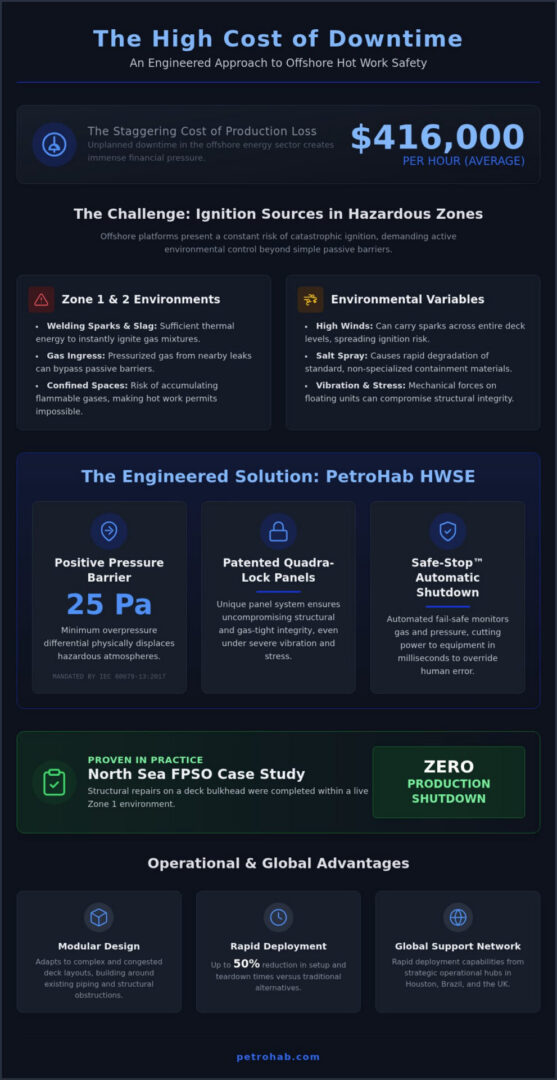
With unplanned downtime in the offshore energy sector costing an average of $416,000 per hour, the decision to halt production for essential maintenance isn’t just a safety protocol; it’s a massive financial liability. You likely recognize that performing ignition-source work near live process equipment in Zone 1 or Zone 2 environments presents a risk profile that most operators find unacceptable without a total platform shutdown. This FPSO hot work safety case study examines a shift in that risk management strategy. We’re moving away from simple containment toward the automated management of pressurized environments to override human error.
You’ll discover how advanced PetroHab LLC Hot Work Safety Enclosures (HWSE) utilize patented Quadra-Lock panels to maintain the 25 Pascal overpressure differential mandated by IEC 60079-13:2017. We’ll explore how the Safe-Stop automatic shutdown system monitors gas levels and pressure to cut power to welding equipment in milliseconds. This article provides a technical overview of how modular habitats achieve zero-incident performance and ATEX compliance without sacrificing production uptime. By the end of this analysis, you’ll understand the engineering required to maintain operational continuity and regulatory adherence during critical offshore repairs.
Key Takeaways
- Learn why maintaining a 25 Pascal overpressure differential is critical for preventing gas ingress during live platform maintenance.
- Review this FPSO hot work safety case study to see how structural repairs were completed on a deck bulkhead without initiating a production shutdown.
- Understand how patented Quadra-Lock technology ensures the structural integrity of modular panels in high-risk Zone 1 and Zone 2 environments.
- Discover the role of the Safe-Stop automatic shutdown system in mitigating human error through millisecond-response gas and pressure monitoring.
- Identify the operational advantages of global support networks in Houston, Brazil, and the UK for rapid deployment of pressurized welding enclosures.
The Critical Challenges of Offshore Welding Safety
Offshore welding safety on a Floating Production Storage and Offloading (FPSO) unit involves the rigorous management of ignition sources within atmospheres where hydrocarbons are present. On these assets, the proximity of process equipment to maintenance areas creates a constant risk of catastrophic ignition. This FPSO hot work safety case study highlights the necessity of moving beyond passive fire blankets toward active environmental control. By 2026, regulatory bodies like the Bureau of Safety and Environmental Enforcement (BSEE) and the latest ATEX directives have intensified requirements for pressurized welding enclosures, demanding documented proof of gas-tight integrity and fail-safe automation.
Environmental variables exacerbate these risks. High winds can carry welding sparks across deck levels, while salt spray causes rapid degradation of standard containment materials. In confined spaces, the accumulation of flammable gases often renders traditional hot work permits impossible to approve without a complete production shutdown. Managing these factors requires a specialized engineering approach that accounts for both the physical containment of sparks and the atmospheric exclusion of volatile gases.
Ignition Sources in Hazardous Zones
Zone 1 and Zone 2 environments on an FPSO require precise containment because welding sparks and molten slag possess enough thermal energy to ignite gas mixtures instantly. Passive barriers often fail because they don’t account for the ingress of pressurized gas from nearby leaks. Effective safety protocols now rely on Hyperbaric welding principles to create a dry, pressurized work area that physically displaces hazardous atmospheres. Within the Permit-to-Work (PTW) system, the use of a pressurized habitat is no longer optional; it’s a technical prerequisite for high-risk maintenance in hydrocarbon-rich areas.
The Economic Impact of Maintenance Downtime
The Live Platform dilemma forces operators to weigh the extreme risk of ignition against the staggering cost of production loss. Verified industry data indicates that unplanned downtime in the offshore energy sector costs an average of $416,000 per hour. When hot work becomes the bottleneck in a maintenance schedule, the financial pressure to bypass shutdowns is immense.
Strategic use of a PetroHab Hot Work Safety Enclosure (HWSE) allows for structural repairs on deck bulkheads or piping while the platform remains fully operational. Utilizing Quadra-Lock panels ensures that the habitat remains gas-tight even under the vibration and mechanical stress common on floating units. By maintaining asset uptime, these systems transform safety from a cost center into a critical operational advantage, allowing for the completion of essential repairs without the fiscal penalty of deferred production.
Engineering the Pressurized Welding Habitat for Offshore Use
Engineering a pressurized habitat for a floating production unit requires a sophisticated understanding of fluid dynamics and material science. It isn’t enough to simply drape fire-retardant blankets over a work area. To prevent the ingress of flammable gases, the enclosure must maintain a consistent overpressure differential. This FPSO hot work safety case study demonstrates that achieving a minimum overpressure of 25 Pascals, as specified by IEC 60079-13:2017, is the only reliable method for ensuring a gas-free interior. Compliance with OSHA hot work safety guidelines requires these habitats to withstand the harsh conditions of the marine environment while protecting personnel from external atmospheric hazards.
The PetroHab Hot Work Safety Enclosure (HWSE) addresses these requirements through a modular design that adapts to the congested deck layouts of FPSOs and jack-up rigs. Unlike fixed structures, modular habitats allow technicians to build around existing piping and structural obstructions. This flexibility doesn’t just improve safety; it enhances operational efficiency. Industry data shows that modular systems can reduce setup and teardown times by up to 50% compared to traditional non-modular alternatives. This efficiency is vital when maintenance windows are tight and every hour of production counts.
Quadra-Lock Technology: Redefining Enclosure Integrity
The core of the PetroHab HWSE is the patented Quadra-Lock panel system. Traditional enclosures often rely on hook-and-loop fasteners that degrade over time and can leave gaps under pressure. Quadra-Lock panels utilize an interlocking mechanism that creates a continuous, air-tight seal across the entire surface area. These panels are engineered from industrial-grade fire-resistant materials capable of withstanding welding temperatures exceeding 1,000°C. On the open decks of an FPSO, where wind loads can be significant, the structural stability of the Quadra-Lock system ensures the habitat maintains its shape and integrity, preventing the pressure fluctuations that lead to safety shutdowns.
Maintaining Positive Pressure in High-Risk Zones
Control systems within the habitat must provide constant feedback to the operator. This FPSO hot work safety case study emphasizes the use of manometers to monitor internal pressure relative to the external atmosphere, ensuring the 0.1 to 0.5 inches of water gauge differential is maintained. To manage fumes and heat, the system requires air ducting capable of providing at least 20 air changes per hour. This constant flow of clean air prevents the buildup of welding gases and maintains a safe working environment for the crew. For a deeper dive into the technical specifications of these systems, read our article on Pressurized Welding Habitats: The Definitive Guide to HWSE Technology. If your team is planning upcoming maintenance in a hazardous zone, consider how a pressurized welding enclosure can bridge the gap between safety and production.
Automated Fail-Safes: The Safe-Stop Shutdown System
Manual monitoring of hazardous environments is a legacy approach that no longer meets the safety mandates of 2026. Human error remains a primary variable in industrial accidents, particularly when technicians are tasked with constant, repetitive surveillance of gas levels and pressure gauges. The Safe-Stop automatic shutdown system removes this variable by providing an automated layer of protection that never suffers from fatigue or distraction. In this FPSO hot work safety case study, the integration of real-time monitoring ensures that the moment a hazardous condition is detected, the ignition source is eliminated before a disaster can occur.
The Safe-Stop system acts as the central intelligence for the PetroHab HWSE. It simultaneously monitors internal overpressure and external gas concentrations, creating a dual-layered defense. If the system detects a loss of pressure or the presence of hydrocarbons, it initiates an automatic power isolation of the welding equipment in less than 0.1 seconds. This millisecond response time is critical on a live FPSO, where a gas leak can reach an ignition source almost instantaneously. For a deeper technical analysis of these protocols, consult A Comprehensive Guide to Advanced Hot Work Safety Systems in 2026.
ATEX Certified Gas Detection Integration
The Safe-Stop system integrates high-precision, ATEX-certified gas sensors to detect Lower Explosive Limit (LEL) thresholds. These sensors are strategically placed at the habitat air intake and other potential ingress points to identify flammable vapors before they enter the enclosure. To ensure offshore reliability, the system utilizes redundant sensor arrays. This redundancy prevents false positives from halting production while ensuring that a single sensor failure doesn’t compromise the entire safety perimeter. By identifying gas at 10% LEL, the system provides a significant margin of safety, allowing for a controlled shutdown long before the atmosphere reaches a combustible state.
Pressure Loss Protocols
Integrity is the foundation of any pressurized habitat. If a Quadra-Lock panel is breached or the air supply is interrupted, the Safe-Stop system reacts immediately to the drop in overpressure. When internal pressure falls below the 25 Pascal threshold, the system triggers both visual and audible alarms to alert personnel to evacuate the enclosure. Power to all welding and grinding tools is cut instantly. Following a shutdown, the system enforces a strict restart procedure. Technicians must restore the required pressure differential and conduct a full gas test to ensure the work environment is completely purged and safe before re-ignition is permitted. This methodical approach ensures that safety is never sacrificed for the sake of speed.
Case Study: Live Platform Welding on a North Sea FPSO
Executing structural repairs on a deck bulkhead located within ten feet of a high-pressure gas manifold presents an extreme risk profile that typically mandates a full production shutdown. This FPSO hot work safety case study details the technical solution implemented to maintain operational continuity during a critical 14-day maintenance window. The objective required continuous welding and grinding in a Zone 1 environment, where any failure in containment could lead to catastrophic ignition. To mitigate this risk, a custom-sized PetroHab Hot Work Safety Enclosure (HWSE) was deployed, utilizing Quadra-Lock panels to ensure atmospheric isolation from the surrounding hydrocarbon-rich environment.
The operational outcome was the successful completion of all structural repairs with zero safety incidents. By maintaining a constant overpressure of 25 Pascals, the habitat successfully excluded external gases throughout the project duration. The economic result was substantial. By avoiding the deferred production associated with a total platform shutdown, the operator realized an estimated $1.2M in savings. This performance underscores the strategic value of active pressurized containment in high-stakes offshore environments.
Project Planning and Mobilization
Success in hazardous zone maintenance begins long before the first arc is struck. PetroHab provided dedicated on-site supervision to manage the complex configuration of the HWSE around existing deck obstructions and the gas manifold. This technical oversight ensured that the Quadra-Lock panels formed a continuous, gas-tight seal despite the irregular footprint of the work area. Before work commenced, the platform crew underwent comprehensive training on Safe-Stop operation and emergency drills. Logistics were managed through the transport of modular components via an offshore supply vessel, allowing for rapid mobilization and assembly without the need for heavy lifting equipment or hot work for the assembly itself.
Performance Data and Safety Metrics
The technical integrity of the system was monitored through continuous data logging. Internal gas readings remained at 0% LEL throughout the 14-day window, even while external sensors occasionally detected trace hydrocarbons near the process manifold. The structural stability of the habitat was tested by Force 7 gale conditions, during which the Quadra-Lock system maintained a steady pressure differential without mechanical fatigue or leakage. HWSE efficiency is defined by the ability to provide a verified, gas-free work environment that remains unaffected by external atmospheric fluctuations or mechanical vibrations on a floating asset. For operators facing similar maintenance challenges, the deployment of a pressurized welding enclosure provides a documented, fail-safe path to maintaining production while ensuring absolute personnel safety.
Implementing PetroHab HWSE for Global Offshore Operations
Implementing the PetroHab HWSE requires a strategic evaluation of your facility’s long-term maintenance needs. Operators must determine whether a rental or purchase model better serves their specific maintenance cycle. For short-term structural repairs, such as those highlighted in this FPSO hot work safety case study, rental agreements provide access to the latest ATEX-certified technology without the capital expenditure of ownership. Conversely, assets with frequent hot work requirements benefit from the permanent availability of on-site Petro-Habitats. PetroHab supports these global operations through a robust logistics network centered in Houston, Brazil, and the UK, ensuring rapid deployment of modular components to any offshore location.
Customization is a core component of the implementation process. Offshore equipment geometries are rarely uniform, requiring habitats that can be engineered to fit around complex manifolds or bulkhead configurations. Utilizing the modular nature of Quadra-Lock panels, technicians can assemble enclosures that maintain gas-tight integrity in the most congested spaces. For a detailed analysis of procurement criteria, refer to our guide on Choosing the Right Hot Work Safety Enclosure Suppliers. This technical approach ensures that safety protocols don’t become a bottleneck for production schedules.
On-Site Supervision and Training
The deployment of a pressurized welding enclosure is a technical undertaking that demands precision. Certified PetroHab technicians are critical for the initial calibration of the Safe-Stop automatic shutdown system, ensuring that gas sensors and pressure manometers are tuned to the specific atmospheric conditions of the site. PetroHab also provides comprehensive training programs for offshore safety officers, focusing on system operation and emergency response protocols. This commitment to competency ensures that the platform crew can manage the hardware with absolute confidence. Continuous 24/7 technical assistance remains available to address any operational challenges that arise during global projects.
Next Steps for Safety Managers
Moving from theoretical risk management to practical implementation requires a structured approach. Safety managers should begin by conducting a site-specific risk assessment for their next hot work project, identifying potential ignition sources and gas ingress points. Following this assessment, you can request a technical specification package for Petro-Habitats to ensure the equipment meets your asset’s regulatory requirements. This documentation is essential for maintaining compliance with 2026 standards for offshore hot work permits. Contact PetroHab directly to receive a project-specific quote and consult with an expert on the most effective configuration for your offshore maintenance needs.
Advancing Offshore Operational Continuity and Safety
The technical integration of automated fail-safes and modular containment transforms high-risk maintenance into a controlled, predictable process. As demonstrated throughout this FPSO hot work safety case study, the 25 Pascal overpressure standard is the definitive baseline for protecting personnel in volatile Zone 1 and Zone 2 environments. By utilizing patented Quadra-Lock technology and the Safe-Stop automatic shutdown system, operators effectively eliminate the variable of human error. These ATEX and IECEx compliant components provide the rigorous protection required to conduct essential repairs without the fiscal penalty of a platform shutdown.
Securing your asset’s future involves more than just meeting current regulations; it’s about adopting a proactive stance against ignition risks. Whether your project is in the North Sea, the Gulf of Mexico, or off the coast of Brazil, the engineering behind PetroHab HWSE ensures that your personnel and high-value assets remain protected under the most demanding conditions. Take the next step in optimizing your maintenance cycle while maintaining absolute safety integrity.
Request a Quote for Your Offshore Hot Work Project and partner with an industry leader dedicated to zero-incident performance. Your commitment to safety is the foundation of operational excellence.
Frequently Asked Questions
What is the primary purpose of an offshore welding safety case study?
An offshore welding safety case study documents the technical validation and economic feasibility of performing hot work in hazardous environments. It provides safety managers with a data-driven blueprint for managing ignition sources without halting production. By analyzing real-world applications, these studies demonstrate how engineered controls mitigate the risks associated with hydrocarbon-rich atmospheres on live assets.
How does a pressurized welding habitat prevent gas from entering the work area?
Pressurized habitats utilize a positive pressure differential to create a physical barrier against external atmospheres. By maintaining an internal pressure of 25 Pascals higher than the outside environment, the system ensures that air only flows out of the enclosure. This constant overpressure effectively excludes flammable gases from entering the work area, even if a leak occurs nearby.
Is hot work safe on a live offshore platform without a shutdown?
Hot work is safe on live platforms when conducted within a certified Hot Work Safety Enclosure (HWSE) equipped with automated detection systems. This FPSO hot work safety case study confirms that repairs can be executed in Zone 1 or Zone 2 areas while production remains active. Success depends on the use of interlocking Quadra-Lock panels and millisecond-response shutdown technology to manage potential hazards.
What is the difference between a standard welding tent and an HWSE?
A standard welding tent only offers passive spark containment and lacks atmospheric control. In contrast, an HWSE is an engineered safety system that provides active protection through environmental pressurization and gas monitoring. Unlike simple tents, PetroHab HWSE systems use specialized Quadra-Lock panels to ensure a gas-tight seal that meets rigorous international safety certifications for hazardous zones.
How does the Safe-Stop system handle power isolation during a gas leak?
The Safe-Stop system initiates an automatic power isolation of all welding and grinding equipment in less than 0.1 seconds upon detecting a hazard. It monitors for both a loss of internal overpressure and the presence of gas at 10% of the Lower Explosive Limit (LEL). This rapid response ensures the ignition source is eliminated before a flammable mixture can reach the work area.
Can PetroHab habitats be customized for complex offshore piping structures?
Petro-Habitats are fully customizable due to their modular design, allowing for assembly around irregular geometries and congested deck layouts. Technicians utilize Quadra-Lock panels to build the enclosure around existing piping, valves, and structural bulkheads. This flexibility ensures a consistent, pressurized seal regardless of the work area’s physical constraints or the presence of high-pressure process equipment.
What international standards do PetroHab HWSE systems comply with?
PetroHab systems comply with IEC 60079-13:2017, the global standard for equipment protection by pressurized rooms. The components are also fully ATEX and IECEx compliant, ensuring they meet the legal requirements for use in potentially explosive atmospheres in the North Sea, Gulf of Mexico, and beyond. This adherence to international standards provides documented proof of safety for regulatory audits.
Does PetroHab provide on-site training for offshore platform personnel?
PetroHab provides comprehensive training for platform crew and safety officers to ensure the correct operation of all safety systems. This training covers Safe-Stop calibration, emergency drills, and habitat inspection protocols. By establishing technician competency on-site, PetroHab ensures that the safety perimeter is maintained with the highest degree of technical precision throughout the project duration.