Blog Posts
Pressurehab vs Safehouse Habitats: Compare Safety and Controls
A familiar habitat name does not automatically mean a safer choice. A pressurehab vs PetroHab LLC habitats comparison is most useful when it considers the controls and protection each system is designed to provide, rather than relying on brand labels. The right fit depends on the work scope and the hazards at the site.
Safety managers and engineers need practical distinctions before selecting a hot-work enclosure. Control-system functions, enclosure design, hazardous-area certifications, and electrical ratings all matter. Assess each against the job’s operating conditions.
This comparison explains how to assess those areas without assuming that either name alone establishes suitability. It outlines the role of habitat controls, what to consider in hot work enclosures, and how compliance and electrical ratings factor into the decision. You’ll have a structured basis for understanding the differences and identifying which technical details are most relevant to your work.
Key Takeaways
- Assess how habitat controls respond to changing gas levels and pressure, and how automatic shutdown functions fit the work plan.
- Identify the enclosure features that support hot work and consider how they affect safe work execution.
- Compare construction approaches, including panel systems, to understand how habitat design aligns with site conditions.
- Use dimensions, capacity, and pressure ratings as practical selection criteria for matching a habitat to the job.
Habitat control systems and safety features
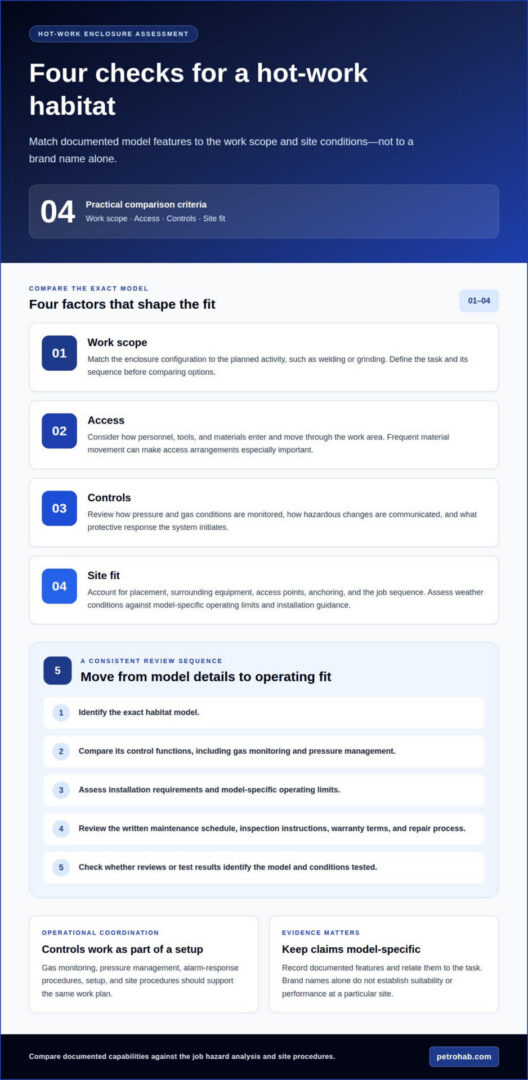
Compare PressureHab and SafeHouse by the control functions of the exact habitat model, not by name alone. A controller that monitors gas levels and pressure can support awareness of conditions inside a pressurized welding habitat. Consider how the system detects hazardous changes, communicates them, and initiates a protective response. Managing ignition risk also depends on the complete work setup, including gas monitoring, pressure management, and alarm-response procedures. Brand names alone do not establish which system performs better.
Setup and anchoring depend on the model, site surface, enclosure configuration, and work plan. Before operation, determine where the habitat will stand, how it will be secured, and how its controls will be operated during the task. Assess performance in wind, rain, or extreme weather using model-specific operating limits and installation guidance. A general comparison cannot establish either brand’s weather rating.
Maintenance, warranty, and repair support vary by manufacturer and model. Compare the written maintenance schedule, inspection instructions, warranty terms, and repair process for the exact habitat. Reviews and test results are useful when they identify the model and conditions tested. Without that detail, they cannot establish how a unit will perform at another site or during different work.
Model availability and purchasing options also depend on the specific habitat and sales arrangements. A brand name alone does not identify the available model or how it can be purchased. Compare each separately rather than assuming all models share the same controls, environmental limits, or support terms.
Use a consistent evaluation sequence: identify the exact model, compare its control functions, and assess installation requirements and operating limits. Then review its maintenance and warranty documents, along with evidence specific to that model. This helps safety teams distinguish documented capabilities from general claims and relate each habitat’s controls to the hot-work scope. It keeps a PressureHab versus SafeHouse assessment focused on operational fit, not unsupported conclusions about either brand.
Industry events can broaden supplier visibility: the AOG exhibition in Australia featured more than 300 exhibiting brands, while ADIPEC 2019 was expected to feature over 2,200 companies from 59 countries and approximately 145,000 attendees.
Pressurized welding enclosures for hot work
Pressurized welding enclosures create a contained work area for hot work where surrounding conditions call for separation. Welding and grinding introduce ignition sources, so evaluate the enclosure alongside the site’s hazard controls. A pressurehab vs Safehouse habitats comparison should focus on the exact model’s configuration, operating instructions, and suitability for the planned task. Brand names alone do not establish performance in a particular work environment.
Define the job before comparing enclosures. Identify whether the scope includes welding, grinding, or another hot-work activity. Then consider the work location, access points, equipment layout, and task sequence. These factors affect how the enclosure is positioned and used. Pressurized hot-work enclosures also require coordinated operation: setup, pressure management, gas monitoring, and site procedures should support the same work plan.
Compare candidate habitats using consistent criteria:
- Work scope: Match the enclosure configuration to the planned welding or grinding activity.
- Access: Consider how personnel, tools, and materials enter and move through the work area.
- Controls: Review how pressure and gas conditions are monitored during operation.
- Site fit: Account for surrounding equipment, placement, and the job sequence.
These criteria connect enclosure design to operational needs. For example, frequent material movement can make access arrangements especially important. The pressurehab vs safehouse habitats comparison should therefore relate documented features to the actual task, not assume every hot-work job presents the same demands.
Align the enclosure plan with the job hazard analysis and site procedures. A useful comparison records how each model’s configuration supports the work scope and how operators use its controls. This helps distinguish documented capabilities from assumptions and keeps the selection focused on the project. For more context on pressurized welding enclosures, consider how enclosure design relates to the task and operating environment.
PressureHab vs SafeHouse: Design and Construction
Compare PressureHab and SafeHouse by exact habitat model, not brand name alone. Construction matters when it affects assembly, access, sealing, or fit at the worksite. Use model-specific construction details to assess each option, rather than making assumptions about its frame, panels, or materials. Record what the documentation states and relate those features to the planned hot-work task.
Start with the physical configuration. Check how the enclosure is assembled, what forms its walls and roof, and where its entry points are. At a site with restricted clearance, for example, component dimensions and assembly sequence may determine whether the enclosure fits. Then examine how wall and roof joints connect, how openings close, and whether the configuration suits the required layout.
- Frame and panels: Record construction materials, connection methods, and how components join.
- Access points: Compare door placement and opening arrangements against personnel and equipment movement.
- Seams and closures: Review how edges, joints, and openings are assembled for the intended enclosure configuration.
- Site fit: Match the documented footprint and assembly sequence to the work area and surrounding equipment.
Next, assess how each design supports setup and handling. A modular construction may use separate components, while another configuration may arrive in larger assemblies. Treat these as questions to answer from the model documentation. Compare assembly steps, connection points, and component-handling requirements using the same worksite assumptions for both options.
A useful PressureHab versus SafeHouse comparison separates evidence from inference. Record each candidate’s model identifier, construction description, and relevant drawings. Map each documented feature to a specific constraint, such as limited access or equipment positioning. This clarifies which design fits the job without assigning unsupported advantages to either manufacturer. Assess construction separately from control performance and operating ratings, which require their own model-specific comparisons.
What are the dimensions, capacity, and pressure ratings of each habitat?
Compare dimensions, capacity, and pressure ratings by exact habitat model. A brand name alone does not establish a unit’s footprint, usable workspace, or operating limits. Use the technical documentation for each PressureHab and SafeHouse model, and compare equivalent configurations. This avoids treating every habitat in a product family as if it shared the same measurements or ratings.
Start with external dimensions, then determine the usable interior area. External measurements show whether an enclosure fits the designated worksite; interior space affects personnel movement, equipment placement, and welding access. A habitat might fit within a site boundary but leave too little room for the planned equipment layout. Compare entrances and obstructions alongside the measurements because they can reduce usable workspace.
Assess capacity against the intended operating load, not enclosure size alone. Consider the personnel, tools, materials, and equipment needed for the hot-work task. A setup with bulky welding equipment needs a different layout from one using compact tools. Relate capacity to the work plan, access routes, and safe movement rather than relying on a size label.
Compare pressure ratings carefully. Record each model’s stated operating pressure and unit, such as psi or kPa, and make sure the figures use the same basis. A rating is meaningful only with the manufacturer’s stated operating conditions and limits. Do not infer pressure performance from dimensions, appearance, or another model in the same range.
Use a comparison sheet with four fields: model, external dimensions, usable capacity, and operating pressure rating. Add configuration notes so each entry describes the habitat as it will be used. This gives project teams a clear way to identify a fit against site constraints and job requirements without assuming either brand is suitable by default. Discuss habitat sizing and pressure requirements in relation to your planned work.
PetroHab: Safe-Stop Automatic Shutdown System
The Safe-Stop Safety Shutdown System monitors differential pressure and gas levels to support worker safety in hazardous environments. It is relevant when selecting a habitat also involves deciding how these conditions will be monitored during hot work. Consider the system alongside the habitat configuration and project operating procedures, not as a substitute for assessing enclosure suitability.
For a complete system assessment, relate gas and pressure monitoring to the work scope and habitat controls. PetroHab’s Hot Work Safety Enclosure (HWSE), Quadra-Lock® panels, and pressurized welding enclosures can support planning for a contained hot-work setup. The appropriate configuration depends on the project’s enclosure requirements.
Contact PetroHab to discuss the Safe-Stop system and habitat options for your hot-work application.
Turn the comparison into a project decision
Use a pressurehab vs Safehouse habitats comparison to match documented equipment capabilities to the job. Next, align the selected habitat’s specifications with the work scope, site conditions, and operating plan. This gives safety and engineering teams a clearer basis for planning without relying on brand reputation or assumptions about a product family.
For work requiring a dedicated hot-work enclosure and integrated monitoring, PetroHab offers the Petro-Habitat™ HWSE, Safe-Stop Safety Shutdown System, and Quadra-Lock® panels. These products are relevant when enclosure construction and gas or pressure monitoring form part of the requirements. The right configuration depends on the application.
Bring your project requirements into a focused discussion about habitat options and control needs. Contact PetroHab about habitat options to take the next step with a clearer basis for your decision.
Frequently Asked Questions
What materials and safety features does each habitat include?
PetroHab’s Petro-Habitat™ HWSE uses fire-retardant materials, including silicone-coated fiberglass panels joined with patented Quadra-Lock® technology; Kevlar thread is used for stitching. PetroHab habitats are ATEX- and IECEx-certified. Safe-Stop monitors differential pressure and gas levels. To compare a SafeHouse habitat, review the exact model’s manufacturer specifications for materials, controls, and included features. A name alone does not establish a unit’s construction or configuration.
What reviews and real-world test results are available for each habitat?
Reviews and real-world test results are useful when they identify the exact model and conditions tested. Compare that evidence with conditions at the intended worksite.
What are PressureHab and SafeHouse Habitats, and who makes them?
PressureHab and SafeHouse habitats are pressurized welding enclosures that create a contained work area for hot work where surrounding conditions call for separation.