Blog Posts
Hot Work Habitat Supervisor Certification: Technical Competency Guide (2026)
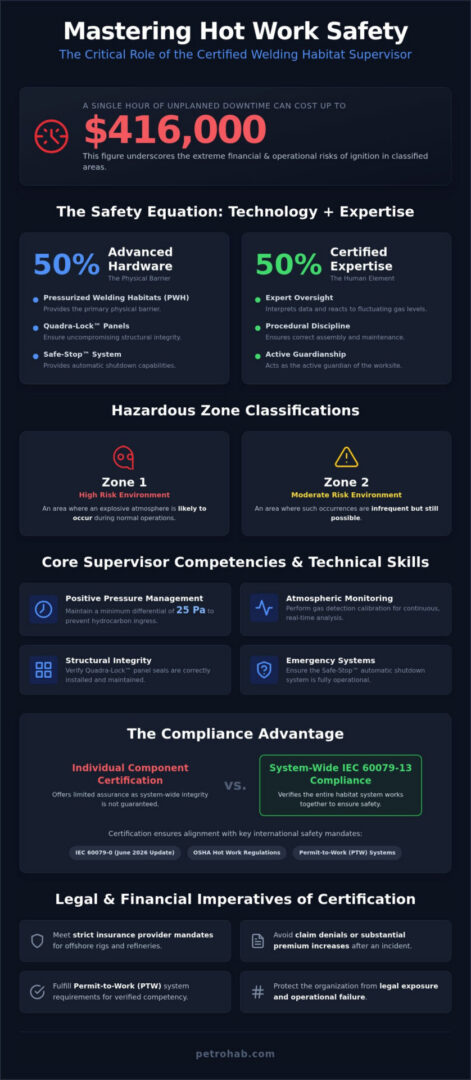
In offshore operations, a single hour of unplanned downtime can cost an operator as much as $416,000. For safety managers and engineers, this figure represents more than just financial loss. It reflects the extreme risks associated with ignition in classified areas. Achieving a welding habitat supervisor certification is no longer a secondary qualification. It’s a critical operational requirement. You likely understand that even the most advanced pressurized welding habitats require a human element of uncompromising precision to maintain safety.
We agree that equipment alone cannot eliminate risk in hazardous environments. This guide provides the technical roadmap to master the safety protocols and regulatory requirements, such as the June 2026 update to IEC 60079-0, necessary for zero-incident hot work. You’ll gain a comprehensive understanding of how to verify structural integrity using Quadra-Lock panels and how to integrate the Safe-Stop automatic shutdown system into existing safety frameworks. We’ll examine the specific competencies required to maintain positive pressure and ensure full compliance with the latest international standards.
Key Takeaways
- Understand the mandatory training requirements for personnel operating in high-risk Zone 1 and Zone 2 environments to mitigate ignition risks effectively.
- Gain insight into the technical curriculum for welding habitat supervisor certification, focusing on gas detection calibration and positive pressure maintenance.
- Identify the regulatory advantages of system-wide IEC 60079-13 compliance over individual component certification for pressurized habitats.
- Learn how to utilize Quadra-Lock technology and Safe-Stop systems within a rigorous competency framework to protect personnel and assets.
- Discover how professional training programs facilitate the seamless integration of Hot Work Safety Enclosures into complex industrial safety systems.
Why Certified Hot Work Habitat Training is Mandatory for High-Risk Sites
Technical competency in hazardous environments isn’t a suggestion. It’s a fundamental safeguard. Specialized training ensures that personnel can maintain the absolute integrity of a pressurized welding habitat (PWH) under operational stress. While hardware like the PetroHab Hot Work Safety Enclosure (HWSE) provides the physical barrier, the human element determines the ultimate success of the containment strategy. Relying on advanced technology without a corresponding welding habitat supervisor certification creates a dangerous gap in site safety.
To better understand the rigor required for technical inspections and preparation in a professional setting, watch this video regarding codebook standards:
Hardware is only 50% of the safety equation. The remaining 50% relies on the supervisor’s ability to interpret environmental data and react to fluctuating gas levels. Without this expert oversight, even the most sophisticated systems can fail due to improper assembly or neglected maintenance. A certified supervisor acts as the active guardian of the site, ensuring that the modular Quadra-Lock panels are correctly sealed and that the Safe-Stop system is fully operational before work begins.
Identifying Hazards in Offshore and Onshore Facilities
In oil and gas facilities, the distinction between Zone 1 and Zone 2 environments dictates the level of protection required. Zone 1 areas involve explosive atmospheres that are likely to occur during normal operations; Zone 2 involves atmospheres where such occurrences are infrequent but still possible. Hot work activities inevitably generate ignition sources like high-velocity sparks and thermal slag. Following established hot work safety practices is mandatory to prevent these sources from contacting flammable hydrocarbons. A habitat failure in these pressurized environments doesn’t just halt production. It risks catastrophic structural damage and loss of life.
The Legal and Insurance Implications of Uncertified Personnel
Safety managers face significant liability risks when deploying uncertified labor for high-stakes hot work. Insurance providers for offshore rigs and refineries often mandate that all habitat operations be overseen by personnel with a recognized welding habitat supervisor certification. Non-compliance can lead to the denial of claims or substantial increases in premiums. Additionally, the Permit-to-Work (PTW) system requires verified competency before any ignition source is introduced into a classified area. Using certified supervisors ensures that every step of the process aligns with international safety mandates, protecting the organization from both legal exposure and operational failure.
The Technical Curriculum: Mastering Pressure Integrity and Gas Detection
A welding habitat supervisor certification demands more than a basic understanding of equipment assembly. It requires deep technical mastery of fluid dynamics and electronic safety interfaces. Supervisors must ensure that the internal atmosphere remains isolated from external explosive gases at all times. This is achieved through precise pressure management and continuous real-time gas monitoring. These protocols align with established OSHA hot work regulations, which dictate rigorous fire protection and environmental controls in hazardous industrial locations.
Pressure Differential Management
The core of HWSE safety is the maintenance of overpressure. Supervisors use calibrated manometers to verify a minimum pressure differential of 25 Pascal. This positive pressure creates a physical barrier, forcing air out of any microscopic gaps and preventing hydrocarbon ingress. Troubleshooting seal integrity issues in real-time is a critical skill. If the manometer shows a pressure drop, the supervisor must immediately identify whether the issue lies with the Quadra-Lock panel alignment or a failure in the air supply system. Maintaining this pressure is the only way to prevent gas ingress effectively.
Safe-Stop Automatic Shutdown Integration
Modern habitats rely on the Safe-Stop Automatic Shutdown System to eliminate the possibility of human error during a gas release event. The certification curriculum covers the specific triggers for an automatic shutdown, which typically occurs if gas is detected at 10% of the Lower Explosive Limit (LEL). Technicians must test the electronic interface between the gas detection sensors and the welding power source regularly. This ensures that the arc is extinguished instantly if hazardous gases are detected at the air intake. Resetting the system after a safety-induced event requires a methodical inspection to confirm the atmosphere is clear before work resumes.
Supervisors are responsible for calibrating and monitoring gas detection sensors. These sensors must be strategically placed at both the air intake and the habitat exhaust to provide a comprehensive safety loop. Managing air ducting and ventilation is equally vital for worker respiratory safety. It prevents the buildup of toxic welding fumes and ensures a continuous supply of breathable air. Because the patented Quadra-Lock technology allows for structural integrity verification in 50% less time than traditional systems, supervisors can focus more of their attention on these high-level monitoring tasks. Our certified training modules provide hands-on experience with these technical interfaces, ensuring supervisors can manage complex HWSE setups with absolute reliability.
Compliance with IEC60079-13 and International Safety Standards
Regulatory compliance in explosive atmospheres requires a rigorous understanding of international directives. Safety managers often mistake component-level certification for system-level safety. While individual sensors or fans might carry ATEX or IECEx labels, the entire pressurized habitat must function as a single, validated unit. Compliance with IEC 60079-13 is the benchmark for these systems. It ensures the habitat maintains integrity under specified fault conditions. A welding habitat supervisor certification provides the technical foundation needed to interpret these standards and apply them to real-world offshore and onshore environments.
Proper training aligns habitat operations with the most current Hazardous Environment Standards. This alignment is critical for maintaining a valid Permit-to-Work (PTW) system. Supervisors must document all safety parameters, including pressure logs and gas sensor calibration records, to satisfy OSHA audits and third-party inspections. Precise record-keeping transforms safety from a concept into a verifiable operational fact. It ensures that the protective measures in place are both active and documented.
Navigating ATEX Zone Classifications (0, 1, 2)
Supervisors must recognize on-site zone boundaries to ensure equipment is fit for purpose. Zone 0 represents a continuous explosive risk, while Zone 1 is likely to experience hazardous atmospheres during normal operations. Zone 2 carries a lower but still significant risk. Certified personnel understand that equipment selection must match these specific requirements. Procurement teams rely on 3rd party verified training certificates to ensure that the personnel managing these zones possess the technical discipline to prevent ignition events.
Global Standards: NFPA 51B and Beyond
Fire prevention during welding, cutting, and burning is governed by NFPA 51B. This standard mandates strict controls over ignition sources. Aligning habitat operations with international welding safety codes ensures that hot work does not compromise the facility’s broader safety culture. During active turnarounds, habitats often face 3rd party safety inspections. A certified supervisor ensures that the modular Quadra-Lock panels and Safe-Stop systems are configured to meet these high-stakes evaluations without causing operational delays. This level of preparedness is essential for maintaining zero-incident operations in the energy sector.
Implementing On-Site Supervision: A Step-by-Step Competency Framework
The transition from technical compliance to field execution requires a structured competency framework. While previous sections detailed the regulatory and theoretical aspects, on-site supervision focuses on the physical reality of habitat containment. A welding habitat supervisor certification validates that a technician can manage the high-stakes environment of a live industrial site. It moves beyond classroom knowledge into the practical application of risk mitigation strategies. This expertise is what prevents minor technical issues from escalating into major safety incidents.
Certified on-site technicians are indispensable for complex HWSE setups. They conduct hands-on assessments to verify that operators can identify potential leak paths before they become safety failures. In 2026, re-certification remains a mandatory requirement to keep skills current with evolving hardware and gas detection software. This ongoing training ensures that the personnel responsible for asset protection remain as resilient as the systems they operate. It’s the only way to maintain a zero-incident safety culture in high-risk environments.
The Modular Setup: Quadra-Lock Panels
The assembly of a gas-tight enclosure in irregular structural environments is a core supervisor competency. Training focuses on the step-by-step interlocking of Quadra-Lock panel technology to ensure a secure seal around pipes, beams, and deck penetrations. Because these panels are modular, they allow for a customized hot work safety enclosure that fits the specific geometry of the work area. This patented design reduces assembly time by 50% compared to traditional methods. This speed doesn’t compromise integrity; it allows for more thorough pre-work safety inspections and faster operational readiness.
On-Site Supervision Best Practices
Effective supervision begins before the first arc is struck. The supervisor leads the daily safety briefing and tool-box talk, ensuring all personnel recognize the specific hazards of the shift. During live welding operations, the supervisor monitors the habitat’s integrity and pressure levels continuously. This role requires constant coordination with the facility’s main control room and safety officers. If a pressure drop occurs or gas is detected, the supervisor manages the site’s response according to established emergency protocols. They act as the active guardian of the site, ensuring that safety is never sacrificed for speed.
For companies seeking to eliminate operational risk, our professional on-site supervision services provide the expertise needed to manage complex offshore and onshore projects with absolute confidence.
PetroHab’s Professional Certification Programs: Securing Your Assets
PetroHab provides tailored training programs designed to meet the rigorous demands of the global energy sector. These modules go beyond basic hardware operation. They embed the Hot Work Safety Enclosure (HWSE) directly into the facility’s overarching safety culture. Whether the asset is a deep-water platform in Brazil or a high-capacity refinery in the UK, the objective remains the same: total risk mitigation through technical mastery. Achieving a welding habitat supervisor certification through our program ensures that your personnel are prepared for the high-stakes environment of heavy industry.
Our certified training teams operate globally, maintaining a consistent presence in the US, Brazil, and the UK. We recognize that offshore platforms present unique spatial and logistical challenges compared to onshore refineries. Our curriculum is customized to address these environmental specifics. For offshore projects, we emphasize the modularity of the HWSE and the critical nature of on-site supervision for complex, multi-level structures. Onshore training focuses on high-volume throughput and the integration of pressurized habitats into dense refinery layouts.
PetroHab Certification: The Industry Benchmark
Trainees receive a formal credential upon successful completion of the course. This welding habitat supervisor certification signifies a verified level of competency in managing pressurized welding enclosures and the Safe-Stop automatic shutdown interface. We maintain comprehensive training records that client procurement and HR teams can verify at any time. This transparency ensures that only qualified personnel operate high-value assets. By standardizing these requirements, we build long-term partnerships focused on safety excellence and operational continuity. It’s a commitment to protecting both personnel and the structural integrity of the facility.
Next Steps: Booking Your Training Session
Integrating professional training with equipment leasing is the most effective way to ensure site safety. Many operators choose to combine the procurement of PetroHab habitats with mandatory supervision to guarantee zero-incident performance. Planning these sessions well in advance of major refinery turnarounds or scheduled shutdowns prevents technical bottlenecks. It ensures your team is ready the moment the permit-to-work is issued. In 2026, PetroHab’s mission is to eliminate industrial accidents by bridging the gap between advanced containment technology and human technical competency.
Advancing Industrial Safety Through Technical Competency
Achieving zero-incident hot work requires a calculated integration of advanced hardware and verified human expertise. We’ve established that maintaining pressure integrity and adhering to the latest IEC 60079-13 standards are the baseline for operational safety. A welding habitat supervisor certification transforms these technical requirements into a functional reality on-site. By deploying patented Quadra-Lock technology alongside certified Safe-Stop shutdown systems, you establish a redundant safety framework that shields your personnel and high-value assets from ignition risks.
Our global expert technicians remain available for on-site oversight in the US, Brazil, and the UK, ensuring every installation meets the highest industry benchmarks. You can Secure Your Site with PetroHab’s Certified Training & Supervision to ensure your team possesses the rigorous discipline required for hazardous environments. Prioritizing these technical competencies today builds a foundation for long-term operational resilience. We’re committed to helping you maintain an uncompromising standard of safety across all your global projects.
Frequently Asked Questions
How long does hot work habitat supervisor training typically take?
Training typically takes two to three days to complete. This duration allows for a thorough review of theoretical safety concepts followed by practical, hands-on assembly of the modular panels. It ensures that every participant can demonstrate technical proficiency before receiving their credentials.
Who is required to undergo HWSE training on an industrial site?
Personnel designated as habitat supervisors or operators must undergo this specialized training. Safety managers and engineers also benefit from understanding the system’s operational limits. This ensures that the entire team understands the protocols for maintaining overpressure in classified areas.
Is PetroHab training compliant with IEC60079-13?
PetroHab training programs are fully compliant with the IEC 60079-13 standard for pressurized rooms. This compliance is vital for operations in Zone 1 explosive atmospheres where system-wide integrity is a legal requirement. We align our curriculum with the latest 2026 regulatory updates to ensure absolute site safety.
Do we need a certified supervisor if we purchase our own habitat?
Verified oversight is mandatory regardless of equipment ownership. Obtaining a welding habitat supervisor certification ensures that your internal team can manage the complex Safe-Stop interfaces and maintain the Quadra-Lock seals effectively. Insurance providers often require this certification to maintain coverage during hot work.
Can training be conducted on-site at our offshore platform?
We provide on-site training at offshore platforms and onshore refineries globally. Our instructors travel to facilities in the US, Brazil, and the UK to provide real-world instruction in your specific operational environment. This approach allows your team to train on the exact structural configurations they’ll manage during live operations.
What is the validity period of a habitat technician certification?
A welding habitat supervisor certification is typically valid for two years. Periodic re-certification is necessary to ensure technicians remain proficient with the latest gas detection technologies and safety standards. This cycle maintains a high level of readiness for major turnarounds and scheduled shutdowns.
Does the training cover the Safe-Stop automatic shutdown system?
The Safe-Stop automatic shutdown system is a core component of the technical curriculum. Trainees learn to calibrate gas sensors and test the electronic interface that shuts down welding power if hazardous gases are detected. This module is essential for preventing human error during a gas release event.
What happens if a habitat technician fails the competency assessment?
Technicians who don’t meet the competency benchmarks must complete remedial modules. We don’t issue certifications until the candidate demonstrates an uncompromising ability to maintain habitat integrity. This rigorous assessment process protects your personnel and high-value assets from operational failures.