
Blog Posts
Wind Load Ratings for Temporary Safety Enclosures: Engineering Stability in High-Stakes Zones
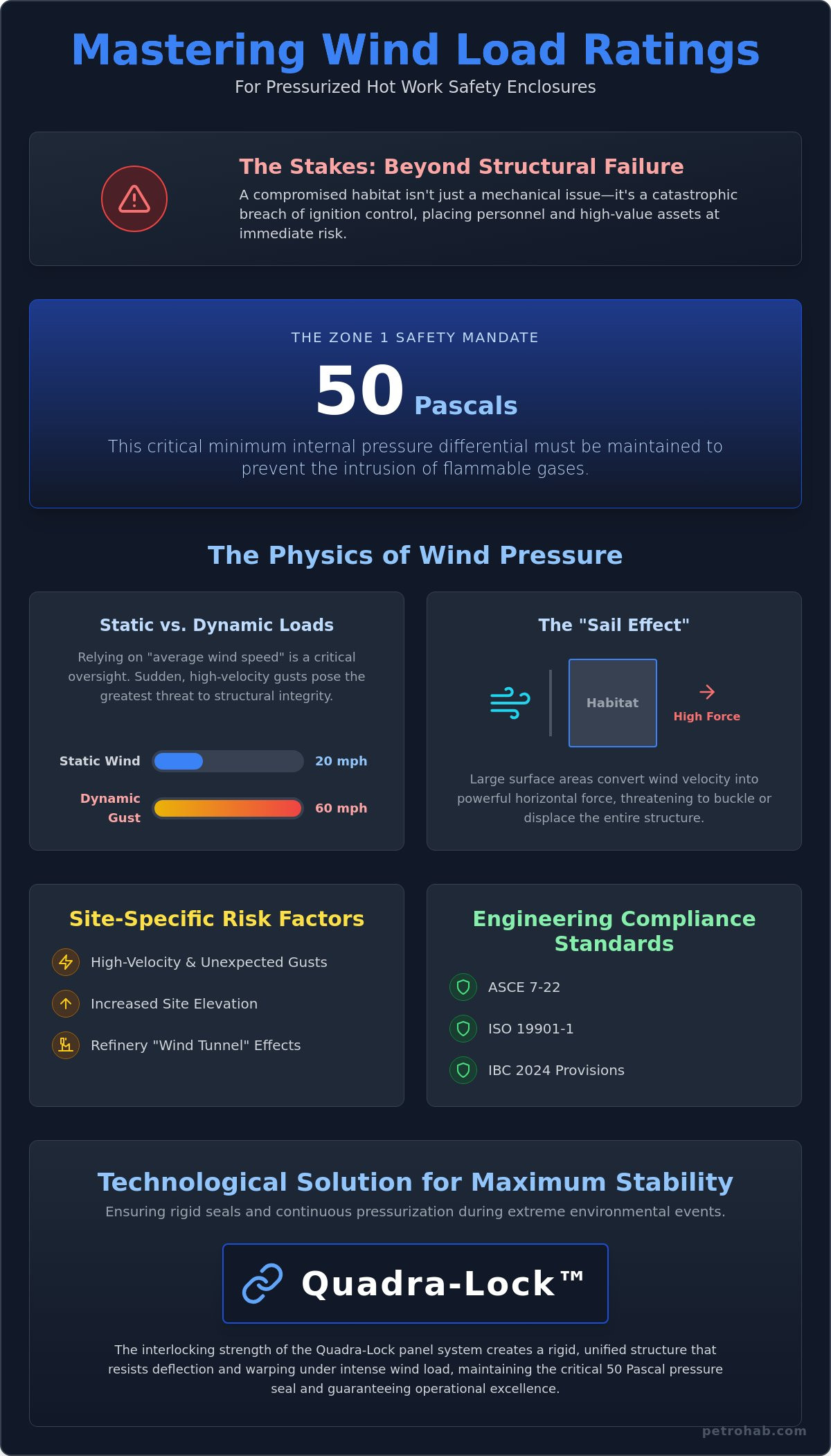
Structural failure in a high-stakes industrial zone is never merely a mechanical issue; it is a catastrophic breach of ignition control that places personnel and high-value assets at immediate risk. Safety engineers frequently struggle with vague manufacturer claims when attempting to verify if a habitat will remain pressurized as environmental conditions deteriorate. Mastering the technical requirements for wind load ratings for temporary safety enclosures is the only definitive way to ensure your hot work operations remain structurally sound and compliant with Permit-to-Work (PTW) protocols during high-wind events.
We understand the difficulty of calculating site-specific wind loads for modular structures, particularly as ASCE 7-22 and the 9th Edition of the Florida Building Code introduce more stringent requirements. This guide provides the technical clarity needed to evaluate enclosure stability against rigorous international standards. You’ll gain a clear understanding of how the Quadra-Lock panel system maintains the critical 50 Pascal pressure differential required to prevent gas intrusion. We will also examine the latest IBC 2024 provisions for temporary structures to help you select a solution that guarantees operational excellence in hazardous environments.
Key Takeaways
- Define the maximum velocity thresholds for wind load ratings for temporary safety enclosures to prevent structural failure and hazardous pressure loss.
- Calculate drag coefficients and manage the “Sail Effect” to maintain structural integrity against high-velocity gusts.
- Apply international engineering benchmarks like ASCE 7 and ISO 19901-1 to verify habitat compliance and safety.
- Identify site-specific risks such as elevation and refinery wind tunnel effects that significantly increase pressure on temporary structures.
- Utilize the interlocking strength of Quadra-Lock technology to ensure rigid seals and continuous pressurization during extreme environmental events.
Defining Wind Load Ratings for Temporary Safety Enclosures
A wind load rating represents the definitive threshold of structural endurance for a pressurized habitat. It’s defined as the maximum wind velocity a temporary structure can withstand before reaching a point of structural failure or unacceptable deflection. In the context of hot work safety enclosures, this rating isn’t merely a performance metric; it’s a critical safety boundary. If the enclosure’s frame or skin deflects beyond its design limits, the internal positive pressure required to exclude flammable gases is compromised.
Engineers must apply principles of wind engineering to account for how external forces interact with modular habitat components. Unlike permanent buildings, temporary enclosures often lack deep-set foundations. This makes them susceptible to sliding or overturning. Accurate wind load ratings for temporary safety enclosures ensure that the system remains anchored and airtight, even when exposed to the turbulent conditions common in refineries or offshore platforms.
To better understand this concept, watch this helpful video:
Static vs. Dynamic Wind Loads
Understanding the distinction between static and dynamic loads is vital for risk mitigation. Static pressure is the constant force exerted by a steady wind. While significant, it’s often the dynamic loads, specifically sudden, high-velocity gusts, that cause the most damage. These rapid changes in pressure create a pulsing effect. This can fatigue modular panel joints and weaken seal integrity over time.
Relying on “average wind speed” as a planning metric is a dangerous oversight. A site may report an average speed of 20 mph, but a single 60 mph gust can exceed the structural capacity of an unrated enclosure. Safety protocols must account for peak gust velocities to prevent catastrophic collapse during unexpected weather shifts. Precision in these calculations is what separates a reliable enclosure from a liability.
The Criticality of Ratings in Hazardous Zones
In hazardous environments, structural geometry is the first line of defense against ignition. If wind pressure causes the habitat to warp, the interlocking seals of the Quadra-Lock panels may experience stress. This potentially allows gas ingress. Beyond structural failure, excessive vibration can trigger false alarms in the Safe-Stop Automatic Shutdown System sensors. This disrupts operations and compromises the safety narrative of the site.
Regulatory bodies in offshore sectors expect enclosures to meet specific wind resistance standards. These requirements ensure that hot work continues safely during moderate weather events. Maintaining the 50 Pascal pressure differential depends entirely on the enclosure’s ability to resist external wind force without deforming. Every millimeter of deflection matters when personnel safety is the priority.
The Physics of Wind Pressure on Pressurized Welding Habitats
The structural integrity of a pressurized welding habitat depends on its ability to counteract aerodynamic forces. Unlike flat fencing, these enclosures are three dimensional structures that disrupt airflow, creating complex pressure differentials. When wind hits a vertical wall, it creates a “Sail Effect.” This occurs when the massive surface area converts wind velocity into high horizontal force. This force attempts to displace the unit or cause the walls to buckle inward, threatening the internal environment.
A critical challenge in maintaining wind load ratings for temporary safety enclosures is the battle between internal positive pressure and external wind force. To prevent gas ingress, Zone 1 safety requirements dictate a minimum pressure differential of 50 Pascals (0.2 inches of water column). If external wind pressure exceeds this internal threshold at any point, the habitat risks losing its protective seal. This is particularly dangerous on the windward side where pressure is highest, and the leeward side where suction can pull panels outward. If you are planning a high-stakes hot work project, you can consult with our technical team to review your site-specific pressure requirements.
Roof stability introduces additional complexity through suction and uplift. As air accelerates over the top of the enclosure, it creates a low-pressure zone. This effectively tries to lift the roof off the frame. Engineers must calculate these uplift forces to ensure the habitat remains grounded. Without rigid panel connections, this uplift can create gaps in the ceiling, allowing pressurized air to escape and potentially drawing in outside contaminants.
Calculating Drag on 3D Modular Structures
Air flow around a cube-shaped pressurized welding habitat is turbulent and non-linear. Panel rigidity is the primary defense against wind-induced deformation. If panels are too flexible, they vibrate and flex. This compromises the airtight seals between modules. For a standard rectangular enclosure, the drag coefficient typically ranges between 1.0 and 1.3, depending on the aspect ratio and surface roughness of the material.
Anchoring and Ballast Strategies
Securing these structures requires a calculated approach to anchoring and ballast. Mechanical anchoring, such as bolting to a steel deck, offers the highest security. However, this is not always feasible on live modules. In these cases, friction-based ballast systems using specialized weights are necessary. Calculating the required weight involves analyzing the wind speed, the structure’s weight, and the friction coefficient of the surface to prevent sliding or overturning.
Adhering to ASCE industry standards ensures that these calculations account for the specific exposure category of your site. In high-exposure locations, such as offshore platforms or elevated refinery decks, specialized bracing becomes mandatory. These braces distribute the horizontal load across multiple points. This reinforces the Quadra-Lock panel joints and maintains the habitat’s geometric stability under extreme stress.
Engineering Standards and Compliance for Wind Resistance
Adherence to established engineering standards is the only way to validate wind load ratings for temporary safety enclosures in high-stakes industrial environments. The industry benchmark for these calculations is ASCE 7, specifically the updated ASCE 7-22 standard. This document provides the methodology for determining minimum design loads for buildings and other structures, including wind speed maps and exposure categories. While some manufacturers attempt to use ASCE 37 guidelines to justify reduced loads for short-term construction, this approach is often insufficient for pressurized habitats. Because a habitat failure in a hazardous zone can lead to an immediate ignition event, the structural requirements must remain uncompromising regardless of the project’s duration.
For offshore assets, ISO 19901-1 provides specific criteria for wind and wave actions. These standards account for the extreme turbulence and sustained high velocities encountered on production platforms and drilling rigs. Compliance with these hazardous environment standards ensures that the enclosure does not become a projectile or a source of ignition during sudden weather shifts. Third party structural engineering certification acts as the final layer of verification. It confirms that the manufacturer’s claims are backed by rigorous mathematical modeling rather than internal estimates.
Global Standards for Temporary Structures
Safety managers operating internationally must navigate varying regional requirements. While the US relies on ASCE, European projects often follow Eurocode (EN) standards, and Australian sites utilize AS 1170.2. A key distinction across these frameworks is how they treat “short-term” design life. Many standards allow for a reduction in wind speed requirements for structures intended to stand for less than six weeks. However, for hot work safety, this reduction is rarely acceptable. The risk profile of a welding habitat does not decrease just because the job is brief. Professional safety planning requires checking manufacturer test reports against OSHA wind safety standards and local building codes to ensure the structure is rated for the 1 in 50 year or 1 in 100 year peak gust for that specific location.
Structural Integrity and ATEX Compliance
There’s a direct, often overlooked link between wind resistance and ignition prevention certifications like ATEX or IECEx. These certifications assume the enclosure remains a sealed, pressurized environment. If wind force causes significant deflection or panel separation, the system’s ability to contain sparks or exclude flammable gases is lost. In effect, a structural failure is an ATEX failure. The Quadra-Lock panel system addresses this by maintaining rigid connections that prevent the gaps that common fabric or loose-panel systems suffer under load. Ensuring the enclosure remains a controlled environment under peak load conditions is the primary function of a high-performance habitat. When seals are compromised by wind-induced movement, the risk of spark escape increases exponentially, rendering the safety protocol void.
Site-Specific Risk Assessment: Evaluating Wind Exposure
A standardized wind rating is only the starting point for industrial safety. Engineers must translate theoretical wind load ratings for temporary safety enclosures into site-specific operational limits. Refineries and offshore modules are dense with structural steel, which creates “Wind Tunnel” effects. These narrow corridors between storage tanks or processing units can accelerate air velocity far beyond the regional average. A habitat placed in such a zone experiences concentrated forces that standard calculations might overlook.
Elevation is another critical variable. Wind speed increases significantly as you move away from the surface of the earth or sea. A pressurized habitat installed at ground level faces much lower pressure than one positioned on a 30-meter high offshore module. Because wind pressure is proportional to the square of the velocity, even a minor increase in height can lead to a substantial jump in the force applied to the Quadra-Lock panels. To ensure your project remains compliant, request a technical site evaluation from our engineering team to verify your habitat’s stability.
Factors Affecting Real-World Wind Speed
Determining the “Exposure Category” is the first step in a professional risk assessment. ASCE 7 defines these categories based on the surrounding terrain. Category B covers urban and suburban areas with numerous obstructions. Category C applies to open terrain with scattered obstructions, while Category D represents the most severe exposure, such as flat, unobstructed shorelines or offshore platforms. Local obstructions create turbulent wind loads that can cause rapid, irregular shaking of the enclosure, testing the limits of its anchoring system.
Operational Limits and Shutdown Protocols
A comprehensive Wind Action Plan must define two distinct thresholds: the maximum wind speed for safe assembly and the “Stop Work” limit for ongoing operations. It is often unsafe to assemble a habitat when wind speeds exceed 20 mph, even if the completed structure is rated for much higher velocities. Once the enclosure is fully secured and pressurized, the shutdown protocol should trigger based on the specific wind load ratings for temporary safety enclosures utilized on-site.
Modern safety management integrates these thresholds into hot work safety systems. If local anemometers detect sustained winds or gusts approaching the habitat’s structural limit, the Safe-Stop Automatic Shutdown System should be prepared to isolate the ignition source. This proactive approach prevents the scenario where a habitat collapses while hot work is active, eliminating the risk of a flash fire in a hazardous zone.
Maximum Stability with PetroHab Quadra-Lock Technology
Traditional paneling systems often fail in high-wind industrial environments because they lack the structural rigidity required to resist deformation. Fabric-based enclosures or loose-fitting modular systems can act as uncontrolled sails. When these systems deflect, the critical seals between components are stretched or broken, leading to a loss of the 50 Pascal positive pressure differential. PetroHab addresses these vulnerabilities through the rigorous engineering of the Quadra-Lock panel system. This technology transforms the habitat from a collection of parts into a resilient, engineered structure capable of withstanding the turbulent forces found in refineries and offshore modules.
The Quadra-Lock Advantage
The Quadra-Lock system creates a unified structural shell that distributes wind loads across the entire habitat surface. This design eliminates the weak links found in standard modular enclosures where panels are merely overlapped or loosely fastened. By utilizing a patented interlocking mechanism, the system ensures superior air-tightness even under significant external wind pressure. This structural continuity is essential for maintaining wind load ratings for temporary safety enclosures in areas where sudden, high-velocity gusts are common.
Key engineering features include:
- High-strength panel composition certified to ANSI/FM 4950 standards for fire resistance.
- Interlocking joint geometry that resists shear forces and prevents panel separation under load.
- Rigid seal surfaces that maintain airtight contact during structural oscillation.
- Direct integration with Safe-Stop Automatic Shutdown System sensors for continuous safety monitoring.
This level of precision ensures that the habitat remains a definitive barrier against ignition, even when external environmental conditions deteriorate. By focusing on the mechanical integrity of the joints, we eliminate the risk of habitat collapse causing a fire in a hazardous zone.
Custom Engineering for Extreme Conditions
PetroHab provides site-specific structural calculations to ensure your habitat meets the exact requirements of your worksite. For projects in high-exposure categories, such as offshore platforms or coastal refineries, we offer optional bracing and anchoring kits. These components reinforce the habitat against peak gust velocities that would compromise lesser systems. This custom approach is vital for securing Permit-to-Work (PTW) approval in high-stakes zones where risk mitigation is scrutinized by safety auditors.
Operational data from offshore deployments confirms that Quadra-Lock enclosures maintain structural geometry and internal pressure during severe storm conditions. While standard habitats are typically designed for wind speeds up to 30 m/s, PetroHab’s engineering team can adapt the system for even more demanding environments. This reliability allows safety managers to proceed with hot work operations with absolute confidence in their safety protocols. To ensure your next project is protected against environmental hazards, contact PetroHab for a technical consultation on your high-wind safety requirements.
Securing Operational Continuity in High-Wind Zones
Engineering stability in hazardous environments requires a disciplined approach to site-specific data and rigorous adherence to international standards. You’ve learned that elevation and local topography can exponentially increase wind pressure; this makes generic manufacturer claims insufficient for high-stakes Permit-to-Work (PTW) approvals. Ensuring accurate wind load ratings for temporary safety enclosures is the only way to prevent structural deflection from compromising your ignition control protocols and personnel safety.
By integrating patented Quadra-Lock panel technology, you move beyond basic containment to a unified structural shell certified to international safety standards. This system has demonstrated proven performance in extreme offshore environments, maintaining the critical pressure differential even when standard modular enclosures fail. We invite you to Request a Quote for Wind-Rated Pressurized Habitats to fortify your next hot work project against environmental risks. Our engineering team stands ready to help you maintain absolute control over your hazardous work zones with equipment built for industrial resilience.
Frequently Asked Questions
What is a typical wind load rating for a hot work safety enclosure?
Most industrial welding habitats are engineered to withstand sustained winds of 30 m/s, which is roughly 67 mph. However, this isn’t a universal constant. The actual wind load ratings for temporary safety enclosures must be verified against the specific exposure category of your site. Factors like elevation and local wind tunnel effects can necessitate higher ratings or additional bracing to prevent structural failure or hazardous pressure loss.
How do I calculate the wind pressure on my temporary habitat?
Calculate wind pressure by applying the standard engineering formula where pressure equals 0.00256 times the square of the wind velocity, adjusted by a drag coefficient and height factor. You should consult ASCE 7-22 wind speed maps to determine the basic wind speed for your geographic coordinates. This calculation ensures the enclosure remains stable and pressurized under the expected environmental loads of the specific module or deck.
Can I use a safety enclosure during a hurricane or tropical storm?
Hot work safety enclosures aren’t designed for hurricane-force winds and must be dismantled before such an event occurs. Standard operational protocols dictate a Stop Work threshold far below hurricane speeds, typically around 35 to 45 mph. Attempting to maintain a habitat during a tropical storm risks catastrophic structural failure and the loss of ignition control in hazardous zones, which endangers both personnel and high-value industrial assets.
Does a pressurized habitat have a higher wind rating than a non-pressurized one?
A pressurized habitat doesn’t inherently have a higher wind rating; rather, it has a more critical requirement for structural rigidity. The internal positive pressure must combat external wind force to prevent gas ingress. Systems using Quadra-Lock panels offer superior stability because the interlocking joints prevent the deflection that common non-pressurized fabric covers experience under high wind loads, ensuring the 50 Pascal safety threshold is maintained.
What anchoring method is best for high-wind offshore platforms?
Mechanical anchoring is the most reliable method for high-wind offshore platforms, involving bolting the frame directly to the steel deck. When hot work permits or structural constraints prevent drilling, friction-based ballast systems using specialized weights are used. These systems must be precisely calculated to prevent sliding or overturning based on the enclosure’s total surface area and the site’s exposure category to ensure continuous safety.
How does wind speed affect the automatic shutdown system?
High wind speeds can impact the Safe-Stop Automatic Shutdown System if the force causes enough structural deflection to trigger pressure sensors. If the enclosure warps and allows the internal pressure to drop below the 50 Pascal safety limit, the system will automatically isolate power to the welding equipment. This ensures that no hot work continues if the habitat’s integrity is compromised by environmental conditions, preventing accidental ignition.
Are wind load ratings for temporary enclosures legally required by OSHA?
OSHA doesn’t provide a single wind rating number, but it legally requires that all temporary structures are engineered to withstand anticipated loads. Failure to provide a structurally sound work environment violates the General Duty Clause. Adhering to wind load ratings for temporary safety enclosures that meet ASCE 7 standards is the recognized industry method for demonstrating compliance and protecting personnel during high-stakes hot work operations.
What is the difference between wind speed and wind pressure?
Wind speed is the velocity of the air, usually measured in miles per hour or meters per second, while wind pressure is the actual force exerted on a surface. It’s critical to understand that wind pressure increases with the square of the speed. A doubling of wind speed results in a fourfold increase in the pressure exerted on the habitat walls, which can quickly exceed the limits of unrated or poorly engineered structures.