Choosing the Right ATEX Certified Gas Detection System for Hazardous Environments (2026 Guide)
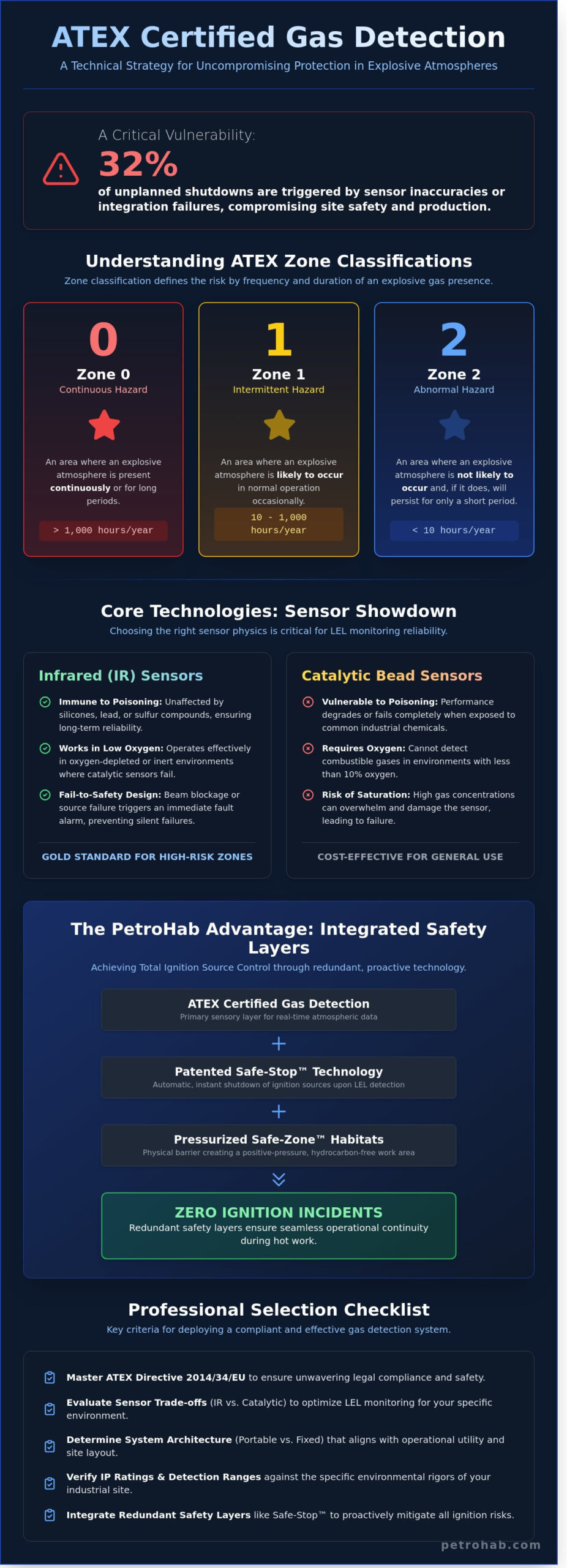
Relying on a standard sensor in a Zone 0 or Zone 1 environment isn’t just a risk; it’s a deficiency in engineering oversight. You recognize that the margin between a controlled operation and a catastrophic ignition incident often rests on a few parts per million. In 2025, industrial facilities reported that 32% of unplanned shutdowns were triggered by sensor inaccuracies or integration failures within their safety systems. These disruptions do more than stall production; they compromise the safety integrity of your entire site.
This guide delivers a definitive technical strategy for evaluating and deploying an **ATEX certified gas detection system** that guarantees uncompromising protection in explosive atmospheres. We’ve developed this framework to ensure your facility achieves zero ignition incidents while meeting the rigorous 2026 regulatory standards. We’ll analyze how to harmonize detection hardware with our patented Safe-Stop technology and pressurized habitats to achieve total ignition source control and seamless operational continuity.
Key Takeaways
- Master the technical requirements of ATEX Directive 2014/34/EU to ensure unwavering legal compliance and safety in explosive atmospheres.
- Evaluate the critical trade-offs between sensing technologies to optimize LEL monitoring and hydrocarbon detection in high-risk zones.
- Determine the most effective architecture for your facility by comparing the operational utility of portable, fixed, and integrated ATEX certified gas detection system configurations.
- Utilize a professional selection checklist to align equipment IP ratings and detection ranges with the specific environmental rigors of your industrial site.
- Learn how to integrate patented Safe-Zone and Safe-Stop technologies to establish a redundant safety layer that proactively mitigates ignition risks during hot work.
Understanding ATEX Certification in Gas Detection Systems
In high-risk industrial environments, safety isn’t a suggestion; it’s a regulated mandate. ATEX, derived from the French “Atmosphères Explosibles,” represents the legal framework for equipment operating in potentially explosive atmospheres. The ATEX directives, specifically Directive 2014/34/EU, dictate that manufacturers must eliminate or control potential ignition sources. Standard gas detection hardware often lacks the robust internal circuitry or reinforced housing required to prevent a spark from igniting surrounding hydrocarbons. An ATEX certified gas detection system provides the verified integrity necessary to operate within these volatile zones without becoming a hazard itself.
These systems act as the primary sensory layer within a facility’s Permit-to-Work (PTW) protocols. By providing real-time atmospheric data, they allow safety managers to authorize or halt high-risk activities instantly. PetroHab integrates these systems into a broader risk mitigation strategy, ensuring that ignition source control is never compromised during hot work operations. Reliability in these settings is measured by the system’s ability to function under extreme pressure and thermal stress.
ATEX Zone Classifications: 0, 1, and 2 Explained
Zone classification defines the frequency and duration of an explosive gas presence. Zone 0 identifies areas where hazards exist continuously for more than 1,000 hours per year. Zone 1 covers intermittent hazards present between 10 and 1,000 hours annually. Zone 2 is reserved for abnormal conditions where gas is present for less than 10 hours per year. Engineers should select detectors that exceed these minimums. For example, deploying a Zone 1 rated detector in a Zone 2 area provides a critical safety margin. The Equipment Protection Level (EPL) must strictly align with these zones to maintain site integrity and protect high-value assets.
The Difference Between ATEX and IECEx Standards
ATEX is a mandatory legal requirement for the European Economic Area; however, IECEx is an international certification scheme based on IEC standards. PetroHab maintains dual compliance to ensure seamless global deployment across diverse jurisdictions, from the North Sea to the Gulf of Mexico. Verification of these standards is critical for compliance. Safety managers must cross-reference the unique “X” or “U” suffixes on certification labels against official manufacturer documentation. This process ensures the ATEX certified gas detection system meets the specific thermal and mechanical requirements of the project. Authenticity is the only path to absolute operational confidence.
Core Technologies: Sensor Types and Detection Physics
Selecting an ATEX certified gas detection system requires a granular understanding of how sensors interact with hazardous atmospheres. In 2026, industrial safety standards demand higher precision to mitigate the risk of catastrophic ignition. Engineers must evaluate sensors based on their detection physics, specifically focusing on the Lower Explosive Limit (LEL) for hydrocarbons. Most hydrocarbon gases pose an explosion risk when their concentration reaches between 1% and 10% by volume. Monitoring this range ensures that personnel can evacuate or suppress ignition sources before the atmosphere reaches its flash point. Accuracy isn’t static; it fluctuates based on atmospheric variables. Sensors are typically calibrated at 20°C and 1013 mbar of pressure. Deviations, such as a 10% increase in humidity or a 15-degree temperature shift, can induce sensor drift, leading to false negatives or nuisance alarms. Operators should consult the HSE guidance on ATEX to ensure their sensor selection aligns with current DSEAR regulatory frameworks for explosive atmospheres.
Infrared (IR) vs. Catalytic Bead Sensors
Catalytic bead sensors remain a cost-effective choice for general combustible gas detection where oxygen levels are stable. However, they’re vulnerable to “poisoning” from silicones, lead, or sulfur compounds, which can permanently deactivate the catalyst. In contrast, IR sensors operate effectively in oxygen-depleted environments and aren’t susceptible to chemical poisoning. Infrared technology is the gold standard for monitoring high hydrocarbon concentrations where catalytic beads might saturate or fail. IR detectors offer a distinct fail-to-safety advantage in offshore applications because the beam’s blockage or source failure triggers an immediate fault signal, preventing undetected system downtime. This reliability is why PetroHab integrates these technologies into our specialized hot work safety solutions to maintain site integrity.
Electrochemical Sensors for Toxic Gas Monitoring
Comprehensive protection requires monitoring toxic gases like H2S and CO alongside combustible threats. Electrochemical cells utilize a chemical reaction to produce a current proportional to the gas concentration. These sensors face challenges with cross-sensitivity; for instance, high levels of hydrogen can cause a CO sensor to provide an inflated reading. In harsh climates, the electrolyte in these cells can dehydrate or freeze, shortening their typical 24-month lifespan. Engineers must schedule replacement cycles every 18 to 24 months to ensure the ATEX certified gas detection system remains reliable. Regular bump testing is mandatory to verify that the internal membranes haven’t been compromised by industrial particulates or extreme pressure fluctuations.
Evaluating System Architecture: Portable vs. Fixed vs. Integrated
Selecting the appropriate ATEX certified gas detection system requires a strategic assessment of the specific hazard zone. Fixed systems provide hardwired reliability and continuous 24/7 monitoring, yet they lack the mobility required for transient maintenance tasks. Portable units offer localized protection for individual technicians but cannot manage the complex environmental variables of a pressurized habitat on their own. Transportable systems bridge this gap. They offer the modularity of portables with the robust telemetry and power capacity of fixed infrastructure. Effective safety protocols rely on 100% data visibility. Modern telemetry modules transmit real-time sensor data to remote safety supervisors. This ensures that gas concentrations never exceed 10% of the Lower Explosive Limit (LEL) without triggering an immediate, automated response.
- Fixed Systems: Best for permanent installations; offer 99.9% uptime and direct integration into facility-wide Emergency Shutdown (ESD) systems.
- Portable Systems: Critical for personal breathing zones; require daily maintenance but offer high mobility in Grade 1 or Grade 2 environments.
- Transportable Systems: Ideal for temporary hot work; they provide the scale of fixed detection with the flexibility of modular deployment.
Portable Detectors for Personal Protection
Handheld monitors are essential for personal safety, but they shouldn’t be the primary line of defense for hot work. Their T90 response time must remain under 30 seconds to be effective in confined spaces. Reliability depends on strict adherence to daily bump testing protocols. Data indicates that up to 20% of sensors may fail to respond accurately if not tested before each shift. While portable units offer up to 24 hours of battery life, they lack the integrated control logic needed to shut down ignition sources automatically during a gas excursion.
Integrated Systems for Pressurized Habitats
PetroHab’s integrated architecture represents the gold standard in hot work safety. These systems monitor both internal habitat air and external intake points simultaneously. Our patented Safe-Stop and Safe-Zone systems don’t just detect gas; they actively manage the environment. If the ATEX certified gas detection system identifies a hazard, the Safe-Stop system automatically terminates power to all ignition sources and adjusts ventilation within seconds. This direct link between detection and ignition source control eliminates human error. By integrating detection into the modular Petro-Wall enclosure, we ensure that every work area remains compliant with IECEx and ATEX safety standards.
Selection Criteria: A Professional Buyers Checklist
Selecting an ATEX certified gas detection system requires more than a cursory review of technical specifications. It demands a rigorous evaluation of how the hardware integrates with live operational risks. Safety managers must prioritize systems that offer precise detection ranges for specific Lower Explosive Limit (LEL) thresholds, particularly when monitoring volatile organic compounds or hydrogen in offshore environments. A failure to match the sensor technology to the specific molecular weight of the target gas can lead to delayed response times or false negatives.
Step 1: Conduct a Site-Specific Gas Hazard Assessment
Engineers must identify every potential leak source, from flange connections to valve manifolds. Gas migration paths often shift based on prevailing wind speeds, which frequently exceed 25 knots in marine settings. PetroHab technicians provide specialized mapping services to determine optimal detection points for any HWSE setup. This ensures the detection grid accounts for both localized hazards, such as a specific welding point, and facility-wide risks that could migrate into the work zone.
Step 2: Verify Certification and Compliance Integrity
Every component must carry the “Ex” mark. A standard coding like II 2 G Ex db IIC T4 Gb indicates the equipment’s suitability for Zone 1 gas environments. Compliance doesn’t end at the sensor; the entire loop, including armored cabling and junction boxes, must meet ATEX requirements. Verify that the manufacturer maintains ISO 9001:2015 credentials to ensure consistent production quality and component traceability. Don’t accept self-certification for high-stakes oil and gas applications.
Step 3: Evaluate Integration and Shutdown Logic
A gas detector is only as effective as the action it triggers. The system must utilize volt-free contacts to facilitate immediate external equipment shutdowns. In high-noise industrial zones where decibel levels often surpass 85 dB, audible alarms must be paired with high-intensity visual strobes. Ensure full compatibility with the Safe-Stop automatic shutdown system to guarantee that all ignition sources are neutralized the moment gas is detected. This automated response is the gold standard for protecting high-value assets.
Professional procurement requires a focus on long-term reliability and environmental resilience. Consider the following technical requirements before finalizing your ATEX certified gas detection system purchase:
- Ingress Protection: Specify IP66 or IP67 ratings to ensure the internal electronics remain sealed against salt spray and fine particulates.
- User Interface: The display must provide clear, backlit readings that remain legible in direct sunlight or heavy fog.
- Vendor Support: Confirm the availability of certified maintenance technicians for quarterly calibration and on-site personnel training.
Rigorous selection protocols prevent catastrophic failures. It’s essential to partner with a provider that understands the granular details of ignition source control. Consult with a PetroHab safety expert to audit your site’s gas detection requirements and ensure total compliance.
The PetroHab Advantage: Integrated Safe-Zone and Safe-Stop Technology
PetroHab’s approach to hot work safety relies on a redundant architecture that removes the burden of safety from human operators. It isn’t just about providing a physical barrier; it’s about an active, intelligent monitoring loop. The Quadra-Lock pressurized habitat works in tandem with the Safe-Zone system to create a zero-leakage environment. This synergy ensures that even in the event of a primary seal breach, the risk of ignition remains effectively zero. By automating the detection and response phases, PetroHab eliminates the 250-millisecond delay inherent in human reaction times, which is often the difference between a controlled event and a catastrophe.
Safe-Zone: Intelligent Gas Detection for Habitats
The Safe-Zone system functions as a high-performance ATEX certified gas detection system specifically engineered for the rigors of Zone 1 and Zone 2 environments. It utilizes ruggedized sensors to monitor for LEL (Lower Explosive Limit) and H2S (Hydrogen Sulfide) at the habitat air intake and other strategic points. If gas levels reach a 10% LEL threshold, the system triggers an immediate visual and audible alert. Each ATEX certified gas detection system we deploy is built to withstand extreme temperatures and corrosive offshore conditions, ensuring 100% uptime during critical maintenance windows.
Safe-Stop: The Ultimate Ignition Source Control
Manual shutdowns are insufficient in explosive atmospheres because they rely on perfect human vigilance during long, fatiguing shifts. PetroHab’s Safe-Stop control hub automates the protection process by acting as the central nervous system for the habitat. Upon detecting gas, Safe-Stop instantly cuts power to all welding machines, grinders, and other potential ignition sources. During a 2019 offshore turnaround in the North Sea, this automated response prevented a potential ignition when a localized gas pocket migrated toward an active welding site. The system’s ability to override human error makes it the gold standard in hot work safety.
Global Support and Certified Supervision
Reliability extends beyond hardware to include logistics and expertise. PetroHab maintains operational hubs in Houston, Dundee, and Brazil to facilitate equipment deployment within 48 hours. We prioritize technical precision by offering on-site training for client personnel, ensuring every team member understands how to maintain system integrity. This local presence reduces operational downtime and ensures compliance with the latest safety standards. You can contact PetroHab today for a specialized safety assessment to secure your facility against hazardous environment risks.
Securing Industrial Integrity Through Advanced Detection
Selecting a sophisticated ATEX certified gas detection system remains the primary defense against ignition in 2026’s volatile energy landscapes. Effective risk mitigation requires a transition from isolated sensors to integrated safety architectures that pair detection with immediate ignition source control. PetroHab’s Safe-Stop technology provides this critical link; it automatically shuts down hot work operations when hazardous concentrations are detected. Our systems utilize patented Quadra-Lock technology to maintain the structural integrity of pressurized habitats, ensuring compliance with the latest IECEx standards. We’ve designed these solutions to meet the rigorous demands of offshore platforms and refineries where error isn’t an option. With global 24/7 technical support, your facility maintains operational continuity while protecting high-value assets. Engineering a fail-safe environment isn’t a luxury; it’s a procedural necessity for every high-stakes site. You can rely on our proven history of protecting personnel in the most hazardous environments on earth. Let’s build a safer future for your operations today.
Request a Technical Consultation for Your Next Hot Work Project
Frequently Asked Questions
What does ATEX certified mean for a gas detection system?
ATEX certification confirms equipment complies with European Union Directive 2014/34/EU for use in explosive atmospheres. It ensures the ATEX certified gas detection system won’t become an ignition source in the presence of flammable gases. This rigorous testing validates that internal electronics prevent sparks from escaping into the hazardous zone. It’s the mandatory requirement for all 450 offshore rigs currently operating in the North Sea to ensure total operational integrity.
Can I use a Zone 2 certified gas detector in a Zone 1 area?
You can’t use Zone 2 equipment in a Zone 1 area because Zone 2 devices only provide Category 3 protection for environments where explosive atmospheres are unlikely. Zone 1 requires Category 2 protection for areas where hazardous gases are present during 10 to 1,000 hours of annual operation. Deploying under-rated equipment violates IEC 60079 standards and compromises site safety protocols. Always match the equipment’s category to the specific risk level identified in your 2026 audit.
How often should an ATEX gas detection system be calibrated?
You should calibrate an ATEX certified gas detection system every 180 days to maintain compliance with manufacturer specifications and ISO 9001 standards. Daily bump tests are also required to verify sensor functionality before each 12 hour shift begins. This 6 month interval ensures the electrochemical sensors haven’t drifted beyond the 5 percent accuracy threshold required for offshore operations. Regular maintenance prevents false alarms that can lead to a 15 percent loss in daily production volume.
What is the difference between LEL and ppm in gas detection?
LEL measures the lower explosive limit as a percentage of the minimum concentration required for ignition, while ppm measures parts per million for toxic exposure. For example, methane has an LEL of 5 percent by volume. 95 percent of industrial safety systems trigger alarms at 10 percent LEL to provide a 90 percent safety margin before a combustible environment forms. Understanding these metrics is vital for managing both explosion risks and the 8 hour exposure limits.
Does PetroHab provide gas detection systems for rental or sale?
PetroHab offers both rental and purchase options for our specialized gas detection units to accommodate varying project durations. Our fleet includes the patented Safe-Stop system, which integrates directly with our modular habitats. We maintain a 100 percent readiness rate for our rental inventory, ensuring every unit arrives with current 2026 certification documents and fresh calibration logs. This flexibility allows safety managers to scale protection based on specific 30 day or 90 day offshore work scopes.
What happens if a gas detector fails while hot work is in progress?
The PetroHab Safe-Stop system automatically terminates all power to ignition sources within 0.5 seconds if a sensor failure or gas detection occurs. This failsafe mechanism prevents accidental ignition by instantly shutting down welding machines and grinders. Work can’t resume until a safety technician restores the system and verifies the atmosphere contains 0 percent LEL of flammable vapors. This rapid response is critical for maintaining the integrity of the Petro-Wall panels and the safety enclosure.
Is wireless gas detection ATEX certified for offshore use?
Yes, modern wireless detectors carry ATEX Zone 0 or Zone 1 certifications specifically for offshore platforms and FPSOs. These systems utilize 2.4 GHz or 900 MHz encrypted frequencies to transmit data across 300 meter distances. PetroHab integrates these wireless solutions to provide real-time monitoring without the 40 percent increase in installation time associated with hardwired cabling. It’s a reliable solution for structures with over 500 individual steel obstructions that block traditional signal paths.
How does gas detection integrate with a pressurized welding habitat?
Gas detection integrates through our Safe-Stop control logic, which monitors the internal habitat and the external air intake. If the system detects gas at 10 percent LEL, it immediately kills power to the hot work equipment. This dual-zone monitoring ensures the pressurized enclosure remains the gold standard in hot work safety by maintaining a 50 Pascal overpressure. It’s a proactive defense that eliminates the risk of hydrocarbon ingress during 24 hour welding operations.