
Blog Posts
2026 Fire Retardant Compliance for Habitat Materials
As of July 2026, OSHA penalties for willful safety violations can exceed $161,000 per instance, yet many site managers still struggle to verify the integrity of their pressurized enclosures. You’re likely aware that a single material failure in a high-risk zone can lead to catastrophic fire spread. The persistent ambiguity between regional safety standards often makes compliance feel like a moving target. Securing the correct fire retardant certification for habitat materials isn’t just a regulatory hurdle. It’s a critical engineering requirement to protect personnel and high-value assets in volatile environments.
Deciphering technical data sheets that don’t align with international expectations creates unnecessary risk. This article provides a rigorous technical breakdown of the NFPA 701, ASTM E84, and BS 5867-2 standards to ensure your hot work safety enclosure meets global benchmarks. You’ll gain a functional framework for auditing material safety data sheets and learn why specialized technologies, such as Quadra-Lock panels, provide the definitive ignition prevention required in explosive atmospheres. We’ll move from high-level safety concepts to the specific certifications that define industrial excellence.
Key Takeaways
- Distinguish between flammability and fire resistance to ensure the correct selection of industrial fabrics for high-risk Zone 1 and 2 environments.
- Understand the specific technical requirements of NFPA 701 and ASTM E84 to verify the fire retardant certification for habitat materials across global jurisdictions.
- Analyze how engineered materials like silicone-coated fiberglass and intumescent coatings maintain the structural integrity of pressurized welding enclosures.
- Establish a rigorous auditing framework for Material Safety Data Sheets (MSDS) to differentiate between batch testing and type testing during the procurement process.
- Evaluate the safety advantages of patented Quadra-Lock technology in providing a mechanical, zipper-free seal that ensures consistent environmental containment.
The Criticality of Fire Retardant Certification in HWSE
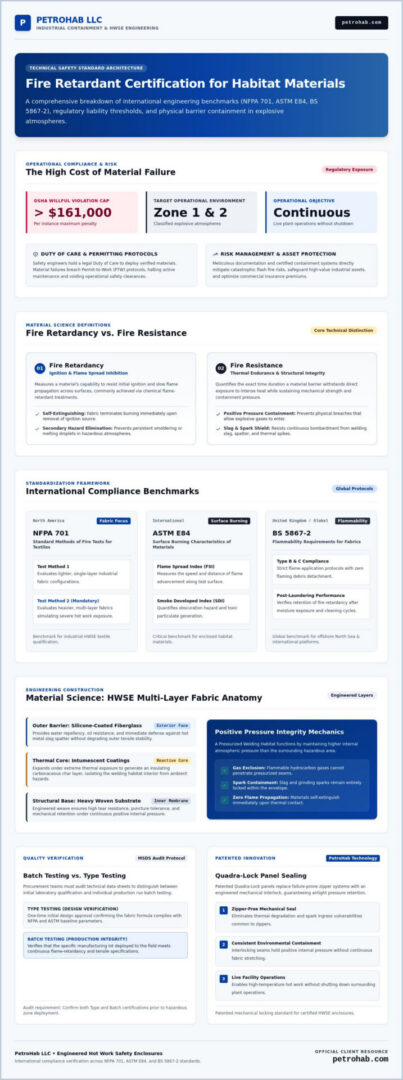
Industrial safety requires a precise understanding of material science. Fire retardancy and fire resistance are distinct technical attributes. Fire retardancy refers to a material’s ability to resist ignition or slow the spread of a flame, often achieved through the application of flame retardants. In contrast, fire resistance measures how long a material can withstand exposure to intense heat while maintaining its structural integrity. For safety managers, obtaining the correct fire retardant certification for habitat materials is the first line of defense in Zone 1 and Zone 2 environments. These zones contain explosive atmospheres where even a minor spark can lead to catastrophic ignition.
Certified materials must possess self-extinguishing properties. This means once the ignition source is removed, the fabric stops burning immediately. If a habitat fabric continues to smolder or melt, it creates a secondary hazard for personnel and equipment. Using uncertified materials in these high-stakes settings isn’t just a technical oversight; it’s a regulatory liability. OSHA penalties for willful violations can exceed $161,000 per instance, making non-compliance a significant financial and operational risk.
To better understand how these materials are evaluated for industrial use, watch this video on rigorous testing and certification processes:
Risk Mitigation in Hazardous Areas
Hot work operations generate sparks and slag that can easily breach standard industrial covers. Fire-retardant materials act as a barrier, preventing these small ignition sources from evolving into flash fires. The integrity of these materials is vital for the performance of a pressurized welding habitat. If the enclosure fabric fails, the positive pressure required to keep flammable gases out is lost. PetroHab utilizes patented Quadra-Lock technology to ensure that these certified panels remain securely interlocked, protecting high-value assets during live plant operations without requiring costly refinery shutdowns.
Personnel Safety and Liability
Safety engineers have a legal Duty of Care to provide the highest level of protection for their teams. Verified equipment is a central component of this responsibility. When habitat materials fail to meet international standards, it compromises Permit-to-Work (PTW) protocols and can halt entire projects. Verified safety systems don’t just protect lives; they reduce insurance premiums by demonstrating a proactive approach to risk management. Meticulous documentation of fire retardant certification for habitat materials ensures that every component of the HWSE is fit for purpose in the most demanding offshore and onshore environments.
Global Compliance Standards for Habitat Fabrics
Operating in hazardous environments requires strict adherence to international safety protocols. Regional compliance is rarely sufficient for offshore platforms or global refinery projects. Engineers must verify that every component of a pressurized enclosure meets specific performance criteria under extreme thermal stress. Obtaining the correct fire retardant certification for habitat materials ensures that containment systems function as an active guardian against ignition. These standards provide a measurable benchmark for safety managers to evaluate supplier claims and mitigate risks.
North American Standards (NFPA & ASTM)
The NFPA 701 standard is the primary benchmark for textiles used in industrial enclosures. It involves two distinct test methods. Test Method 1 applies to single-layer fabrics, while Test Method 2 evaluates heavier, multi-layer materials. For habitat fabrics, large-scale testing under Method 2 is essential to simulate real-world hot work conditions accurately. Fabrics must demonstrate that they don’t support combustion and that any flaming residue self-extinguishes within two seconds.
ASTM E84 complements this by measuring the surface burning characteristics of materials. This test provides a Flame Spread Index (FSI) and a Smoke Developed Index (SDI). In confined industrial spaces, a low SDI is critical to maintain visibility and breathable air during an accidental ignition event. Most high-performance habitat fabrics target a Class A rating, which requires an FSI of 0 to 25. You can verify these technical ratings by reviewing the certified safety systems currently deployed in major oil and gas basins.
International and European Standards (BS & ISO)
Global equipment deployment requires familiarity with British and European standards. BS 476 Part 7 is a critical requirement for offshore environments, particularly in the North Sea. It classifies materials based on the lateral spread of flame across their surface. Achieving a Class 1 rating under BS 476 indicates superior performance in preventing fire propagation. ISO 15025 provides additional protection by testing fabrics for limited flame spread, ensuring that materials used in pressurized enclosures don’t contribute to a fire’s fuel load.
European classifications, specifically EN 13501-1, use a different grading system that incorporates flame spread, smoke production, and flaming droplets. A material rated as B-s1, d0 is roughly equivalent to a Class A rating in the US. Understanding these technical overlaps is vital for procurement teams sourcing fire retardant certification for habitat materials for international projects. Meticulous adherence to these standards allows for the seamless transition of equipment across borders while maintaining an uncompromising commitment to personnel safety.
Material Science: Engineering Flame-Resistant HWSE
Pressurized hot work safety enclosures rely on advanced material science to withstand the harsh conditions of the energy sector. Selecting the appropriate base fabrics determines the system’s ability to resist thermal degradation. Silicone-coated fiberglass and specialized high-performance polymers represent the industry standard for these demanding applications. These materials undergo rigorous testing to secure a valid fire retardant certification for habitat materials, confirming their suitability for high-heat environments. Beyond simple flame resistance, these textiles must exhibit exceptional durability factors, including UV resistance, chemical exposure resilience, and high mechanical tensile strength.
Chemical engineering plays a vital role in enhancing fabric performance during thermal events. Certain advanced composite fabrics utilize the process of intumescence. When exposed to extreme temperatures, an intumescent matrix expands rapidly, creating a thick, carbonaceous char layer. This layer acts as an insulating barrier, drastically reducing heat transfer through the fabric. PetroHab integrates these highly engineered, fire-resistant materials directly into its modular Quadra-Lock Panels, ensuring that the containment boundary remains uncompromised during live operations.
Advanced Fabric Coatings
Silicone coatings are highly preferred for hot work applications due to their excellent thermal insulation and water-repellent properties. The coating seals the underlying fiberglass substrate, preventing the shedding of irritating fibers while protecting against oil, chemical splashes, and ambient moisture. Multi-layered habitat fabrics combine these coatings with structural cores to maximize thermal protection. This engineering approach maintains the fabric’s physical flexibility, allowing operators to assemble the enclosure around complex pipe geometries without cracking the fire-retardant barrier.
Structural Integrity and Fire Barriers
Material performance is only as effective as the joining system that connects the panels. The patented Quadra-Lock interlocking system provides a mechanical, zipper-free panel connection that eliminates gaps where flames or hot gases could ingress. Traditional hook-and-loop or zippered seams present vulnerabilities under intense heat. Precise panel engineering eliminates the hazardous ‘chimney effect,’ where hot air rises and draws flammable gases into the enclosure through lower seams. The structural frame materials complement the fabric panels, ensuring the entire modular assembly maintains its geometry and positive pressure during critical welding operations.
Verification and Testing Protocols for Habitat Materials
Relying on a single annual inspection is insufficient for high-risk industrial containment. Procurement teams must understand the complete laboratory testing lifecycle that validates a fabric’s performance under thermal stress. Securing a legitimate fire retardant certification for habitat materials requires specialized testing that replicates severe operational hazards. A clear distinction exists between batch testing and type testing. Type testing evaluates a prototype material to establish a baseline rating, while batch testing ensures that every production run maintains identical safety characteristics. Procurement managers must demand batch-specific data to prevent sub-standard materials from reaching the field.
Third-party auditing by independent bodies like Underwriters Laboratories (UL) or Intertek eliminates supplier bias. These organizations conduct unannounced facility audits and independent laboratory testing to verify that production materials match certified specifications. Field verification complements this process through on-site documentation audits and visual inspections of panel integrity before hot work begins. To ensure your operations meet these rigorous criteria, you can request certified compliance documentation from PetroHab for your next project.
Laboratory Testing Stages
The laboratory testing lifecycle follows a strict sequence to eliminate environmental variables. Technicians begin with specimen preparation, cutting the fabric to precise dimensions required by standards like NFPA 701 or ASTM E84. These specimens undergo environmental conditioning, exposed to specific humidity and temperature levels for up to 48 hours to ensure consistency. Once conditioned, the fabric undergoes controlled ignition inside a test chamber. Technicians use precision burners to apply a flame for a designated duration, measuring exactly how long the material burns after the flame source is removed. The final stage involves analyzing the char length and afterglow timing, ensuring the material meets the self-extinguishing benchmarks necessary for hazardous zones.
Documentation and Auditing
Reviewing a Certificate of Compliance (CoC) requires technical scrutiny rather than a superficial glance. Safety managers must verify that the document lists the exact fabric weight, coating type, and batch number matching the delivered equipment. Check the test report dates to ensure the certifications are current and verify that the issuing laboratory holds valid ISO/IEC 17025 accreditation. Integrating these material logs into advanced hot work safety systems provides an unbroken chain of custody. This meticulous documentation forms the foundation of a defensible safety program, proving compliance to regulators and insurance underwriters during routine plant audits.
The PetroHab Standard: Excellence in Certified Containment
Compliance with international safety protocols represents the minimum requirement for high-stakes oil and gas operations. PetroHab positions itself as the industry benchmark by consistently exceeding hazardous environment standards through rigorous engineering and certified material selection. While many providers offer standard enclosures, the PetroHab Hot Work Safety Enclosure (HWSE) represents a specialized technological remedy for volatile atmospheres. This commitment ensures that every fire retardant certification for habitat materials utilized in our systems is backed by verifiable data and patented protective features. Our role as an active guardian of industrial sites is defined by this uncompromising approach to risk mitigation.
Patented Quadra-Lock Engineering
The technical advantage of our system lies in the proprietary Quadra-Lock panel interface. Conventional enclosures often rely on zippers or hook-and-loop fasteners, which are prone to thermal failure and gas leakage under pressure. The Quadra-Lock system utilizes a mechanical, zipper-free interlocking design to create an airtight and fire-resistant seal. This specific geometry prevents flame ingress and maintains the positive pressure required to isolate ignition sources from the surrounding environment. Modularity is sometimes perceived as a vulnerability in fire containment, but our engineering ensures that each panel connection reinforces the overall structural integrity. This allows for flexible deployment around complex piping without compromising the stringent safety certifications required for Zone 1 and 2 environments.
Comprehensive Safety Solutions
Reliable protection requires a holistic approach that extends beyond high-grade fabrics. PetroHab integrates certified materials with the Safe-Stop Automatic Shutdown System to provide a multi-layered defense. This technology continuously monitors the internal and external environment, triggering an immediate cessation of hot work tools if gas ingress or pressure loss is detected. Our global operations in the US, UK, and Brazil ensure that operators can access these certified systems for lease or purchase regardless of project location. We maintain a steady pace of innovation to ensure our technology evolves alongside shifting regulatory demands.
To maintain the integrity of the enclosure, we provide expert supervision and on-site training for every deployment. This ensures that the compliant setup is executed correctly, eliminating human error during the assembly of critical fire barriers. Safety managers are encouraged to request project-specific technical documentation to verify that their fire retardant certification for habitat materials meets the precise requirements of their high-value assets. By blending safety advocacy with advanced engineering, we ensure that commercial offerings remain essential components of a broader mission to eliminate workplace accidents.
Advancing Industrial Safety Through Certified Containment
Achieving absolute reliability in pressurized environments requires a synthesis of rigorous material science and mechanical precision. We’ve examined how international standards like NFPA 701 and ASTM E84 serve as the definitive benchmarks for operational safety. Verification isn’t a one-time event; it’s a continuous process of auditing batch-specific data and maintaining strict documentation. Securing the correct fire retardant certification for habitat materials ensures that your site remains compliant and your personnel stay protected against the risk of catastrophic ignition.
PetroHab remains the industry benchmark by integrating patented Quadra-Lock technology with globally certified fire-resistant materials. We provide expert on-site supervision to ensure every enclosure is configured for maximum risk mitigation. This methodical approach to safety allows you to focus on operational excellence without compromising on asset protection. Our commitment to technical precision ensures your projects proceed with the highest level of environmental containment. Secure Your Site with PetroHab’s Certified HWSE Solutions. We look forward to partnering with you to elevate your safety protocols and protect your most valuable assets.
Frequently Asked Questions
What is the difference between NFPA 701 and ASTM E84 for habitat materials?
NFPA 701 evaluates the flame propagation of textiles and films, focusing on how hanging fabrics react to ignition. ASTM E84 measures the surface burning characteristics, specifically the Flame Spread Index and Smoke Developed Index. For pressurized welding enclosures, both standards are vital. NFPA 701 ensures the fabric self-extinguishes, while ASTM E84 confirms the material won’t contribute to rapid fire spread or excessive smoke within confined industrial spaces.
Do fire retardant certifications for welding habitats expire?
Certifications are typically issued for specific material types or batches. While the standard doesn’t always have a hard expiration date, industry best practices require re-verification every 12 to 24 months. Environmental factors like UV exposure and mechanical wear can degrade fire-retardant properties over time. Safety managers should always request current test reports to ensure the fire retardant certification for habitat materials remains valid for the specific project duration.
Are all silicone-coated fiberglass fabrics certified for hot work?
Not all fabrics are equal. While silicone-coated fiberglass is a standard base, fire performance depends on the specific formulation of the coating and the density of the fiberglass weave. Many generic fabrics lack the rigorous laboratory testing required for high-risk Zone 1 environments. PetroHab only uses materials that have been independently verified to meet international standards, ensuring the containment boundary provides definitive protection against ignition sources during hot work.
How do I verify the fire retardancy of a leased HWSE on-site?
Verification begins with a thorough documentation audit. You must cross-reference the batch numbers on the panel labels with the provided Certificate of Compliance and test reports. Certified technicians should perform a visual inspection to identify any physical damage or chemical contamination that could compromise the material’s integrity. Ensuring every panel is correctly interlocked using the Quadra-Lock system is also a critical step in verifying the enclosure’s overall fire-resistant performance on-site.
What happens to habitat fire retardancy after exposure to chemicals or oil?
Chemical or oil saturation poses a significant risk to habitat integrity. Even certified fire-retardant fabrics can become flammable if they absorb hydrocarbons, which act as a fuel source on the material’s surface. Exposure to certain industrial solvents can also degrade the silicone coating, reducing its thermal insulation properties. Any panels showing signs of heavy oil soaking or chemical damage must be removed from service and replaced to maintain a compliant safety environment.
Can fire-retardant materials be used in ATEX Zone 1 environments?
Fire-retardant materials are essential components for operations in ATEX Zone 1 environments. When used as part of a PetroHab Hot Work Safety Enclosure, these materials help isolate ignition sources from potentially explosive atmospheres. The system must be paired with an automatic shutdown system, such as Safe-Stop, to monitor for gas ingress. This combination of certified fabrics and automated monitoring allows for safe hot work in areas where flammable gases are likely to occur.
Why is the Quadra-Lock system superior for fire containment?
The Quadra-Lock system is superior because it replaces vulnerable zippers and hook-and-loop fasteners with a patented mechanical interlock. Traditional joining methods often fail when exposed to high heat, creating gaps for flame ingress. The Quadra-Lock design ensures an airtight, fire-resistant seal that maintains positive pressure throughout the enclosure. This engineering prevents the chimney effect, where hot air rising within the habitat could draw flammable gases through compromised lower seams.
Is third-party certification mandatory for offshore welding habitats?
Third-party certification is a mandatory requirement for most offshore operations. Regulatory bodies and insurance underwriters require independent verification from organizations like UL or Intertek to ensure equipment meets global safety benchmarks. Relying solely on manufacturer claims is insufficient in high-stakes environments. Meticulous third-party auditing of the fire retardant certification for habitat materials provides the necessary evidence of compliance for Permit-to-Work protocols and reduces the overall liability for the operating company.